
Elementor Hosting, and what happened to Elementor Cloud
I reviewed Elementor's hosting when it launched in 2022 and found one problem big enough to sink it. The product has since been renamed and rebuilt, and the deal has changed in a way current buyers need to know about.
Prefer hosting reviews on video?
There is no video for this review, but I cover WordPress tooling, hosting and site building on the channel. Subscribe to catch new tutorials the moment they go live.
The short version
The product I reviewed in 2022 no longer exists in the form I reviewed it. Elementor Cloud Website is now Elementor Hosting, running on much stronger infrastructure, and the crippling time to first byte problem I documented belongs to a platform that has since been re-architected. The catch is the bargain itself: Elementor Pro is no longer bundled in, and the total cost has more than doubled. The thing that made the original offer remarkable is the thing that went away. For what it is worth, time to first byte is the metric that eventually decided my own hosting: I left WordPress altogether in 2026, and the before-and-after numbers are the clearest argument I can make about where that time actually goes.
Better hosting, but no longer the bargain it wasWhat changed since this review
Editor's note, July 2026. This review was written in June 2022, when the product was called Elementor Cloud Website. It is now Elementor Hosting, and it has been substantially rebuilt: Google Cloud C2 machines, Cloudflare Enterprise CDN, auto-scaling, Redis object caching and a proper staging environment. The performance findings below describe the 2022 platform and should not be read as a current benchmark. I have not re-tested the rebuilt product, so I am not going to tell you it is fast now or that it is still slow. The structural criticisms further down, on plugin limits and migration, are the ones most worth checking against the current plan before you buy.
The change that matters most to anyone reading this for buying advice is not technical. When I signed up, the entire pitch was that a single yearly fee bundled the hosting together with a full Elementor Pro licence, an SSL certificate and daily backups. That bundle is gone. Elementor Pro is now sold separately, the plugin restrictions have if anything tightened, and the total cost of ownership has more than doubled. Elementor Hosting is objectively better hosting than Elementor Cloud Website was. It is no longer the same value proposition.
What I signed up for in 2022
- Elementor Pro licence included
- SSL certificate and daily backups included
- Google Cloud Platform with a Cloudflare CDN
- 100GB bandwidth, 100K monthly visits, 20GB storage
- Site Lock for pre-launch development
- Under ten dollars a month, paid yearly up front
What it is now
- Elementor Pro sold separately, not bundled
- Google Cloud C2 machines and Cloudflare Enterprise
- Auto-scaling, Redis object caching, staging
- An aggressive list of disallowed plugins
- Total cost of ownership more than doubled
- Check the current pricing page before committing
Setup was genuinely excellent
I love using Elementor. It is one of the best page builders I have used, and I have used a fair few over the years, so when the people who make it announced their own hosting platform I was intrigued, and when the first details landed I was keen to try it.
They start you on a subdomain at domain.elementor.cloud so you can build a development site before launching on whatever domain you want. Connecting a domain is genuinely straightforward: point the A record at your account, and their system detects it and configures the site for you. It updates all the URLs automatically, so there is no search and replace to run afterwards, which saves a real headache.
You can also keep the site locked behind a one time per session passcode, so it stays in development on a live domain while your client can still see it. Sign up to running site took me about thirty minutes, most of which was waiting on the domain, and backups were already running from the moment the account existed. I did not need to open a single guide, even on the first attempt. The whole process was smooth.
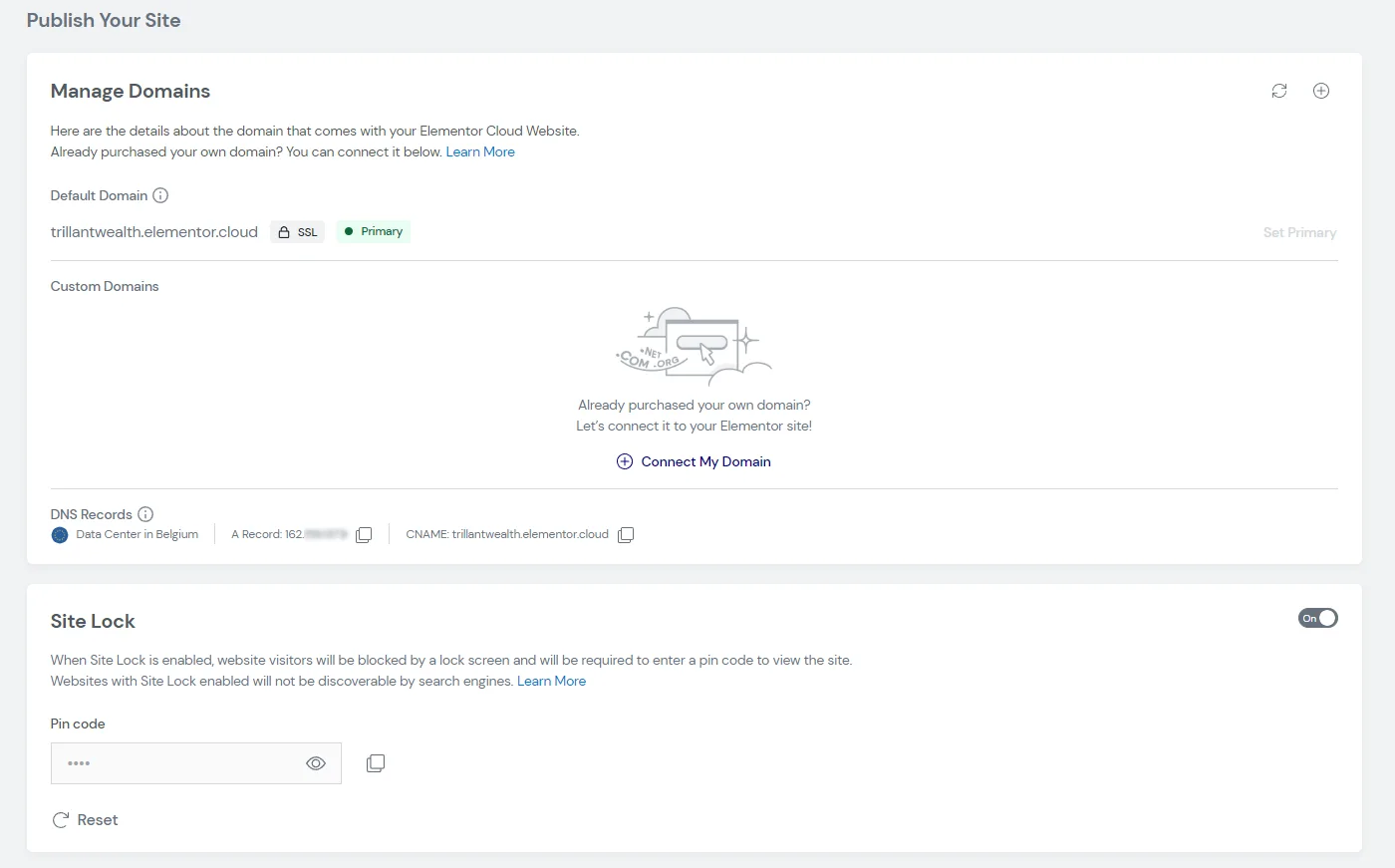
Logging in the first time, the install is refreshingly clean. The only plugins present were Elementor, Elementor Pro, and the usual WordPress stowaways Akismet and Hello Dolly. It did not take long, though, to notice something was not right.
The performance problem that sank it
I imported a basic template, made the site live, and ran it through GTmetrix. The result was bad, and there is no sugar coating it: time to first byte was over eight seconds. That is unacceptable from any hosting environment, let alone one selling itself on speed.
I ran the tests several times in case the first was a fluke, and got the same results or worse. I asked Elementor support through their built-in chat, which is admittedly very convenient, and they told me they were aware of the issue and investigating, and hoped it would be temporary. It had not been temporary. It had been going on for months, and this was on a site as optimised as I could make it: SVG and WebP images only, Cloudflare in front, everything cached.
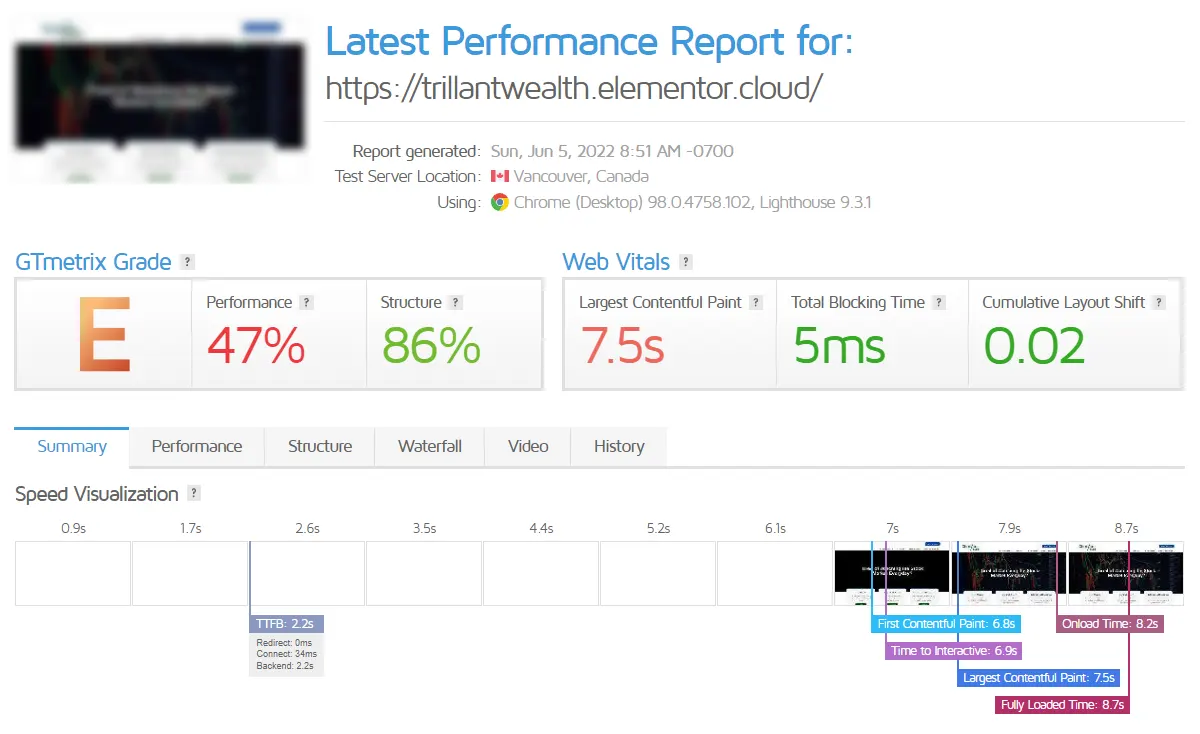
Every other negative here was overshadowed by this. A slow first byte is a search ranking problem you cannot optimise your way out of.
To be clear about where this stands now: that verdict was about the 2022 platform. Elementor Hosting has since moved to different machine classes, a different CDN tier and a different caching stack, so the eight second figure above no longer describes what you would be buying. I have not re-benchmarked it, so treat this section as history rather than a current test.
Plugin limits, no FTP, and migration pain
These are the more structural complaints, and the ones most likely to have survived the rebuild, so they are worth checking against whatever plan you are considering.
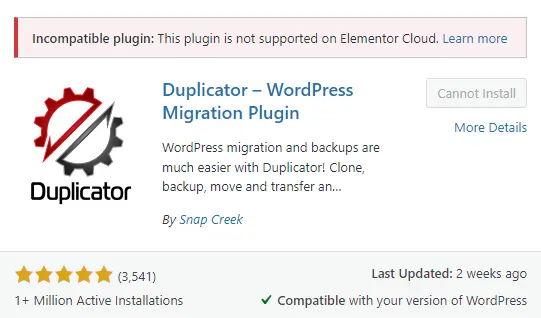
Plugin limitations. Like other WordPress-specific hosts such as WP Engine, they restrict which plugins you may install: anything that helps you migrate the site, plus anything they consider incompatible or a security risk. That is understandable in principle, though being able to install something like Duplicator would be nice. In a moment you will see exactly why that matters.
No FTP access. Restricting plugins is normal for this kind of host. Offering no FTP access of any kind is, frankly, bizarre. I assume it is a security decision, but it sharply limits the custom work you can do. Support suggested using a File Manager plugin instead, which anyone who takes development seriously will recognise as poor advice: if the site is down you cannot reach it anyway, and file manager plugins are notorious for security vulnerabilities.
In fairness, I expect this platform is aimed at sites that do not need custom work, and Elementor users know how much you can do through the interface alone with a few supporting plugins. That described the site I was building, a fairly standard blog with some service pages. But coming from running servers with WHM and cPanel access, where I could do whatever I wanted, the absence still felt uncomfortable. Then again, a server costs many hundreds a month once you add everything this platform includes out of the box, so credit where it is due.
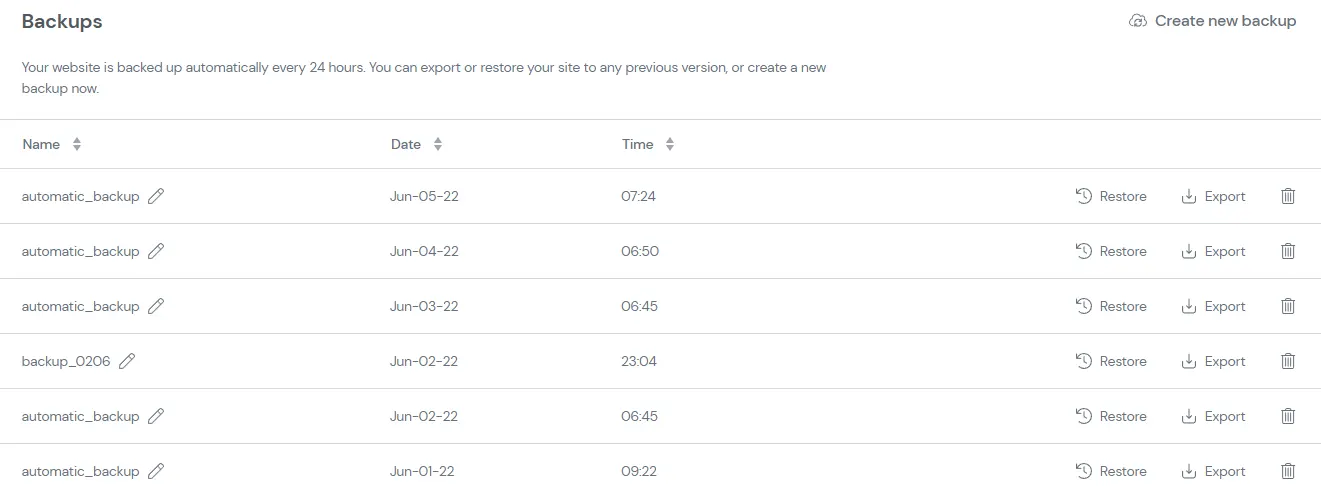
Migration is the real trap. The backup system runs every 24 hours and offers an export, and that export is unusable. It is a SQL dump plus files, exactly like any WordPress migration, and it simply does not work. I tried multiple approaches and modified the SQL to suit the destination, and everything came out broken. I eventually got as far as logging into the WordPress backend, and that was broken too. Elementor support can restore from those exports, because they have a system built for their own platform, which is a little galling: WP Engine also customises WordPress for its needs, but you can undo their work and leave.
Elementor's answer is to use the kit export feature, and that does work as far as it goes: it moves the design and the content. What it does not move is your post categories or the metadata you have entered into an SEO plugin like Rank Math or Yoast. I did successfully move a site to another platform using kit export, but redoing every meta title and description and rebuilding categories and tags is a serious time cost. Know that going in.
Frequently Asked Questions
What happened to Elementor Cloud Website?
It was renamed and rebuilt as Elementor Hosting. The underlying platform moved to Google Cloud C2 machines with a Cloudflare Enterprise CDN, auto-scaling, Redis caching and staging environments.
Does Elementor Hosting still include Elementor Pro?
No. Elementor Pro is now sold separately rather than bundled with the hosting, which was the single biggest reason the original offer was such good value. Budget for both if you are pricing it up.
Can you get FTP access on Elementor Hosting?
There was no FTP access of any kind when I reviewed the platform, and support directed users to a File Manager plugin instead. Confirm this on the current plan if you need to work with files directly.
Can you migrate a site away from Elementor Hosting?
Not easily using the platform's own backup export, which would not restore elsewhere when I tested it. The kit export does move your design and content, but it leaves behind post categories and any SEO plugin metadata, so plan for that work.
Are the performance numbers in this review still accurate?
No. The time to first byte figures here were measured in 2022 on the original platform, which has since been re-architected. Treat them as historical and look for a current benchmark before making a decision.
Where this leaves the recommendation
In 2022 I said this was a great platform for anyone needing a basic site, held back by one fatal performance problem, and that I would happily recommend it once that was fixed. The company effectively answered that by rebuilding the product, which is the right response, and I will take the infrastructure improvements at face value.
What I cannot do is carry the old recommendation across, because the offer it was attached to has changed. The version I praised was remarkable because of what it bundled for the money. Unbundle Elementor Pro, more than double the price, and you are looking at a competent managed WordPress host that now has to be judged against every other competent managed WordPress host, rather than a uniquely good deal. Judge it on the current plan and the current price, not on the one in this review.
Disclosure: The Elementor link below is an affiliate link. I paid for the hosting account reviewed here myself, and nothing in this review was seen or approved by Elementor. This post also contains affiliate links. As an Amazon Associate I earn from qualifying purchases, at no extra cost to you. Affiliate links like these and my YouTube channel are what keep the site running.