The Elgato Stream Deck: A Secret Weapon for Productivity
Chances are you associate the Stream Deck with live streaming. But this little grid of 15 customizable LCD keys is one of the most useful productivity tools on my desk, whatever your profession. Here is how it works, and exactly how I set mine up.
Prefer to see it in action?
I dig into gear like this in more depth on the channel. Subscribe to catch new tutorials and product reviews the moment they are released.
The short version
The Elgato Stream Deck MK.2 is a compact grid of 15 customizable LCD keys, and it is far more than a streaming gadget. Program a key to launch apps, run a multi-step macro, toggle system settings, or fire off a smart-home scene, all with one press. The chassis feels solid, the desktop software makes customizing it genuinely easy, and the only real weak spot is the key stabilization. For anyone who repeats the same actions all day, it is a real productivity multiplier.
Verdict: a productivity multiplier for almost anyoneWhat the Stream Deck MK.2 actually is
If you have heard of the Elgato Stream Deck, chances are you have filed it under live streaming. It is a fantastic tool for content creators, but I am here to tell you this little device has surprising potential for boosting productivity across a huge range of tasks.
At its core, the Stream Deck MK.2 is a compact device with 15 customizable LCD keys. Each key is a mini display you can program to do almost anything imaginable, from launching programs to streamlining complex workflows. Let us explore how it can transform your workday, and even your personal life.
Disclosure: This review reflects my own hands-on use of the Stream Deck MK.2 on my daily setup. This post also contains affiliate links. As an Amazon Associate I earn from qualifying purchases, at no extra cost to you.
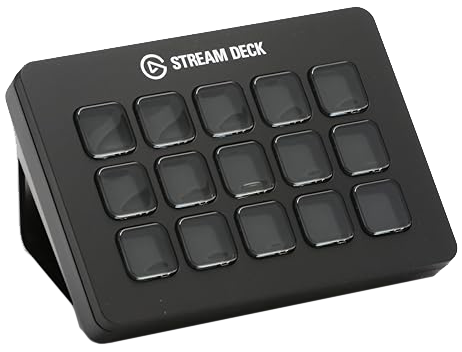
The device tested
Elgato Stream Deck MK.2
The 15-key model at the center of this review: a compact macro controller with customizable LCD keys for Windows and macOS.
Workflow optimization: stop fumbling through menus
The whole point of the Stream Deck is turning things you do constantly into a single, deliberate press. A few of the biggest wins:
- One-touch app and website launch: stop hunting through menus for your most-used software and sites. Assign keys to open them instantly. You can even group programs and pages together to open all of them with one press to start your day in style.
- Automating the mundane: one of the Stream Deck's best features is multi-actions. Chain commands to resize a batch of images, send a formatted template email, or run a complex script with one button.
- System settings at your fingertips: say goodbye to tedious volume adjustments or Wi-Fi toggles. Create dedicated buttons for screen brightness, audio output, and other frequently used settings.
- Flexibility: the customization lets you spin up actions tailored to one specific project, then clear them out later, maximizing efficiency without cluttering your long-term setup.
How it helps specific kinds of work
The Stream Deck is not one-size-fits-all. Here is how it pays off across a range of professions:
- Software developers: integrate your code editor, debugging tools, and build processes directly into your setup. Design custom shortcuts that match your workflow, and insert commonly used code strings with a single button instead of memorizing cumbersome key combinations.
- Designers: map your most-used tools and actions in Photoshop, Illustrator, InDesign, and the rest of the Adobe Creative Suite. That cuts your reliance on menus and finger-twisting multi-key shortcuts, so you stay in your creative flow.
- Writers: give your hands a break. Tap a key to reach text formatting tools, insert standard phrases or research links, and launch your go-to dictionary or reference sites.
- Project managers: connect your project management tools, communication apps like Slack or Teams, and your calendar. Switch context with a flick of a finger to stay on top of deadlines and scheduling.
- Musicians and audio engineers: control your DAW with transport functions (play, stop, record) mapped to keys. Adjust mixer levels, mute or unmute tracks, apply effects, and trigger pre-recorded cues for live performances or studio sessions.
- Video editors: add shortcuts for cut, split, trim, and transitions. Apply favorite color presets, navigate the timeline, and mark important edits so you can focus on the creative process.
- Educators: launch presentation tools or interactive whiteboards with one press, control online classroom settings such as muting students or starting breakout rooms, and keep quick access to frequently used resources for smooth transitions between lessons.
The desktop software: where you program it
The desktop app, available for Windows and macOS, is the heart of the Stream Deck experience. It lets you program your buttons and build advanced workflows in an interface that is genuinely user-friendly and easy to learn.
- Intuitive drag-and-drop: assign actions to keys by dragging icons from a vast library of built-in actions and plugins.
- Folders and profiles: organize actions with nested folders and create profiles that switch automatically based on the app you are using.
- Icon customization: design your own icons or download pre-made packs to make your layout easy to read at a glance.
- Multi-actions: build complex sequences that fire from a single press, streamlining repetitive or time-consuming tasks.
- Stream Deck Store: discover and download more plugins, icon packs, and pre-built profiles right inside the app.
Life beyond work: personal productivity
The Stream Deck is not only about work efficiency. It can simplify everyday life just as easily:
- Smart home central: integrate smart lighting such as Philips Hue, thermostats, and more. Turn a button into a "movie night" preset that dims the lights and launches your favorite streaming service.
- Personal command center: start your day with buttons to play your morning playlist, pull up the weather, or open a quick note-taking app.
- Life admin shortcuts: automate frequent online purchases, streamline bill payments, or set reminders with dedicated buttons that save you from digging through apps.
Tap into the power of plugins
The true potential of the Stream Deck lies in its extensive library of plugins. These provide ready-made integrations with countless popular apps and services, expanding what the device can do far beyond the core functionality. A glimpse of what is available:
- Smart home control: interact with Philips Hue, LIFX, and other platforms to set lighting scenes, adjust thermostats, and control devices.
- Communication and collaboration: connect to Zoom, PowerPoint, Keynote, and even Apple Mail for direct actions from your keys.
- Developer tools: streamline workflows with plugins for popular code editors, task management, and collaboration platforms like Jira and GitHub.
- Business essentials: add time tracking, expense reporting, and customer relationship management (CRM) tools to your setup.
- Content creation and streaming: even if you are not a streamer, plugins for OBS, Twitch, XSplit, and YouTube offer useful controls. If you record tutorials on an NVIDIA GPU, it is also worth knowing how to get your mouse cursor into the recording.
- Music and entertainment: control Spotify playlists and adjust settings in Elgato's Wave Link or 4K Capture Utility software.
- Automation central: the IFTTT plugin opens up a world of potential by connecting to hundreds of web services and devices.
The best part? You can find all of these (and many more) in the Stream Deck Store, which is constantly adding new tools and integrations.

Build quality: mostly good, with one glaring issue
The Elgato Stream Deck MK.2 generally boasts solid build quality, with a sturdy chassis that feels designed to withstand regular use. The keys themselves, however, offer a slightly less premium experience. The keycaps feel durable, but their stabilization mechanism leaves room for improvement.
If you tend to hit the edges of keys rather than dead center, you might run into accidental double presses or misfires. This is likely an inherent design challenge in balancing stabilization against the need to fit an LCD screen beneath each key.
Overall the build is sufficient for most users, but it is worth flagging if you are particularly sensitive to key feel. Coming from a mechanical keyboard with good switches, the keys are a small let down. There simply is not a better alternative doing what the Stream Deck does, though, so I can live with it.
Stream Deck tips and tricks
- Organize with folders and profiles: use folders to group actions, and profiles to switch seamlessly between sets of actions based on the app or project.
- Visualize with custom icons: create or download icons so identifying an action at a glance is effortless.
- Lean on multi-actions: combining several actions into one press is a genuine game-changer, automating entire sequences of tasks.
- Show, hide, or combine titles: each key can show an icon, a title, or both, so you can tune how much detail each button displays.
- Find your inspiration: discover pre-made profiles, plugins, and icon packs from the vibrant Stream Deck community.
Inspired to build your own? Here is my Stream Deck setup
The power of the Stream Deck is its customization, so I wanted to share my personal layout to spark some ideas. Feel free to adapt these or forge your own path entirely. Some of these icons are fully custom, so do not hesitate to ask for the files. Below is my home screen, with a grid coordinate on each key so I can reference it in the descriptions that follow.

-
A1
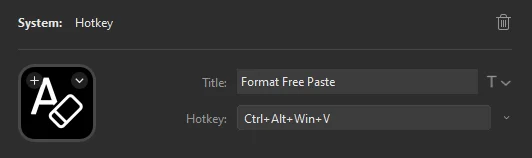
Clear Formatting Paste Hotkey
I use this constantly when copying content from other sources, especially anything with a dark-mode theme, so it does not drag a dark background or other formatting along with it. The native shortcut Ctrl+Alt+Win+V is tricky to hit over and over, but now it is one press.
-
A2-A4
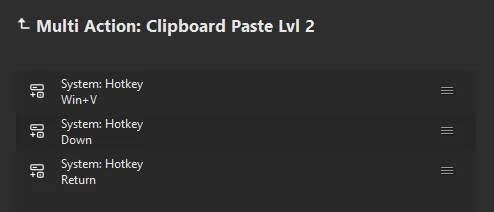
Clipboard History Multi Action
Three buttons dedicated to my Windows clipboard history: one pastes the second item on the list, another the third, and the last the fourth. Each one runs Win+V, then a down arrow, then Enter, with extra down-arrow steps to reach further back.
-
A5
Stopwatch Plugin
A plugin called, simply enough, Stopwatch. It runs right in the key, so I can start, stop, and reset it on the Stream Deck instead of juggling a desktop app. Because it is right there, I actually remember to use it.
-
B1
Voice to Text Hotkey
A simple shortcut that is very useful for dropping text anywhere just by speaking. Again, since it is right there on the Stream Deck, I actually remember to use it. This runs Win+H.
-
B2
Word Count in Google Docs Hotkey
This brings up the word count feature in a Google Doc, which I always need but for some reason you have to tell it to always show, which is incredibly annoying. This runs Ctrl+Shift+C.
-
B3
Window Screenshot Hotkey
Takes a screenshot of the active window with the Windows screenshot tool. Normally you have to move a hand to the middle of the keyboard for the shortcut, but now it is much closer for my left hand. This runs Alt+PrtScn.
-
B4
Code Insertion Text
A simple text insertion of a tiny bit of code that adds the HTML to make text bold. I use it a lot and it saves so much time, especially with lists that have a bold intro on each item. This inserts the string <strong></strong>.
-
B5
Left-hand Delete Hotkey
This is just the Delete key, but I realized my left hand cannot reach the real one easily, so I added one here. It mimics pressing Delete.
-
C1-C3
App Launchers Open
Launch their corresponding apps. In the future, like the next example, these will become folders with additional actions. Each is an Open action that runs the .exe for the app.
-
C5
Photoshop Folder Folder
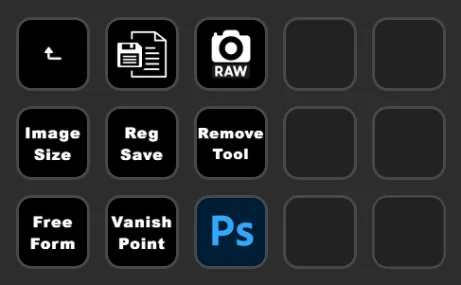
A folder that houses all the shortcuts I always use in Photoshop, including launching Photoshop itself. The screenshot below shows what is inside. Most are self-explanatory, and there are still open spots I am sure I will fill soon.
-
C6
Screen Navigator Next Page
A Next Page action that jumps to a second page of links to folders I open often. It saves me from opening File Explorer and drilling down every time, since each folder opens directly. The screenshot below shows that page, again with room to grow.
A quick note: you can have up to 10 pages on the Stream Deck, and effectively unlimited depth using folders. Past about three layers of folders, though, you start defeating the point of convenience. Then again, you may find it useful. That is the power of the Stream Deck.
These are just my examples, but hopefully they show that you can do almost anything you want in almost any situation.

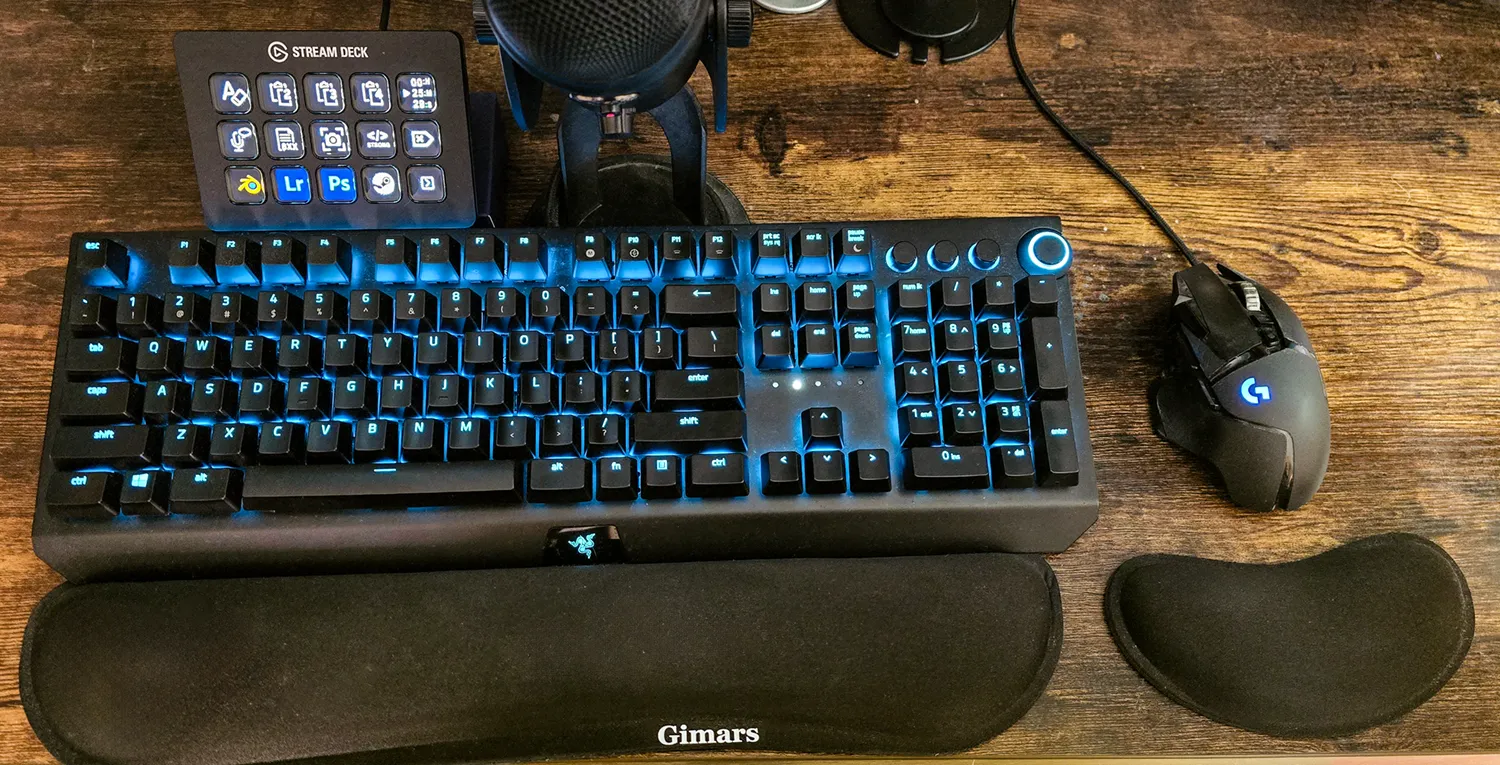
This is how it sits on my desk, set up so it is easy to reach with my left hand, which is my dominant one. My left hand is always on the keyboard, so it can slide over to the Stream Deck without taking my other hand off the mouse. The deck is elevated by a small weighted box underneath to line it up with my tilted keyboard. The rest of the setup is a Razer BlackWidow Elite mechanical keyboard with silent yellow switches (since replaced by the EPOMAKER HE108 Hall effect keyboard), a Logitech G502 Hero wired mouse, a Blue Yeti microphone, and Gimars wrist rests.
Exploring the Elgato Stream Deck family
The MK.2 is the most popular choice, but Elgato makes several other versions for different needs and budgets. The main difference between the core models is simply how many keys you get:
- Stream Deck Mini: a more compact, more affordable version with 6 keys. Great if you have limited desk space or just want a streamlined set of essential shortcuts. See the Mini on Amazon.
- Stream Deck XL: the powerhouse of the lineup with 32 keys for extensive control. Perfect for professionals who need an abundance of commands at their fingertips. See the XL on Amazon.
- Stream Deck +: a powerful addition offering LCD keys, a touch strip, and four customizable dials. Built for audio mixing, precise adjustments, and even greater flexibility. See the Stream Deck + on Amazon.
Frequently Asked Questions
Is the Stream Deck only for streamers?
Absolutely not. While the Stream Deck is popular among streamers, its customization potential makes it a productivity powerhouse for anyone. Developers, designers, writers, project managers, and countless other professionals can streamline their work with it.
Can I use the Stream Deck MK.2 to improve my non-work life?
Yes. The Stream Deck integrates with smart home devices, music apps, and more. Control your lights, set the perfect playlist, and even order your favorite food with a simple button press.
What is the difference between the Stream Deck MK.2, Mini, and XL?
The main difference is the number of customizable LCD keys: the Stream Deck Mini has 6 keys, the MK.2 has 15 keys, and the XL has 32 keys. Choose the version that best suits your needs and budget.
How do I set up my Stream Deck MK.2 for productivity?
The basic steps are: download the Stream Deck software for Windows or macOS, connect your Stream Deck, then drag and drop actions such as launching apps, opening websites, or system controls onto your keys. From there, explore plugins for the specific apps and services you use.
I am a developer. How can the Stream Deck MK.2 enhance my workflow?
The Stream Deck is fantastic for developers. Map shortcuts for your favorite code editor and debugging tools, create buttons to execute build processes or run common scripts, and integrate with task management and collaboration tools.
The bottom line
The Elgato Stream Deck MK.2 is a surprisingly versatile tool for optimizing workflows and streamlining everyday tasks. Whether you are a designer, a developer, a project manager, or simply someone chasing a little more efficiency, there is a way to customize this device to your needs.
Think creatively, explore what is possible, and transform how you work. If the key feel is the one thing holding you back, it is worth handling one in person first. For everyone else, this is an easy device to recommend.