

Skip to content
CKBench: claims, tested

Lab-tested storage, starting with memory cards

CKBench is the bench we built because the numbers on the package answer almost none of the questions that matter. Every test byte is committed to the device and confirmed, every byte is read back and checked, and the result gets published whether it flatters the product or not. Its first module is CardCheck, for memory cards, and a microSD is a good place to start: it is the cheapest component in your dash cam and the one most likely to quietly ruin it.

CardCheck · the corpus

Memory cards: every one we have tested

Same bench, same reader, same suite. Write speed is committed sequential, which reads lower than burst benchmarks because every byte had to land before the clock stopped. Capacity is what the card actually delivered against the number on its label, verified byte by byte.

CardCommitted writeSustained floorCapacity deliveredPeak tempScore
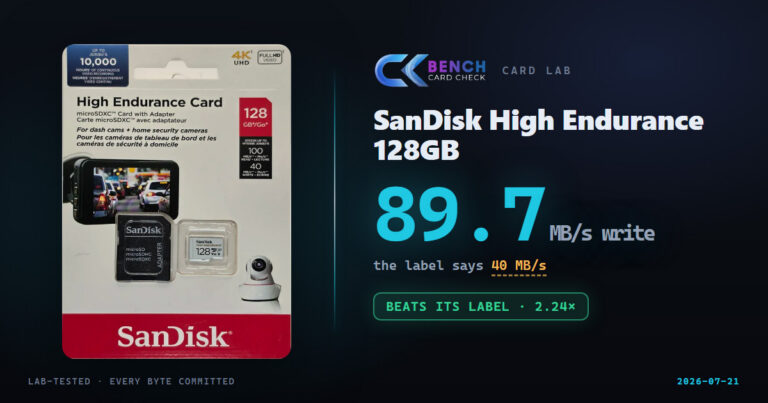
SanDisk High Endurance 128GB 89.7 MB/s 88.0 MB/s, V60 100.0% of label 151.4 F 5/5
Kioxia Exceria G2 128GB 65.3 MB/s 62.6 MB/s, V60 96.7% of label 143.3 F 4.5/5
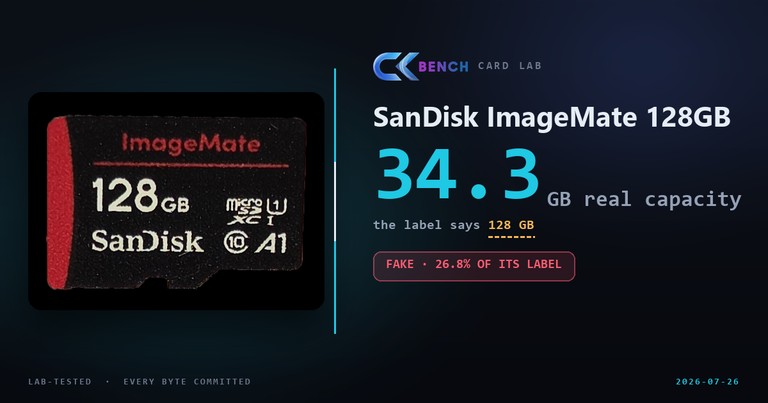
SanDisk ImageMate 128GB 33.2 MB/s 31.8 MB/s, V30 26.8% of label 150.1 F 1/5

Three cards, three completely different failure modes for a buyer. One delivers everything it promises and then some. One quietly keeps four gigabytes for card management and tells you only in a spec sheet. One is not the size it says it is at all, while passing every speed test in the suite.

The reviews

Read the full autopsies

SanDisk High Endurance 128GB review, measured 89.7 MB/s committed write against a 40 MB/s claim
Scored 5/5

SanDisk High Endurance 128GB

The card that under-sells itself. It committed writes at 89.7 MB/s against a printed 40, held V60 against a printed V30, delivered all 128.0 GB with zero mismatched bytes, and lost only 2.1% of its random-write speed under the churn that collapsed our reference card by 71%.

Read the deep dive
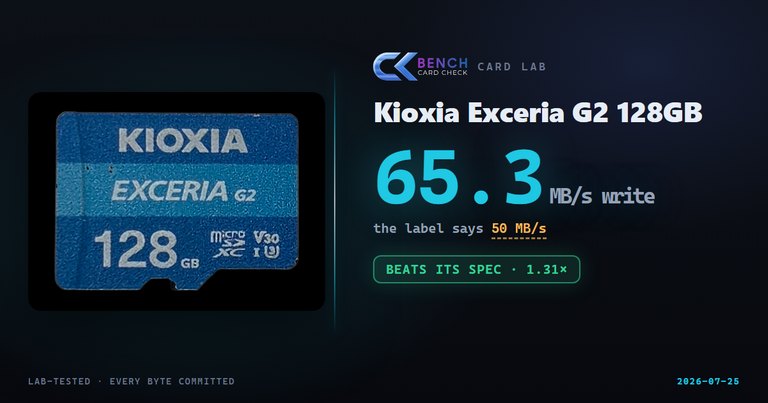
Kioxia Exceria G2 128GB review, measured 65.3 MB/s committed write against a 50 MB/s spec
Scored 4.5/5

Kioxia Exceria G2 128GB

The card that came with your dash cam, and the standard advice to bin it is wrong. It beat its published write spec by 31% and did not fade at all under loop-recording churn. Its one real fault is capacity: you get 123.7 GB of the 128 on the front, and only a spec sheet tells you.

Read the deep dive
Counterfeit SanDisk ImageMate 128GB, measured 34.3 GB real capacity against a 128 GB label
Scored 1/5

SanDisk ImageMate 128GB

A counterfeit, and the most interesting one we have seen: it holds 34.3 GB against a 128 GB label while passing Class 10, U3, A1 and V30. Fast flash, fraudulent number. It is the proof that you cannot catch a fake card by benchmarking it.

Read the autopsy
Start here

What buyers actually ask

Should I replace the card that came with my dash cam? Probably not. The bundled Kioxia we tested beat its own spec and handled loop recording without flinching. Here is the full run.

How do I tell if my card is fake? Not with a benchmark. Check the reported size first, then fill the whole card with verifiable data and read it all back. The counterfeit we tested passes every speed test there is.

Why does my 128GB card only show 119 GB? That is normal. Your computer counts in binary, so 128,000,000,000 bytes displays as about 119 GB. Nothing was taken. A real shortfall looks very different, and the Kioxia review explains where the missing gigabytes on that card actually went.

How much footage fits on a card? Work it out for your own camera's bitrate in the dash cam storage calculator.

The method

How these numbers are produced

Every figure on this page comes from one results file per card, written by a bench built for this: writes are committed and confirmed before the timer stops, a cache-leak canary aborts the run if the operating system serves a cached read, and every test byte is seeded so it can be verified on the way back. Cards are scored on five dimensions against the job they are sold for, and a card that misrepresents its capacity is capped at 1 out of 5 no matter how fast it is.

The full method, the rubric, the unit conventions and an honest list of what we deliberately do not test are all on one page.

How we test and score memory cards

The bench, the five-dimension rubric, the conventions, and the gaps we will not paper over.

Read the method