
SanDisk High Endurance 128GB: the card that under-sells itself
We ran a retail SanDisk High Endurance 128GB through the full CKBench suite: every byte committed, every byte verified, thermal camera on the bench. It beat almost every number printed on its own box. Here is the whole hour, measured.
Prefer to watch a review?
No video for this lab run yet, but I cover dashcams, storage, and the gear around them on the channel. Subscribe to catch the next test the moment it goes live.
The short version
This is a genuine 128 GB card that outruns its own label. The box promises 40 MB/s writes; we measured 89.7 MB/s committed, meaning every byte was confirmed written to the card itself rather than parked in a buffer, 2.24 times the claim, and it held a V60 floor against the V30 printed on the front. Every one of its 128 billion bytes wrote and read back with zero mismatches. If you need a dashcam or security-camera card, buy it with confidence. If you need a card to run apps from, this is not that card, and it never claimed to be. My rating: 5/5, scored against the CKBench rubric.
Verdict: 5/5, buy it for cameras, not for appsUpdated 19 August 2026. We bought two more of this exact card, and one of them is not the same card. Same model number, same barcode, same printed claims, but the unit built in April 2025 reads 174.9 MB/s and holds V90, where the two built in 2026, including the card reviewed here, read 96.8 and hold V60. Nothing on the outside of the package tells them apart. The review below still stands for the card we tested, and the new section covers what you may actually receive.
Who this card is for
- YesDashcamAny resolution these cameras record, with room to spare.
- YesHome security cameraBuilt for continuous loop recording.
- YesAction or consumer 4K cameraClears 4K60 and high-bitrate 4K120.
- NoRaspberry Pi, app storage, OS driveOrdinary random performance. Pick an A2 card or an SSD.
Rough capacity math: at the 6 MB/s a 4K30 dashcam writes, 128 GB holds a little under 6 hours of footage before it starts looping over the oldest clips. Your camera's bitrate is the variable that matters, so work out your own numbers in the dash cam storage calculator.
Why we lab-test memory cards
A microSD card is the cheapest component in your dashcam and the one most likely to quietly ruin it. The marketing numbers on the package answer almost none of the questions that matter: what the card sustains when its cache runs out, whether it is really the size it says, and what happens after a year of loop-recording abuse. So we built a bench that answers them. CKBench writes every test byte to the card and waits for it to land, guards itself against the operating system serving cached data, and stores every figure in one results file that this article quotes directly.
This SanDisk High Endurance 128GB (model SDSQQNR-128G-GN6IA) is the first card we bought at retail and ran against its own printed claims. We paid for it, SanDisk has no idea we exist, and the card had no idea it was being graded. Those are the best possible conditions for honesty.
It was also the first card on CKBench, the running index of every card we have put on the bench. Others have followed it: a Kioxia Exceria G2 pulled out of a dash cam that quietly keeps four gigabytes for itself, a counterfeit SanDisk that passes every speed test while holding barely a quarter of its label, a pair of VIOFO High Endurance cards that share a name but not a factory, a bundled Botslab card whose write speed never sits still, and a half-terabyte Samsung whose video speed class changes with the reader you use. The line this card belongs to is now on the bench in two sizes and two histories: a used SanDisk High Endurance 512GB holds V60 like this one does and stops writing for seconds at a time, on two readers, which this card has never done. All of them are scored the same way, against the same published rubric.
Why our write numbers read lower than other reviews. Every write here is committed to the card and confirmed before the clock stops, the way a dashcam actually writes, so our figures land below burst benchmarks like CrystalDiskMark that measure a few seconds of the card's RAM buffer. That rule, and the decimal MB/s and binary MiB conventions used throughout, are set out on the how we test and score page.
What the box claims, and what the card did
Every card in the lab carries a stored record of what its own packaging promises, entered once and reused on every run. That turns each benchmark into a comparison instead of a bare number, and this card is the reason that feature earns its keep. On three of its four headline claims it does not merely pass. It laps the spec.
Watch the bars land against the dashed label lines. The write bar blows past its own claim before the read bar even finishes drawing.
The label vs the bench
The full scorecard, straight from the results file. Every floor is judged against the worst ten seconds of sustained writing, not the average, because a class rating is a promise the card has to keep for the whole recording.
| Printed on the card or package | Measured | Verdict |
|---|---|---|
| 128 GB | 128.0 GB written and read back, 0 mismatches | MET |
| Up to 100 MB/s read | 96.8 MB/s committed sequential | MET (97%, at the bus ceiling) |
| Up to 40 MB/s write | 89.7 MB/s committed sequential | BEATEN 2.24× |
| C10 | floor 88.0 MB/s vs 10 MB/s | BEATEN 8.8× |
| U3 | floor 88.0 MB/s vs 30 MB/s | BEATEN 2.9× |
| V30 | floor 88.0 MB/s → holds V60 | BEATEN by one grade |
| (no A-class printed) | 1549 / 1030 IOPS (small operations per second) vs A1's 1500 / 500 floors | A1 met, unprinted |
| 10,000 hours continuous recording | not measurable in one lab session; see the note below | NOT TESTABLE |
| 2-year limited warranty | printed on the back, card only | NOT A PERFORMANCE CLAIM |
| (no operating temperature range printed) | hottest point on the card reached 66.3 C (151.4 F) under five minutes of flat-out writing with no fan | NOT CLAIMED |
That second-to-last row is the biggest number on the front of the box, and it is the one claim here that no honest bench can settle. Ten thousand hours cannot be measured in an hour. It can, however, be translated, because SanDisk print the exact condition behind it in the fine print on the back: "Based on Full HD (1920x1080) video content recorded at 26 Mbps to one device." That single sentence is the whole story, and it is worth reading twice. The headline number is not a 4K figure.
Do the arithmetic and the claim becomes auditable. 26 Mbps is 3.25 MB/s. Ten thousand hours at that rate is 117 terabytes written, which on this card's measured 127.97 GB works out to roughly 914 complete fills. In felt time, at 90 minutes of driving a day it is about 18 years; run as a 24/7 security camera it is about 14 months. Note also what the fine print concedes on its own: "actual hours of video saved less." The rating describes a write workload, not a promise about how much footage ends up on the card. On every endurance ladder I have checked, the hours are the card's capacity times a constant, which the endurance-rating explainer works through.
What our bench can say is narrower and worth being precise about. We measured how this card behaves under the churn that wears cards out, and it gave up 2.1% of its random-write speed where a floor-tier card lost 71%. For scale on the other side, the Vantrue Endurance PRO 128GB gave up 0.04% on the same test. That is a strong indicator that the flash and the controller are built for loop recording. It is not an endurance measurement, and nothing in a one-hour session can be. Treat the 10,000 hours as a manufacturer's rating with a published and now-stated condition, and treat our fade number as independent evidence that the rating is not decorative.
The packaging is the defendant here, so it belongs in evidence. The front prints the two headline speeds and the 10,000-hour endurance claim; the class logos and the fine print live on the back.
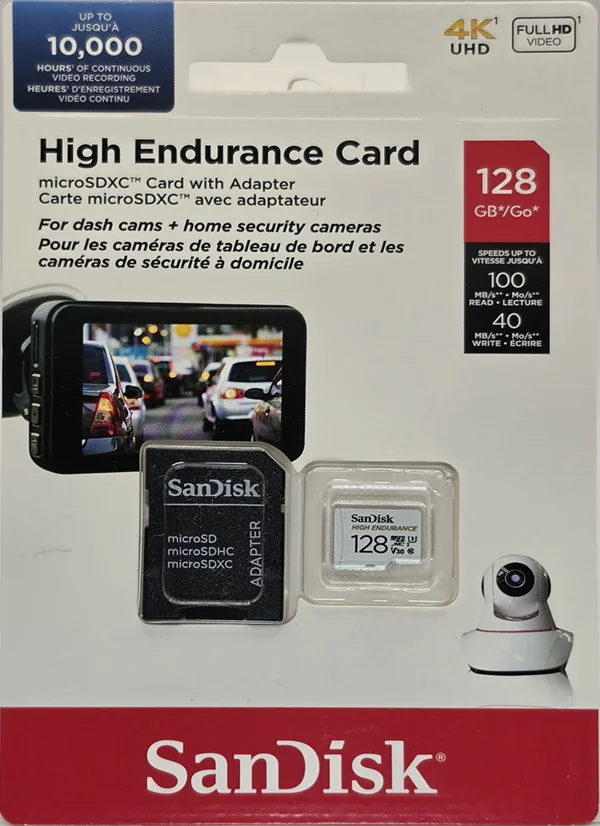
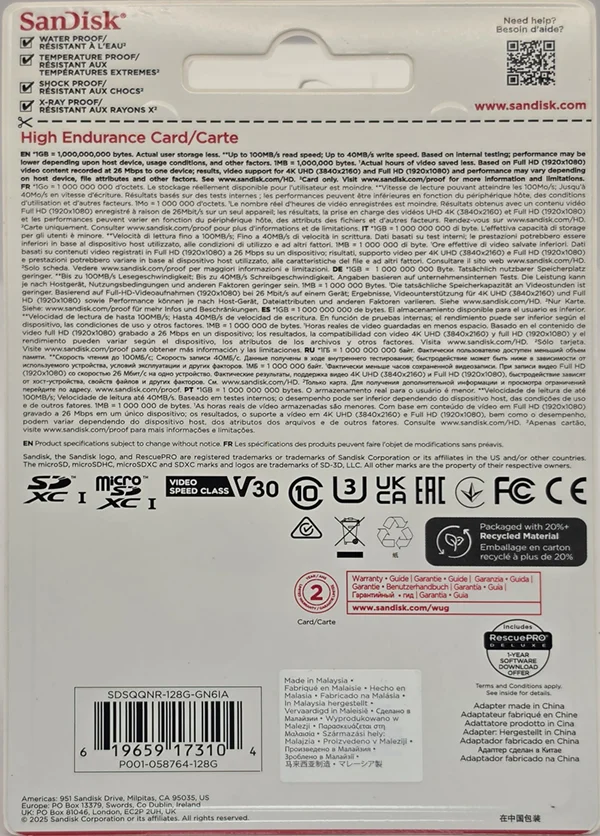
Disclosure: I bought this card at retail with my own money; SanDisk had no involvement in this test and no editorial input. This post contains affiliate links. As an Amazon Associate I earn from qualifying purchases, at no extra cost to you. Affiliate links like these and my YouTube channel are what keep the site running.
The card tested
SanDisk High Endurance 128GB
The dashcam-duty microSD, bought at retail and run through the full CKBench suite on 2026-07-21.
Why would SanDisk under-rate its own card?
A 40 MB/s write claim on a card that commits at 89.7 is not modesty. It is contract law. The printed number has to hold for every unit of every production revision for the life of the SKU, across NAND suppliers and controller respins, on the slowest host the card might ever meet. So the label is a floor the manufacturer will defend, not a description of the card in your hand.
The same logic explains V30 on a card that holds V60. V30 is what the dashcam and 4K-camera market actually asks for, so it is the promise worth making, and any headroom above it is margin the manufacturer keeps in reserve rather than in marketing. The practical consequence is the one this whole lab exists for: you cannot rank cards by their labels. Two cards both printed V30 can differ by a factor of three in the number that decides whether your camera drops frames. Only measurement separates them.
The printed number is a floor the manufacturer will defend, not a description of the card in your hand.
The one honest asterisk: the bus, not the flash. UHS-I in its fastest mode tops out around 104 MB/s of raw bandwidth, and real-world ceilings land in the mid-to-high 90s once protocol overhead is paid. At 96.8 read and 89.7 write, this card is as fast as its interface allows, and its flash may well be faster than we can see. The "up to 100 MB/s" on the package is effectively a statement about UHS-I, not about the NAND. Keep that in mind for the cache discussion below; it cuts both ways, and we say so where it matters. Getting past that ceiling takes a second row of pins, which is a separate question: whether you actually need a UHS-II card.
Five minutes at full throttle: the write curve
Modern consumer cards frequently write fast into a small SLC cache and collapse when it fills. That is the failure mode that ambushes long recordings: fine for the first few gigabytes, then a cliff. So the sustained test writes flat out for five minutes, fan off, logging every second, while a class ladder keeps score of which speed ratings the card is still holding.
This chart is the same component the live bench UI draws, replaying the run's actual 300 one-second samples. There is no drama in it, and that is the finding. Hover the line for the exact sample under your cursor.
SanDisk High Endurance 128GB
The card opens at 89.3 MB/s, settles to 88.5, and its worst ten-second stretch in five minutes of continuous committed writing is 88.0 MB/s. Every one of the 300 samples falls between 83.9 and 91.2 MB/s, a total spread of about 8% peak to trough. The distance between the best and worst windows is under one and a half percent. That worst window sits at 1:00, the earliest moment a complete ten-second window exists to score, and it is 0.6% below the steady state. So it marks where the measurement opens, not a card digging itself out of a hole, which is why the endurance section can say this card needed no recovery without contradicting the chart. Compare that to our reference card, whose chart is a two-minute climb out of a hole, and the difference in character is visible from across the room.
Averages still hide the thing that actually ruins footage, though. A card can post a fine mean and freeze for two seconds, and two seconds is a hole in your recording no average will show. So the suite also times every individual block it writes and keeps the tail. Across 25,336 one-megabyte blocks, the slowest single write took 51.8 milliseconds, landing exactly where such things land: on a file roll, closing one test file and opening the next. Nothing crossed 500 ms. Nothing came close. For a 4K30 dashcam writing roughly 6 MB/s into a buffer, a 52 ms hiccup is invisible. This is the cleanest stall profile the lab has recorded.
One more detail worth reading closely: the run used a settle pre-pass, which writes untimed until the card's throughput stabilizes, so the measurement starts on a controller that has finished reacting to whatever came before. This card settled at 60 seconds, the earliest moment the analyzer can declare, immediately after the random-write abuse you will meet two sections down. A conditioned card's settle time is its recovery time. The reference card needed nearly two minutes to climb back after the same abuse. This one was already stable when the clock first allowed the question.
Is it really 128 GB? Every byte, verified
Counterfeit cards lie about their size. A controller reprogrammed to report 128 GB will happily accept writes forever, silently wrapping new data over old once the real flash runs out. The only test that cannot be fooled is the brute-force one: fill every free byte with seeded pseudorandom data, then read all of it back and compare against what the seed says each byte must be. Every block carries a unique stamp, so a controller can never fake capacity by recognizing repeated data. A fake fails loudly at its real capacity. This card told the truth.
One thing to expect before you go hunting for a refund: put this card in a Windows PC and it will report about 119 GB, not 128. That is not shrinkage and it is not a fake. The card really does hold 128 billion bytes, which is what "128 GB" means on the package, but Windows divides by 1,024 three times instead of 1,000, and 128,000,000,000 bytes expressed that way is 119.2. Formatting overhead takes a sliver more. A genuinely fake card does not come up slightly short like this; it fails outright partway through a full write and verify, which is the test above.
Every byte, written and read back
128.0 GB written across 120 files, 128.0 GB verified, zero mismatched bytes, zero read errors. The tool draws a distinction worth repeating: a read error would be a transport fault and never counts as fake evidence; only data that reads back wrong convicts a card. Nothing read back wrong.
The verify pass doubles as a measurement no manufacturer advertises and every user eventually cares about: how long it takes to get your footage off. Reading all 128 GB back took 23 minutes flat at 92.7 MB/s wall-clock. Fill this card with dashcam footage and you should budget twenty-three minutes and a reader at least as good as ours.
One number in that panel deserves the same treatment we just gave the read side. The fill is quoted at 90.1 MB/s, which is the rate across 1,421 seconds of actual I/O, but the wall clock on that phase was 1,606 seconds, or 79.7 MB/s end to end. Most of that 185-second difference is one unexplained pause. After the calibration step finished having written 268 MB, the next progress heartbeat two minutes later reported 272.6 MB, roughly 4 MB of counted progress in 127 seconds. Then the card wrote 5.2 GB in the following minute and never hesitated again. The per-second samples show nothing unusual during the pause, the slowest being 79.7 MB/s, so this was time spent between write operations rather than inside a slow one. The likeliest explanation is controller housekeeping: the sustained test had just deleted 30 files totalling 26.6 GB, and a card handed that much freshly discarded space may go away and erase blocks before it accepts new ones. Calling that proven would be overreach. It is one unexplained window in an otherwise flawless hour, it did not recur, and it is recorded here rather than smoothed away because a card that occasionally pauses for two minutes would matter enormously if it were real and repeatable. The follow-up is cheap: run the capacity test standalone on a freshly formatted card and see whether the pause survives without a bulk deletion preceding it.
And because this run also swept the whole 128 GB fill with the same knee analysis as the five-minute test, the cache question closes at full scale. The curve holds 87.2 MB/s for the first hundred gigabytes, then steps down about 2.7% for the last twenty percent of the card as the controller runs out of pre-erased blocks. That is not a cache cliff; a cliff is a fall of thirty to seventy percent at a fixed boundary early in the fill. A card written from byte zero to byte 128 billion at one unbroken rate has nowhere left to hide a tier. Whatever this card's internal architecture, it writes at one speed from the first byte to the last.
What "high endurance" actually means
Here is the single most revealing result in the run, and it is not a speed. Random 4K writes are what loop recording looks like to a card: event-file saves, FAT updates, and above all the constant overwrite churn of a dashcam that never stops. A dashcam card lives in that workload permanently. So the bench runs three consecutive 20-second random-write passes specifically to see whether a card degrades as its flash translation layer gets churned. That layer is the firmware that decides where your data physically lands on the flash, and it is the part that gets tired first.
We put the lab's reference card through the identical test, though on the Transcend reader this bench used before the ProGrade became the standard. Be clear about what that card is: an unbranded Class 4 32 GB card that writes sequentially at 11.4 MB/s, the slowest tier still sold and a bus generation behind this one. It is a floor, not a fair fight, and a current mainstream V30 card would land somewhere between the two. Watch both cards take the same minute of abuse. Each bar is that card's percentage of its own best pass, so the shape of the collapse is comparable even though their absolute speeds differ by six times, and no reader can change how far a card falls against itself.
One minute of loop-recording abuse
This card: run SanDisk-High-Endurance-128GB_2026-07-21_125559 · reference card: lab baseline, same bench, same test · cardcheck v0.7.0
The reference card faded 183 to 76 to 53 IOPS, a 71% collapse in sixty seconds of scattered writes, and then needed nearly two minutes of continuous writing just to climb back to its normal speed. This card went 1038, 1035, 1016. That is a 2.1% fade. It is essentially a flat line, and it needed no recovery at all.
That indifference, not the headline megabytes per second, is what the words "high endurance" are supposed to mean. It is the one property that is invisible on a spec sheet and invisible in a burst benchmark. Treat it as indicative rather than proven: three 20-second passes measure how the controller behaves under churn, which is a good directional read on whether a card is built for loop recording, but it is not an endurance test and it cannot tell you the card is still working in year three. The honest claim is narrower and still useful. Under the workload that cost a floor-tier card 71 percent of its random-write speed, this one gave up 2.1 percent and needed no recovery at all.
Two honest caveats stay in the open. First, in absolute terms these random figures are ordinary microSD numbers: 6.35 MB/s read and 4.22 MB/s write is two orders of magnitude below an SSD, which is why this is not a card to run an operating system from. Second, the A1 floors it clears (1549 and 1030 IOPS against A1's 1500 and 500) are recorded as indicative rather than certified, because the SD Association's procedure differs from ours, and A2 is not testable at all on USB readers, whose floors assume command queuing they do not perform. No A-class is printed on this card anyway. It meets A1 regardless.
How hot does it get?
The sustained leg runs with the bench fan off, so the card heats the way it would inside a sealed camera body, and the thermal frame is captured the instant the write stops, because a card sheds heat in seconds. This is the first card in the corpus measured with a thermal imager rather than by touch. The question that matters is not just the peak. It is whether the card slowed down as it got there.
It got hot. It did not slow down.
A 4K30 dashcam writes about 6 MB/s, one-fifteenth of this workload · Run SanDisk-High-Endurance-128GB_2026-07-21_125559 · cardcheck v0.7.0
The thermal camera does not lie, so here is the frame itself, captured the moment the timed write ended. The spot marker reads 151.4 F or 66.3 C at the hottest point; the crosshair reads 132.2 F or 55.7 C on the body. The nineteen-degree Fahrenheit gap between them (10.6 C) is itself informative: heat concentrates at one end of the package, which is exactly what you expect when a controller die is doing the work.
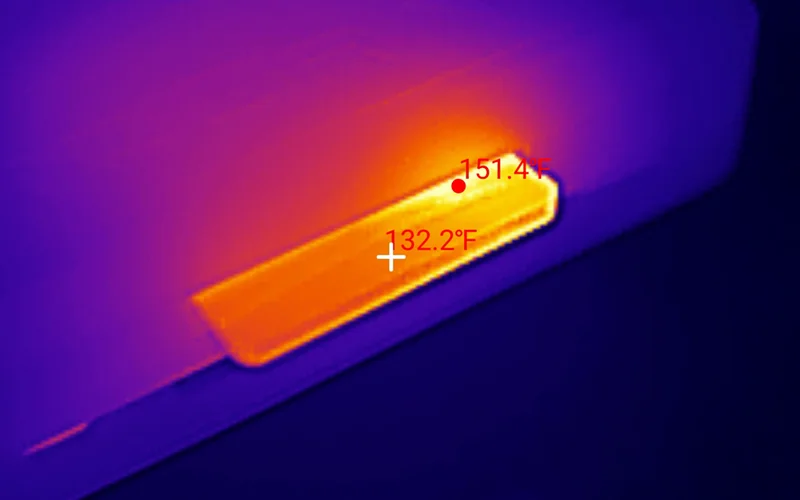
Now the dashcam arithmetic, done honestly in both directions. Take the rise at face value and it looks alarming: a car parked in summer sun reaches 140 F or 60 C in the cabin, and stacking a +41.9 C writing rise on that lands past the 85 C most consumer cards are rated for. That arithmetic is where a lazier review would stop, and it would be wrong. Our rise came from writing 88 MB/s continuously. A 4K30 dashcam writes about 6 MB/s, roughly one-fifteenth the data rate, and controller heat scales with how hard the controller works. The bench deliberately generates a thermal load no dashcam will ever impose.
The honest reading: this card's worst-case self-heating is real and substantial, a dashcam will not come near invoking it, and in absolute terms 66.3 C leaves around 19 C of headroom under the typical 85 C rating even at full abuse. What the figure does tell you is that thermal headroom is not unlimited, so mount choice matters. A camera baking against black dash plastic in direct sun starts from a much worse ambient than our bench at 76 F. Give the camera air and keep it out of direct sun. Not a dealbreaker, just know it going in.
What can the SanDisk High Endurance 128GB record?
Every row below is judged against the worst ten seconds of the run, 88.0 MB/s, not the average. Averages do not appear in this table on purpose: your camera does not get to record over the average, it records over the worst moment.
| Workload | Needs (MB/s) | Margin | Verdict |
|---|---|---|---|
| 1080p30 dashcam | 1.5 | 58.7× | PASS |
| 1080p60 dashcam | 3.0 | 29.3× | PASS |
| 4K30 dashcam | 6.0 | 14.7× | PASS |
| 4K60 consumer camera | 12.0 | 7.3× | PASS |
| 4K120 / high-bitrate video | 35.0 | 2.5× | PASS |
| V60 class floor | 60.0 | 1.5× | PASS |
| V90 class floor | 90.0 | 0.98× | N/A (not claimed) |
Yes, the V90 line came in 2.2% short: 88.0 against 90.0. It is tempting to call that heartbreaking, but this card never claimed V90, and it is sitting at its interface ceiling besides. Standard UHS-I signalling tops out near 104 MB/s in theory and closer to 96 on both of the readers we use, which is exactly where this card reads. The right reading is that it delivers essentially everything the wire physically permits, and stops there because the wire stops there. A small number of UHS-I cards do beat that ceiling using a proprietary DDR200-class extension, but only when the reader speaks it too, and this card does not use it.
One cross-check ties the whole run together. The canary probe wrote at 87.6 MB/s. The sequential test averaged 89.7. The settle pre-pass stabilized at 89.2. The five-minute sustained test held 88.5. The capacity fill wrote the entire card at 90.1. Five independent measurements, three different engines, spanning 64 MB to 128 GB, all landing inside a 2.9% band. That agreement is the strongest evidence in the report that the methodology is measuring the card and not the tool.
SanDisk High Endurance 128GB
Scored against the CKBench rubric. Five dimensions, each out of 5.
Final score: 5 out of 5. The five dimensions average 4.8. This is the reference card the others are measured against, and the only reason it does not score higher is that the scale stops here. The rows were restated on the September 2026 scoring tables on 30 September 2026: thermal went from 5 to 4 because the tables score headroom under the rating, not heat per unit of work.
Bench conditions, and what we did not test
The bench. Card read through a ProGrade MSD PGM0.5 over USB on a Windows 11 host, tested on the card's own exFAT filesystem exactly as it shipped, 512-byte sectors with every operation issued 4096-byte aligned. All test I/O uses unbuffered write-through handles, and the write timer stops only after the flush returns. That is what "committed" means throughout this article. We publish the filesystem because it matters: random 4K results in particular move with the filesystem and the allocation unit, so a number measured on exFAT is not directly comparable to one measured on FAT32. One thing we cannot report is the reader's negotiated USB link speed, which this version of the tool does not capture.
Read speed depends on your reader, and this one was measured twice. The 96.8 MB/s above came from the ProGrade. We have since run this same card through a second reader, a Transcend TS-RDF5, and it returned 96.1, a 0.7% difference across two independent paths, which is why you can treat 96.8 as the card's real read speed rather than a property of our hardware. It is also genuinely the card at its limit and not our equipment running out of road: a different card on that same ProGrade has since read at 145 MB/s. That is the direct evidence behind the bus-ceiling point made further up. Expect roughly 96 MB/s from this card on any standard UHS-I reader.
Power loss is not tested, and it is the honest gap. For a dashcam, sudden power removal mid-write is arguably the most common way a card actually fails in the field, and nothing in this suite touches it. Testing it properly needs switchable power hardware and a protocol that deliberately risks the card and its filesystem, so it is a separate project rather than a line item. Until we build it, treat every result here as describing a card that was never interrupted.
One card, one session. This is a single retail unit, with one run on most phases and three passes within each speed test. That is enough to characterize this card and to give us a fingerprint to diff future cards against, but it cannot see unit-to-unit variation across a production SKU. A second sample could land a few percent either side of these figures, and a genuinely defective one would be invisible to us entirely.
There are two of this card, and the box will not tell you which one you have
Since this review went up we bought two more units of the same model, SDSQQNR-128G-GN6IA, to find out whether a card bought today behaves like the one we tested. Two of the three are the same card. The third is not, and it is not close.
| Measured on the same bench | Built April 2025 | Reviewed card, built May 2026 | Built July 2026 |
|---|---|---|---|
| Sequential read | 174.9 MB/s | 96.8 MB/s | 96.8 MB/s |
| Sequential write | 107.6 MB/s | 89.7 MB/s | 89.7 MB/s |
| Worst ten seconds of sustained writing | 100.8 MB/s | 88.0 MB/s | 88.0 MB/s |
| Video speed class held | V90 | V60 | V60 |
| Small random writes | 716 IOPS | 1030 IOPS | 1020 IOPS |
| Capacity delivered | 127.84 GB | 127.97 GB | 127.97 GB |
| Name burned into the card | SN128, revision 8.5 | SA128, revision 8.7 | SA128, revision 8.7 |
The April 2025 card is faster at everything a camera asks for. It reads roughly twice as quickly, sustains 14.5% more under a five minute flat-out write, and holds V90 where ours holds V60. It is also 30% slower at small random writes, the one thing a phone or a Raspberry Pi would care about. Faster at the job this card is sold for, slower at the job it never was.
The obvious worry is that we measured the bench rather than the cards, so here is why we did not. All three ran in the same reader and the same slot, with the same settling procedure, the same five minute test and the same room temperature. More to the point, the third card is the control. Bought at Walmart in August 2026, it reproduced the reviewed card to within one percent on every single measurement, several of them identical to the decimal. Worst ten seconds, 87.98 MB/s on both. Full card fill, 90.05 MB/s on both. The same number of bytes delivered, to the byte. When two cards agree that precisely, a third disagreeing by 81% is not the bench wobbling.
The difference is burned into the silicon. Every SD card carries an internal identity, and the two 2026 cards call themselves SA128 at firmware revision 8.7, while the April 2025 card calls itself SN128 at revision 8.5. The older one negotiates a faster non-standard read mode that some UHS-I cards and some readers support, which is how it clears 174.9 MB/s on a bus whose official ceiling is about 104. The newer cards do not negotiate it, so they sit at that ceiling instead.
You can see the split on the packaging if you know to look, though not in a way you can shop with. The faster card comes in a Western Digital branded box carrying a 2022 copyright. The two newer boxes say Sandisk Corporation and carry a 2025 one, from after SanDisk was separated from Western Digital. So the tell is how long a particular card sat in the supply chain rather than which product you chose, and both are genuinely on sale right now. The model number and the barcode are identical across all three.
None of which makes the newer card a bad buy. Both builds beat the 40 MB/s write speed printed on the box, ours by 2.24 times and the older one by 2.69. Both hold at least V60 against a printed V30. Both delivered every byte of their capacity with zero mismatches. For a dashcam or a security camera either one does the job with a large margin, and the 5/5 above stands for the card we tested. The gap shows up when you copy a full card of footage to a computer, where the older build is about twice as quick, and in class headroom you are unlikely ever to use.
One thing we are deliberately not claiming. Every 2026 card we have measured so far is a High Endurance, so we cannot yet tell you whether SanDisk dropped the faster read mode across its whole range or only on this line. Those are different claims and only one of them is supported. Until a 2026 built card from another SanDisk family goes on the bench, this finding is about the High Endurance 128GB and nothing wider.
Frequently Asked Questions
Is the SanDisk High Endurance 128GB good for a dashcam?
Yes, and it is one of the best matches we have measured. Its worst ten seconds of sustained writing was 88.0 MB/s, which is 14.7 times what a 4K30 dashcam needs, and it lost only 2.1% of its random-write performance under the loop-recording churn that degrades ordinary cards by far more.
Is this card faster than its official rating?
Yes. The package claims up to 40 MB/s write and a V30 class; we measured 89.7 MB/s committed sequential write, 2.24 times the claim, and the card held a V60 floor for the entire test. Manufacturers print a floor they can defend across every production revision, not the speed of the card in your hand.
How do I know if a memory card is fake?
The only test a counterfeit cannot pass is a full fill and verify: write every free byte with data that cannot be predicted, then read all of it back. A card lying about its capacity fails loudly at its real size. This card verified all 128.0 GB with zero mismatched bytes.
Does the SanDisk High Endurance overheat?
No. At full bench abuse, writing 88 MB/s for five minutes with no fan, it peaked at 151.4 F or 66.3 C, still under the 85 C most consumer cards are rated for, and it never slowed down. A dashcam writes about one-fifteenth of that data rate, so it will not come near this worst case. Sun-baked mounts are the thing to manage, not the card.
Can I run apps or an operating system from this card?
Not its job. Its random 4K performance is ordinary microSD territory at 6.35 MB/s read and 4.22 MB/s write, roughly a hundred times slower than an SSD. It meets the A1 floors in our indicative test but does not print an A-class, and that honesty is fair: it is built to stream video, and it is excellent at exactly that.
Will the SanDisk High Endurance I buy today match this review?
Probably, and either way it will do the job. Of the three units we have measured, the two built in 2026 match this review almost exactly. One built in April 2025 is a different and mostly faster card, reading about twice as quickly and holding V90 rather than V60, though it is 30% slower at small random writes. Both builds beat the 40 MB/s write speed printed on the box and both delivered every byte of their capacity. Nothing on the packaging distinguishes them, so which one arrives comes down to how long that card sat in the supply chain.
Do these results apply to the 64GB or 256GB High Endurance?
Treat them as a guide, not a measurement. We tested the 128 GB only. Capacities in the same line usually share a controller and firmware but differ in how many NAND dies the controller can write to at once, and smaller cards generally have fewer, which tends to cost sustained write speed. So the 64 GB may well be slower than what you see here, while the 256 GB is more likely to match or beat it. The claim-checking behavior, whether the card holds its printed class and whether it is really the size it says, is the part most likely to carry across. We have not benched the siblings and will not pretend otherwise; if we test one, the numbers will be published like these were.
Bottom line: buy it for what it is
Bottom line: this is a genuine 128 GB card that comfortably outperforms its own label. It commits writes at 89.7 MB/s against a printed 40, holds V60 against a printed V30, verified every one of its 128 billion bytes, and its slowest single block write in an hour of abuse took 52 milliseconds. It will run any dashcam and nearly any consumer camera, short of the V90 cinema bodies that need a UHS-II card, with margin measured in multiples rather than percentages. It is also one of the two cards I recommend in my review of the COXPAL A17D, a 4K dashcam that ships without a card.
But the reason to buy it over a cheaper card is not the speed. It is the 2.1% random-write fade where our reference card collapsed 71%. That indifference to abuse is what high endurance is supposed to buy you, it is invisible on every spec sheet, and it is the best directional evidence we can gather in a session that this card is built for years of loop recording rather than months. We are careful with that claim: three 20-second passes are an indicator, not an endurance test, and only time in a dashcam settles it. The two things to know going in: it is not an app card, and it self-heats meaningfully under loads no dashcam will produce. Neither is a dealbreaker. Both are worth knowing.
This run is now the reference fingerprint for SDSQQNR-128G-GN6IA on CKBench. If a future unit of this SKU shows a cache knee, a random-write fade, or a longer settle, the guts changed, and this page is the receipt it gets diffed against.
Device identity: what this card reports about itselfReference data from the July 31 register capture, collapsed because most people do not need it. Open it to check a card of your own against a verified-genuine unit, or to see what honest paperwork looks like before you read the counterfeit's.
| Raw CID register | 035344534131323887…01a500 (serial digits elided) |
| Manufacturer ID (MID) | 0x03 (SanDisk / Western Digital) |
| OEM / application ID (OID) | 0x5344, ASCII "SD" |
| Product name (PNM) | SA128 |
| Product revision (PRV) | 8.7 |
| Serial number (PSN) | 0x54…44 (truncated) |
| Manufacture date (MDT) | May 2026 |
| Model code (from the package) | SDSQQNR-128G-GN6IA |
| Declared capacity (from CSD) | 249,999,360 sectors of 512 bytes = 127,999,672,320 bytes, 100.0% of the label |
| Raw CSD register | 400e0032db790003b9ab7f800a404000 |
| Raw SCR register | 0205848f00000000 |
| Raw SD status (SSR) | 0000000008000000040090000000391e000800000002fc0003000000000000000000000000000000000000000000000000000000000000000000000000000000 |
| Captured on | Raspberry Pi 4 native SD host, no USB bridge in the path · 2026-07-31 |
Everything above except the serial and the date is model-level: another genuine unit of this SKU should match it, which is what makes the table worth publishing. It extends the reference fingerprint from the verdict: if a future unit shows a different product name, revision, or a capacity that stops being 100.0%, the guts changed. The serial is unique to our unit, so it appears truncated here and its digits are elided from the raw CID hex; publishing a verified-genuine serial in full would mostly be a favor to whoever wants to clone it onto a counterfeit. The manufacture date publishes in full because it is batch-level and diagnostic.
A caution that this table can damn but cannot clear: the counterfeit we autopsied presents a complete forged SanDisk identity carrying exactly these model-level values. Matching this table is necessary for a genuine card, never sufficient. The only physical proof remains a full write-and-verify of every byte.
What is missing: the SD status register above carries the card's self-declared speed classes, which we have not yet decoded against the printed marks, and no register reaches the NAND part numbers inside, which need vendor tooling. The table is testimony, not a teardown.