
Patriot EP 128GB: fast for 4 GB, then under its own V30 floor
Patriot’s budget V30 card prints no speed on its blister, only a promise, in eight languages: 30 megabytes a second minimum sustained write. I bought it sealed on Amazon, filled every byte, ran it three times on two readers and read its identity registers on a Raspberry Pi. It writes at 91 MB/s for its first few gigabytes and at 22.5 for the rest of the card, and its registers match another brand’s card on my bench almost field for field.
No video for this bench run
Everything on this page came off the bench, not a camera. The channel covers the dash cams, phones and readers these cards end up in; subscribe and the next one lands in your feed the day it goes up.
The short version
The Patriot EP 128GB does not hold the V30 and U3 marks on its box. After a fast stage of at least 4.4 GB at 91 MB/s it writes at 22.7 MB/s, and its worst ten seconds of continuous writing were 22.54 MB/s on my primary reader and 22.44 on the second, against a floor of 30 that the box also spells out as a minimum sustained write. Fill it once and the fast stage shrinks to about 1 GB, and neither a discard command from a native SD host nor a fresh format brought it back. It reads 97.2 MB/s against Patriot’s published 90, and every byte of its 121.0 GB volume verified, though that space is only 94.55% of the 128 GB on its label, the lowest share of any genuine card I have tested. One of its random-write passes collapsed to 0.72 MB/s, and since protocol v1.28 the rubric counts that. My rating: 2.5/5, scored against the CKBench rubric.
Verdict: 2.5/5, real capacity, but not the V30 card it says it isWho this card is for
- YesDash cams recording 1080p, or 4K at an ordinary bitrateIts worst ten seconds were 22.5 MB/s, about 3.8 times what a 4K dash cam writes at 6 MB/s, and that speed held from the first gigabyte of the card to the last.
- YesPhotos, music and video on a phone or tabletIt reads at 97.2 MB/s, the UHS-I ceiling, and cleared the A1 floors at queue depth one on both readers.
- NoCameras and drones whose video modes ask for V30 or U3Those modes are built to a 30 MB/s floor. This card sustains 22.5, so a mode recording above about 180 megabits a second can drop frames or stop.
- NoCopying large files onto it after its first full cardOnce it has been filled it takes about 1 GB at 90 MB/s and writes the rest at 22.8.
121.0 GB of usable space is roughly 5 hours 36 minutes of single-channel 4K at 6 MB/s, or about 11 hours 12 minutes of 1080p at 3 MB/s, before a dash cam loop starts overwriting. Work out your own numbers in the dash cam storage calculator.
What is the Patriot EP?
Patriot Memory is a memory brand from Fremont, California, best known for PC memory and its Viper gaming line. This is its EP series microSD card in the V30 A1 version, part number PEF128GEP31MCX, and the box says Made in Taiwan beside a Designed in California seal. Patriot also sells cards called EP Pro and EP Express; they are different products, I tested only this one, and nothing below carries over to them. I bought it sealed on Amazon, and it is the first Patriot card on my bench.
It is worth testing because of what the box leaves out. It prints no read or write speed at all. What it does print, on the back and in eight languages, is 30 Megabytes per second minimum sustained write speed, which is the V30 mark spelled out in words. Patriot’s own product page and its spec sheet for this part number add the speeds the box omits: up to 90 MB/s read and 80 MB/s write. The card is in CKBench now, the running index of every card on my bench, next to the other budget 128 GB cards I have bought this autumn, among them the Silicon Power Superior Pro, which turns out to share its registers, and the LinkMore XV23 Lite.
Every write figure on this page is a committed write: the data is on the flash before the clock stops, with no operating-system cache in the way. That is why the numbers here read lower than a marketing sheet or a quick benchmark; the methodology page explains the difference and why it is the one that matters for recording.
What the Patriot EP claims, and what it did
| Claim | Printed | Measured | Verdict |
|---|---|---|---|
| Capacity | 128 GB (box front, card face), with “1GB equals 1 billion bytes” and “Capacities stated are unformatted” (box back) | 121.0 GB written and verified, zero errors; the card declares 94.55% of its label | VERIFIED |
| Read speed | None on the box; up to 90 MB/s on Patriot’s product page and spec sheet | 97.2 MB/s (ProGrade PGM0.5); 97.3 MB/s (SanDisk QuickFlow SDDR-B751). Both at the UHS-I SDR104 ceiling | MET (108%) |
| Write speed | None on the box; up to 80 MB/s on Patriot’s spec sheet | 91.2 MB/s committed on a new card (114%), inside its fast stage; 22.8 MB/s on the same test after one write of the whole card | MET ONLY WHEN NEW |
| Minimum sustained write | “30 Megabytes per second minimum sustained write speed” (box back, in eight languages) | 22.54 MB/s worst ten seconds (ProGrade), 22.44 (QuickFlow), 20.76 across a write of the whole card | FAILS (75%) |
| Speed class | C10 (box, card face) | 22.54 MB/s worst ten seconds, above C10’s 10 | HELD |
| UHS speed grade | U3 (box, card face) | 22.54 MB/s worst ten seconds (ProGrade), 22.44 (QuickFlow), against U3’s 30 | FAILS (U1 held) |
| Video speed class | V30 (box, card face) | The same figures against V30’s 30; V10 held on both readers, new and after a fill | FAILS (V10 held) |
| App performance class | A1 (box, card face) | 2,059 read / 817 write IOPS at queue depth one on the ProGrade, 2,373 / 1,013 on the QuickFlow, above A1’s 1,500 / 500; one write pass fell to 176 | INDICATIVE ONLY |
| Bus | UHS-I (box, card face) | One row of eight contacts; declares SD specification 6.x; reads at the SDR104 ceiling on two readers | CONSISTENT |
| 4K | “Supports 4K” (box front), no bitrate given | 22.5 MB/s sustained, enough for 4K up to about 180 megabits a second | NO BITRATE STATED |
| Endurance rating | None printed | n/a | NOT CLAIMED |
| Operating temperature | Not on the box; -25 to 85 °C on Patriot’s product page and spec sheet | 135 °F (57.2 °C) at most, in a 76 °F room | WITHIN RANGE |
| Warranty term | “Limited 3 year warranty” (box back) | n/a | NOT A PERFORMANCE CLAIM |
Because the box prints no speeds, my rubric takes the ones Patriot publishes for this exact part number, and its spec sheet carries the same UPC as the box. The read lands: 97.2 MB/s is where every standard UHS-I card on my bench lands, the practical ceiling of the SDR104 mode, and it clears Patriot’s 90. The write lands too, but only on a new card and only while its fast stage lasts; the next sections show how short that is. The line that matters is the one the box does print. A 30 MB/s minimum sustained write is exactly what the V30 and U3 marks mean, and the card sustained 22.54 MB/s, a quarter short, on both readers and in every state I put it in. A1 cannot be settled on a USB reader; the card cleared its floors at queue depth one, which is indicative and nothing more.
A blister with no speeds and one promise
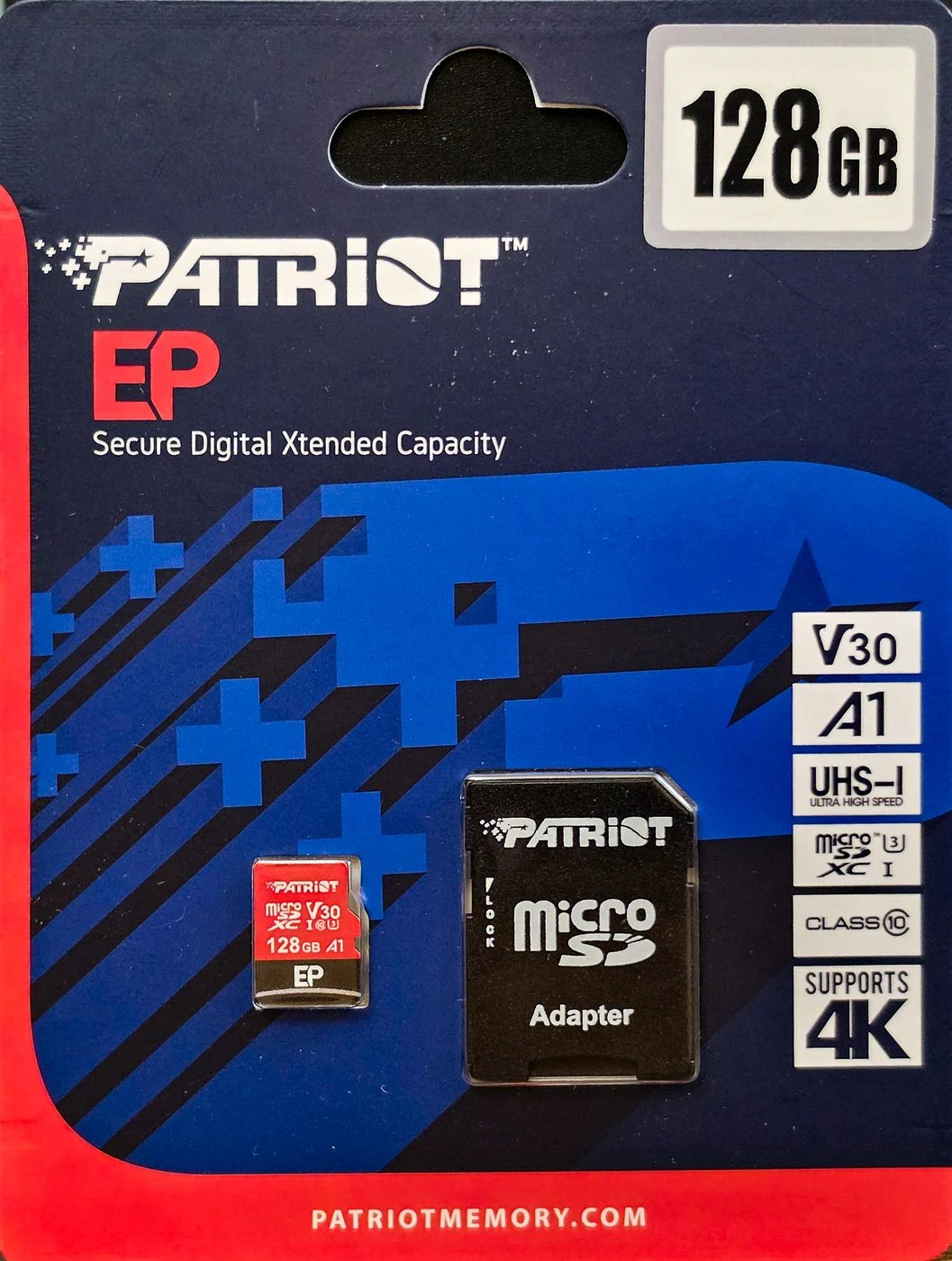
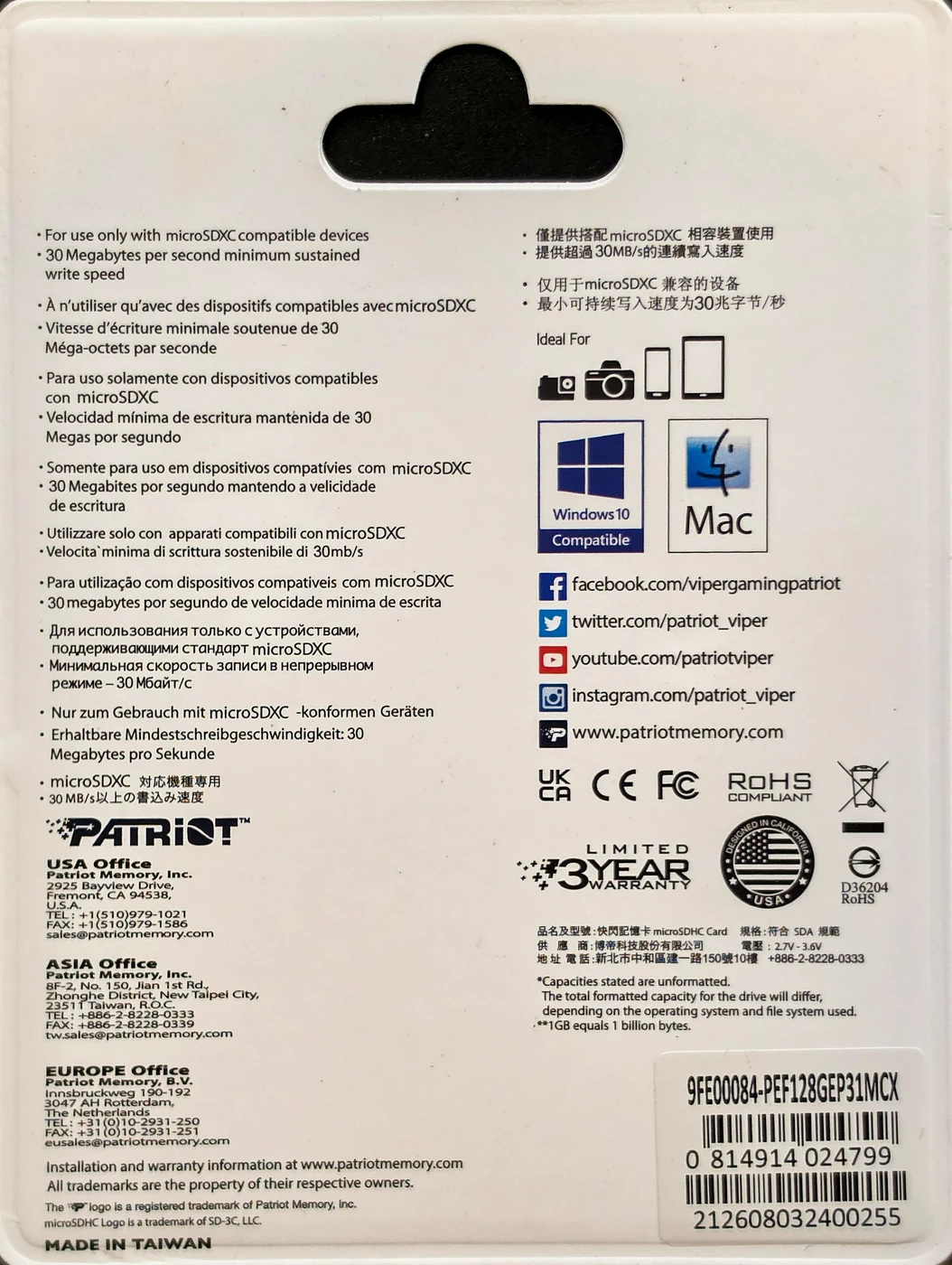
The EP comes sealed in a retail blister with a full-size SD adapter. The front carries every mark, V30, A1, UHS-I, U3 and Class 10, plus “Supports 4K”, and no speed. The back has the line this review turns on, 30 Megabytes per second minimum sustained write speed, in English, French, Spanish, Portuguese, Italian, Russian, German, Japanese and two forms of Chinese; the Portuguese version says megabits, a translation slip. It also carries a limited three-year warranty badge, Windows 10 and Mac badges, the footnote that capacities are unformatted and that 1 GB equals a billion bytes, and Patriot’s sticker with the part number and UPC. The Taiwanese compliance label calls it a microSDHC card, boilerplate from an older package; it is microSDXC. There was no returns sticker on any panel.
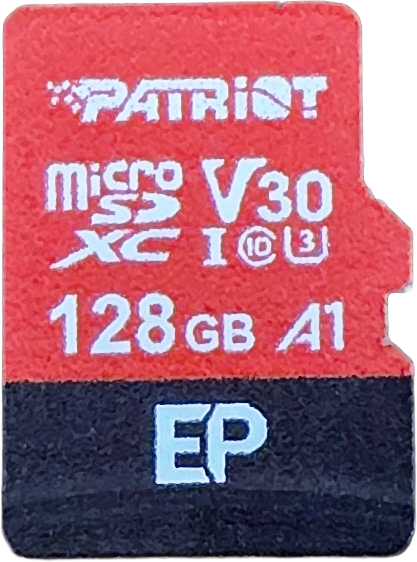
The card arrived empty and formatted exFAT with 128 KB clusters and no volume label, a clean factory layout. Its volume serial number, which an ordinary format fills with a value derived from the clock, read 0E16-2000. That is no accident: written as one number, 0E162000 is the length of the card’s partition in sectors, so whatever formatted it at the factory used the partition size as the serial. Hold that thought, because one other card on my bench arrived with a serial built the same way.
Five minutes at 22.7 MB/s, under the V30 floor
The timed write starts after an untimed warm-up that runs until the speed stops changing, so the five minutes that decide the video class start on a settled card. On this card the warm-up began at 8 to 12 MB/s for its first eight seconds, the card still cleaning up after the random-write test, then sat at 22 to 23 and settled at 90 seconds. The trace below is the scored run, one sample a second, with the speed-class floors marked. The first thirty seconds averaged 22.65 MB/s and the last thirty 22.75, the whole five minutes 22.74, and the worst ten seconds were 22.54 MB/s. The longest single write took 112 milliseconds; the bench flags anything over half a second. On the second reader, twice, the same five minutes ran at 22.68 steady with worst ten seconds of 22.44.
Patriot EP 128GB
22.54 is 7.46 MB/s under the V30 floor, 75% of it, and U3 carries the same 30 MB/s floor, so both marks fail; V10 holds with more than twice its floor in hand. There is nothing dramatic in the trace to blame: no dips, no stall, no cliff, just a card whose own write speed is 22.7 MB/s. In the CKBench table, only three no-brand fakes hold a lower floor. For context, the SUNEAST Ultimate Pro lost V30 only after it had been filled, at 27.4; this card never had it.
At least 4.4 GB at 91 MB/s when new, about 1 GB after its first full card
The fast writes are real, for a while. Like many budget cards, this one writes new data into a fast area first and moves it into slower flash afterwards. On a new card, every write before the random-write test ran at 88 to 91 MB/s: a 64 MB check, a 1 GiB preparation file and three 1 GiB passes, 4.36 GB in all. The fast stage never ran out inside that, so how far beyond 4.36 GB it would have gone, I cannot tell you; the suite pauses there. By the time the timed write began, the random test and the warm-up had used it up.
tools/burst-scan.py does in the Card Check repo. Runs Patriot-EP-128GB_2026-10-16_164329, _2026-10-17_140451 and _2026-10-21_164144; SP-Superior-Pro-128GB_2026-09-27_102455 and _120225.Then I filled the card once, end to end, and emptied it. On the next run, the 1 GiB preparation file took 17.1 seconds, which means about 1 GB of it went at 90 MB/s and the rest at 22.8, and all three 1 GiB passes after it ran at 22.8. The card had sat idle for 19 hours first, so it was not still busy. A card reader cannot tell a card which space is free again, and that is the usual explanation for a card that slows down after a fill; I wrote it up in why a used microSD card tests slower. So I sent the strongest reset my bench can: from a Raspberry Pi’s native SD slot, a discard of all 121 GB, the command that tells a card every block is free, then a fresh format. The next run took about 1.1 GB fast and wrote 22.8 again. I cannot tell from outside whether the card ignored the discard or whether freeing the space simply does not bring its fast stage back; either way, for a buyer, the 4 GB burst belongs to a new card only.
That is also the honest reading of Patriot’s 80 MB/s write figure. On a new card it held at 114%; after one full card, the same test ran at 22.8, 28.5% of it. Its register twin, the Silicon Power Superior Pro, keeps its fast stage after a fill: at least 4.36 GB both times, and 4.8 and 4.7 GB more after its random test. The SUNEAST Ultimate Pro loses most of its much larger one.
121.0 GB, every byte verified, and only 94.55% of the label
The capacity test wrote 113 files of unpredictable, dedup-proof data until the card was full, 120,984,043,520 bytes, then read every one of them back and compared. Zero mismatched bytes. Zero read errors. At this card’s write speed the fill took 89 minutes 29 seconds; the read-back took 21 minutes 27 seconds at 98.3 MB/s. Across the first, middle and last tenth of the card the write ran at 24.4, 22.6 and 22.6 MB/s, the first tenth lifted by a short fast stage at the start, and the read at 94.2, 94.2 and 94.1.
Every byte, written and read back
The fill is the clearest picture of this card. After a pause before it began, the card wrote about 1.2 GB at 87 MB/s, then dropped to 22.6 and stayed there for the rest of the card: 99.7% of the fill’s seconds ran under 30 MB/s, and its worst ten seconds were 20.76. The Silicon Power Superior Pro, filled on the same reader, spent one second of its 3,130 under 30, and its worst ten seconds there were 36.6.
Patriot-EP-128GB_2026-10-16_164329 and SP-Superior-Pro-128GB_2026-09-27_102455. Both cards verified every byte.Every byte it declares is real. What it declares is the smaller story: 121,018,253,312 bytes, 94.55% of the 128 GB on its label, about 7 GB short of it. Every other genuine card I have tested declares between 96.7% and 100.1% of its label; the box’s footnotes, that capacities are unformatted and a gigabyte is a billion bytes, do not cover a gap this size. Windows will show the card as about 112.7 GB, because it counts in binary; that part is arithmetic, and the methodology page has the conversion. The capacity row of the rubric scores the declared share of the label, and 94.55% is a 3.
The Silicon Power Superior Pro’s registers, under a blank name
Every SD card carries a set of registers, written at the factory, that a USB reader cannot show you and a native SD host can. One names the card: manufacturer ID, OEM ID, product name, revision, serial and build date. The others describe it: how big it is, which SD specification it follows, which speed classes it declares. I read this card’s on a Raspberry Pi before its first run. Its naming fields are nearly empty, and its describing fields match a card I reviewed in September, the Silicon Power Superior Pro 128GB, almost byte for byte.
| Field | Patriot EP 128GB | Silicon Power Superior Pro 128GB | Match |
|---|---|---|---|
| Manufacturer ID / OEM ID | 0x00 / 0x0000, both blank | 0x9F / “TI” | DIFFERENT |
| Product name / revision | Viper / 0.0 | SPCC / 0.7 | DIFFERENT |
| Build date | June 2026 | July 2025 | PER UNIT |
| Size register (CSD) | Every byte the same except the capacity field | SAME BUT SIZE | |
| SD specification (SCR) | 6.x on both, the same in every field but one security setting, including four bytes the maker fills, which read “3309” on both | SAME BUT ONE | |
| Declared classes (SD Status) | C10, U3, V30 and A1 | C10, U3, V30 and A2 | SAME BUT THE APP CLASS |
| A reserved field in the identity register | 7 on both, and 0, 2 or 10 on every other card I have read | SAME | |
| Declared capacity (CSD) | 121,018,253,312 bytes (94.55%) | 124,415,639,552 bytes (97.20%) | DIFFERENT |
| Factory volume serial | 0E16-2000 | 0E7B-6000 | SAME RULE |
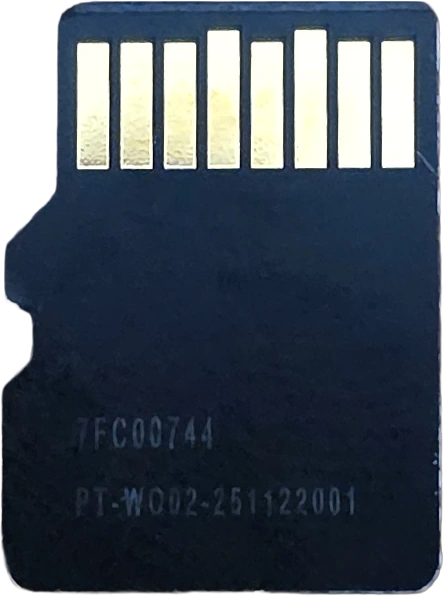
The manufacturer and OEM IDs are blank, so the card does not say who built it; Patriot’s own ID in the public lists is not used. The product name, Viper, is Patriot’s gaming brand. Everything else lines up with the Superior Pro, down to a reserved field no other card on my bench sets to 7 and to the factory serials, which on both cards are the partition’s length in sectors (0x0E7B6000 is the Superior Pro’s). That points to the same controller family set up for two brands, the app class matching each brand’s print. It does not tell you whose flash is inside, and my manufacturer ID register has more on what these fields can and cannot prove. The laser marks on the card back read like a work order with a date in it, 22 November 2025, seven months before the register’s build date, so I would not read anything into them.
Then I ran them on the same reader. The Superior Pro writes about 39 MB/s after its fast stage and holds V30 with a quarter in hand; the Patriot writes 22.7, 58% of that, and holds V10. The Superior Pro keeps its fast stage after a fill; the Patriot loses most of it. Same register platform, a slower card: it is the second time this autumn that matching registers have hidden a different card, after the LinkMore XV23 Lite and the SUNEAST.
One random-write pass fell to 0.72 MB/s
Loop recording is a long write interrupted constantly by small ones, and random 4K writes are the bench version of that: three twenty-second passes, and the question is whether any later pass falls below the first. On this card one did, hard. The scored run did 1,125, 176 and 1,151 write IOPS, 4.61, 0.72 and 4.71 MB/s: the middle pass fell to 16% of the first, and the third recovered.
One minute of loop-recording abuse
This card: run Patriot-EP-128GB_2026-10-16_164329 · reference card: lab baseline, same bench, same test · cardcheck v0.8.5
It was not a one-off. On the second reader the third pass fell instead, to 2.61 MB/s, 54% of the first, and after the discard and format the third pass fell to 3.71, 76% of the first. Afterwards the card was back to 90% of its sustained rate 17 seconds into continuous writing, after starting the warm-up at 8 to 12 MB/s.
This card changed how the rubric reads the test. Until protocol v1.28 the endurance row compared the first pass with the third, which on this run reads as no fade at all, since the third pass was the fastest of the three; the deepest drop on the scored run fell in the one pass the old rule did not look at. Since 21 October 2026 the row compares the first pass with the slowest pass after it, and on this card that is 84.38%, the bottom row of the table. A pass that falls to a sixth of the first is exactly the stall a loop recorder runs into, and a rule that cannot see it is the wrong rule.
135 °F at most, and no throttling
Patriot rates the card for -25 to 85 °C, on its product page and spec sheet rather than the box. At the end of five minutes of uncooled writing in a 76 °F room the card read 134 °F on the scored run and 135 °F on both runs on the second reader. The rubric takes the highest reading on file: 135 °F is 57.2 °C, 27.8 °C under Patriot’s maximum, which scores a 5.
It got warm. It did not slow down.
Run Patriot-EP-128GB_2026-10-16_164329 · cardcheck v0.8.5 · ProGrade PGM0.5
It did not throttle: the last thirty seconds of the timed write ran at 22.75 MB/s against 22.65 for the first thirty. Heat follows work, and this card does little of it; the LinkMore XV23 Lite, writing at more than three times the rate on the same reader, reached 153.5 °F. With 27.8 °C of margin, heat is the one thing on this card that is not a concern.
Three runs, two readers, one floor
Every card I review runs on my primary reader, a ProGrade PGM0.5, and again on a SanDisk QuickFlow SDDR-B751. This card ran once on the ProGrade, with its whole-card fill, and twice on the QuickFlow: once after the fill, and once after the discard and the format.
| Measurement | ProGrade, run 1 | QuickFlow, run 2 | QuickFlow, run 3 |
|---|---|---|---|
| Card at the start of the run | sealed, first writes | after one write of the whole card | after a Pi discard and a format |
| Sequential read | 97.2 MB/s | 97.3 MB/s | 96.4 MB/s |
| Sequential write, committed | 91.2 MB/s | 22.8 MB/s | 22.8 MB/s |
| Fast stage before the drop | at least 4.36 GB | about 0.98 GB | about 1.14 GB |
| Sustained write, steady state | 22.74 MB/s | 22.68 MB/s | 22.68 MB/s |
| Sustained write, worst ten seconds | 22.54 MB/s | 22.44 MB/s | 22.44 MB/s |
| Random 4K read / write | 2,059 / 817 IOPS | 2,373 / 1,013 IOPS | 2,403 / 1,109 IOPS |
| Random write passes | 1,125 / 176 / 1,151 IOPS | 1,188 / 1,214 / 637 IOPS | 1,199 / 1,223 / 905 IOPS |
| Peak temperature | 134 °F | 135 °F | 135 °F |
| Blocks over 500 ms | 0 | 0 | 0 |
The floor does not move: 22.54 and 22.44 MB/s, new and used, on either reader, within half a percent. What moves is the fast stage, and that follows the card’s history, not the reader, since the Superior Pro kept its fast stage on the same QuickFlow. Random reads always run higher on the QuickFlow, which is normal on this bench.
How the 2.5 breaks down
Patriot EP microSDXC 128GB
Scored against the CKBench rubric. Five dimensions, each out of 5, every row read off its published table.
Final score: 2.5 out of 5. The five dimensions average 2.5. A genuine card that holds every byte it declares, held back by a write floor under the V30 and U3 marks on its own box, a fast stage that does not survive its first full card, a random-write pass that collapsed, and a declared capacity 5.45% short of its label.
Under the rubric as it stood before 21 October, the endurance row would have read 5 and the overall 3.5. I changed the rule because of this card, and the change moved two other published cards’ endurance rows by half a point with no change to their overall scores.
Frequently Asked Questions
Is the Patriot EP 128GB a good microSD card?
It is a genuine card with a weak write. It held every byte of its 121.0 GB volume and read 97.2 MB/s, but after a fast stage of at least 4.4 GB it writes at about 22.7 MB/s, and its worst ten seconds were 22.54, short of the 30 MB/s minimum that the V30 and U3 marks on its box promise. It scores 2.5 out of 5.
Is the Patriot EP V30?
It prints V30, and its box says 30 megabytes per second minimum sustained write, but on my bench it held only V10. Its worst ten seconds of continuous writing were 22.54 MB/s on a ProGrade reader and 22.44 on a SanDisk QuickFlow, new and after being filled, and 20.76 across a write of the whole card.
Is the Patriot EP good for a dash cam?
For most dash cams, yes. A 4K dash cam writes about 6 MB/s and a 1080p one about 3, and this card held 22.5 MB/s through its worst ten seconds across the whole card, with no stalls over half a second. It is not a card for a camera mode that needs V30, which means roughly anything recording above 180 megabits a second.
Why does the Patriot EP slow down after a few gigabytes?
It writes into a fast area first, at about 91 MB/s, and once that is used up it writes at its own rate, about 22.7 MB/s. On a new card the fast stage lasted at least 4.4 GB; after the card had been filled once it was about 1 GB, and it stayed that size after 19 hours idle, a discard from a native SD host and a fresh format.
Does formatting the Patriot EP restore its speed?
Not on my unit. After one write of the whole card, a discard of the whole card from a Raspberry Pi’s native SD slot followed by a format left the fast stage at about 1.1 GB, against at least 4.4 GB new. Its sustained speed, 22.4 to 22.5 MB/s through the worst ten seconds, did not change in any state.
Is the Patriot EP really 128GB?
It holds every byte it declares: I filled 120,984,043,520 bytes with unpredictable data and read them all back with zero errors. But it declares 121,018,253,312 bytes, 94.55% of the 128 GB on its label, the lowest share of any genuine card I have tested; the others declare between 96.7% and 100.1%. Windows shows it as about 112.7 GB.
Who makes the Patriot EP microSD card?
Patriot Memory of Fremont, California sells it, and the box says made in Taiwan. The card’s manufacturer ID is blank, so it does not say who built it, and its product name is Viper, Patriot’s gaming brand. Its other registers match the Silicon Power Superior Pro 128GB almost byte for byte, which points to the same controller family rather than the same card: the Superior Pro writes about 39 MB/s and keeps its fast stage after a fill.
Is the Patriot EP good for a phone?
For storing photos, music and video, yes: it reads at 97.2 MB/s and cleared the A1 floors at queue depth one, 2,059 random reads and 817 random writes a second on my primary reader. One of its three random-write passes fell to 176 IOPS before recovering, a sign it can stall under heavy small writes, so it is a weaker choice for running apps from the card.
The bottom line
The Patriot EP 128GB holds every byte it declares, and almost everything else on its box overstates it. The V30 and U3 marks, and the 30 MB/s minimum sustained write the box spells out, are missed by a quarter on two readers and in every state I could put it in. Patriot’s 80 MB/s write figure holds only for a new card’s first few gigabytes, and the space it declares is 94.55% of the label. For a dash cam at ordinary bitrates, or for photos and music on a phone, it works. For anything that needs the marks it prints, it does not, and the Silicon Power Superior Pro, on the same register platform, holds V30.
It is also the second card this autumn whose fast stage did not survive its first full card, and the first where I could send the card a discard from a native host to try to bring it back. It did not come back. If a card’s headline speed is a cache, the size of that cache after a fill is worth knowing before you buy it, and the box will not tell you.
Sample size: one unit, purchased sealed at retail from Amazon. Three runs on two readers on 16, 17 and 21 October 2026, scored under CKBench protocol v1.28.
Device identity: what this card reports about itselfFor anyone checking their own card or tracking silent hardware revisions
| Raw CID register | 000000566970657200…71a600 (serial digits elided) |
| Manufacturer ID (MID) | 0x00, blank: no manufacturer named |
| OEM / application ID (OID) | 0x0000, blank |
| Product name (PNM) | Viper, Patriot’s gaming brand |
| Product revision (PRV) | 0.0 |
| Serial number (PSN) | 0x2E8E… (per unit, truncated) |
| Manufacture date (MDT) | 06/2026 |
| Declared capacity (from CSD) | 236,363,776 sectors of 512 bytes = 121,018,253,312 bytes, 94.55% of the label |
| SD specification (from SCR) | SD_SPEC 2 with SD_SPEC3 = 1, SD_SPEC4 = 1 and SD_SPECX = 2 (specification 6.x), so the UHS-I, U3 and V30 marks are legitimately declared; the bench says whether they are delivered |
| Declared classes (from SD Status) | Class 10, U3, V30 and A1, exactly the marks it prints; discard supported |
| Card back | A single row of eight contacts; 7FC00744 above PT-WO02-251122001 (the character after the W reads as O or 0) |
| Factory format | exFAT, 128 KB clusters, no volume label, no user files present |
| Captured on | Raspberry Pi 4 native SD host, no USB bridge in the path · 2026-10-16 |
The MID, OEM ID, product name and revision are model-level, and on this card the first two are blank, so a match on them proves little; the rest of the registers match the Silicon Power Superior Pro 128GB but for its capacity, app class and one security field. The serial and the manufacture date are per unit. The laser marks on the card back include what reads like a date, 22 November 2025, which the register’s June 2026 build date does not confirm.
Disclosure: I bought this card at retail from Amazon. Patriot Memory had no involvement in or knowledge of this review, saw no result before publication, and had no opportunity to influence any number on this page. This post contains affiliate links. As an Amazon Associate I earn from qualifying purchases, at no extra cost to you. Affiliate links like these and my YouTube channel are what keep the site running.