Skip to content
CKBench: claims, tested

Lab-tested storage, starting with memory cards

CKBench is the bench we built because the numbers on the package answer almost none of the questions that matter. Every test byte is committed to the device and confirmed, every byte is read back and checked, and the result gets published whether it flatters the product or not. Its first module is CardCheck, for memory cards, and a microSD is a good place to start: it is the cheapest component in your dash cam and the one most likely to quietly ruin it.

CardCheck · the corpus

Memory cards: every one we have tested

Same bench, same reader, same suite, with one exception the table states outright: a microSD Express card carries PCIe on its second row of pins and cannot reach that bus through any ordinary reader, so it was run on both and appears twice, once per bus. Every other row shares one measurement chain. Write speed is committed sequential, which reads lower than burst benchmarks because every byte had to land before the clock stopped. Capacity is what the card actually delivered against the number on its label, verified byte by byte.

CardCommitted writeSustained floorCapacity deliveredPeak tempScore
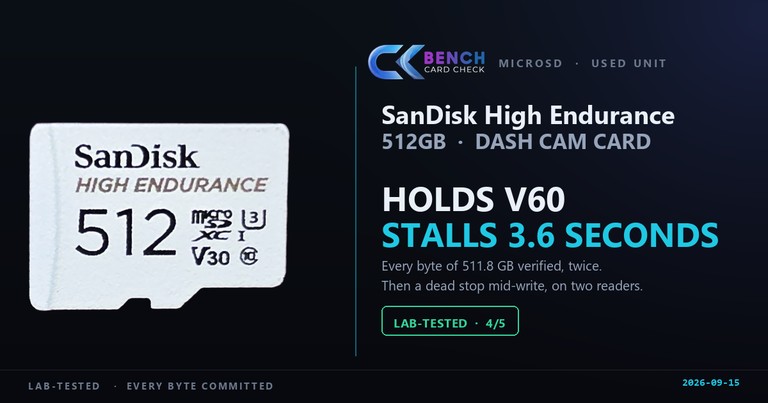
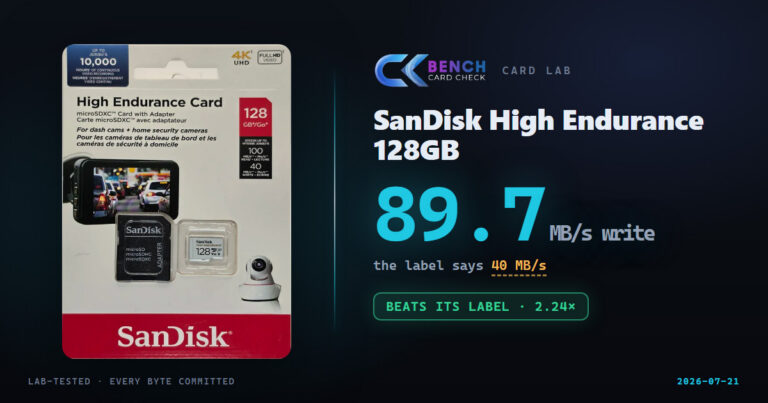
SanDisk High Endurance 128GB 89.7 MB/s 88.0 MB/s, V60 100.0% of label 151.4 F 5/5
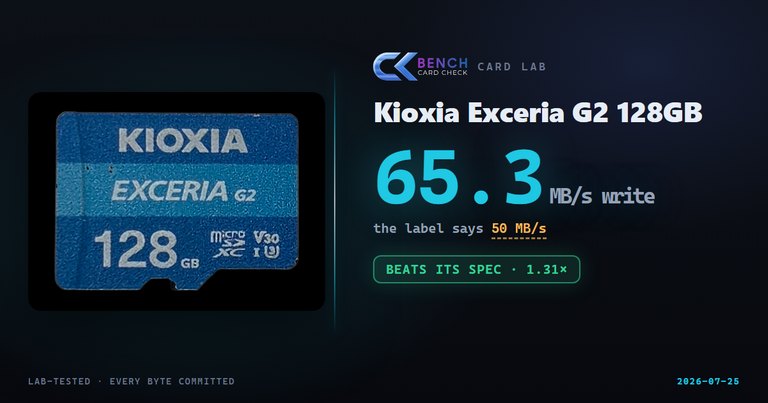
Kioxia Exceria G2 128GB 65.3 MB/s 62.6 MB/s, V60 96.7% of label 143.3 F 4.5/5
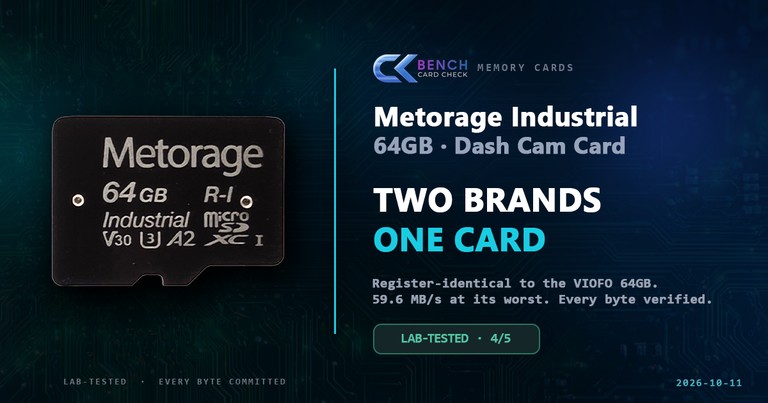
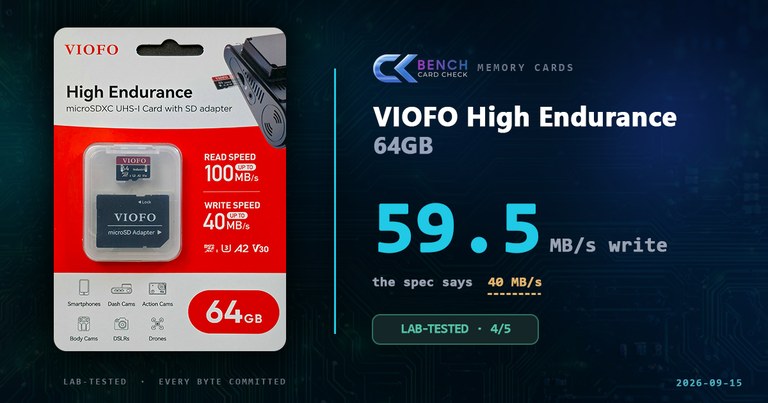
VIOFO High Endurance 128GB 57.0 MB/s 55.8 MB/s, V30 97.4% of label 160.8 F 3/5
VIOFO High Endurance 32GB 35.2 MB/s 14.9 MB/s, V10 99.1% of label 152.9 F 3/5
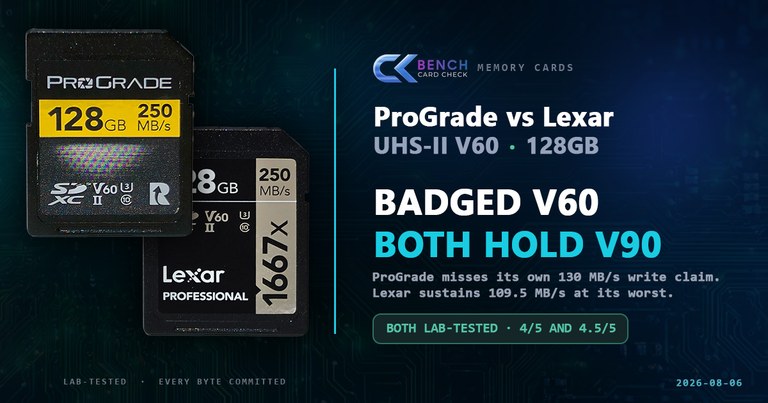
ProGrade SDXC UHS-II V60 128GB 108.4 MB/s 102.8 MB/s, V90 100.1% of label 145.1 F 4/5
Lexar Professional 1667x 128GB 119.3 MB/s 109.5 MB/s, V90 100.0% of label 142.7 F 4.5/5
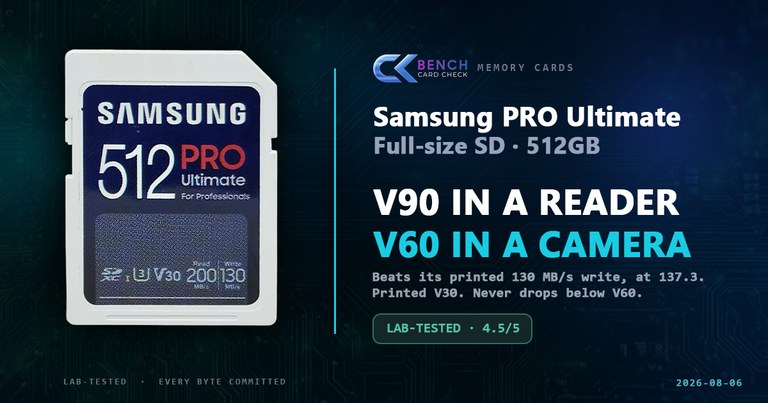
Samsung PRO Ultimate SD 512GB 137.3 MB/s 133.1 MB/s, V90 on this reader
V60 in a camera
100.1% of label 144.4 F 4.5/5
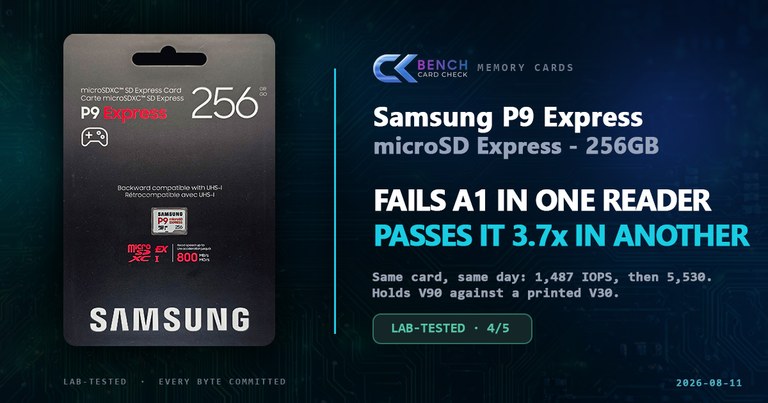
Samsung P9 Express 256GB (SD Express) 212.9 MB/s 161.3 MB/s, V90 100.1% of label 194.8 F 4/5
Samsung P9 Express 256GB (UHS-I fallback) 87.7 MB/s 87.0 MB/s, V60 100.1% of label 140.9 F 4/5
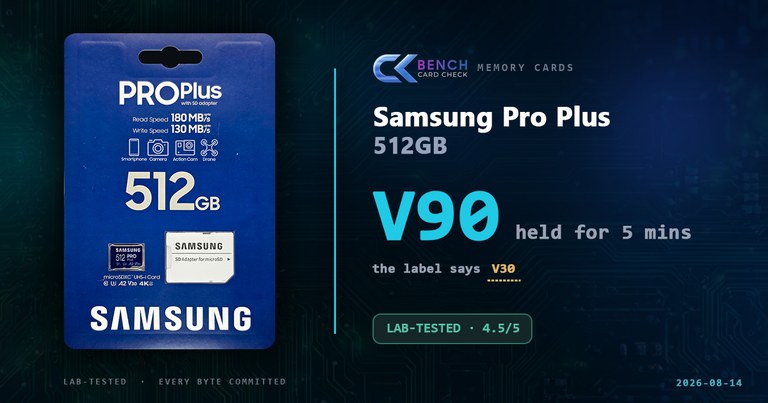
Samsung PRO Plus 512GB 142.2 MB/s 141.6 MB/s, V90 100.1% of label 169.6 F 4.5/5
Botslab 128GB (bundled) 59.0 MB/s 53.9 MB/s, V30 97.4% of label 135 F 3/5
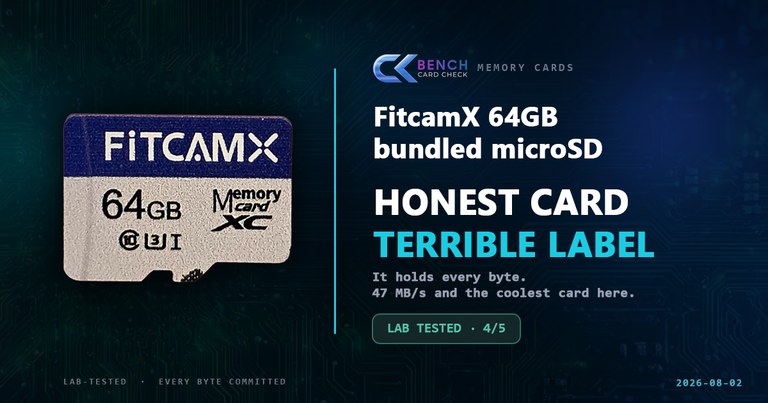
FitcamX 64GB (bundled) 47.1 MB/s 43.8 MB/s, V30 97.3% of label 131 F 4/5
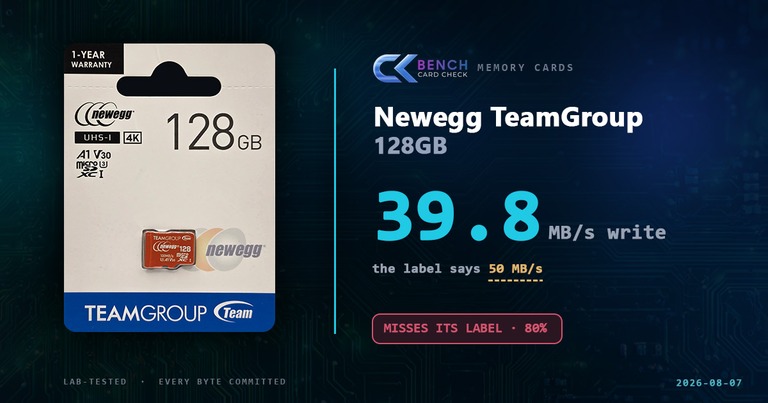
Newegg TeamGroup 128GB 39.8 MB/s 35.5 MB/s, V30 96.7% of label 133 F 2.5/5
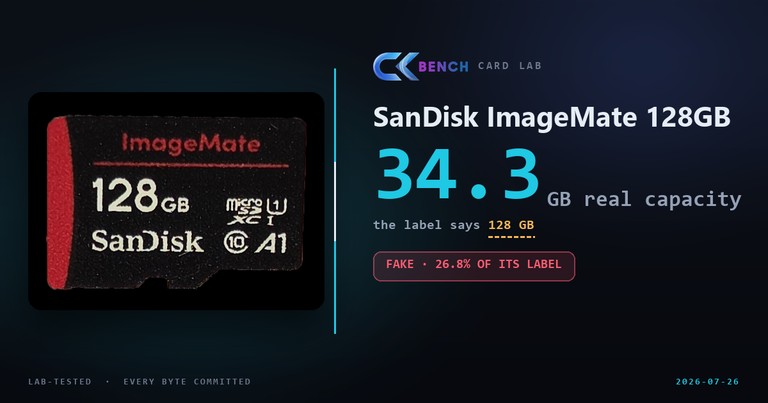
SanDisk ImageMate 128GB 33.2 MB/s 31.8 MB/s, V30 26.8% of label 150.1 F 1/5

The VIOFO 32GB's sustained floor is duty-dependent and is shown here on the same measurement every other card gets. Under pure video recording it holds 34.2 MB/s and its V30 rating; the 14.9 figure is what it does for about 75 seconds after a burst of random small writes. The review explains which number applies to you.

What the table shows

Six patterns across thirteen cards

Thirteen cards, one measurement chain. Read down the columns and the same shapes keep coming back, and not one of them is visible from a single review.

1 of 13

was not the size on its label. The SanDisk ImageMate holds 34.3 GB behind a 128 GB label while passing Class 10, U3, A1 and V30. Every other card delivered between 96.7% and 100.1%.

6 of 10

cards that print a video speed class sustain a higher one, every one of them by at least a full class. The PRO Ultimate and the P9 Express beat theirs by two, holding V90 against a printed V30. Only the VIOFO 32GB falls below its mark, and only for about 75 seconds after random writes.

3 of 8

cards that print a write speed miss it: the VIOFO 128GB by 29%, the Newegg TeamGroup by 20%, the ProGrade by 17%. It runs the other way too. The SanDisk High Endurance commits at 89.7 MB/s against a printed 40.

3 of 13

never write at one steady speed. The Botslab cycles between 34 and 82 MB/s every 9.5 seconds, the TeamGroup between 5 and 83 every 2.7, and the FitcamX runs a 2.13 second rhythm that makes an honest card look broken. Neither of the two that print a V30 ever drops below it.

2 of 13

change what they are depending on the reader. The P9 Express carries PCIe on its second row of pins: 89.7 MB/s read on an ordinary reader, 596.7 on an Express one. The PRO Ultimate holds V90 on a reader that speaks Samsung's fast mode, V60 on the plain bus a camera gives it.

1 name

covers two different cards. The VIOFO High Endurance 32GB and 128GB share a brand, a package and a product line, and their identity registers name two different manufacturers seventeen months apart.

The reviews

Read the full autopsies

Samsung P9 Express 256GB microSD Express review, a card that fails the A1 mark on its own face in one reader and beats it more than three times over in another
Scored 4/5

Samsung P9 Express 256GB

The first microSD Express card on the bench, and the first tested twice on one day because it has two personalities. Its second row of pins carries PCIe, not a faster SD bus, so the reader decides what the card is: 89.7 MB/s read on an ordinary one, 596.7 on an Express one. It wrote all 256 GB with no cache cliff anywhere, holds V90 against a printed V30, and runs hotter than anything else here at 194.8 F. It never reached the 800 MB/s on its box. And it fails its own printed A1 rating in one reader while clearing it 3.7 times over in the other.

Read the deep dive
Newegg TeamGroup 128GB microSD review, 39.8 MB/s committed write against a printed claim of 50 MB/s
Scored 2.5/5

Newegg TeamGroup 128GB

The cheap card that turned out to be completely real, and completely slow. Every byte of its capacity is there and verified, and it holds every class mark it prints, but it misses its printed 50 MB/s write by 20% and posts the lowest sustained floor of any genuine card here. Its write speed also swings from 5 to 83 MB/s on a 2.7 second cycle, and its identity registers are byte for byte identical to the no-name cards bundled with dash cams.

Read the deep dive
Samsung PRO Ultimate 512GB full-size SD review, a UHS-I card whose video speed class changes with the reader you put it in
Scored 4.5/5

Samsung PRO Ultimate SD 512GB

The first 512GB card on the bench, and the first whose printed speed the standard interface cannot reach at all. It beat the 130 MB/s write on its own face, handed over 100.13% of half a terabyte with zero mismatched bytes, and faded 0.25% under scattered writes, the steadiest result here. Its video class, though, depends on what you plug it into: V90 on a reader that speaks Samsung's fast mode, V60 on the plain bus a camera gives it.

Read the deep dive
ProGrade SDXC UHS-II V60 and Lexar Professional 1667x review, two full-size UHS-II cards badged V60 that both sustain V90
Scored 4/5 and 4.5/5

ProGrade V60 + Lexar 1667x 128GB

The first full-size SD cards on the bench, and the first UHS-II. Two cards that agree on every number a shopper can read: 128GB, UHS-II, V60, 250 MB/s. Both turned out to be badged a full video class below what they deliver, sustaining V90 with no cache cliff anywhere in a complete fill. They part company on honesty: Lexar claims 120 MB/s writes and delivers it, ProGrade claims 130 and manages 108.

Read the deep dive
FitcamX 64GB bundled microSD review, an honest card behind a look-alike SD logo, writing 96 MiB every 2.13 seconds
Scored 4/5

FitcamX 64GB (bundled)

The card in the FitcamX box wears a look-alike SD logo where the licensed one belongs, and then holds every byte of its 64GB anyway. Its speed graph appears to fall apart twice a second, which turned out to be a 2.13 second rhythm inside the card interfering with the one-second sampling interval rather than anything wrong with the card. It also runs cooler than anything else here.

Read the deep dive
Botslab 128GB bundled microSD review, write speed cycling between 34 and 82 MB/s every nine and a half seconds
Scored 3/5

Botslab 128GB (bundled)

The card taped inside a dash cam box, and the strangest write curve on this bench. It cycles between 34 and 82 MB/s every nine and a half seconds, for as long as you care to watch, and still never drops below the V30 floor it prints. It also runs cooler than any other 128GB card here, and prints no speed number at all.

Read the deep dive
VIOFO High Endurance 32GB and 128GB review, two cards sold under one name that came from two different manufacturers
Scored 3/5 each

VIOFO High Endurance 32GB + 128GB

The first pair we tested as a matched set, and they turned out to be two unrelated cards wearing one name. Their identity registers name two different manufacturers, seventeen months apart. The 128GB reaches 70% of its printed write speed while holding its V30 without flinching; the 32GB beats its printed speed and then loses its V30 for a minute after any random-write activity.

Read the deep dive
SanDisk High Endurance 128GB review, measured 89.7 MB/s committed write against a 40 MB/s claim
Scored 5/5

SanDisk High Endurance 128GB

The card that under-sells itself. It committed writes at 89.7 MB/s against a printed 40, held V60 against a printed V30, delivered all 128.0 GB with zero mismatched bytes, and lost only 2.1% of its random-write speed under the churn that collapsed our reference card by 71%.

Read the deep dive
Kioxia Exceria G2 128GB review, measured 65.3 MB/s committed write against a 50 MB/s spec
Scored 4.5/5

Kioxia Exceria G2 128GB

The card that came with your dash cam, and the standard advice to bin it is wrong. It beat its published write spec by 31% and did not fade at all under loop-recording churn. Its one real fault is capacity: you get 123.7 GB of the 128 on the front, and only a spec sheet tells you.

Read the deep dive
Counterfeit SanDisk ImageMate 128GB, measured 34.3 GB real capacity against a 128 GB label
Scored 1/5

SanDisk ImageMate 128GB

A counterfeit, and the most interesting one we have seen: it holds 34.3 GB against a 128 GB label while passing Class 10, U3, A1 and V30. Fast flash, fraudulent number. It is the proof that you cannot catch a fake card by benchmarking it.

Read the autopsy
Samsung PRO Plus 512GB microSD review, a card printed V30 that holds V90 and beats its own 130 MB/s write claim
Scored 4.5/5

Samsung PRO Plus 512GB

The fastest sustained writer on this bench that is not on a PCIe bus, and it beat several UHS-II cards costing more. It exceeds its own printed 130 MB/s write at 142.15, holds its speed flat across all 512 GB with no cache cliff anywhere, and delivers 100.13% of its label with zero mismatched bytes. The V30 stamped on its face undersells it by three whole tiers. Two marks come off: the 180 MB/s read claim sits above what this bench can adjudicate, and at 169.6 F it is the hottest conventional card here, though it never throttled. A second unit from the same batch landed within 1.4% on every figure.

Read the deep dive
Beyond cards

The bench tests its own gear too

CKBench is not only for review samples. Before a piece of storage earns a job on this bench, it gets the same suite as everything else, and the first one through was a USB flash drive about to become the boot device for our card-identity rig. It is not a memory card, so it is scored on its own terms and stays out of the card table above. It also produced the strangest finding on this page: a drive whose read speed depends on how the data on it was written.

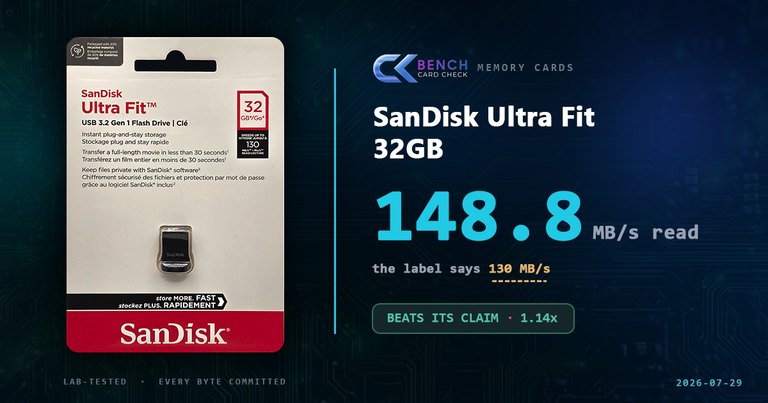
SanDisk Ultra Fit 32GB tested, measured 148.8 MB/s read against a 130 MB/s claim
Scored 4/5 as a flash drive

SanDisk Ultra Fit 32GB

The thumb drive that beat its only printed number and hid everything else. 148.8 MB/s read against a claimed 130, full capacity verified with zero bad bytes, and a thermal camera that cleared the heat of all charges: the slowdown turned out to be written into the data itself.

Read the bench notes
Start here

What buyers actually ask

Should I replace the card that came with my dash cam? Probably not. The bundled Kioxia we tested beat its own spec and handled loop recording without flinching. Here is the full run.

How do I tell if my card is fake? Not with a benchmark. Check the reported size first, then fill the whole card with verifiable data and read it all back. The counterfeit we tested passes every speed test there is.

Why does my 128GB card only show 119 GB? That is normal. Your computer counts in binary, so 128,000,000,000 bytes displays as about 119 GB. Nothing was taken. A real shortfall looks very different, and the Kioxia review explains where the missing gigabytes on that card actually went.

Do I need a special card for a Nintendo Switch 2? Yes, it needs microSD Express, and the marking to look for is EX. An ordinary microSD will not run games on it, and a UHS-II card will not either: both rows of pins look alike but carry different signals. We tested one on two readers to show what the format actually delivers.

How much footage fits on a card? Work it out for your own camera's bitrate in the dash cam storage calculator.

Do you only test memory cards? No. Anything storage can go on the bench, and the gear we rely on ourselves goes on first. The SanDisk Ultra Fit 32GB got the full suite before we trusted it to boot our card-identity rig.

The method

How these numbers are produced

Every figure on this page comes from one results file per card, written by a bench built for this: writes are committed and confirmed before the timer stops, a cache-leak canary aborts the run if the operating system serves a cached read, and every test byte is seeded so it can be verified on the way back. Cards are scored on five dimensions against the job they are sold for, and a card that misrepresents its capacity is capped at 1 out of 5 no matter how fast it is.

The full method, the rubric, the unit conventions and an honest list of what we deliberately do not test are all on one page. Alongside it sits the reference we built while identifying these cards: every SD manufacturer ID we have decoded, and an honest account of what that number can and cannot prove.

How we test and score memory cards

The bench, the five-dimension rubric, the conventions, and the gaps we will not paper over.

Read the method

SD card manufacturer IDs, decoded

Look up the CID register your own card reports, and see why a matching manufacturer ID does not make a card genuine.

Read the register