
SanDisk Extreme 512GB Review: It Beats Its Read Claim, and Writes Small Files Slowest in Its Class
It beats every number printed on its box, holds V90 against a printed V30, and gives back 511.8 GB of a 512 GB label without a single bad byte. It also writes small files slower than every other premium 512 GB card here, and it runs hotter than any of them.
Prefer to watch a review?
No video for this lab run yet, but I cover dashcams, storage, and the gear around them on the channel. Subscribe to catch the next test the moment it goes live.
Updated 29 August 2026: the read claim is settled, and the original review was measuring my reader. This card first published with NOT SETTLED ON THIS HARDWARE against its printed 190 MB/s read, because it returned a flat 180.5 MB/s no matter what I asked of it and I could not tell whether that ceiling belonged to the card or to the reader. A second host answered it. On a SanDisk QuickFlow the same card reads 193.3 MB/s, which is 101.7% of the claim, and the 180.5 was the ProGrade PGM0.5’s own microSD limit. The claim row below now reads BEATEN, the claim-accuracy score moves from 4 to 5, and the final score stays 4.5 because the other four dimensions are unchanged. Every write, sustained, capacity and thermal figure in this review is untouched: the same two-host pair moves sequential write by 1.04% and the sustained floor by 0.25%. The full four-host comparison is in which SD card reader should you buy.
The short version
The box promises 190 MB/s read. On a host that can show it the card delivers 193.3 MB/s, or 101.7% of the claim. It took two readers to learn that: on the first it returned a flat 180.5 MB/s to within 0.6 MB/s whether it was handed 64 MiB or the entire 511.8 GB card, and that number turned out to be the reader. It writes at 135.8 MB/s against a printed 130, holds V90 through its worst ten seconds of a five minute flat-out write on a card whose face is stamped V30, and returned every one of its 511.80 GB with zero mismatched bytes and zero read errors. Two things keep it off a clean sweep. The 190 MB/s read I cannot settle on this bench, and its random 4K write of 745 IOPS is the slowest of any premium 512 GB card here, which is the number that decides what this card is actually good at. My rating: 4.5/5, scored against the CKBench rubric.
Verdict: 4.5/5, it beats every number on its box and it is the slowest small-file writer of its classWho this card is for
- Yes4K and high bitrate video captureAction cameras, drones and mirrorless bodies writing big files fast. Worst case here is 127.6 MB/s, clearing the V90 floor of 90 MB/s and beating 4K60 by more than ten times, and it held 128.6 MB/s across a complete 511.8 GB fill without one sample under 100.
- YesAnyone who offloads a full card often193.3 MB/s read on a capable host, and it does not sag with position or transfer size. A full 511.8 GB read takes about 47 minutes on the reader I timed it with.
- NoPhone expansion or app storage, despite the A2 badge745 random write IOPS at queue depth one, roughly two and a half times slower than the Samsung PRO Plus and PRO Ultimate on the identical test. A2 itself needs command queuing no USB reader implements, so it cannot be tested here, but the queue-depth-one picture argues against it.
- NoA dash cam or a 24/7 security cameraNot because it is slow. It is far more card than a 4K30 dash cam writing about 6 MB/s needs, it prints no endurance rating, and a high endurance card is the right tool and much cheaper per gigabyte.
- YesAnyone who needs 190 MB/s reads specificallyIt gets there, at 193.3 MB/s, but only on a reader that can. The same card returns 180.3 on my main reader and about 96 on an ordinary one, so budget for the host as well as the card.
What the package promises, and what the card delivered
Everything below was measured on a ProGrade PGM0.5 reader, microSD slot, with cardcheck v0.8.2 under the CKBench protocol, except the read row, which needed a second host and was re-measured on a SanDisk QuickFlow with cardcheck v0.8.3 on 25 August 2026. Every write figure is a committed write, flushed to the card before the timer stops, which is why these numbers read lower than the ones on the box and lower than most consumer benchmarks.
| Claim | Printed | Measured | Verdict |
|---|---|---|---|
| Capacity | 512 GB | 511.80 GB usable, 99.96% of label | PASS |
| Sequential read | 190 MB/s | 193.3 MB/s (SanDisk QuickFlow), 180.3 MB/s (ProGrade PGM0.5) | BEATEN, 101.7% of claim |
| Sequential write | 130 MB/s | 135.8 MB/s | PASS |
| Speed class | C10 | Held, worst 10 s 127.6 MB/s | PASS |
| UHS speed grade | U3 | Held | PASS |
| Video speed class | V30 | V90, three tiers above the label | PASS |
| App performance | A2 | A1 floors met at QD1, A2 floors need command queuing | NOT TESTABLE |
| Endurance rating | Not published | No endurance-hours figure is printed, as expected for the Extreme line rather than an endurance card | NOT PUBLISHED |
| Operating temperature | "Temperature proof", no range printed | Reached 172.3 °F on its own under sustained load with no throttling | NOT TESTABLE |
| Warranty | Lifetime limited, card only | Not testable in a session | NOT TESTABLE |
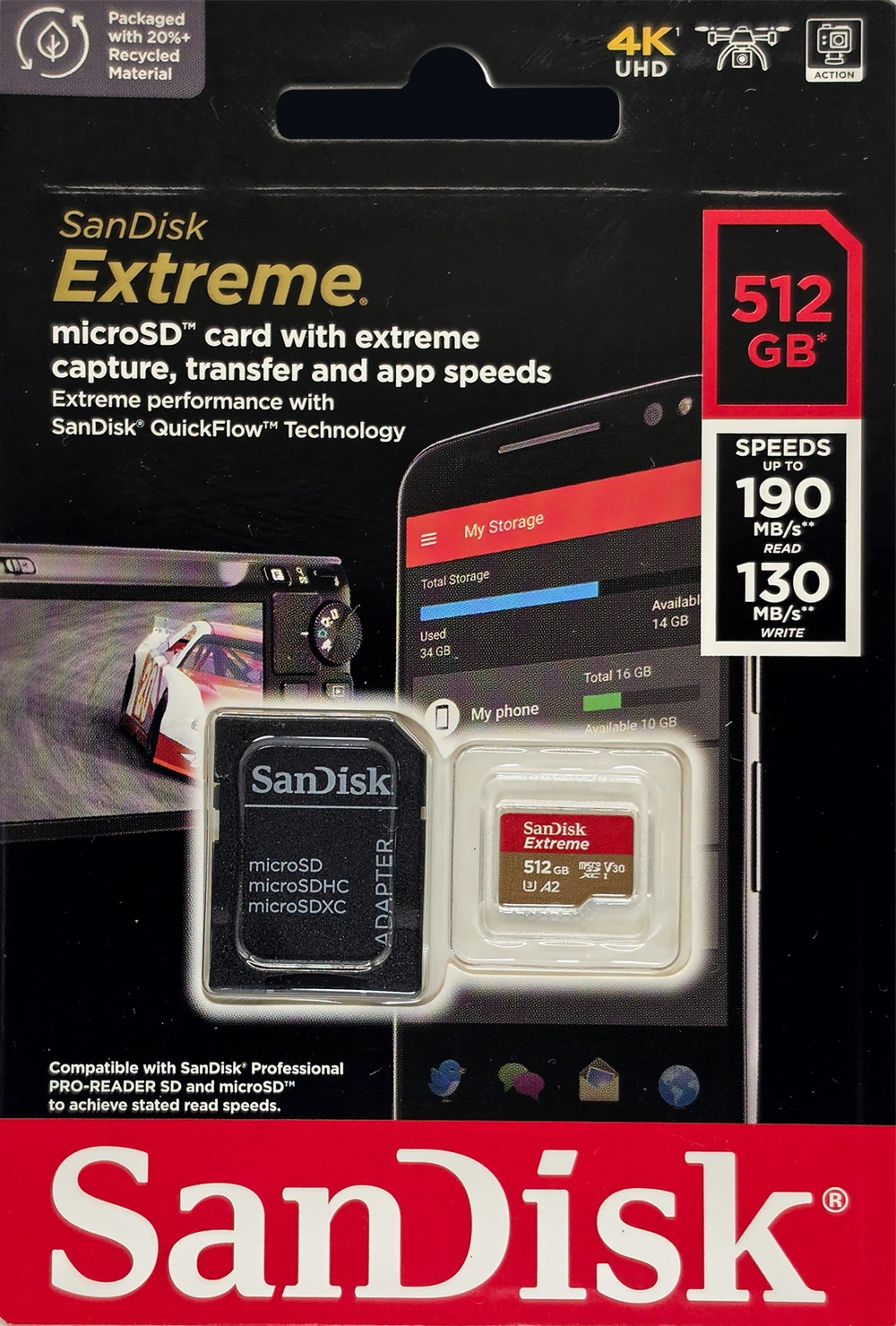
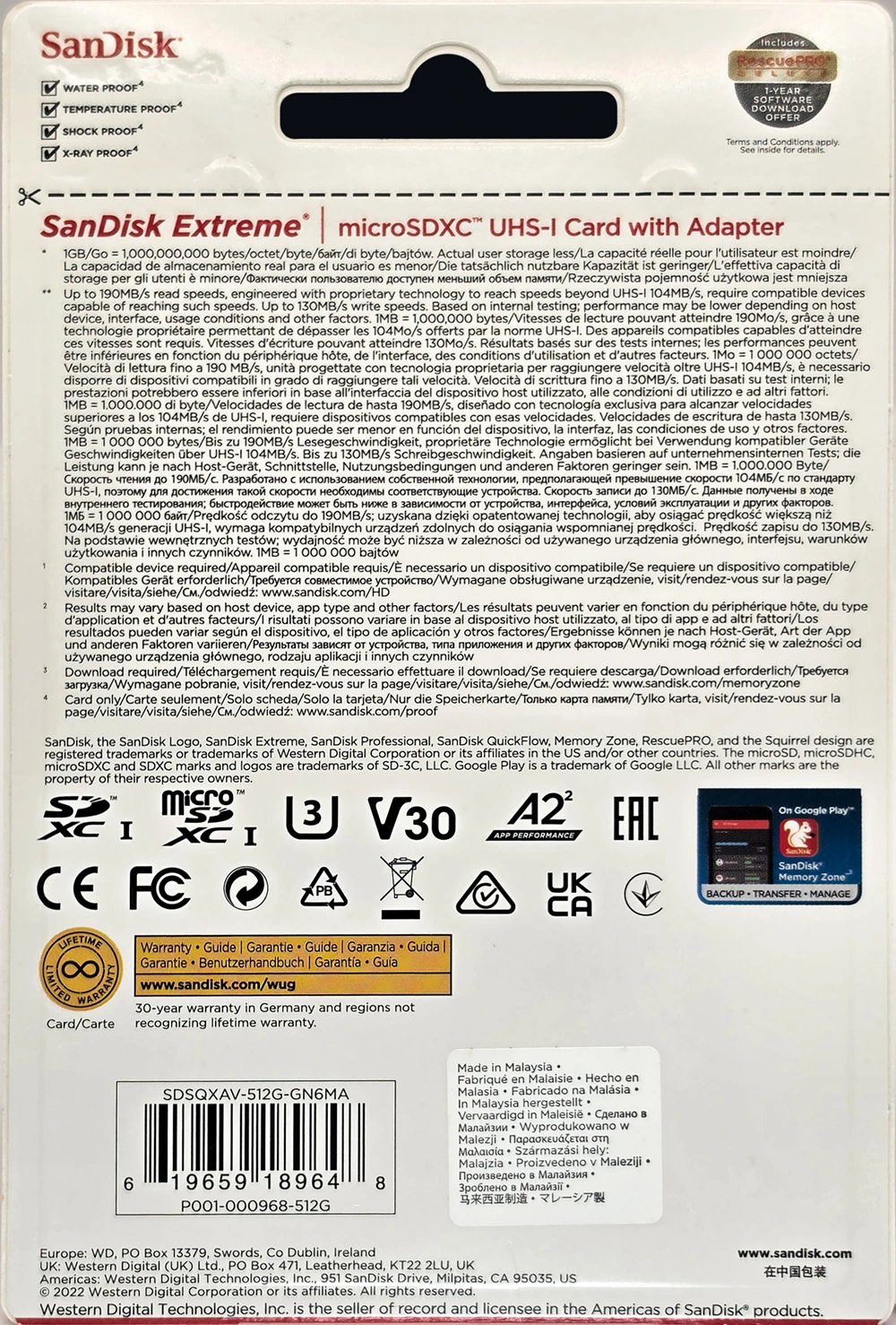
Committed-write speeds always read lower than marketing figures because the card has to acknowledge the data before the clock stops. The full explanation, and the unit conventions used throughout, are on how we score memory cards.
Why the read claim needed a second reader
On my main reader the card measured 180.5 MB/s, which is 95.0% of its printed 190. Ordinarily that is a miss. It was not, and the tell was that the number refused to move.
| Measurement | Transfer size | Read |
|---|---|---|
| Canary probe | 64 MiB | 178.2 and 180.1 MB/s |
| Capacity calibration | 256 MiB | 179.7 MB/s |
| Sequential test, three passes | 2 GiB each | 179.9, 180.5, 180.5 MB/s |
| Full-card verify | 511.8 GB | 180.5 MB/s |
| Position sweep, first / middle / last 10% | across the card | spread of 0.06% |
That is 180.4 give or take 0.6 MB/s across four orders of magnitude of transfer size, and across every physical region of the card. A card limited by its own flash varies with position or size. A ceiling this flat, that never shifts no matter what you ask of it, is the transport, not the media.
It was also the highest read figure this bench had produced at the time, beating the previous best of 174.94 MB/s, and it sat 6.1% above the UHS-I DDR200 window the tool watches for, which is why no interface-ceiling flag fired. SanDisk's own fine print says the 190 MB/s figure needs a compatible device capable of reaching those speeds and is based on internal testing. That is a disclosure, not a dodge, and reaching 190 was going to take a faster host than any reader I owned. So I bought one.
On a SanDisk QuickFlow the same card reads 193.3 MB/s, across three passes of 193.39, 193.26 and 193.19, which is 101.7% of the printed claim. The 180.5 was never this card: two unrelated cards land within 0.24% of it in the same ProGrade slot and nothing has ever gone faster there, so about 181 MB/s is that reader's own microSD ceiling. The row above now reads BEATEN. The reasoning behind the original NOT SETTLED verdict was right, and that is the part worth keeping: a figure that flat, across four orders of magnitude of transfer size, was the transport rather than the media, and calling it a fail would have blamed the card for my hardware. The rule it produced is that an instrument has to be able to exceed a claim before it can test it. The same question is still open on the Samsung PRO Ultimate, which is a full-size SD card the QuickFlow cannot take, and it is why every read figure on this site is attributed to a reader.
Five minutes of committed writing, and then the whole card
The five-minute sustained leg settled at 129.0 MB/s with a worst ten-second window of 127.6 MB/s. Against the V90 floor of 90 MB/s that is 42% of headroom on a card whose package prints V30. The trace never dropped below 114.3 MB/s across all 300 samples.
SanDisk Extreme 512GB
Every byte, written and read back
Run SanDisk-Extreme-512GB_2026-08-17_171500 · cardcheck v0.8.2 · ProGrade PGM0.5 microSD slot
One minute of loop-recording abuse
This card: run SanDisk-Extreme-512GB_2026-08-17_171500 · reference card: lab baseline, same bench, same test
It got hot. Very hot. It did not slow down.
A 4K30 dash cam writes about 6 MB/s, roughly a twenty-first of this workload · Run SanDisk-Extreme-512GB_2026-08-17_171500
The five-minute number is the one that sets the class, but the capacity leg is the more interesting test, because it wrote all 511.8 GB in one pass. Across 3,980 one-second samples the fill averaged 128.6 MB/s, the slowest single sample was 111.2 MB/s, and not one sample fell below 100. Split into quarters, the card wrote at 128.78, 128.67, 128.64 and 128.18 MB/s. It gives up half a percent between the first quarter of the card and the last.
One caveat worth stating plainly, because it is easy to over-read: the capacity fill runs after the sustained test and the settle pre-pass, so the card arrives at it already churned and already at its media rate. A flat fill curve there is the normal result on this bench, not a special property of this card. What is not normal is the level it holds that curve at, and the fact that its floor never drops into double digits.
The A2 badge and the number behind it
This is where the card is weakest, and it is worth being precise about what was and was not measured. The A2 specification requires 4,000 read and 2,000 write IOPS, but it reaches those figures using command queuing, which USB card readers do not implement. No USB bench can test A2, including this one. The tool marked the row not testable on its own.
What can be measured is random 4K at queue depth 1, and there the Extreme returned 1,796 read IOPS and 745 write IOPS. It clears the A1 write floor of 500, but only by 1.49 times. Set against the other premium 512 GB cards on the same reader with the same test:
| Card | Sequential read | Random 4K read | Random 4K write | Worst 10 s |
|---|---|---|---|---|
| SanDisk Extreme 512GB | 180.3 MB/s | 1,796 IOPS | 745 IOPS | 127.6 MB/s |
| Samsung PRO Plus 512GB | 169.3 MB/s | 2,372 IOPS | 1,895 IOPS | 141.6 MB/s |
| Samsung PRO Plus 512GB (second unit) | 169.3 MB/s | 2,405 IOPS | 1,907 IOPS | 142.7 MB/s |
| Samsung PRO Ultimate 512GB | 169.8 MB/s | 2,466 IOPS | 1,822 IOPS | 133.1 MB/s |
The Extreme wins sequential read by roughly 11 MB/s and loses random write by a factor of two and a half. That is not a defect, it is a design: this card is tuned for streaming large files, which is exactly what SanDisk sells the Extreme line for. It does mean the A2 badge sets an expectation at queue depth 1 that the card does not meet relative to its peers, and if small-file work is your use case, one of the Samsungs is the better buy.
The good news is that it does not degrade under churn. Across three consecutive 20-second random write passes it went 747, 743 and 744 IOPS, a fade of 0.3%. The SanDisk High Endurance control fades 2.1% on the same test, and the unbranded reference card in the panel above collapses 71%.
511.80 GB of a 512 GB label, verified byte for byte
Every CKBench review fills the card completely with seeded, dedup-proof data and reads all of it back. This one wrote 477 files totalling 511.80 GB, then verified every one of them: zero mismatched bytes, zero read errors. At 99.96% of label, the 0.2 GB shortfall is the normal decimal-gigabyte gap that SanDisk states on the package itself.
A note on the read-back timing, because two different numbers are defensible and only one of them describes the card. The verify pass took 52 minutes 23 seconds of wall time but only 47 minutes 15 seconds of read I/O. The five-minute difference is the verifier generating and comparing its expected data, which is work the harness does, not the card. The card's own read rate through that pass was 180.5 MB/s. Any figure derived from the wall clock, 162.8 MB/s, understates it by ten percent, so this review quotes the I/O figure and says why.
The hottest card we have ever measured, and it did not care
At the end of the five-minute sustained write, with the fan off as the protocol requires, the card surface read 172.3 °F against a 76 °F ambient. That is a 96.3 °F rise, and it makes this the hottest conventional card in the corpus, taking the record from the Samsung PRO Plus at 169.6 °F. Only the Samsung P9 Express is hotter, and that card runs on a PCIe bus in a different reader.
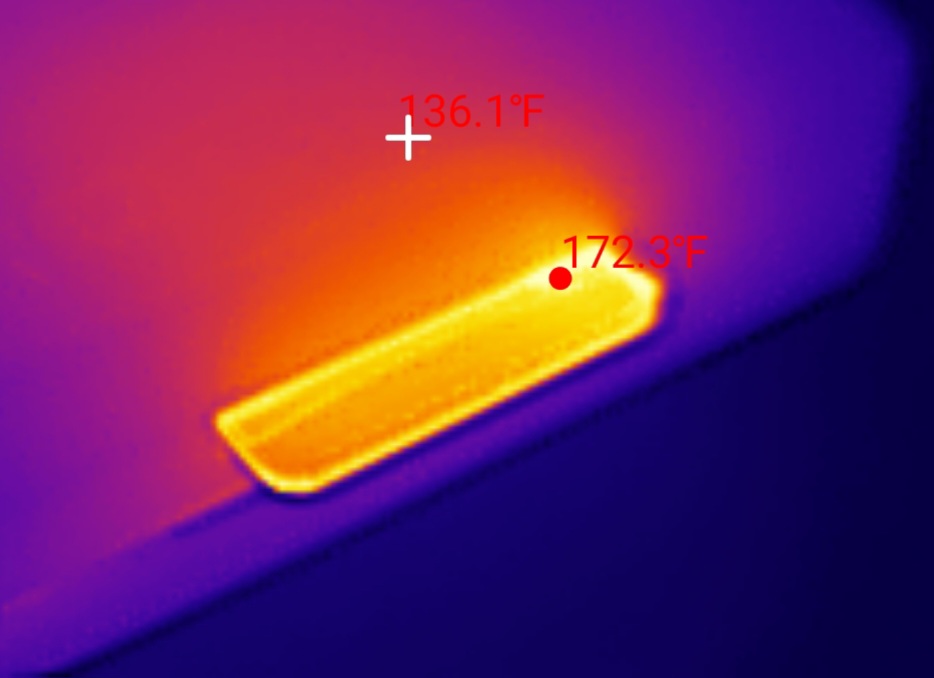
The second reading in that frame matters. A card that disappears into a reader can only be read through the slot aperture, which under-reports by 10 to 14 °F, so those figures are published as floors. A microSD in this reader's dedicated slot leaves real card body exposed, so this is a genuine card-surface measurement and it is directly comparable to every other microSD figure on the site.
None of that heat cost anything. The sustained curve is flat across all four quarters, the worst ten-second window lands at 2:02 rather than late in the run, and the full-card fill afterwards held its level to the last byte. The card gets hot and keeps working. Worth knowing if you plan to run it hard inside a sealed enclosure with no airflow, where the surrounding air will be a good deal warmer than 76 °F.
Every headline number from the test
How it scores against the rubric
SanDisk Extreme 512GB
Scored against the CKBench rubric. Five dimensions, each out of 5.
Final score: 4.5 out of 5. It beats every number on its label and gives back every byte it promises. The marks it drops are for heat: it runs among the hottest cards in its class, without ever slowing down because of it. The read row moved from 4 to 5 in the August 2026 update above. The rows were restated on the September 2026 scoring tables on 30 September 2026: endurance rose to 5 because the tables score fade and recovery rather than the small-file margin, and thermal went to 3 on 7.1 °C of headroom. They average 4.6, still 4.5.
SanDisk Extreme 512GB: common questions
Is the SanDisk Extreme 512GB really 512 GB?
Yes. A full write-and-verify of every block returned 511.80 GB usable, which is 99.96% of the 512 GB label, with zero mismatched bytes and zero read errors across 477 test files. The 0.2 GB gap is the standard decimal-gigabyte difference that SanDisk states on the packaging.
Does it actually reach 190 MB/s?
Yes, on a reader that can reach it. The card reads 193.3 MB/s on a SanDisk QuickFlow, which is 101.7% of the claim. On my main reader it returns a flat 180.5 MB/s, and that figure turned out to be the reader's own ceiling rather than the card's. SanDisk's own fine print says the 190 MB/s figure requires a compatible device capable of those speeds, and that turns out to be exactly right.
Is the SanDisk Extreme good for a dash cam?
It works well but it is more card than a dash cam needs. It sustains 127.6 MB/s at its worst, where a 4K30 dash cam writes about 6 MB/s. A High Endurance card is designed for that constant-overwrite duty and costs much less per gigabyte.
What video speed class does it actually hold?
V90. Its worst ten-second committed write was 127.6 MB/s against the 90 MB/s V90 floor, three tiers above the V30 printed on the package.
Does the A2 rating mean it is fast for apps?
Not in a way this bench can confirm, and the queue-depth-1 numbers argue against it. A2 floors require command queuing that USB readers do not implement, so A2 cannot be tested here. At queue depth 1 the card managed 745 random write IOPS, roughly two and a half times slower than the Samsung PRO Plus and PRO Ultimate on the identical test.
Does it get too hot?
It gets hotter than any other conventional card measured here, 172.3 °F at the card surface after five minutes of sustained writing with no fan, against a 76 °F ambient. It showed no throttling at that temperature and the write curve stayed flat throughout.
Device identity: what this card reports about itselfFor readers checking their own unit
| Raw CID register | 035344534e353132 86 -------- 019500 (serial digits elided) |
| Manufacturer ID (MID) | 0x03, SanDisk / Western Digital |
| OEM / application ID (OID) | 0x5344, "SD" |
| Product name (PNM) | SN512 |
| Product revision (PRV) | 8.6 |
| Serial number (PSN) | 0x4f65… (truncated) |
| Manufacture date (MDT) | May 2025 |
| Declared capacity (from CSD) | 999,743,488 sectors of 512 bytes = 511,868,665,856 bytes, 99.97% of the label |
| Lot code (printed on the pack) | P001-000968-512G |
| Captured on | Raspberry Pi 4 native SD host, no USB bridge in the path · 2026-08-17 |
The manufacturer ID, OEM ID, product name and product revision are model level: every SanDisk Extreme 512GB of this revision reports the same four values, which is what makes them useful for checking a card you already own against this one. The serial number is unique to this individual card and is truncated here on purpose, and its digits are elided from the raw register above for the same reason. The manufacture date is batch level and publishes in full because it is diagnostic, and May 2025 lines up with a July 2025 purchase. The printed lot code uses the same P001 and six digits and capacity frame as both SanDisk High Endurance units in the corpus, which shows that numbering runs across SanDisk product lines rather than inside one. You can decode your own card with the SD card CID decoder, or browse every card tested so far in the CID register. These registers do not reach the flash controller or the NAND part numbers, which need a vendor tool, so this table is an identity record rather than a complete bill of materials.
Disclosure: I bought this card at retail with my own money and SanDisk had no involvement in this review. This post contains affiliate links. As an Amazon Associate I earn from qualifying purchases, at no extra cost to you. Affiliate links like these and my YouTube channel are what keep the site running.