
Dash cam reviews from a real windshield
Every dash cam I have reviewed on this site, newest first, and the tools I built for the questions owners keep asking: which card, how many hours it holds, how long parking mode lasts, and how hot it gets behind the glass. The recent reviews take their numbers from the camera’s own files, a printed test chart and a meter at the power input, not from the box.
Every dash cam post, newest first
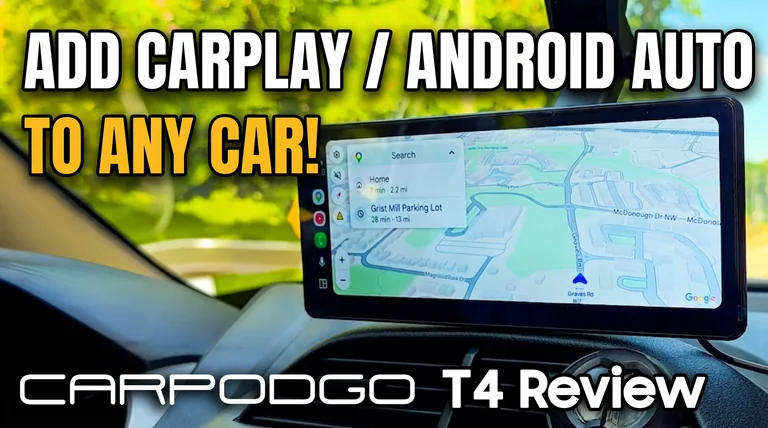
Reviews, install guides and explainers, from the newest camera back to the first dash cam I reviewed here. The list builds itself from the site’s post index, so a new review lands on this page the day it publishes. One car product that is not a camera is in it too: the CarpodGo T4, a wireless CarPlay screen for a car with no Bluetooth at all.


Tools for the questions owners ask
Each one answers a single question from measurements rather than a spec sheet, and each reads its numbers from the bench’s own data files when the site is built, so a new measurement reaches the tool without anyone retyping a figure.
Dash Cam SD Card Picker
Pick a dash cam I have recorded with, or type your own camera’s bitrate, and every card on the bench is laid out against it: its worst ten seconds of sustained writing, the capacity that was really there, how it held up under loop-recording churn, and how many hours it records. Open this one when you want the working, not just the answer.
Built on 33 cards benched so far
Open the pickerDash Cam Storage Calculator
Drop in a clip from your own dash cam and it reads the bitrate straight out of the file, in your browser, with nothing uploaded. Or pick a camera I have recorded with. Either way you get how many hours your card holds before loop recording starts writing over the oldest footage.
Reads the bitrate from your own clip, on your own machine
Open the calculatorParking Mode Battery Calculator
Battery amp-hours, the hardwire kit’s cutoff voltage and what the camera draws while it waits, and it gives you the hours until the kit cuts the power, as an honest bracket with every assumption stated on the page. A camera’s measured preset appears the day its review does.
Measured parking draws so far: 1.85 to 3.81 W at the camera’s 5 V input, across two cameras
Open the calculatorDash Cam Heat Log
A temperature probe on the glass beside my dash cams, logging around the clock against the outdoor air at the nearest airport. It answers how hot the spot a windshield camera lives in really gets, which no spec sheet does, and it grows every time I pull the logger.
Hottest so far: 146.1 F (63.4 C) on Sep 30, with 31 days logged
Open the heat logBefore you pick a camera
The resolution printed on the box decides less about a dash cam’s footage than these do.
Same sensor, different dash cam
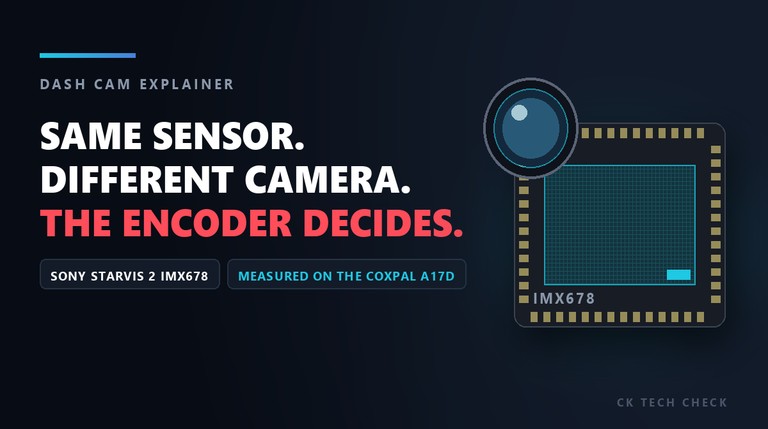
Nearly every 4K dash cam now runs Sony’s IMX678, and they still look nothing alike. The processor, its tuning and the bits the encoder is given decide the picture, measured side by side on the COXPAL A17D and the VIOFO A119M Pro, with what to look for on a spec sheet.
Read the explainerWhy I turn HDR off
On the VIOFO A229 Plus, HDR halves the frame rate, adds motion blur and ghosting, and does not deliver the night-time plates the marketing implies, so it stays off there. The newer reviews test HDR again on each camera, because the answer depends on the camera.
Read whyHow a dash cam gets tested here
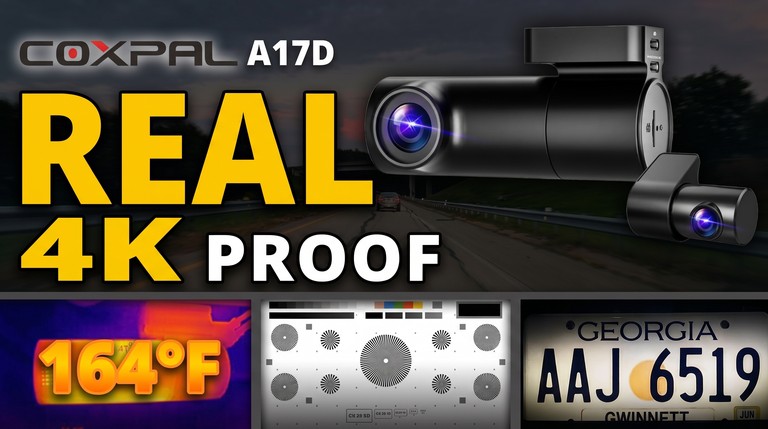
The earlier reviews on this page lean on footage and the install, the way most dash cam reviews do, with measurements added as the bench grew. Since the COXPAL A17D, each camera goes through the same chain, so any two can be read side by side.
The files. DashCheck, software I wrote for this, reads every clip a camera writes to its card: bitrate, dropped frames, gaps between clips, blown highlights, and how much real detail the picture holds against the pixels the file claims. No AI, just arithmetic on what the camera recorded.
The chart. A printed test chart on an easel, with Siemens stars that measure resolution directly and license plates that shrink across the bottom, so one frame is also a plate test at several distances. It is how a camera sold as 4K gets checked for real 4K.
Parking mode. A power bench stands in for the car: a small battery, the camera’s own hardwire kit, a switch on the accessory wire and a USB meter at the camera, so a park can run until the kit cuts the power without flattening my car’s battery. Those meter readings are the presets in the parking calculator.
Heat. A thermal camera on the case while the camera records, and the heat log’s probe on the windshield beside it, which reads what the camera is sitting in.
The card. Memory cards go through CKBench, the same bench as every card review on the site, including cards that came in the box with a dash cam. That is where the SD card picker’s numbers come from.
Memory cards, benched
The card is the cheapest part of a dash cam and the one most likely to quietly ruin it. CKBench has the whole corpus: committed write speed, verified capacity, thermals and a published score for each card.
Open CKBenchNot sure which card to buy?
Answer a few plain questions about your camera in the card finder and it names a card or two, chosen only from ones the bench has filled, read back and timed.
Find my card