
Same sensor, different dash cam: the encoder decides
Nearly every 4K dash cam sold today runs the same Sony STARVIS 2 IMX678. What you actually get is decided above the sensor, by the processor, its tuning and the bits the encoder is given. I have measured all of it on one of them.
Prefer to watch?
There is no video for this one yet. The COXPAL A17D review the measurements come from is on the channel.
The short version
Almost every current 4K dash cam runs a Sony STARVIS 2 IMX678, and that badge guarantees a floor: a real 3840 by 2160 capture on 2.0 micron pixels, with two HDR modes built into the silicon. Everything above the floor is the camera maker's call, and most of it happens in the processor. Its image pipeline decides how hard the picture is sharpened and denoised, its firmware decides what the encoder is allowed to spend, and the encoder's bit budget, rate control and keyframe interval decide how much of the sensor's detail survives to the card. On the IMX678 camera I have measured most closely, a 10 percent bitrate bump bought 6.7 percent more real detail, the processor draws edge contrast the scene does not contain, and the rear channel, which is not an IMX678 at all, is the one that fails at night.
The sensor is the floor. Shop the ceiling.Why do IMX678 dash cams look so different?
Pull up any 4K dash cam listing from the last two years and the sensor line reads the same. VIOFO, Vantrue, 70mai, Thinkware, BlackVue, COXPAL, Redtiger: an IMX678 dash cam is the default now. Same 1/1.8-inch chip, same 8.3 million recording pixels, same 2.0 micron photosites.
And the cameras are not remotely the same. One ships at 4K60 with 65 megabits per second on the front channel. Another, on the same processor family and the same sensor, ships at 32. One has no HDR at all. One has HDR you cannot turn off. One drops to 25 frames per second the moment you plug in the rear camera. Same badge on every box.
People talk about the sensor. The encoder decides the quality. If every camera has the IMX678 and every processor, tuning and bit budget is different, every result is different. I have spent the last month putting one of these cameras, the COXPAL A17D, through a printed test chart, a license plate rig and a thermal camera, with my own analysis tool reading every file it wrote. That is why I can put numbers on this instead of adjectives. This post is about what the badge buys you, what it does not, and where the differences actually come from.
Disclosure: Every COXPAL A17D figure in this post comes from a unit COXPAL sent me for review, free of charge; they had no editorial input and saw nothing before publication. The same disclosure sits on the review. This post also contains an affiliate link to my Amazon storefront. As an Amazon Associate I earn from qualifying purchases, at no extra cost to you. Affiliate links like these and my YouTube channel are what keep the site running.
What does the IMX678 badge actually guarantee?
Two things need separating first, because listings blur them. STARVIS 2 is a family. IMX678 is a part.
Sony’s STARVIS 2 is a generation of back-illuminated pixel technology, not a chip. Sony’s own footnote on the IMX678 flyer describes it as pixel technology for security cameras with more than 8 dB of extra dynamic range over the first STARVIS generation at the same pixel size, in a single exposure. That is a property of the family. It says nothing about how many pixels a given part has or how big they are. Four STARVIS 2 parts show up in dash cams right now, and they are not interchangeable:
| Part | Optical format | Recording resolution | Pixel size | Where it shows up | Source |
|---|---|---|---|---|---|
| IMX662 | 1/2.8 inch | 1920 x 1080 (2 MP; 1980 x 1080 effective) | 2.9 um | Cabin cameras (Vantrue Pilot 2, N4 Pro S) and some rears (70mai M800; the A810S with its RC24 rear camera) | FRAMOS product page; Vantrue and 70mai pages, DashCamTalk |
| IMX675 | 1/2.8 inch | 2592 x 1944 native, recorded at 2560 x 1440 (5 MP) | 2.0 um | Front on the VIOFO A229 Plus and the Vantrue Pilot 2; the rear on many IMX678 cameras | FRAMOS and TechInsights |
| IMX678 | 1/1.8 inch | 3840 x 2160 (8.3 MP) | 2.0 um | The front camera on nearly every current 4K model | Sony flyer IMX678-AAQR1 ver 2.0 |
| IMX585 | 1/1.2 inch | 3840 x 2160 (8.3 MP) | 2.9 um | No dash cam I can find. Astronomy cameras use it. | Sony flyer IMX585-AAQJ1 ver 1.0 |
So a “STARVIS 2 dash cam” can be a 1080p cabin camera or a 4K front camera, on pixels of two different sizes. The Vantrue N4 Pro S is sold as an all-STARVIS-2 three-channel system, and Vantrue’s own product page lists three different sensors: IMX678 in front, IMX675 behind, IMX662 in the cabin. The Vantrue Pilot 2 says STARVIS 2 on the box and records 2K, because its front sensor is the 5 megapixel IMX675. My own VIOFO A229 Plus is STARVIS 2 and records 2560 by 1440 for the same reason.
The IMX678 itself is precise, and Sony’s three-page flyer for it says exactly what the part number promises:
- Type 1/1.8 (8.86 mm diagonal), 8.40 million effective pixels, 3840 by 2160 recommended recording pixels
- 2.0 by 2.0 micron unit cells
- Readout up to 60 frames per second at 12-bit, 72 at 10-bit, in all-pixel mode
- Two HDR functions in silicon: digital overlap HDR and Clear HDR
- A 2/2-line binning mode that outputs 1920 by 1080, and a window-cropping mode
- Applications: security cameras
Nobody at Sony designed this part for a windshield. It is an 8 megapixel low-light security sensor that fits a dash cam’s budget and lens, and the whole industry standardized on it. Sony’s own comparison in the flyer is against the previous-generation IMX334: the same scene at 0.2 lux comes out at the same brightness with the IMX678 running a quarter of the gain. That is the real low-light advantage the badge buys, and every camera on this sensor starts with it.
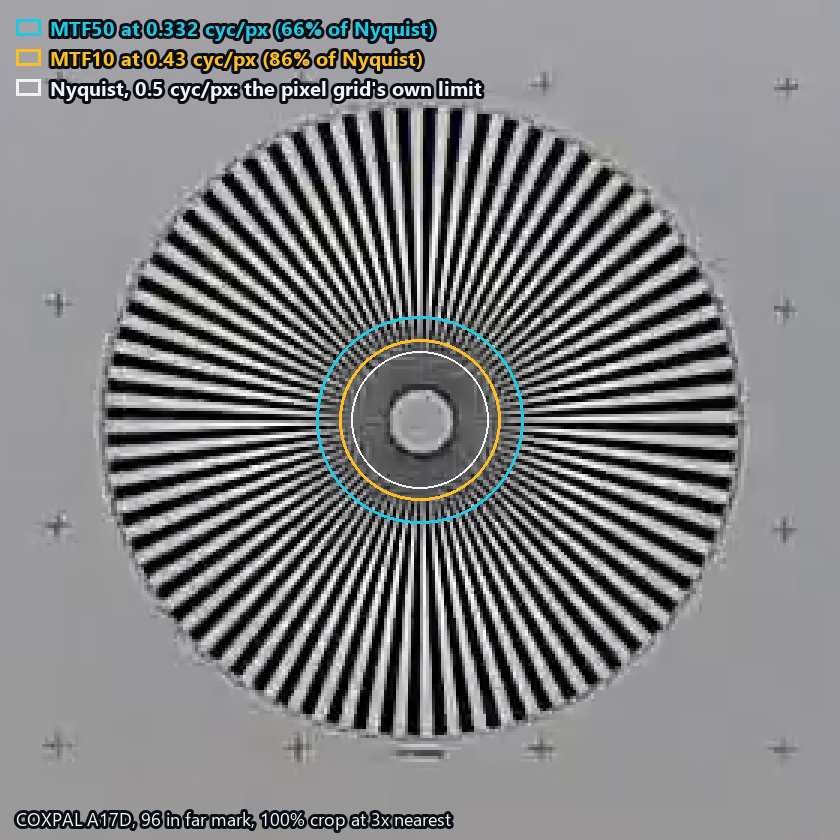
So the part number sets a floor, and I checked that the floor is real. On my printed test chart the A17D’s 4K output carries measurable detail out to 86 percent of the pixel grid’s theoretical limit. A 2K sensor upscaled to 4K, which is what the previous-generation Mangoal I reviewed was doing with its 5 megapixel IMX335, cannot carry anything above 67 percent, because the information was never captured. The IMX678 camera passes that test. It is a native 4K capture.
That is where the guarantee ends.
The same sensor, shipped a dozen different ways
Here is the same sensor as it actually ships. The last column says where each number comes from, because most of these I have not measured myself, and a spec is not a measurement. Only the COXPAL row is measured here.
| Camera | Processor | Top mode | HDR | Front bitrate | Codec | Field of view | Source |
|---|---|---|---|---|---|---|---|
| VIOFO A329S | Novatek NT98530 | 4K60; HDR forces 4K30 | Yes, scheduled | 65 Mbps | H.265 | 140 | VIOFO spec page |
| 70mai 4K Omni | Novatek NT98530 | 4K60 single, 4K30 with HDR | Yes | 32 Mbps | H.265 | 146 | 70mai, owner reports |
| BlackVue DR970X Plus | Not published | 4K30 | Not published | 60 Mbps (25 on the non-Plus) | H.265 | Not published | BlackVue product page |
| Thinkware U3000 | Ambarella H22A77 | 4K30, 2K60 | None at all | 24 or 30 Mbps, selectable | H.265 | 152 | Thinkware product page |
| Vantrue E1 Pro | Novatek NT98528 | 4K30 | Yes, scheduled | 32 Mbps | H.264 | 158 | DashCamTalk database |
| Vantrue N4 Pro | Novatek NT98529 | 4K30 | Yes | 32 Mbps (31.9 owner-measured) | Not confirmed | 155 to 158, sources differ | DashCamTalk |
| 70mai A810 | Novatek NT98529 (per DashCamTalk) | 4K at 60, 30 or 25 fps per 70mai; owners report 25 fps with the rear attached | Yes | 31 Mbps | H.265 | 150 | 70mai product page, DashCamTalk |
| BlackVue Elite 10 | Not published | 4K30 front; the rear is a second STARVIS 2 sensor whose part number BlackVue does not print (retailers list IMX675) | Front yes; rear not listed | Not published | Not published | Not published | BlackVue product page, retailer listings |
| VIOFO A119M Pro | Novatek NS02302 (named in VIOFO’s firmware, not published) | 4K30 | Yes | 37 Mbps on launch firmware, 62 Mbps from V1.2 | Not published | 140 | Owner-measured, DashCamTalk, VIOFO firmware |
| COXPAL A17D | Novatek NT98529 | 4K30 | Yes | 33.6 Mbps (36.9 in the app’s high mode) | H.264 | 140 | Measured here; processor per COXPAL |
Read down the bitrate column first. The A329S and the 4K Omni are the same processor and the same sensor, and one gets twice the bits of the other. BlackVue more than doubled the DR970X’s bitrate at the same resolution between one model and its Plus revision, by decision. VIOFO’s A119M Pro went from 37 to 62 megabits between two firmware versions on identical hardware, according to the owners who measured it. The sensor did not change in any of those cases.
Now the HDR column. Thinkware’s U3000 is an IMX678 camera with no HDR whatsoever, because the Ambarella chip in front of the sensor does not offer it. BlackVue’s Elite 10 gives only its front camera HDR. Two of the sensor’s headline features, and whether you get them is decided by the chip and the firmware, not the badge.
Where the picture is actually made: the processor and its encoder
A dash cam’s picture passes through six stages between the scene and the file on the card. One of them is shared. Three of them live inside the processor, and those three are where two IMX678 cameras stop being the same camera.
- Maker’s choice1. LensAperture, field of view, element count. Sets how many pixels land on a plate.
- 2. SensorThe IMX678. The floor, and the shared limits: Bayer color, no 2K binning.
- Maker’s choice3. Processor and image pipelineSharpening, noise reduction, the frame-rate ceiling.
- Maker’s choice4. Firmware tuningEvery knob in stage 3, and it moves between versions.
- Maker’s choice5. EncoderCodec, bit budget, rate control, keyframe interval. What survives to the card.
- Maker’s choice6. Thermal envelopeWhether stages 3 to 5 keep running on a hot windshield.
The processor’s image pipeline: sharpening, noise reduction and the frame-rate ceiling
Novatek or Ambarella, and which generation. This stage decides the frame-rate ceiling before the sensor gets a vote. COXPAL told me directly when I asked why the A17D records 4K30: the IMX678 supports 60 frames per second, but the NT98529’s encoder tops out at 4K30. The sensor can do it; the chip in front of it, as COXPAL has built with it, cannot. 70mai lists 60 frames per second at 4K on the A810, which DashCamTalk identifies as the same NT98529 family, so the ceiling is set by what each maker’s firmware asks of the chip as much as by the chip itself. Either way, the sensor is not what decides it.
What is inside these chips differs more than the badge suggests. The A17D’s NT98529 has two ARM Cortex-A9 cores, which its firmware lets run at up to 1.2 GHz, and COXPAL pairs it with 512 MB of DDR3 memory. The A119M Pro, the next camera through this, runs a newer Novatek part. VIOFO does not publish it, but the camera’s own firmware image names an NS02302, built on Novatek’s NT98539, with a 64-bit ARM Cortex-A53 and 512 MB of faster DDR4. Same sensor and the same amount of memory, on a newer generation of chip.
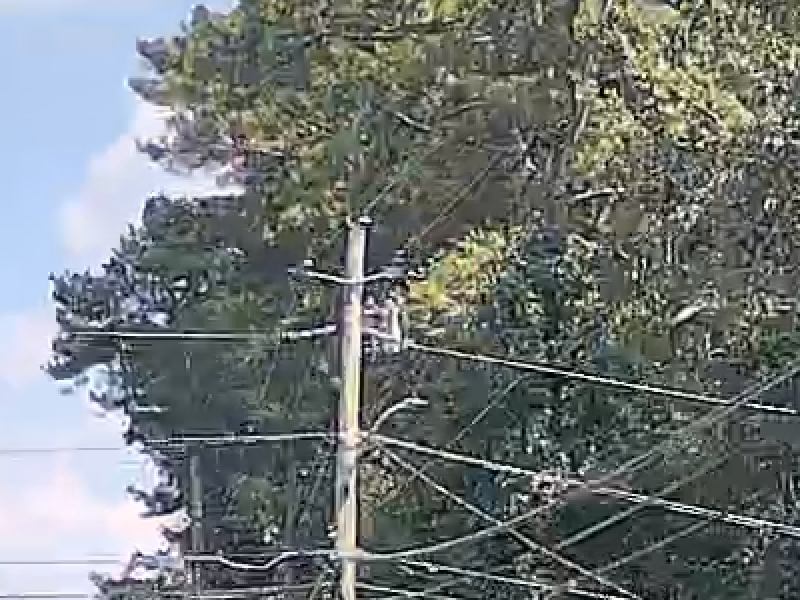
The processor’s image pipeline is also where sharpening and noise reduction live, and this is the stage that makes two IMX678 cameras look different. On the chart, the A17D returns edge contrast at 111 percent of what is printed with HDR on and 124 percent with it off. Anything over 100 is not optics. It is the processor drawing edges in, and on real road footage that shows up as halos of roughly a quarter to a half of the edge height, depending on the light. COXPAL’s answer when I asked about a sharpness setting: “There is no other settings except HDR.” So that is what every owner gets, permanently.
The processor’s signature is its own. The older-generation Mangoal I tested last year sharpened vertical edges 2.5 times harder than horizontal ones, which is a processor’s fingerprint, not a lens’s. The A17D sharpens both axes within 8 percent of each other. Same idea, different tuning, and you cannot see either on a spec sheet.
Firmware tuning, and why it moves
Every parameter in stage 3 is a knob the camera maker sets, and it changes between firmware versions. BlackVue markets “improved ISP tuning” as a feature of the DR970X Plus. Owners on DashCamTalk report that VIOFO’s A119M Pro nearly doubled its bitrate ceiling in a firmware update, and that its launch firmware had the bitrate menu inverted, with High recording Low. Vantrue N4 Pro owners have reported picture changes across firmware versions. The A17D ships on firmware V1 and, per COXPAL, no update exists, so the tuning I measured is the only one there is.
If a review does not tell you the firmware version, its picture-quality findings have an unknown shelf life.
The encoder’s bit budget: codec, bitrate, rate control and GOP
H.264 or H.265, how many megabits, constant or variable rate, how often a full frame is written. This is the stage with the biggest published spread in the table, and it is the one I can measure most directly, because every one of those choices is written into the file.
The A17D’s front channel is 33.6 megabits per second of H.264 at 4K30, dead-flat constant bitrate: the rate moves by about a tenth of a percent whether the scene is an empty highway or dense sunlit foliage, and a keyframe is written every half second. That works out to 0.135 bits per pixel per frame. The camera’s own 2K rear channel gets 0.163. So the 4K stream, the one the marketing is about, is the most compression-starved stream in the system.
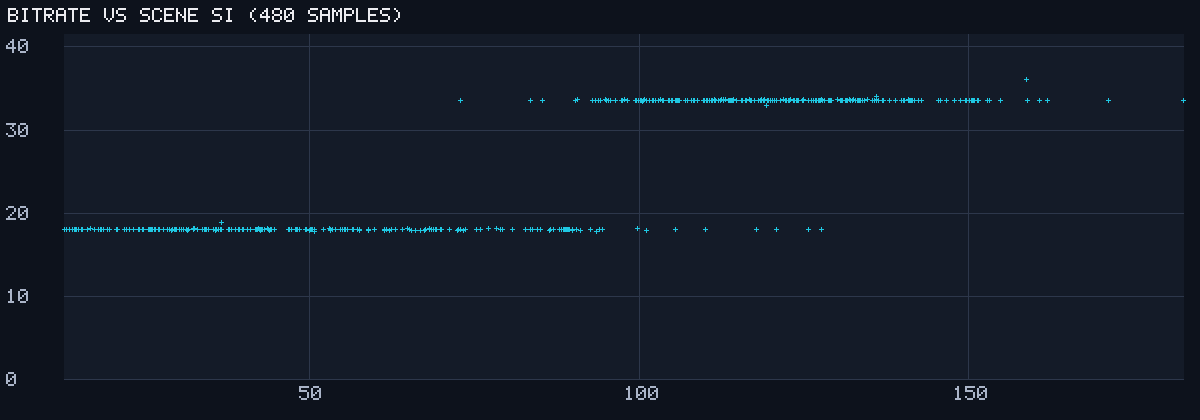
And the starvation is measurable. The app has a high-bitrate mode at 36.9 megabits, about 10 percent more. On the chart, that 10 percent bought 6.7 percent more resolved detail. The 2K crop mode, at 0.163 bits per pixel, read 6.9 percent higher again. Resolution tracked bits per pixel and then flattened out (one bench position, one afternoon, so treat the exact figures as indicative). In plain terms: at its default setting the A17D is leaving real detail on the table for want of bits, and a camera maker who spends 65 megabits on this sensor instead of 32 is not just making bigger files.
The encoder is also where I was wrong. I assumed H.265 from the chip. The files are H.264. Assume nothing; read the file.
What the bit budget costs in storage, since that is the trade: about 23 gigabytes per hour on both channels, measured over 157 clips on a full card, so a 128 GB card holds about 5.4 hours of loop against COXPAL’s claimed 5.8. The storage calculator works that arithmetic for any card size. And the half-second keyframe interval earns its keep the way a dash cam needs it to: the A17D closed its file cleanly on power loss three times, and every one of those 157 clips decoded clean.
What the bit budget does to a plate at night
Night is where the processor and the encoder meet. Gain goes up, noise comes with it, the noise reduction has to decide what is grain and what is a character stroke, and whatever survives that lands on an encoder whose bit budget has not changed. On the A17D the blockiness index my tool reads off the block grid the codec leaves behind sits at 1.06 to 1.18 on an overcast day, climbs to 1.24 to 1.33 through a sunset, and is worst of all in bright sun, 1.19 to 1.51, because that is when the scene is busiest. A fixed 33.6 megabits meets its busiest scene and shows it.
The shadows are where a constant-rate encoder gives up first, and that is exactly where a plate lives at night. On a sunset drive the A17D’s rear channel carried the most encoder blocking in the whole system in its dark regions, 1.31 to 1.50 against the front’s 1.16 to 1.30. Two days later, on a pre-dawn drive, at the same instants on the same road, the front channel crushed 0.06 to 0.22 percent of the frame to pure black and the rear channel, a different sensor with no HDR, crushed 11 to 62 percent, with worst frames above 95. That is not a dim picture. It is a frame with no data in it. And two nights before that, the same front channel with HDR on had held a real plate in its headlight beam at 1 to 2 percent blown, legible at a stop. On the pre-dawn pair, same car, same second, only one of the two files has an identifiable vehicle in it.
That is the whole argument in one drive. The sensor set the floor for both channels; the processor and the encoder decided which one kept the evidence.
How much does the lens matter on an IMX678 dash cam?
Aperture, field of view, element count, coatings. Almost everything in the table is F1.8 or close to it, but the field of view runs from 140 to 158 degrees on the same 3840 pixels. A wider lens spreads those pixels over more scene, so a plate at 50 feet lands on fewer of them. That is a trade, not a defect: more of the intersection, less of the plate.
Two things I measured. On the printed chart, the A17D’s whole chain (lens, sensor, processor and encoder together) holds half its edge contrast out to about two-thirds of the pixel grid’s limit, 66 percent on my two September chart sessions and a few points lower on a later one, which is respectable for a fixed-focus F1.8 lens over 2.0 micron pixels and nowhere near the grid itself. And the spec sheet’s field of view is not a measurement: the A17D’s front and rear cameras are both listed at 140 degrees, and the rear measures about 25 percent narrower than the front on the same chart from the same spot.
The sensor has two shared limits worth knowing, and the lens cannot help with either. A Bayer sensor has one red photosite in every four, so when a plate is lit mainly by the brake lights of the car ahead, three quarters of the pixels are guessing. On the chart under a red LED the A17D lost 21 percent of its resolving power against the same chart under white light. Every camera on this sensor, and on any Bayer sensor, starts from that same physics.
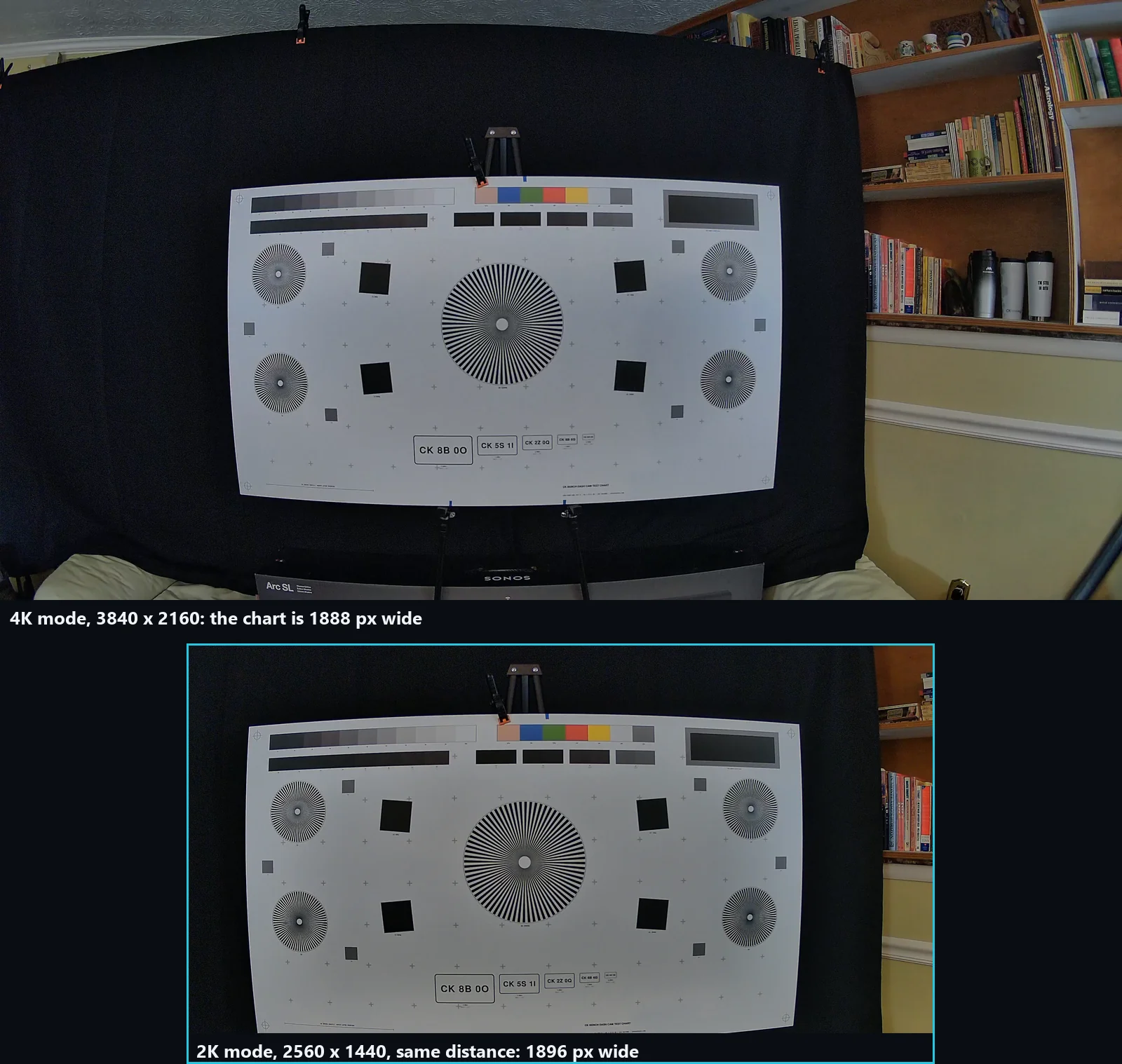
The other limit is one every “2K mode” on an IMX678 camera inherits: the chip’s binning mode outputs 1920 by 1080, not 2560 by 1440. So a 2K mode on an IMX678 camera is either a crop of the sensor or a downscale done by the processor. It is never a bin, and it never gets you bigger effective pixels for low light. On the A17D it is a crop: the chart measured 1888 pixels wide in 4K and 1896 in 2K at the same distance, so the pixel scale is identical and a third of the horizontal scene is simply gone. 2K on that camera buys smaller files and nothing else.
Which HDR does an IMX678 dash cam use, DOL or Clear HDR?
The IMX678 has two HDR modes in silicon, and they are not the same thing. Sony’s own security-sensor page describes both.
Digital overlap HDR (DOL) captures two images in succession, a short exposure for the bright region and a long one for the dark region, and the processor merges them. Because the two exposures are offset in time, moving edges can ghost, and the second readout costs frame rate. That is the behavior my VIOFO A229 Plus shows: turning HDR on there halves the frame rate and ghosts moving detail, and I wrote a whole post on it.
Clear HDR is a STARVIS 2 addition. In Sony’s words, the sensor captures two images simultaneously, one at a low gain level for the bright region and one at a high gain level for the dark region, and synthesizes them. One exposure, so nothing to misalign, no ghosting from the merge and no inherent frame-rate cost.
Which mode a given camera runs is the camera maker’s choice, and I have not found a single spec sheet that says. There is a tell, but it only works sometimes. On a processor that can do 4K60, HDR forcing the camera to 30 is a DOL signature. On the NT98529, which is most of the table, the camera is at 4K30 either way, so the tell is silent. The A17D records exactly 30.00 frames per second with HDR on and with it off. When I asked COXPAL what their HDR does, the answer named both modes from the flyer and did not say which one the camera uses. Motion answers it instead. With HDR on, a card swung fast past the A17D’s lens left one smooth blur, and an overhead highway sign at speed came out as one continuous smear, never a doubled edge. Two exposures taken one after the other leave a second edge on anything that moves between them, and a single exposure cannot, so the A17D behaves like Clear HDR.
Here is what the setting measurably does on this camera, and it is a lot:
- Blown highlights on a daylight drive: 0.04 and 0.02 percent of the frame with HDR on against 1.90 and 4.54 percent with it off, at matched average brightness. Worst single frames 0.39 percent against 14.72. On a static chart at night, 0.07 against 0.58. About a hundred-fold reduction.
- Shadows: HDR on lifts the darkest printed grey step by 19 percent, tapering to no change at white. It compresses the range from both ends.
- Resolution: no measurable cost, in two of three controlled tests.
- Sharpening: about 25 percent less halo with HDR off, though still far above the level where halos are visible.
- The plate: on the bench with a spotlight beside the lens, the same Georgia plate face read 6.5 percent blown with HDR on, 78.7 percent with it off, and 4.6 percent back on. With it off, three plates bloomed into one white slab.
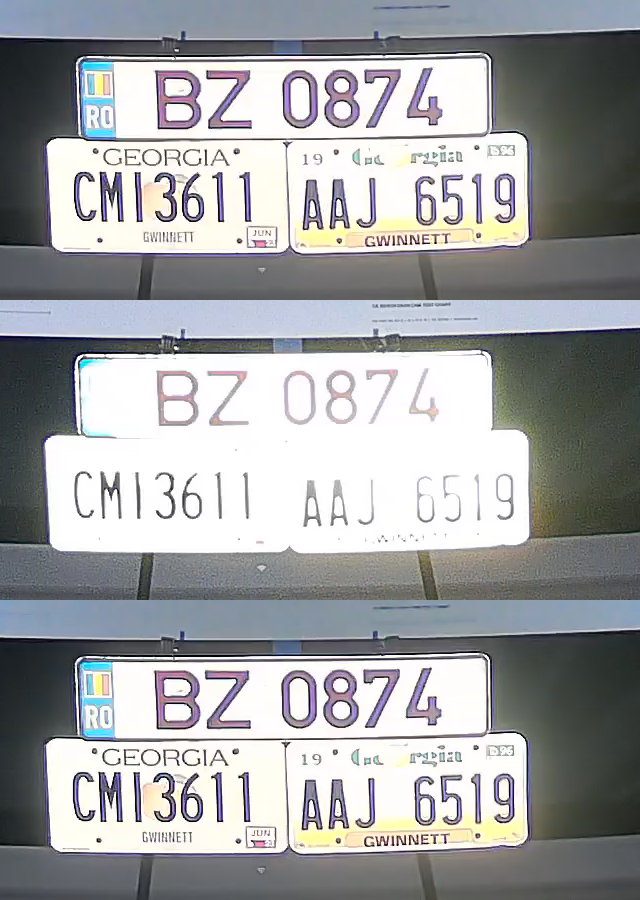
So on the A17D, “leave HDR on” is a plate-legibility instruction. On another camera in the same family the honest answer can be the opposite, because the pipeline around the sensor is different and the frame-rate cost is real there.
How the HDR switch is even offered varies too, going by the makers’ own pages and owner reports. The VIOFO A229 Ultra and BlackVue Elite 9 have it always on with no off switch. The A329S, Vantrue E1 Pro and Thinkware U3000 Pro schedule it by time of day. The Vantrue S1 Pro Max switches it per channel. The Elite 10 has it on the front only. The U3000 has none. Same sensor family in every one.
Does an IMX678 dash cam overheat?
The sixth stage is whether stages 3 through 5 keep running after an hour on a hot windshield. The IMX678’s thermal behavior is shared; the case and the chip cooking beside it are not.
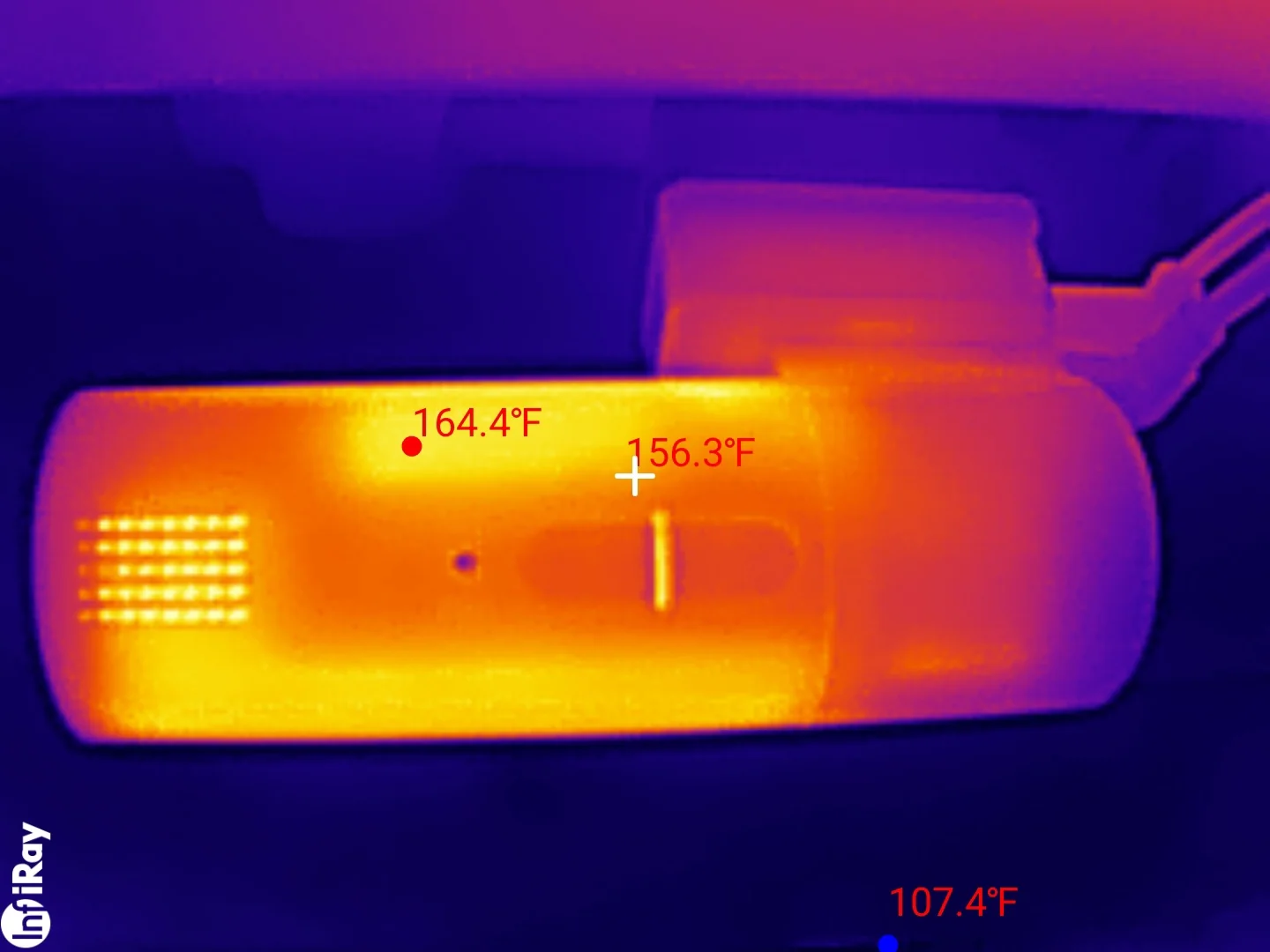
The A17D’s case measured 137.7 F (58.7 C) after an hour of 4K30 on a mild overcast morning with the cabin at 86 to 88 F, and 164.4 F (73.6 C) about half an hour into a drive on a 93 F afternoon after four hours parked. That is above the 70 C printed on the box, though the printed figure is an air-temperature rating and this is the case, so it is not a spec violation as written. The stable finding across both days is the rise: the camera adds its own 50 to 57 F to wherever it sits. COXPAL confirmed, when asked, that there is no thermal cutoff of any kind, by design. It kept recording. Another camera maker’s case, on the same sensor, will land somewhere else on that scale, and nothing on the box tells you where.
The sensor on the box is the front one
“IMX678 dash cam” describes the front camera. The rear is where the real spread between these systems lives, and it is the channel nobody looks at until they need it.
Across the cameras in the table, the rear sensor is a GalaxyCore GC4653 on the COXPAL, an IMX662 on the 70mai M800 and on the A810S with its RC24 rear camera, an IMX675 on the VIOFO A229 Pro and the Vantrue N4 Pro S, and a second IMX678 on the VIOFO A229 Ultra, the Vantrue S1 Pro Max and the Redtiger F77, each per its maker’s own page. BlackVue’s Elite 10 has a second STARVIS 2 sensor behind it whose part number BlackVue does not print. Four different sensors, spanning 2 to 8 megapixels, under one front badge.
On the A17D the rear is a 2K GC4653 with no HDR, and its numbers are the ones that would decide a claim. On the same pre-dawn drive, at the same instants, the front channel crushed 0.06 to 0.22 percent of the frame to pure black. The rear crushed 11 to 62 percent, with worst frames above 95. Under a retroreflective plate return on the bench, the front held the plate face at 13 to 18 percent blown and legible; the rear went to 85 percent and the characters became ghosts.
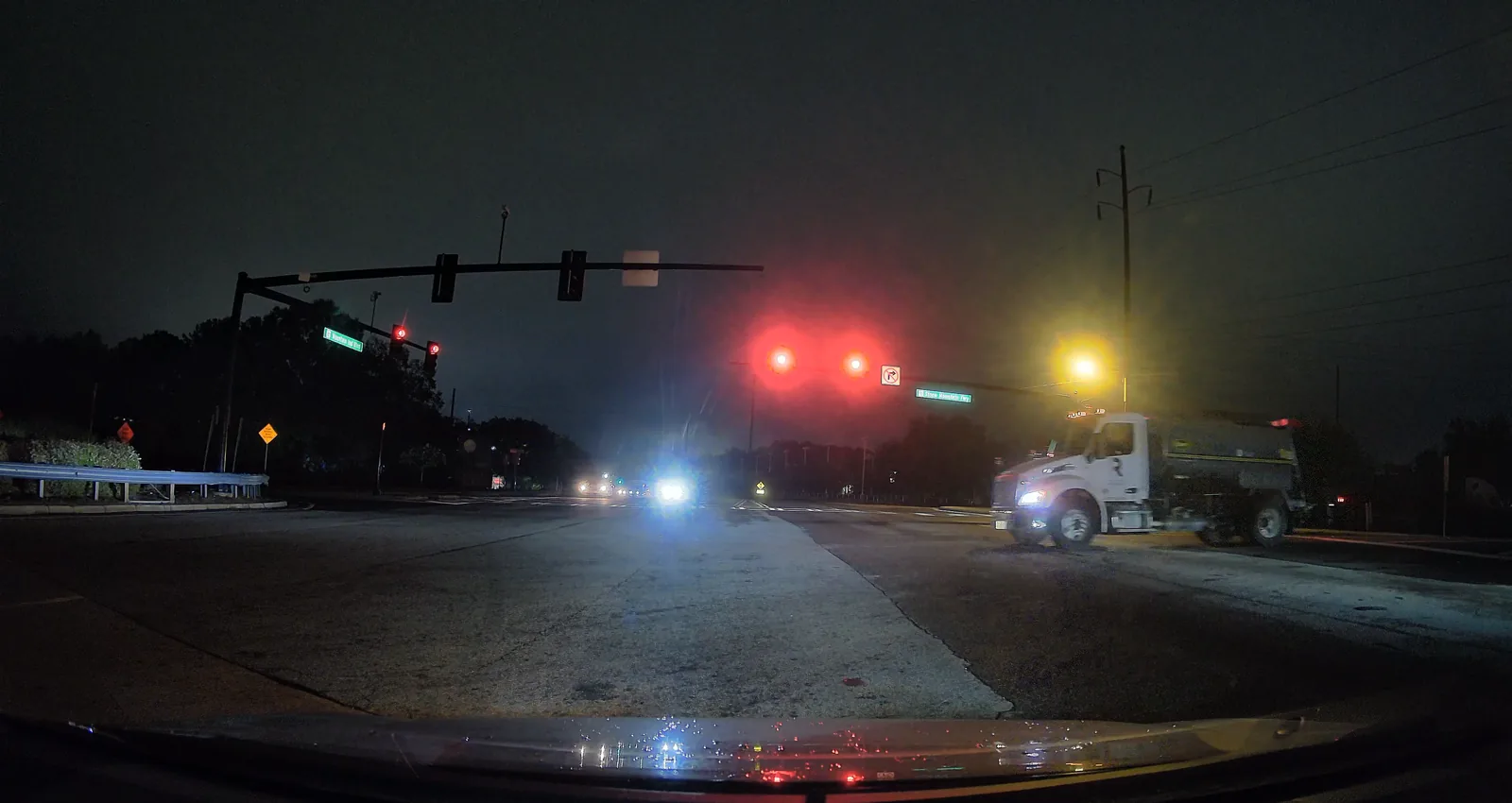
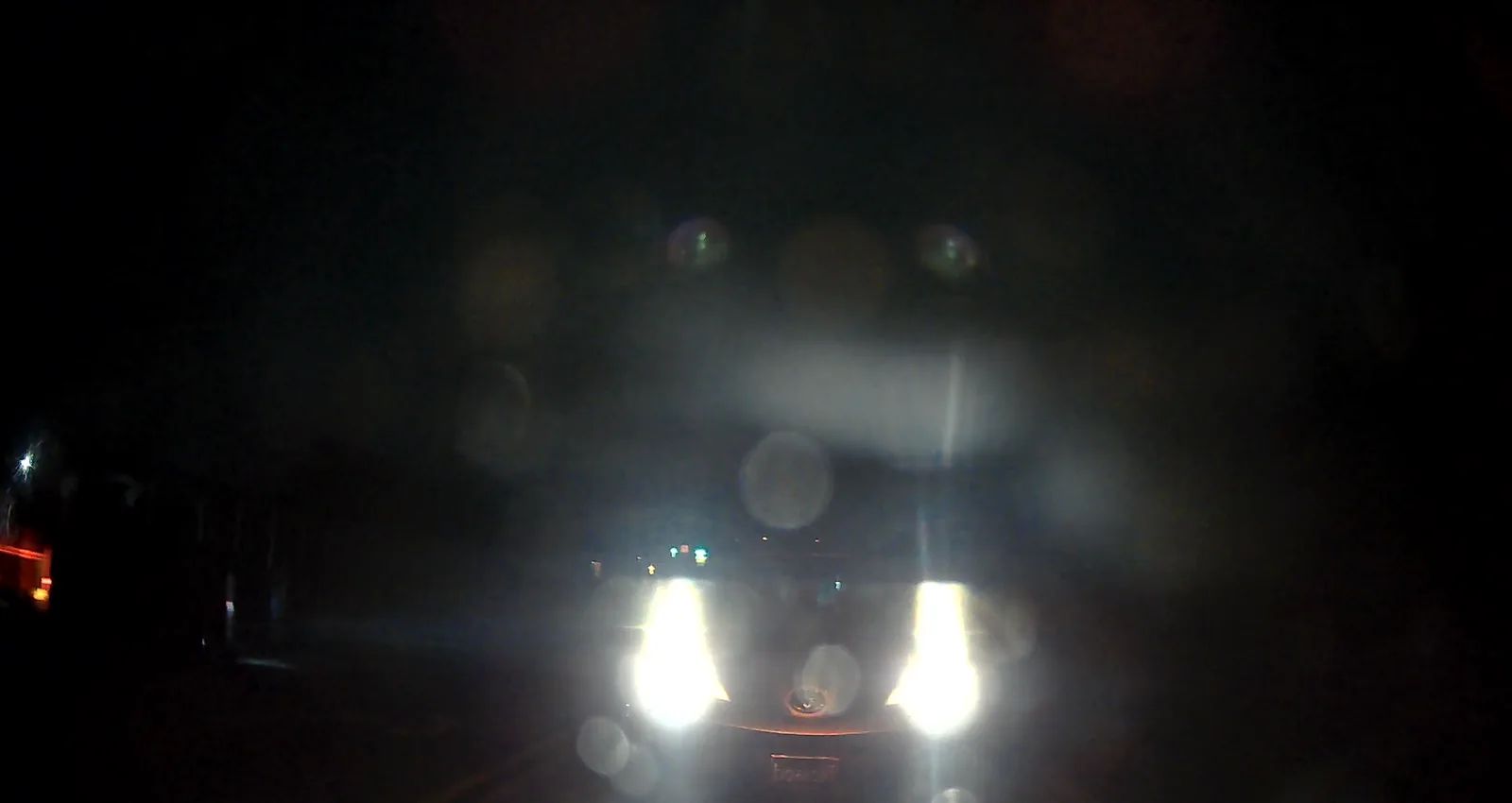
Where that bites: 22 states, mine included, do not require a front plate. The car behind you may have no plate to show your rear camera at all, so the rear channel’s job is to record an identifiable vehicle, and at night the A17D’s rear does not. The front sensor on the box has nothing to do with that.
How I will tell IMX678 dash cams apart
Six measurements, the same on every camera, so the numbers compare across reviews rather than only within one:
- Resolving power on the printed chart: real detail against the pixel grid, plate legibility at fixed distances, and the field-of-view trade.
- Bits: codec, average and peak bitrate, rate control, keyframe interval, and delivered frame rate against claimed, all read from the files.
- HDR behavior: frame-rate cost, ghosting on moving edges, which channels get it, whether it can be turned off, and plate legibility on against off at the same distance.
- Frame-rate integrity: single channel against multi-channel, HDR on against off, claimed against delivered. The 70mai A810’s reported 25 fps with a rear attached is the test case.
- Multi-channel load: what the front channel loses when the rear or cabin camera is plugged in.
- Thermal: case temperature over an hour or more, and whether bitrate or frame rate move with it.
The second measured column is coming. The next camera through this is the VIOFO A119M Pro: the same IMX678 on a newer Novatek processor, with a different company’s tuning. It is on my bench now. VIOFO gets its standalone review first, and when that is live this post gains a second “measured here” row in the spread table and a direct A/B at the processor, encoder and thermal stages. Same sensor, a different processor and different firmware: a direct test of everything above, and I will publish whatever it shows.
What to look for on an IMX678 dash cam spec sheet
- The sensor part number, not the family name. “STARVIS 2” can be 2 megapixels or 8. Ask which.
- The processor, and the frame rate at the top mode with HDR on, with it off, and with the rear attached. The processor and the firmware set that ceiling; the sensor does not.
- The bitrate at the top mode, in megabits, and whether you can raise it. On the same sensor, 32 and 65 are different cameras. If the number is not published, that is information too.
- HDR: on which channels, whether it can be turned off, and what it costs in frame rate. Nobody will tell you DOL or Clear. Watch the frame rate and look for ghosting.
- The rear sensor’s part number. It is the camera that records the vehicle behind you, and it is the one the badge is not about.
- The firmware version in any review you read, this one included: the A17D figures here are firmware V1.
The one thing no spec sheet gives you is what the processor does to the picture, and that only shows up on a chart. Which is why I keep pointing cameras at one.
Frequently Asked Questions
Is the Sony IMX678 a good dash cam sensor?
Yes. The IMX678 is a native 3840 by 2160 security sensor with 2.0 micron pixels and two HDR modes in silicon, and Sony's own flyer shows it matching the previous-generation IMX334 at 0.2 lux with a quarter of the gain. On my chart the COXPAL A17D's IMX678 carries real detail out to 86 percent of the pixel grid's limit, which a 2K upscale cannot do. It is a good floor. It says nothing about the processor, tuning and encoder above it, which is where two IMX678 cameras differ.
Does every 4K dash cam use the IMX678?
Nearly every current one does on the front camera: VIOFO, Vantrue, 70mai, Thinkware, BlackVue, COXPAL and Redtiger all ship IMX678 front cameras. The rear camera is a different story, ranging from a 2 megapixel Sony IMX662 through a 4 megapixel GalaxyCore GC4653 and a 5 megapixel IMX675 to a second IMX678, depending on the model.
What is the difference between STARVIS 2 and IMX678?
STARVIS 2 is Sony's name for a generation of back-illuminated pixel technology, and several different sensors carry it. IMX678 is one specific STARVIS 2 part: 1/1.8 inch, 3840 by 2160, 2.0 micron pixels. The IMX675 (5 megapixels) and IMX662 (2 megapixels) are also STARVIS 2, so a STARVIS 2 badge on its own does not tell you the resolution.
Why does my IMX678 dash cam only record 4K at 30 fps?
Because the processor in front of the sensor, or the maker's firmware, caps it there. Sony's flyer rates the IMX678 at 60 frames per second in all-pixel mode at 12-bit, but COXPAL told me the NT98529 in the A17D encodes 4K at 30 at most, and the cameras that advertise 4K60 get there on a newer chip, with HDR off, or both. Turning HDR on also halves the frame rate on cameras that use the sensor's digital overlap HDR mode.
Does HDR reduce resolution on an IMX678 dash cam?
On the COXPAL A17D, not measurably: two of three controlled chart tests found no resolution cost with HDR on, and it cut blown highlights by roughly a hundred-fold and kept a spotlit license plate legible that HDR off bloomed into a white slab. On a camera that uses the digital overlap mode the cost is frame rate and ghosting on moving edges rather than chart resolution, so the answer depends on the processor, not the sensor.
Which matters more in a dash cam, the sensor or the processor?
Once the sensor is an IMX678, the processor and its encoder. The sensor sets the floor and every camera on it starts from the same place. The processor's sharpening and noise reduction, its firmware tuning, and the bitrate, rate control and keyframe interval the encoder is given decide how much of the sensor's detail reaches the card, and on the A17D a 10 percent bitrate increase measurably bought 6.7 percent more real detail on the chart.