
Wolfbox High Endurance 128GB: a V60 card in a V30 pack
Wolfbox’s own microSD card, which the company sent with a K9 Pro dash cam I was reviewing. I ran it on two readers, from the sealed pack through a write of the whole card, and read its identity registers on a Raspberry Pi. It beat both speeds on its pack and held V60 against the V30 it prints, and its registers match two retail cards that write twice as fast.
No video for this bench run
Everything on this page came off the bench, not a camera. The channel covers the dash cams, phones and readers these cards end up in; subscribe and the next one lands in your feed the day it goes up.
The short version
The Wolfbox High Endurance 128GB is a better card than its pack says. On my primary reader it read 168.4 MB/s against a printed 100 and wrote 83.2 MB/s against a printed 70, and it held V60 on two readers against the V30 it prints, with its worst ten seconds of continuous writing at 78.96 MB/s on the first and 74.55 on the second. There is no fast cache in front of that speed: it writes at a flat 80 MB/s from the first byte to the last. Every one of its 125.7 GB came back byte for byte, and it peaked at 148.5 °F. The words High Endurance come with no rating of any kind, so they are a name, not a spec. My rating: 4.5/5, scored against the CKBench rubric.
Verdict: 4.5/5, beats every speed its pack printsWho this card is for
- YesDash cams and security camerasIts worst ten seconds were 74.55 MB/s, about twelve times what a 4K dash cam writes at 6 MB/s, and it was no slower after the whole card had been written once.
- YesCameras that ask for V60It held V60 on both readers, and its worst ten seconds across a write of the whole card were 75.81 MB/s.
- NoBuyers who want the fastest write on this platformThe Amazon Basics 128GB and the Lexar Blue 128GB report the same capacity, bus and class registers and wrote 143 to 189 MB/s on the same readers, against this card’s 83.
- NoBuyers who want an endurance ratingHigh Endurance is printed with no hours, terabytes or recording condition behind it, and the warranty is 12 months.
125.7 GB of usable space is roughly 5 hours 49 minutes of single-channel 4K at 6 MB/s, or about 11 hours 38 minutes of 1080p at 3 MB/s, before a dash cam loop starts overwriting. Work out your own numbers in the dash cam storage calculator.
What is the Wolfbox High Endurance 128GB?
Wolfbox makes dash cams, and this is its own-brand microSD card. It came to me free with a Wolfbox K9 Pro the company sent for review, in its own retail blister with an SD adapter, as an extra outside the camera’s standard package. The pack prints a read and a write speed, A2, V30, U3, Class 10 and the words High Endurance. The SD card pages on Wolfbox’s US and UK stores did not match it when I looked on 7 November 2026: they quote write speeds of 40 and 85 MB/s against this pack’s 70, and the photos on the US store show a card marked A1. Its Amazon listing, which I found on 9 November, matches the pack’s speeds and class marks, and its photos show the A2 face this card has, though the title leaves out the words High Endurance. It is the first Wolfbox card on my bench.
A card that arrives free with a review camera gets the same test as one I buy, and the same suspicion until it passes. It is in CKBench now, the running index of every card on my bench, beside the card another dash cam brand sent me, the Vantrue Endurance PRO 128GB, and two retail cards it turned out to share its registers with, the Amazon Basics 128GB and the Lexar Blue 128GB.
Every write figure on this page is a committed write: the data is on the flash before the clock stops, with no operating-system cache in the way. That is why the numbers here read lower than a marketing sheet or a quick benchmark; the methodology page explains the difference and why it is the one that matters for recording.
What the Wolfbox High Endurance 128GB claims, and what it did
| Claim | Printed | Measured | Verdict |
|---|---|---|---|
| Capacity | 128 GB (pack front, card face); no definition of a GB printed | 125.7 GB written and verified, zero errors; the card declares 98.18% of its label | VERIFIED |
| Read speed | Up to 100 MB/s (pack front) | 168.4 MB/s (ProGrade PGM0.5); 168.8 MB/s (SanDisk QuickFlow SDDR-B751) | BEATEN |
| Write speed | Up to 70 MB/s (pack front) | 83.2 MB/s committed (ProGrade); 83.1 MB/s (QuickFlow) | BEATEN |
| Speed class | C10 (pack front only) | 74.55 MB/s worst ten seconds on the lower reader, far above C10’s 10 | HELD |
| UHS speed grade | U3 (pack front, card face) | 74.55 MB/s worst ten seconds, against U3’s 30 | HELD |
| Video speed class | V30 (pack front, card face) | 78.96 MB/s worst ten seconds (ProGrade, sealed); 74.55 (QuickFlow, after a whole-card write); 75.81 across the whole-card write | HELD, V60 ON BOTH READERS |
| App performance class | A2 (pack front, card face) | 2,014 read / 1,907 write IOPS at queue depth one on the ProGrade, 2,491 / 2,049 on the QuickFlow, over both A1 floors. Indicative only: the SD A-class procedure differs | NOT TESTABLE |
| Bus | UHS-I (pack front, card face) | Declares SD specification 6.x; reads at 168 MB/s on both readers through a faster bus mode than standard UHS-I, which both readers offer to cards that support it | CONSISTENT |
| Endurance rating | “High Endurance” on the pack front; no hours, no TBW, no bitrate condition | n/a | NOT CLAIMED |
| Operating temperature | Not printed (the Amazon listing says -13 to 185 °F) | 148.5 °F (64.7 °C) at its hottest after five minutes of uncooled writing in a 76 °F room; 20.3 °C under the 85 °C the rubric assumes | NOT CLAIMED |
| Warranty term | 12 months (pack back) | n/a | NOT A PERFORMANCE CLAIM |
Both printed speeds are beaten with room to spare, and the read needs a word of context. Cards limited to the standard UHS-I mode, SDR104, read about 96 to 97 MB/s on my readers; this one reads 168 on both, through a faster bus mode that both readers support. In a reader or camera limited to SDR104 it would be held to that mode’s ceiling like any other card. The class marks all hold, and the video class holds one step above the one printed. A2 is not testable on a USB reader: at queue depth one the card cleared both A1 floors on both readers, which is indicative and nothing more.
The pack, and the card inside it
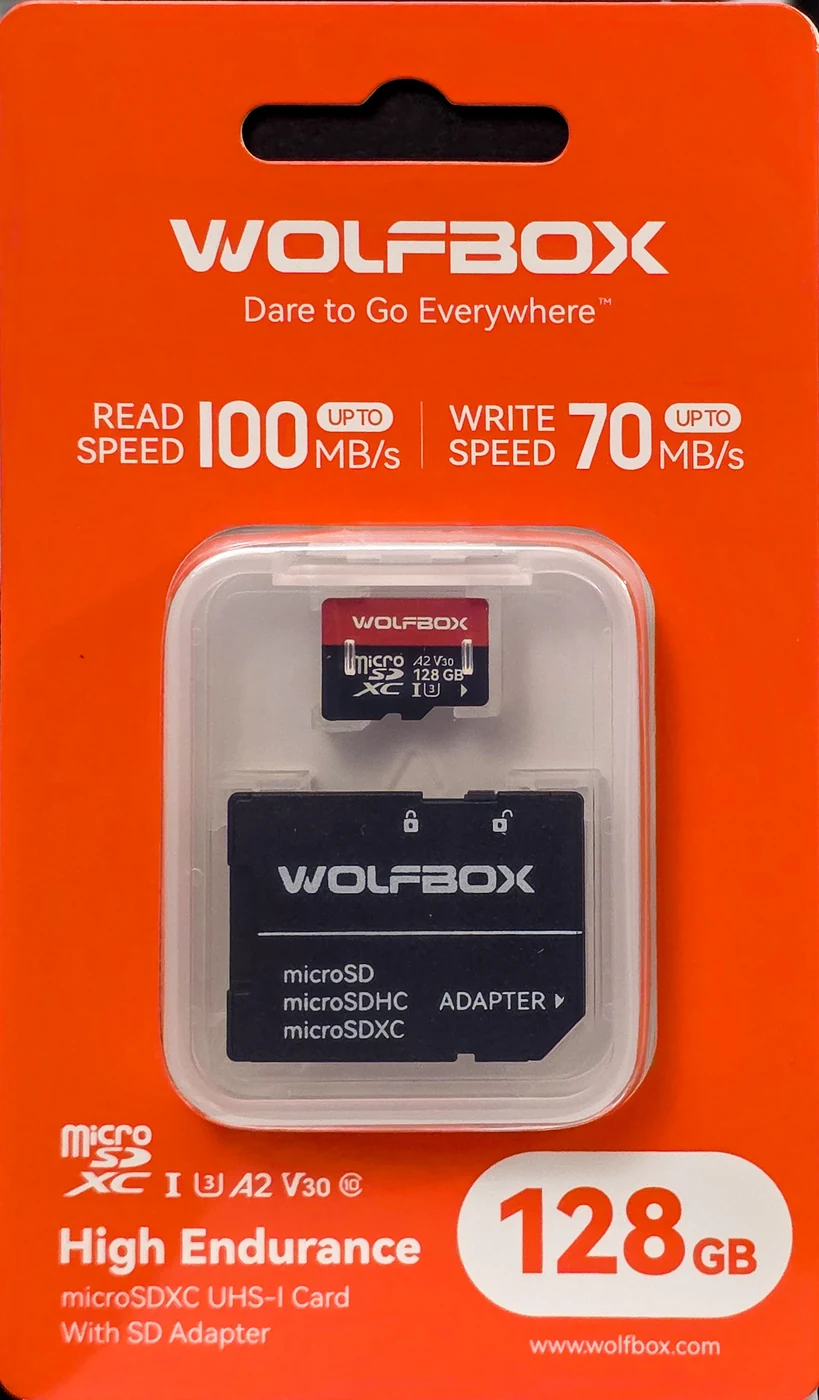
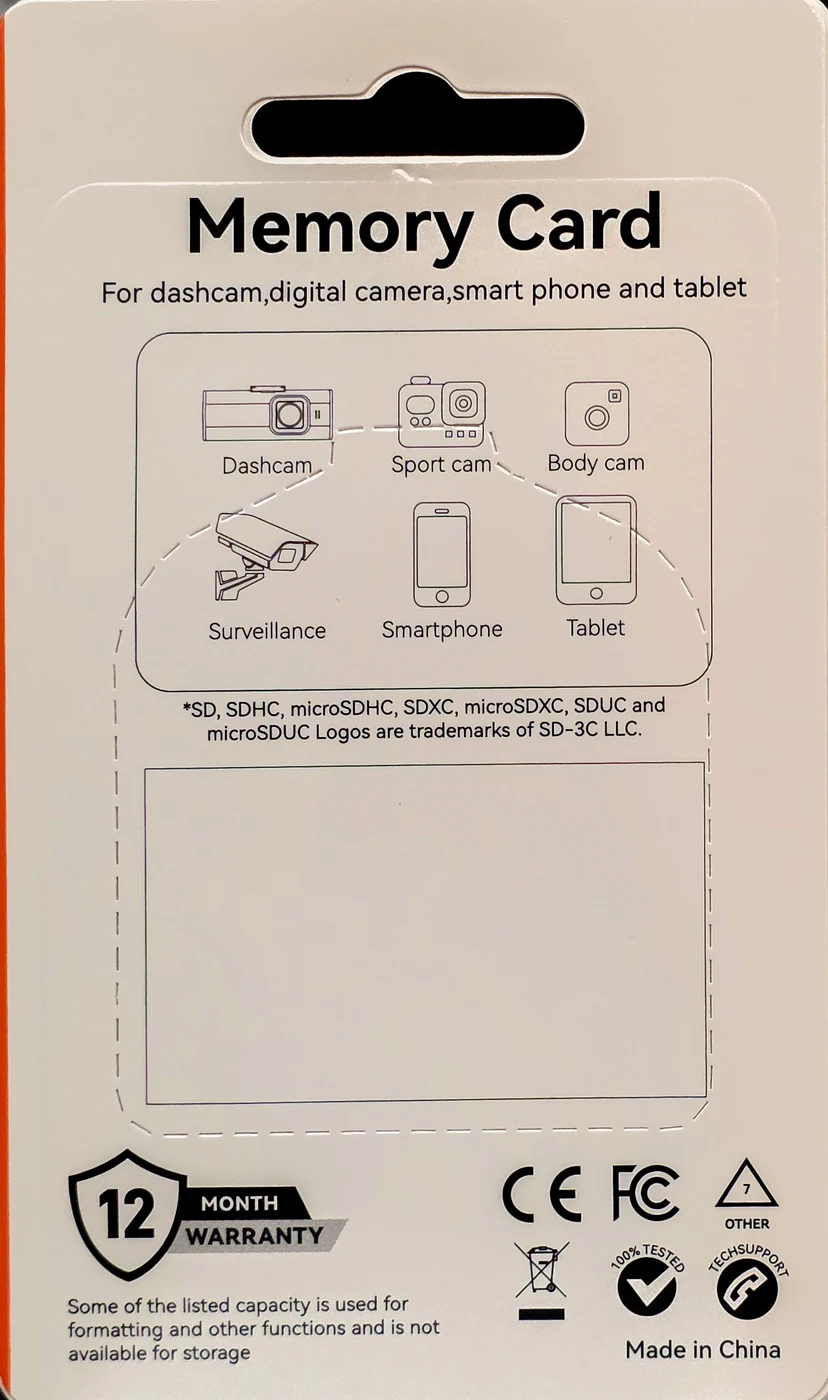
The front carries the speeds, the class marks and the words High Endurance, with the card visible under the plastic above its adapter. The back lists the uses Wolfbox has in mind, dash cams first, then sport, body and surveillance cameras, phones and tablets, and adds a 12-month warranty badge, the SD trademark notice and a line saying some of the listed capacity is used for formatting and other functions. It never says what a GB is, so the card is measured against the usual decimal 128,000,000,000 bytes. There is no model number, barcode or lot code on either side, and the printed label rectangle on the back is empty.
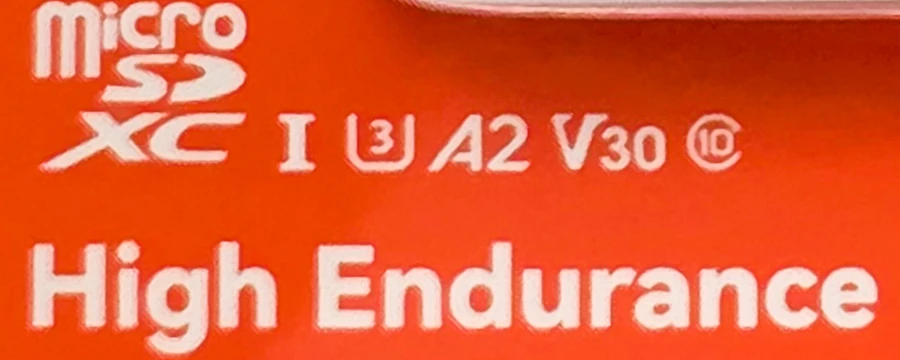
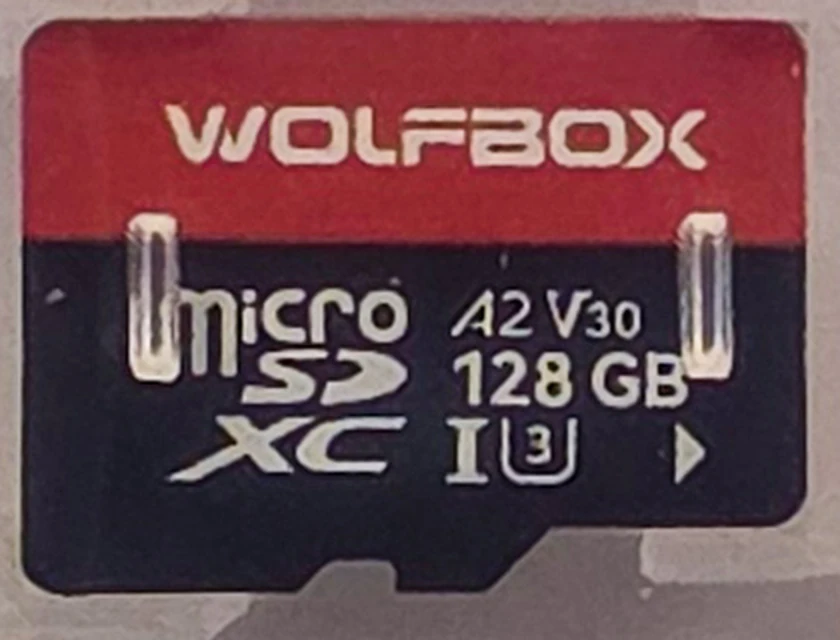
The card itself prints less than the pack. Class 10 and the words High Endurance appear only on the pack front, so the card in a camera carries no endurance claim at all, and there is no speed figure on it. Its registers, which I read before its first run, declare exactly the classes the pack prints: Class 10, U3, V30 and A2. It arrived empty, formatted FAT32 with 64 KiB clusters and no volume label, the same factory format field for field as the Vantrue Endurance PRO’s. I ran it as it came.
A flat 80 MB/s, with no cache to run out
The timed write starts after an untimed warm-up that runs until the speed stops changing, so the five minutes that decide the video class start on a settled card. This card settled at the earliest point the tool can declare, 60 seconds, at 80.46 MB/s. The trace below is the scored first run on the ProGrade, one sample a second, with the speed-class floors marked. The first thirty seconds averaged 80.3 MB/s and the last thirty 80.4, the whole five minutes 80.35, and the worst ten seconds were 78.96 MB/s, at 0:19.
Wolfbox High Endurance 128GB
Plenty of fast microSD cards take data into a quick first stage and slow down once it fills; the bench looks for that knee in every sustained write and every whole-card fill. This card has no quick stage to lose. The first 64 MiB it ever stored went in at 78.51 MB/s, the warm-up’s first ten seconds averaged 80.3, and the whole-card fill further down opens at 80.15 MB/s and closes at 80.08. What a camera gets in its first second of recording is what it gets with the card nearly full.
Two slow seconds on the second reader
The second run, on the QuickFlow after the whole card had been written once, averaged 79.95 MB/s over the same five minutes, within half a percent of the first. Its worst ten seconds came out lower, 74.55 MB/s, and the chart shows why: at 4:21 the speed fell to 57.7 and then 58.7 MB/s for two seconds and went straight back to 80. No single write in that run took longer than 43 milliseconds, so this is a run of slightly slower writes, not a stall; the bench flags any write that takes over half a second.
Wolfbox-High-Endurance-128GB_2026-11-08_142324 (ProGrade PGM0.5, the sealed card’s first run) and Wolfbox-High-Endurance-128GB_2026-11-08_154404 (SanDisk QuickFlow SDDR-B751, about 27 minutes after a write of the whole card).It is not the reader. The same kind of dip turns up in the whole-card fill on the ProGrade: single seconds at 64.0 and 66.1 MB/s about 17 and a half minutes in, and one at 60.8 two minutes later. Across the 2,290 seconds of continuous writing the two runs logged second by second, warm-ups and fill included, I caught three of them, about one every thirteen minutes, so a five-minute run either catches one or misses it. Over a long write this card’s floor is about 75 MB/s, still well clear of the 60 that V60 needs. It also decides the score, because the rubric takes the lower of the two readers, and 74.55 sits 0.45 MB/s under the line for a 5 on sustained performance.
125.7 GB, every byte verified
The capacity test wrote 118 files of unpredictable, dedup-proof data until the card was full, 125,650,665,472 bytes, then read every one of them back and compared. Zero mismatched bytes. Zero read errors. The writing took 25 minutes 18 seconds of I/O at 82.8 MB/s and the read-back 12 minutes 26 seconds at 168.5. Across the first, middle and last tenth of the card the write ran at 80.08, 80.17 and 80.04 MB/s, a spread of 0.16%, and the read spread by 0.98%: flat from one end of the card to the other, where the three no-brand fakes on my bench spread by 10 to 23%.
Every byte, written and read back
The flat 80 MB/s ran through the whole fill, every tenth of it between 79.85 and 80.18 MB/s, and the worst ten seconds anywhere in it were 75.81 MB/s, still V60. The chart below puts this fill beside the only two other cards on my bench that declare exactly the same capacity. They carry the same registers besides, and all three were filled on the same reader.
Wolfbox-High-Endurance-128GB_2026-11-08_142324, Lexar-Blue-128GB_2026-09-04_102023 and Amazon-Basics-128GB_2026-09-17_093850. All three verified every byte. The Lexar Blue and the Amazon Basics sit at the ProGrade’s own write ceiling, not theirs: on the QuickFlow the Amazon Basics wrote 189.4 MB/s.The card declares 125,671,833,600 bytes, 98.18% of the 128 GB on the label, which is ordinary overhead for a genuine card and the same figure as its two register twins. Windows will show it as about 117 GB, because it counts in binary. That is arithmetic, not a shortfall; the methodology page has the conversion. The capacity row of the rubric scores the declared share of the label, and 98.18% is a 4.5.
The registers of two cards that write twice as fast
Every SD card carries registers, written at the factory, that a USB reader cannot show and a native SD host can. One names the card: manufacturer ID, OEM ID, product name, revision, serial and build date. The others describe it: how big it is, which SD specification it follows and which speed classes it declares. I read this card’s on a Raspberry Pi before its first run. Its identity register reports manufacturer ID 0xAD with the OEM field LS, which my manufacturer ID register attributes to Longsys, the company that owns Lexar, and the white-label product name USD00 at revision 2.0, built in October 2025. Its capacity, specification and class registers are byte for byte those of the Amazon Basics 128GB and the Lexar Blue 128GB. Of the 41 cards whose registers I have read, these three are the only ones that declare exactly 125,671,833,600 bytes.
| Field | Wolfbox High Endurance 128GB | Lexar Blue 128GB | Amazon Basics 128GB | Vantrue Endurance PRO 128GB |
|---|---|---|---|---|
| Manufacturer ID / OEM ID | 0xAD / LS | 0xC9 / 0x4D60 | 0xAD / LS | 0xAD / LS |
| Product name / revision | USD00 / 2.0 | MSSD0 / 2.0 | USD00 / 2.1 | USD00 / 1.0 |
| Build date | October 2025 | December 2025 | February 2025 | April 2025 |
| Capacity, specification and class registers | (this card) | identical | identical | identical except the capacity |
| Factory format | FAT32 | exFAT | exFAT | FAT32 |
| Sequential read, ProGrade / QuickFlow | 168.4 / 168.8 MB/s | 168.4 / 168.5 MB/s | 168.6 / 206.1 MB/s | 96.5 / 96.5 MB/s |
| Sequential write, ProGrade / QuickFlow | 83.2 / 83.1 MB/s | 152.6 / 142.6 MB/s | 157.3 / 189.4 MB/s | 84.7 / 85.0 MB/s |
| Worst ten seconds, ProGrade / QuickFlow | 78.96 / 74.55 MB/s | 155.08 / 154.98 MB/s | 155.92 / 188.11 MB/s | 83.36 / 83.36 MB/s |
The registers predicted the read and not the write. This card reads exactly like the Lexar Blue on both readers, 168 MB/s, the bus behavior a shared register set implies, and only the Amazon Basics goes faster on the QuickFlow. It writes at about half the rate of either twin. Its write is the Vantrue Endurance PRO’s to within 2 MB/s, the other dash cam brand’s USD00 card on my bench, though the Vantrue reads at plain UHS-I speed. And of the six microSD cards on my bench from Longsys and its Lexar brand, the three sold by dash cam brands write well below the three sold by retail ones: on the CKBench table the VIOFO High Endurance 32GB, the Vantrue and this card hold 34 to 83 MB/s through their worst ten seconds, the Amazon Basics, the Lexar Blue and the Lexar Silver Plus 155 or more.
That is six cards and an observation, not an explanation. The flash and firmware behind identical registers are invisible to anything I can measure, and the factory format does not explain a gap this size (the filesystem moves a card’s speed by under 1% on my bench). The LinkMore XV23 Lite taught the same lesson on another platform, and the identity explainer lays out why a register match names a platform and not a card. It is the reason I bench every card rather than trusting one.
Sealed or filled, the same card
Two things can make a card’s first run unrepresentative, and this one shows neither. The first is a slow start. The two USD00 cards on my bench at revision 1.0, the VIOFO High Endurance 32GB and the Vantrue, ran slow on their first-ever writes and recovered for good after about 6 GB; I never established why. This card arrived sealed, so its first run was its first-ever writing, and every leg of it ran at its normal speed: 9.65 GB had gone onto the card before the timed five minutes began. One unit at revision 2.0 cannot say whether those slow starts belonged to revision 1.0 or to something else, so I am reporting what this card did, not why the others did what they did.
The second is what a full card does. Some cards write much more slowly once every block has been written, until something tells them which space is free again, and a dash cam never sends that signal; why a used microSD card tests slower covers the effect. This card’s second run started about 27 minutes after the first run’s whole-card fill and read-back, on the other reader, with the card neither formatted nor erased in between.
| Measurement | Sealed, first run (ProGrade) | After a whole-card write (QuickFlow) |
|---|---|---|
| Sequential write, committed | 83.2 MB/s | 83.1 MB/s |
| Sustained write, steady state | 80.35 MB/s | 79.95 MB/s |
| Sustained write, worst ten seconds | 78.96 MB/s | 74.55 MB/s, the two-second dip |
Filled once, on another reader, the card came back within 0.4 MB/s of its sealed self on every steady figure. There is no used state to recover from.
Random writes do not move it
Loop recording is a long write interrupted constantly by small ones, and random 4K writes are the bench version of that: three twenty-second passes, and the question is whether the third is as fast as the first. On the scored run all three ran at 7.81 MB/s, 1,906, 1,908 and 1,907 write IOPS, a fade of 0.0%, and the card was back at 90% of its sustained rate within 10 seconds of continuous writing afterwards.
One minute of loop-recording abuse
This card: run Wolfbox-High-Endurance-128GB_2026-11-08_142324 · reference card: lab baseline, same bench, same test · cardcheck v0.8.5
The QuickFlow run differs in the way random figures on my bench usually do. It read 24% more IOPS at random than the ProGrade, 2,491 against 2,014, and wrote 7% more, and its write passes faded 10.4%, from 8.98 to 8.05 MB/s. Random figures move with the reader, which is part of why the A classes cannot be tested on a USB reader. The rubric scores the primary reader’s run, where this is a 5; scored on the QuickFlow’s it would be a 4, and the overall would still be 4.5.
High Endurance, with no rating behind it
SanDisk’s High Endurance cards print an endurance rating in hours, along with the video bitrate it assumes, 26 Mbps on both SanDisk boxes I have checked; the endurance-rating explainer works through what those hours mean. This pack prints the words High Endurance on its front and nothing else: no hours, no terabytes written, no bitrate. The card itself does not carry the words at all. The VIOFO High Endurance and the Vantrue Endurance PRO, two other dash cam brands’ cards, print no rating either.
So there is nothing to verify, and nothing on this bench measures endurance in any case: three random-write passes show how a card copes with churn, not how long it lasts. The warranty is 12 months, a short term for a card sold on its endurance. Read High Endurance on this pack as a name. How the card behaves under a dash cam’s kind of load is a different question, and the rest of this page measures it.
148.5 °F at its hottest
The pack prints no operating temperature, so the rubric assumes 85 °C, as it does for any card without one. The Amazon listing gives -13 to 185 °F, and though the rubric does not take a range from a retail listing, 185 °F is the same limit. At the end of five minutes of uncooled writing in a 76 °F room the card read 148 °F, and the thermal frame taken in the last seconds of that write reads 148.5 °F at its hottest point. That is 64.7 °C, 20.3 °C under the assumed 85, and it scores a 4.5.
It got warm. It did not slow down.
Run Wolfbox-High-Endurance-128GB_2026-11-08_142324 · cardcheck v0.8.5 · ProGrade PGM0.5
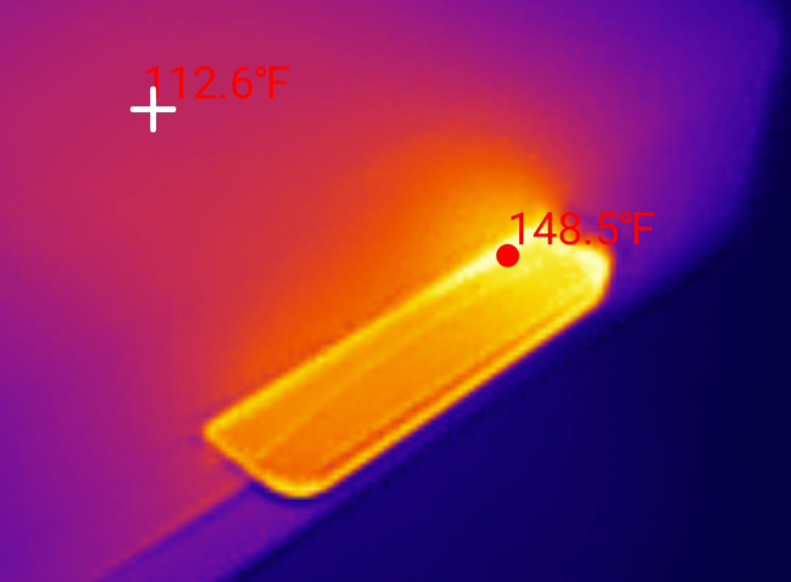
It did not throttle: the last thirty seconds of the timed write ran at 80.4 MB/s against 80.3 for the first thirty. Of the six Longsys-family microSD cards on my bench it ran the coolest, against 162 °F for the Lexar Blue and 171 °F for the Amazon Basics, and the reason is work rather than design, because it writes at half their rate. Per megabyte a second of writing it warmed more than either twin, about 0.9 °F of rise against about 0.6, and less than the Vantrue at about 1.1, which writes at the same rate and ran more than 20 °F hotter. A windshield in summer is hotter than a reader with its fan off, so the 20.3 °C of margin is worth having; for a dash cam in a hot climate, it is the figure to keep in mind.
Two readers, one write speed
Every card I review runs on my primary reader, a ProGrade PGM0.5, and again on a SanDisk QuickFlow SDDR-B751, which can drive a faster bus mode on cards that support one. This card ran once on each, the ProGrade run first and with the whole-card fill.
| Measurement | ProGrade PGM0.5 (primary) | QuickFlow SDDR-B751 |
|---|---|---|
| Card at the start of the run | sealed, first-ever writes | after a whole-card write |
| Sequential read | 168.4 MB/s | 168.8 MB/s |
| Sequential write, committed | 83.2 MB/s | 83.1 MB/s |
| Sustained write, steady state | 80.35 MB/s | 79.95 MB/s |
| Sustained write, worst ten seconds | 78.96 MB/s | 74.55 MB/s |
| Random 4K read / write | 2,014 / 1,907 IOPS | 2,491 / 2,049 IOPS |
| Random 4K write fade | 0.0% | 10.4% |
| Peak temperature | 148.5 °F (frame) | not taken |
| Longest single write | 49 ms | 43 ms |
The two readers agree to within half a percent on every sequential and steady write figure, so the card sets its speed, not the reader, and neither reader comes near its own write ceiling with this card. The worst ten seconds differ only by the dip described above. The QuickFlow found no faster read either: 168 MB/s is the card’s own read on both, where the same reader takes the Amazon Basics to 206.
How the 4.5 breaks down
Wolfbox High Endurance microSDXC 128GB
Scored against the CKBench rubric. Five dimensions, each out of 5, every row read off its published table.
Final score: 4.5 out of 5. The five dimensions average 4.7. It beats every speed it prints, holds V60 against a printed V30 and verifies every byte, and gives back half points for a dip that puts its worst ten seconds just under the top sustained band, an ordinary 98.18% of its label, and 20.3 °C of margin under an assumed limit.
The first reader alone would have scored the sustained row a 5 and the card a 5 overall, from a mean of 4.8. When a card runs on two readers the rubric takes the lower figure, and the dip that set 74.55 belongs to the card, as the fill on the other reader shows, so 4.5 is the honest reading rather than bad luck. Running it again could not raise it either: another run only adds a figure, and the lowest one stands.
Frequently Asked Questions
Is the Wolfbox High Endurance 128GB a good microSD card?
Yes. It beat both speeds printed on its pack, reading 168.4 MB/s against 100 and writing 83.2 MB/s against 70 on my primary reader, and it held V60 on two readers against the V30 it prints, with its worst ten seconds of continuous writing at 78.96 and 74.55 MB/s. It verified every one of its 125.7 GB with zero errors and peaked at 148.5 °F. It scores 4.5 out of 5.
Is the Wolfbox High Endurance 128GB good for a dash cam?
Yes. Its worst ten seconds of continuous writing were 74.55 MB/s, about twelve times what a 4K dash cam writes at 6 MB/s, and it writes at the same flat 80 MB/s from an empty card to a full one, with no fast stage to run out of. It was no slower after a write of the whole card, and it peaked at 148.5 °F in a 76 °F room with no throttling. Its 125.7 GB holds about 5 hours 49 minutes of 4K at 6 MB/s.
How fast is the Wolfbox High Endurance 128GB?
On my bench it read 168.4 MB/s on a ProGrade PGM0.5 reader and 168.8 on a SanDisk QuickFlow SDDR-B751, against the 100 printed on the pack, and wrote 83.2 and 83.1 MB/s against the printed 70. Over five minutes of continuous writing it averaged about 80 MB/s on both readers. The read needs a reader with a faster bus mode than standard UHS-I; on my readers, cards limited to the standard SDR104 mode read about 96 to 97 MB/s.
Is the Wolfbox High Endurance 128GB really 128GB?
Yes. I filled every free byte with unpredictable data and read it all back: 125,650,665,472 bytes written and verified, zero mismatched bytes, zero read errors. The card declares 125,671,833,600 bytes, 98.18% of the 128 GB label, which is ordinary overhead for a genuine card. Windows shows it as about 117 GB because Windows counts in binary.
What does High Endurance mean on the Wolfbox card?
Nothing you can measure. The pack prints High Endurance on the front with no endurance rating of any kind: no hours, no terabytes written and no recording bitrate, and the card itself does not carry the words. The warranty is 12 months. SanDisk’s High Endurance cards, by contrast, print a rating in hours with the bitrate it assumes. My bench does not measure lifespan, so I treat the words as a product name.
Does the Wolfbox High Endurance 128GB slow down when it is full?
No. Writing the whole card took it from 80.15 MB/s at the start to 80.08 at the end, with every tenth of the card between 79.85 and 80.18, and a second run on another reader after that fill wrote within half a percent of the first. Its worst ten seconds anywhere in the whole-card write were 75.81 MB/s, still above the 60 that V60 needs.
Is the Wolfbox card the same as the Amazon Basics or Lexar Blue 128GB?
Not in how it writes. All three report identical capacity, specification and class registers, and the Wolfbox and the Amazon Basics also share Longsys’s manufacturer ID and the product name USD00. The Wolfbox reads exactly like the Lexar Blue, 168 MB/s on both of my readers, but it writes at about 83 MB/s where the Lexar Blue and the Amazon Basics wrote 143 to 189 on the same readers. Identical registers describe a platform; they do not show the flash and firmware behind it.
The bottom line
The Wolfbox High Endurance 128GB is a good dash cam card in a pack that undersells it. It beats both speeds it prints, holds V60 where the pack says V30, writes at the same 80 MB/s on an empty card and a full one, and verifies every byte of an ordinary 98.18% of its label. It runs cool because it writes at a moderate rate, and a whole-card write did not slow it down. The 4.5 rather than a 5 comes from two seconds near 58 MB/s on the second reader, a dip the card repeats now and then; its long-write floor is about 75 MB/s, comfortably above the 60 a V60 camera relies on.
Two things on the pack deserve less weight than they get. High Endurance has no rating behind it, and the warranty is 12 months. And the registers it shares with the Amazon Basics 128GB and the Lexar Blue 128GB do not make it either card: both wrote about twice as fast on the same readers. For a dash cam or anything else that records at V60 rates or below, this card does the job with room. If raw write speed matters more to you, the same platform comes faster under other labels.
Sample size: one unit, supplied by Wolfbox with a K9 Pro review camera, sealed. Two runs on two readers on 8 November 2026 under CKBench protocol v1.28.
Device identity: what this card reports about itselfFor anyone checking their own card or tracking silent hardware revisions
| Raw CID register | ad4c53555344303020…a19a00 (serial digits elided) |
| Manufacturer ID (MID) | 0xAD, attributed to Longsys in my register; the Amazon Basics 128GB, the Vantrue Endurance PRO 128GB, the VIOFO High Endurance 32GB and two Lexar cards report it too |
| OEM / application ID (OID) | 0x4C53, “LS” |
| Product name (PNM) | USD00, a white-label name shared with the Amazon Basics, Vantrue and VIOFO cards above |
| Product revision (PRV) | 2.0 |
| Serial number (PSN) | Per unit, withheld |
| Manufacture date (MDT) | 10/2025 |
| Declared capacity (from CSD) | 245,452,800 sectors of 512 bytes = 125,671,833,600 bytes, 98.18% of the label; byte for byte the Amazon Basics 128GB’s and the Lexar Blue 128GB’s |
| SD specification (from SCR) | SD_SPEC 2 with SD_SPEC3 = 1, SD_SPEC4 = 1 and SD_SPECX = 2 (specification 6.x), so the UHS-I and U3 marks are legitimately declared |
| Declared classes (from SD Status) | Class 10, U3, V30 and A2, matching the pack |
| Factory format | FAT32, 64 KiB clusters, no volume label, no user files, the partition starting 4 MiB into the card |
| Captured on | Raspberry Pi 4 native SD host, no USB bridge in the path · 2026-11-08 |
The MID, OEM ID, product name and revision are model-level, but on this platform they are shared across brands, so a match tells you the platform, not the card. The serial and the manufacture date are per unit.
Disclosure: Wolfbox provided this card free with a K9 Pro dash cam I was reviewing, along with the camera and a hardwire kit. I did not buy it, and Wolfbox describes it as an extra that is not part of the camera’s standard package. Wolfbox had no editorial input, saw no result before publication, and had no opportunity to influence any number on this page. This post contains affiliate links. As an Amazon Associate I earn from qualifying purchases, at no extra cost to you. Affiliate links like these and my YouTube channel are what keep the site running.