
Vantrue Endurance PRO 128GB: a card that claims almost nothing
No read speed. No write speed. No endurance rating, on a card with the word Endurance on its face. Four class marks and a capacity are the only things here I can hold it to, so I held it to all five.
The camera this card came with gets its own video
There is no video for this bench run, but the Vantrue dash cam that arrived alongside this card is going on camera. Subscribe and it lands in your feed the day it goes up.
The short version
It is a good card that tells you almost nothing about itself. Every mark it does print is true, and two of them it beats: it prints V30 and it held 83.4 MB/s through its worst ten seconds, which is V60 territory and 2.8 times the floor it is certified to. All 126.4 GB came back byte for byte with zero read errors. What it will not tell you is how fast it is in either direction, or what endurance the word on the front is supposed to mean, because neither figure is printed anywhere on the card or the box. The one place it is genuinely behind its peers is heat: it ran hotter than any other 128GB card I have measured, in an air-conditioned room, for mid-pack throughput. My rating: 4.5/5, scored against the CKBench rubric.
Verdict: 4.5/5, keeps every promise it makes and makes remarkably fewWho this card is for
- YesAny dash cam, including multi-channel 4K rigsIts worst ten seconds run about fourteen times what a four-channel dash cam actually asks of a card, and the write curve is flat for five minutes with no cache cliff anywhere in it.
- YesAnyone who wants capacity they can trustEvery free byte was written with unpredictable data and read back and compared. Zero mismatches, zero read errors.
- NoA car that bakes, if you have a cooler option in front of youIt reached the highest peak temperature of any 128GB card on this bench while doing mid-pack work in a 76 °F room. It never slowed down, so this is about margin rather than measured failure, but margin is what a windshield in July eats.
- NoShoppers who compare on printed numbersThere is no read or write figure to compare, and no endurance rating to weigh against the cards that publish one.
126.4 GB of usable space is roughly 5 hours 50 minutes of single-channel 4K at 6 MB/s, or about 11 hours 40 minutes of 1080p60 at 3 MB/s, before the loop starts overwriting. Work out your own numbers in the dash cam storage calculator.
Why a card with no numbers on it is worth testing
Most cards give you something to check. A printed 100 MB/s read, a 40 MB/s write, an endurance figure in hours with a bitrate condition in the fine print. This one gives you four class marks, a capacity, and a two-year warranty, and that is the entire list. Which makes it an unusually clean test: there is no marketing figure to beat or miss, so the bench is measuring the card rather than adjudicating a claim. It joins CKBench, the running index of every card on the bench, alongside the VIOFO High Endurance pair, which is the other dash cam brand selling an endurance card with no endurance rating on it, and the SanDisk MAX Endurance 128GB, which prints a full hours ladder and the bitrate that ladder assumes.
One unit, supplied by Vantrue, tested on September 10, 2026. Three full runs across two independent card readers, because the first run disagreed with the two that followed and I would rather show you that than quietly drop it. The same two-reader method cuts the other way too: on a used SanDisk High Endurance 512GB it pinned a multi-second write stall to the card, because the fault followed the card to the second reader instead of staying behind.
Why my write numbers read lower than other reviews. Every write here is committed to the card and confirmed before the clock stops, the way a dash cam actually writes, so my figures land below burst benchmarks like CrystalDiskMark that measure a few seconds of the card's RAM buffer. That rule, and the decimal MB/s and binary MiB conventions used throughout, are set out on the how we test and score page.
What the box claims, and what the card did
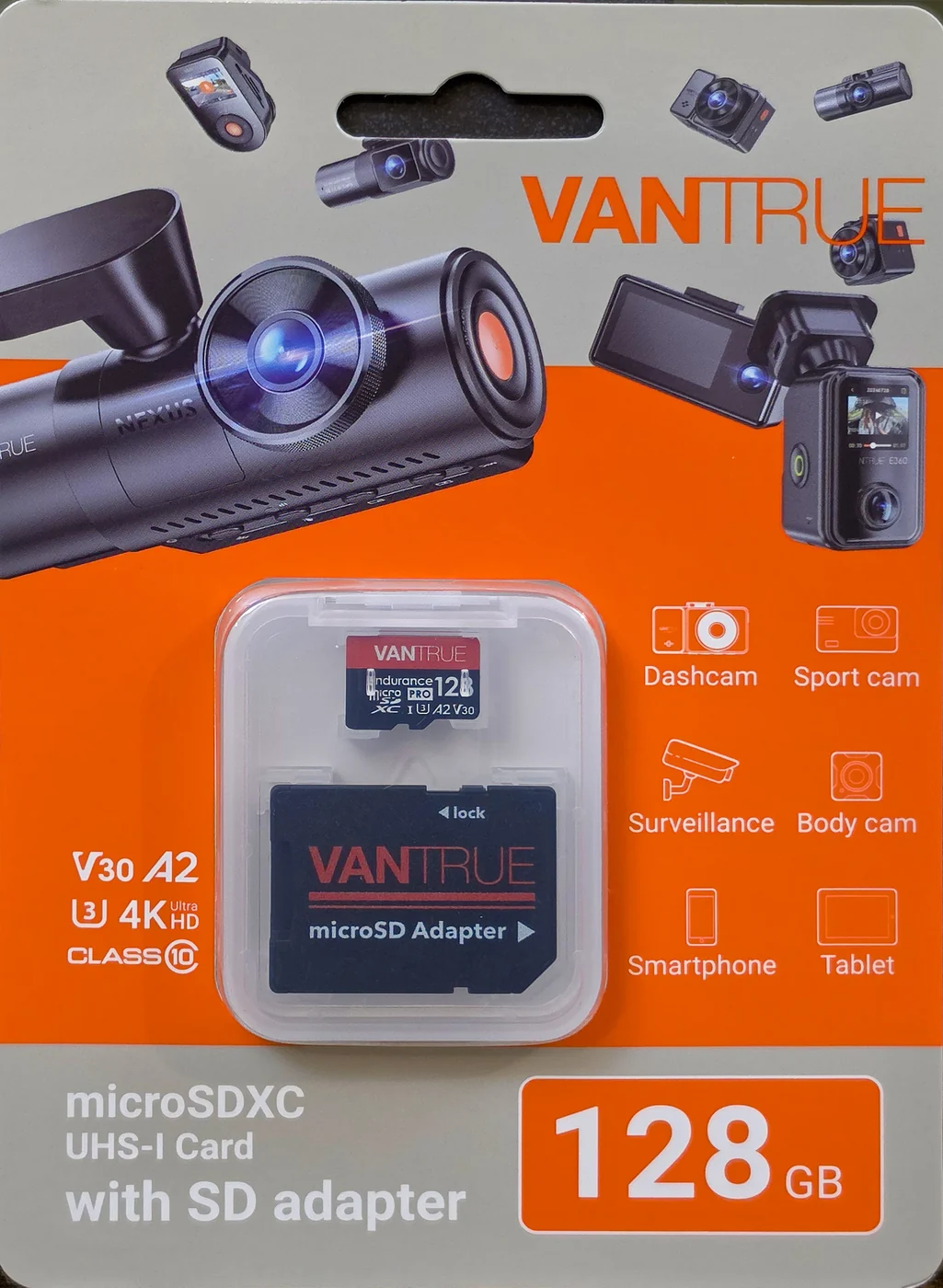
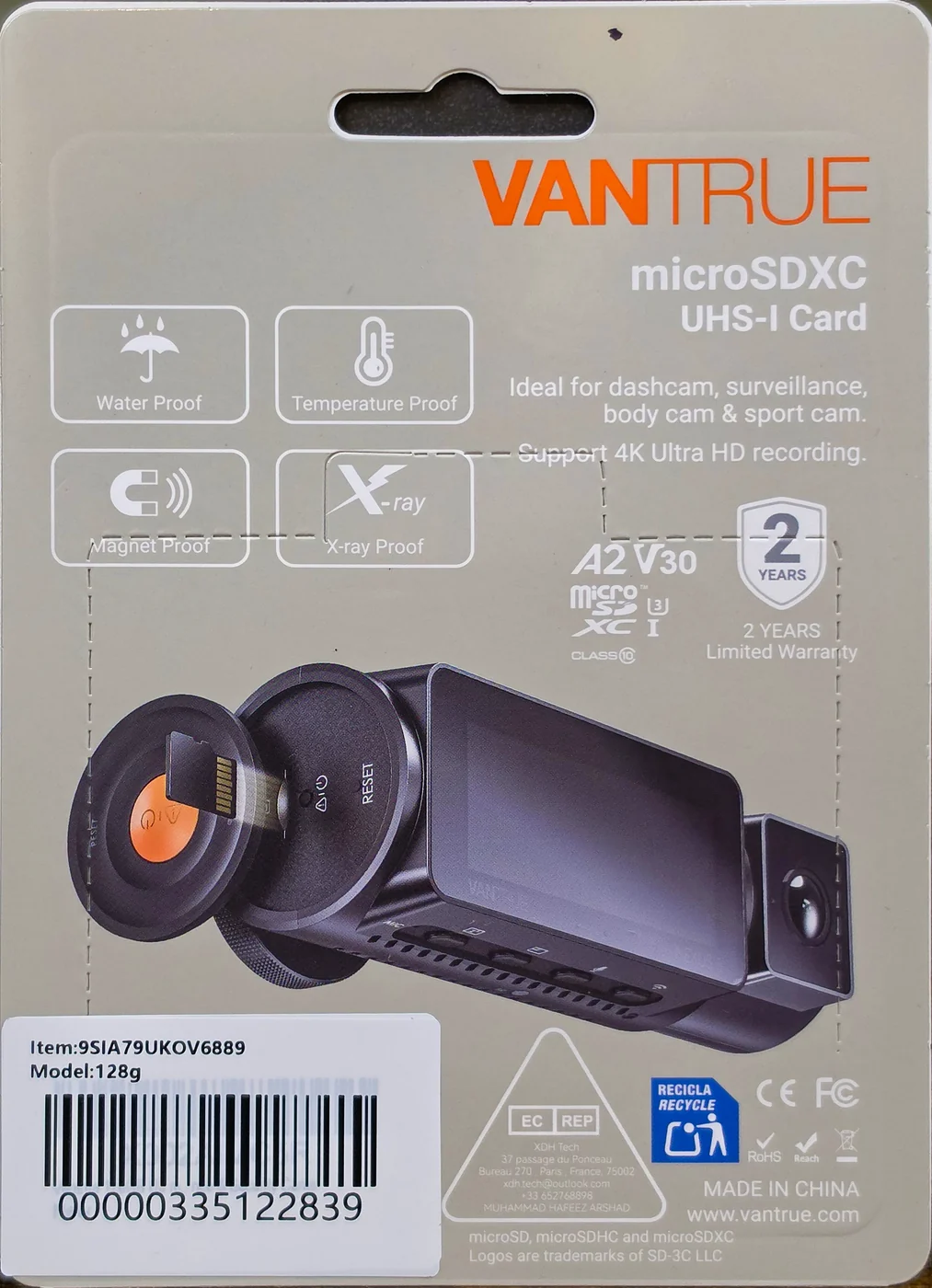
Everything below is read off the retail packaging and the card face, which agree with each other. Half of this table is empty on purpose: a claim the card does not make still gets a row, because the absence is information.
| Claim | Printed | Measured | Verdict |
|---|---|---|---|
| Capacity | 128GB (packaging + card face) | 126.4 GB written and verified, 98.8% of label | VERIFIED |
| Read speed | Nothing printed | 96.5 MB/s (ProGrade PGM0.5 microSD slot) | NOT CLAIMED |
| Write speed | Nothing printed | 84.7 MB/s committed | NOT CLAIMED |
| Speed class | C10 (packaging + card face) | 83.4 MB/s worst ten seconds | HELD |
| UHS speed grade | U3 (packaging + card face) | 83.4 MB/s worst ten seconds | HELD |
| Video speed class | V30 (packaging + card face) | 83.4 MB/s worst ten seconds, clears the V60 floor | BEATEN |
| App performance class | A2 (packaging + card face) | 1,689 read / 983 write IOPS at queue depth 1 | NOT TESTABLE |
| Endurance rating | Nothing printed. No hours, no TBW, no bitrate condition | n/a | NOT CLAIMED |
| Operating temperature | Temperature proof is ticked. No range given | n/a | NOT CLAIMED |
| Warranty term | 2-year limited (packaging) | n/a | NOT A PERFORMANCE CLAIM |
A2 is not a failure and I never score it as one. The A-classes assume command queuing that USB card readers do not perform, so A2 is untestable on any reader bench, for any card. The A1 thresholds of 1,500 read and 500 write IOPS are at least measurable at queue depth 1, and this card cleared both.
The word Endurance appears once, and never again
The card face reads Endurance PRO. The packaging never uses the word at all, and neither surface carries an endurance rating of any kind: no hours, no terabytes written, no bitrate condition to hang a figure on. That is not unique. The VIOFO High Endurance cards, all three capacities of them, do exactly the same thing, which is what turns it from one brand's quirk into a pattern worth naming. The contrast is SanDisk, whose High and MAX Endurance boxes both print a capacity-indexed hours ladder and the 26 Mbps Full HD condition that ladder assumes, so you can convert it into something real.
I cannot tell you why the rating is absent, and I am not going to guess. What I can tell you is what is printed, which is on the back of the pack in the two photos below, and that the model field on the applied label reads 128g. That is the capacity restated, not a part number, which means there is no SKU here to tell this hardware apart from a future revision of it.
How fast is it when the writing does not stop?
This is the number that decides a video speed class, and it is always the worst ten-second window rather than an average, because a camera does not get to record over the mean. Five minutes of continuous committed writing with the cooling fan off, sampled once a second.
Vantrue Endurance PRO 128GB
Flat, and two grades above what it prints
Ten consecutive thirty-second blocks land between 84.1 and 84.4 MB/s. The worst single second in the whole five minutes is 77.6 MB/s. There is no cache cliff, and I checked that twice: the knee scan came back with no knee, and the whole-card fill later in this review held 82.4 MB/s across 126.4 GB without a single sample dropping below 60.
Against the V30 the card prints, 83.4 MB/s is 2.8 times the floor. It clears V60 as well, which is two grades above its own label. That is worth saying plainly and then putting in proportion: the one dash cam duty cycle I have actually measured, by reading a four-channel camera's own recordings off its bundled card, came to about 4.8 MB/s aggregate. This card's worst moment is roughly fourteen times that. For the job it is sold for, sustained write was never going to be the constraint, and the honest read is that it has enormous headroom rather than that it is unusually fast.
Does it slow down under the writes loop recording actually makes?
Loop recording is not one long clean write. It is scattered small writes: event saves, file table updates, overwrites of the oldest clip. Three passes of random 4K writes in a row shows whether a card's controller degrades as that churn accumulates. This is a directional indicator, not an endurance test, and nothing done in an hour tells you about year three.
One minute of loop-recording abuse
This card: run Vantrue-Endurance-PRO-128GB_2026-09-10_175034 · reference card: lab baseline, same bench, same test · cardcheck v0.8.3
It does not fade at all
983, 982, 983 write IOPS across three consecutive passes. The last pass sits 0.04% below the best one, which is noise rather than degradation. For comparison, the reference card in that panel is a cheap Class 4 unit that loses 71% of its write IOPS across the same three passes, and that collapse is what this test exists to find.
The settle behavior says the same thing from another angle. The bench writes an untimed warm-up pass before the timed one so the measured window starts on a controller that has finished reacting to the previous test. On both clean runs this card came out of the random 4K leg already writing at its full media rate, around 84 MB/s, on the first two thirty-second windows. It does not need to recover, because the churn did not cost it anything.
Is all the space really there?
Every free byte gets filled with data generated from a seeded random stream, then every byte gets read back and compared. It is slow and it is the only test that catches a fake, because a fraudulent card looks perfectly normal until you use the far end of it.
Every byte, written and read back
126.4 GB, verified, zero errors
126,415,273,984 bytes written across 118 files, the same number read back and compared, zero mismatched bytes and zero read errors. The card reported itself full exactly when it should have. That is a pass, and after three counterfeit 128GB cards earlier this month that returned 66, 48 and 65 GB of real space, it is not a formality.
The 98.8% is not a shortfall you should hold against it. Every card reserves flash for spares and metadata, no usable-capacity figure is printed on this package for it to miss, and genuine cards on this bench land between about 96.7% and 100.1% of their label. Throughput across the address range was flat too: 82.9, 82.9 and 81.6 MB/s writing across the first, middle and last tenth of the card, a spread of 1.5%. Tiered fake flash shows its seams there, and this card has none.
How hot does it get, and does it slow down?
Five minutes of uncooled sustained writing, with the temperature read at the reader's slot aperture the moment the timed write stops. The question is always two questions: how hot, and did the card give up any speed getting there.
It got warm. It did not slow down.
All three runs returned 170 °F independently. No infrared frame on file for this unit, so treat the figure as a floor rather than a card-surface peak · Run Vantrue-Endurance-PRO-128GB_2026-09-10_175034 · cardcheck v0.8.3 · ProGrade PGM0.5 microSD slot
The one place this card is behind its peers
It did not throttle. The write trace is flat at 84.2 MB/s for the full five minutes with no decay at the end, and the 126.4 GB fill held its speed too. On the test that matters most, heat cost this card nothing.
But 170 °F (76.7 °C) is the highest peak I have recorded from any 128GB card on this bench, and it got there while delivering mid-pack throughput rather than class-leading throughput. On heat per MB/s of work done it ranks ninth of the twenty 128GB cards on file. Two things make that worth a paragraph rather than a footnote. First, that reading is a floor, not a ceiling: it is taken at the slot aperture, and when I ejected cards and shot them face-on the aperture was under-reporting the card surface by 10 to 14 °F, which puts true surface in the low 80s °C against the roughly 85 °C these parts are typically rated for.
Second, and this is the part that matters for this specific product: my ambient was 76 °F in a climate-controlled room, and a windshield in summer is not 76 °F. This is a card sold to sit behind glass in a parked car. It produced the highest peak of anything in its capacity class while doing ordinary work in ideal conditions, which means it has the least margin in hand of any card here for the day the ambient climbs. It cost no speed on my bench and I am not calling it a defect. It is the one dimension where this card is measurably behind its peers, and it is behind them in exactly the environment it was built for.
One honest gap: all three runs independently returned 170 °F, which is good corroboration of the number, but there is no infrared frame on file for this unit. A thermal photo only means something if it is captured within seconds of the write stopping, and a card cools too fast for a later picture to be worth anything.
Why this review has three runs instead of one
The first run on this card, on a sealed unit that had never been written to, produced a sequential write that fell across three passes and a worst ten seconds of 20.3 MB/s, which would have published as V10. Two later runs, one on a second card reader and one back on the first, both returned 83.4 MB/s and V60. They agree with each other to the hundredth of a MB/s.
So the first run is excluded from every speed and class figure above, and I want to be straight about what I do and do not know. It is not the reader, because the third run used the same reader and came back clean. It is not sensitivity to the random-write churn that runs before the sustained test, because the third run did that churn too and still settled at full speed. And it is not something this bench does to fresh cards generally, because most cards here reproduce their own figures run to run. What is left is that it was the only run that started on a card which had never been written to, and that is suggestive rather than proof. A one-off event on my test machine cannot be ruled out either. I could not determine whether the cause was the card or my own bench, so I am not attributing it to the product, and it changes none of the numbers in this review. Update, 15 September 2026: the VIOFO High Endurance 32GB, built on the same Longsys platform, turned out to have done the same thing on its own first run in July and never again across five later runs on two readers, which makes a slow first-writes phase on this platform the more economical reading.
The capacity result above does come from that first run, because it is the only run that filled the card. That leg was flawless: not one of its 1,530 fill samples fell below 60 MB/s, and the whole-card read-back held 93.4 MB/s. Whatever the first few minutes were, it was long over before the fill began.
How the 4.5 breaks down
Vantrue Endurance PRO 128GB
Scored against the CKBench rubric. Five dimensions, each out of 5.
Final score: 4.5 out of 5. A card that keeps every promise it makes, makes remarkably few of them, and runs hotter than anything else in its class while doing it. The five rows were restated on the September 2026 scoring tables on 19 September 2026: sustained rose to 5 because the tables' ladder tops out at 75 MB/s, endurance rose to 5 because a missing rating is reported rather than docked, and thermal moved to 3 on the headroom table. They average 4.5, unchanged.
Frequently Asked Questions
Is the Vantrue Endurance PRO 128GB good for a dash cam?
Yes. It held 83.4 MB/s through its worst ten seconds of continuous writing, which clears the V60 floor and is about fourteen times what a four-channel dash cam actually writes. All 126.4 GB of its capacity verified with zero read errors. The one caveat is heat: it ran hotter than any other 128GB card I have tested, so if your car parks in full sun a cooler card leaves you more margin.
How fast is the Vantrue Endurance PRO 128GB?
I measured 96.5 MB/s read and 84.7 MB/s committed write, with a sustained write floor of 83.4 MB/s over five minutes. Vantrue does not print any speed figure on the card or the packaging, so there is no manufacturer claim to compare those against. The read figure is the ceiling of the standard UHS-I bus mode rather than a limit of the card, so a faster reader will not unlock more.
Does the Vantrue Endurance PRO have an endurance rating?
No. Despite the words Endurance PRO on the card face, there is no endurance rating printed anywhere on the card or the packaging: no hours, no terabytes written, and no bitrate condition. The packaging does not use the word endurance at all. SanDisk's endurance lines print a full hours ladder plus the 26 Mbps Full HD condition it assumes, so if a published endurance figure matters to you, that is where you will find one.
Is the Vantrue Endurance PRO 128GB actually 128GB?
Yes. I filled every free byte with unpredictable data and read all of it back: 126,415,273,984 bytes written and verified, zero mismatched bytes and zero read errors. That works out to 98.8% of the 128 GB label, which is normal provisioning overhead and sits inside the 96.7% to 100.1% range genuine cards occupy on this bench. Your computer will display it as roughly 118 GB because it counts in binary.
Does the Vantrue Endurance PRO 128GB get too hot?
It gets hot but it does not slow down. I measured 170 °F (76.7 °C) at the end of five minutes of uncooled writing, which is the highest peak of any 128GB card on this bench, and the write speed stayed flat at 84.2 MB/s the whole time. The concern is margin rather than performance: that reading is a floor, my ambient was a climate-controlled 76 °F, and a parked car in summer is a great deal hotter than that.
Does the Vantrue Endurance PRO come with the camera?
Not necessarily. This card is sold separately in its own retail packaging. Mine arrived alongside a Vantrue dash cam as part of a review kit, but it was not inside the camera's retail box, so do not assume buying the camera gets you one.
The bottom line
Judged on what it does rather than what it says, this is a good dash cam card. It beats the video class printed on it by a factor of 2.8, it does not fade under churn, its capacity is entirely real, and its write curve is one of the flattest I have recorded. If you already own one, or one arrives with your camera, there is nothing here that should worry you.
Judged on what it tells you, it is frustrating. There is no speed figure to compare against the card next to it on the shelf, and there is no endurance rating behind a card that puts the word Endurance on its face. Those are not test failures, they are documentation choices, and my rubric has no dimension for them, which is why they cost it nothing in the score and get a section of their own instead. The heat is the one measured mark against it, and it lands squarely in the use case the card was built for.
Device identity: what this card reports about itselfFor anyone tracking silent hardware revisions
| Raw CID register | ad4c535553443030103589...0400 (serial digits elided) |
| Manufacturer ID (MID) | 0xAD (Longsys) |
| OEM / application ID (OID) | 0x4C53, "LS" |
| Product name (PNM) | USD00 |
| Product revision (PRV) | 1.0 |
| Serial number (PSN) | 0x3589… (per unit, truncated) |
| Manufacture date (MDT) | 04/2025 |
| Declared capacity (from CSD) | 246,947,840 sectors of 512 bytes = 126,437,294,080 bytes, 98.78% of the label |
| SD specification (from SCR) | SD_SPEC 2 with SD_SPEC3 = 1, so the UHS-I and U3 marks are legitimately declared |
| Captured on | Raspberry Pi 4 native SD host, no USB bridge in the path · 2026-09-10 |
The MID, OEM ID, product name and revision are model-level: another Vantrue Endurance PRO 128GB should report the same four. The serial and the manufacture date are per unit. This matters more than usual here, because the packaging carries no part number at all, so these registers are the only way to tell this hardware apart from a future revision sold under the same name. The product name USD00 is a Longsys catalogue part: the VIOFO High Endurance 32GB reports it at the same revision, and the Amazon Basics 128GB reports it at revision 2.1, which on my bench is the version that runs the fast DDR200 mode.
Disclosure: Vantrue supplied this card as part of a review kit for one of their dash cams. I did not buy it, and it was not inside the camera's retail box. Vantrue had no editorial input, saw no result before publication, and had no opportunity to influence any number on this page. This post contains affiliate links. As an Amazon Associate I earn from qualifying purchases, at no extra cost to you. Affiliate links like these and my YouTube channel are what keep the site running.