
SanDisk MAX Endurance 128GB: the cheaper card is faster
SanDisk sells two endurance microSD cards at this capacity, and they print identical speeds on the box. So I tested both on the same bench four hours apart. The results are not identical at all.
Prefer to watch a review?
I did not shoot a video for this card, but I cover dash cams, memory cards and the bench itself on the channel. Subscribe to catch new reviews the moment they go live.
The short version
The SanDisk MAX Endurance 128GB does everything its box says. It delivers its full capacity, beats its printed 40 MB/s write speed by a third, holds its V30 mark with 1.7 times the margin it needs, and writes at the same rate from the first byte of the card to the last. Then I tested the cheaper SanDisk High Endurance card on the same reader four hours later, and it wrote 39.5% faster and held V60. Both boxes print the same speeds and the same V30 badge. If you record continuously, which is what this card is for, you will never notice. If you fill cards and empty them, the cheaper one is the better card.
Verdict: 4.5/5. Buy it for the rating, not for the speed.Who this card is for
- YesDash cams, security cameras and anything that records around the clockThis is the job printed on the front of the box, and the card is excellent at it. Its own endurance rating is defined at 26 Mbps, and the slowest ten seconds I measured is 15.9 times that. That a figure exists at all is worth noticing, because plenty of endurance-branded cards publish none: the Vantrue Endurance PRO 128GB prints no rating, no bitrate condition and no speed figure anywhere on the product. It also carries a 10-year warranty against the High Endurance line's 2-year.
- YesAnyone who wants the longest rating SanDisk sells at this capacity60,000 hours against 10,000 for High Endurance, both quoted at the same 26 Mbps, so the 6x really is 6x. That is the reason to buy this card and it is a real one.
- NoPhotographers, filmmakers, or anyone who fills a card and offloads itIt writes at 52.8 MB/s. The cheaper SanDisk High Endurance writes at 88.4 on the same bench and holds a full video speed grade higher. For fill-and-dump work you are paying more for the slower card.
- No4K120 or other high-bitrate video workIt clears high-bitrate 4K at only 1.5x and misses the V60 floor. That is not a defect, since the card only ever claimed V30, but it does mean this is not a camera card.
At 1080p dash cam bitrates a 128 GB card holds roughly a day of continuous loop recording. Work out your own numbers in the dash cam storage calculator.
Two cards, one brand, and the same numbers on both boxes
SanDisk sells two endurance-rated microSD lines. High Endurance is the one most people buy for a dash cam. MAX Endurance sits above it, and at 128 GB the two boxes make an unusual claim: exactly the same one. Up to 100 MB/s read, 40 MB/s write, Class 10, U3, V30, no app performance class on either.
Everything that differs between them is something a review cannot measure. MAX Endurance is rated for 60,000 hours of continuous recording against High Endurance's 10,000, and it carries a 10-year warranty against 2. Nobody can verify either figure in a review timeframe, and I am not going to pretend otherwise. What the hours are made of, and why 60,000 of them imply a cell mode SanDisk never names, is in the endurance-rating explainer. What a bench can measure is behavior under continuous writing, and the High Endurance line has since produced one result of that kind here: a used SanDisk High Endurance 512GB that holds V60 and still stops writing for seconds at a time, on two readers.
So the useful question is not whether the endurance rating is true. It is whether the two cards behave the same on everything a bench can measure, because if they do, the premium buys exactly what it says and nothing else changes. I ran the full suite on the MAX Endurance card, then ran a High Endurance card four hours later on the same reader, the same slot, the same room and the same software build. That answer turned out to be no.
Every printed claim, judged
This is the whole label, tested. Write speeds here are measured with every byte committed to the card, the way a camera actually writes, so they read lower than burst benchmarks like CrystalDiskMark. A burst benchmark measures the card's small buffer for a few seconds. This measures what the card sustains when the data has to land.
| Claim | Printed | Measured | Verdict |
|---|---|---|---|
| Capacity | 128 GB | 127.83 GB written and read back, 99.87% of label | VERIFIED |
| Read speed | Up to 100 MB/s | 96.5 MB/s, which is the UHS-I bus ceiling | AT THE BUS CEILING |
| Write speed | 40 MB/s | 52.8 MB/s committed, 132% of the claim | BEATEN |
| Speed class | Class 10 (10 MB/s) | 51.6 MB/s worst ten seconds, 5.2x the floor | HELD |
| UHS speed grade | U3 (30 MB/s) | 51.6 MB/s worst ten seconds, 1.7x the floor | HELD |
| Video speed class | V30 (30 MB/s) | 51.6 MB/s worst ten seconds, 1.7x the floor | HELD |
| Endurance rating | Up to 60,000 hours | About 702 TB at the 26 Mbps the box specifies | TRUSTED, NOT TESTED |
| Warranty | 10-year limited, card only | Outlives any review | TRUSTED, NOT TESTED |
| App performance class | None printed | 1721 read / 634 write IOPS | NOT CLAIMED |
| Operating temperature | None printed | n/a | NOT CLAIMED |
The read row is not a failed claim, and I will not report it as one. 96.5 MB/s against a printed 100 looks like a narrow miss. It is not. This card runs in standard UHS-I mode, whose real-world ceiling sits about 7% under its 104 MB/s theoretical limit, and five cards I have tested now land inside a band 0.7% wide: 96.78, 96.75, 96.74, 96.47 and 96.08. The reader is not the limit either, because the same slot has read 174.94 MB/s from a card that negotiates the faster extension. An instrument has to be able to exceed a claim before it can test it, and on this bus nothing can separate a card that would hit 100 from one that would not.
The label vs the bench
Five minutes of continuous writing, fan off
A dash cam does not care about burst speed. It cares about the slowest moment, because that is when a frame gets dropped. So the number this review turns on is the worst ten-second stretch out of a five-minute continuous write, with the cooling fan switched off.
The MAX Endurance held 51.6 MB/s through its worst ten seconds and settled at 52.8. That clears the 30 MB/s V30 floor by 1.7 times, and it clears the 26 Mbps its own endurance rating assumes by 15.9 times. There is no cache cliff anywhere: the card opened at 52.0 and finished at 53.0.
The whole-card fill is the stronger evidence. Writing all 127.83 GB, a job twenty-two times longer than the timed test, the rate started at 52.7 MB/s and finished at 52.9. Sampling the first, middle and last tenths of the card gives 52.8, 53.4 and 52.9, a spread of 1.2%. There is no fast zone, no slow zone and no cache to run out of. Many cheap cards print a big number they can only hold for a few gigabytes; a card with no cache has nothing to exhaust.
SanDisk MAX Endurance 128GB
Both cards print V30. Only one of them is only a V30
Four hours after the MAX Endurance run I put a SanDisk High Endurance 128GB through the identical suite: same software build, same reader and slot, same drive letter, same 76°F room. Before comparing anything I checked the bench had not moved, and it had not. That card reproduced its own result from three weeks earlier to within a rounding error, 96.75 MB/s read against 96.77, and 88.47 MB/s sustained against 88.45.
Then it held 85.3 MB/s through its worst ten seconds, against this card's 51.6. It writes 39.5% faster, and where the MAX Endurance holds the V30 it prints, the High Endurance holds V60, a full video speed grade above the badge on its own package.
| Measurement | MAX Endurance | High Endurance | Difference |
|---|---|---|---|
| Sequential read | 96.5 MB/s | 96.8 MB/s | Same, both at the bus ceiling |
| Sequential write | 52.8 MB/s | 88.4 MB/s | 40% slower |
| Worst ten seconds | 51.6 MB/s | 85.3 MB/s | 39.5% slower |
| Random 4K write | 634 IOPS | 995 IOPS | 36% slower |
| Peak temperature | 140°F | 156°F | 16°F cooler |
| Video speed class held | V30 | V60 | One full grade |
| Endurance rating | 60,000 hours | 10,000 hours | 6x longer |
| Warranty | 10 years | 2 years | 5x longer |
Nothing here is broken and no promise is missed. The MAX Endurance meets every claim on its own box, and the High Endurance simply exceeds a claim it shares. But a buyer moving up the endurance ladder is not getting a faster card with a longer rating, and there is no way to tell from the packaging, because the two spec sheets are word for word the same.
Both boxes print V30. Only one of them is only a V30.
The card registers back this up rather than sitting oddly against it. Every SD card carries an internal ID, and this one reports the product name SH128 at revision 8.0, made in June 2026. The High Endurance cards report SA128 at revision 8.7 and SN128 at 8.5. These are genuinely different parts, not one part sold at two ratings, and one of the High Endurance cards was manufactured within a month of this one, so it is not a case of newer silicon against older.
One card of each, so read this as a result about these two cards. I tested a single MAX Endurance unit, and a single result cannot describe a whole product line. That is not a formality: two High Endurance cards of the same model number, bought months apart, measured 88.0 and 100.8 MB/s in this same corpus, a 15% spread inside one product name. If I get a second MAX Endurance card I will publish what it does, whichever way it goes.
What that write speed actually supports
Every row below is judged against the worst ten-second figure of 51.6 MB/s, never an average, because the worst moment is the one that drops a frame.
| Format | Needs | Margin | Verdict |
|---|---|---|---|
| 1080p30 dash cam | 1.5 MB/s | 34.4x | PASS |
| 1080p60 dash cam | 3 MB/s | 17.2x | PASS |
| 4K30 dash cam | 6 MB/s | 8.6x | PASS |
| 4K60 consumer camera | 12 MB/s | 4.3x | PASS |
| 4K120 / high-bitrate video | 35 MB/s | 1.5x | PASS |
| V30 class floor | 30 MB/s | 1.7x | PASS |
| V60 class floor | 60 MB/s | 0.9x | FAIL |
| V90 class floor | 90 MB/s | 0.6x | FAIL |
For the job on the front of the box this is not close. A dash cam recording 4K30 needs about an eighth of what this card delivers at its worst. If you want the background on what those badges actually promise, I wrote up what the speed classes on an SD card really mean.
One minute of loop-recording abuse
This card: run SanDisk-MAX-Endurance-128GB_2026-09-04_082739 · reference card: lab baseline, same bench, same test · cardcheck v0.8.3
Capacity: all of it, verified byte for byte
Every card gets filled to the brim with verifiable data and read back, because a fraudulent card looks perfectly normal until you try to use the far end of it. This one wrote and verified 127,831,244,800 bytes across 120 files with zero mismatched bytes and zero read errors. That is 99.87% of the 128 GB label, and the small shortfall is ordinary formatting overhead rather than anything to complain about.
The package states the decimal-gigabyte convention directly, "1GB = 1,000,000,000 bytes. Actual user storage less", without publishing a usable figure. That is worth partial credit: it discloses the thing behind most of the confusion about missing space, then declines to say what you actually get.
Filling the card took 41 minutes 9 seconds. Reading it all back took 22 minutes 43 seconds. The High Endurance card fills in about 25 minutes, and if you routinely fill and offload a card, that gap is what stepping up the endurance ladder actually costs you in time. You pay it every single time.
Every byte, written and read back
The coolest of the family, for a reason worth knowing
With the fan switched off for the full five-minute write, the card peaked at 140°F in a 76°F room, a rise of 64°F. That is the coolest of the four SanDisk endurance cards on this bench: the High Endurance units ran 151, 155 and 156°F. It reads like an advantage, and mostly it is not one.
Divide the heat by the work and the ranking flips. This card produced 1.21°F of rise for every MB/s it delivered. The High Endurance card measured hours later produced 0.90. It runs cooler because it does about 40% less work, not because it wastes less energy doing it. Both numbers are honest and they answer different questions. The absolute figure is what matters in a sealed dash cam housing on a hot day. The per-MB/s figure tells you which controller is working harder.
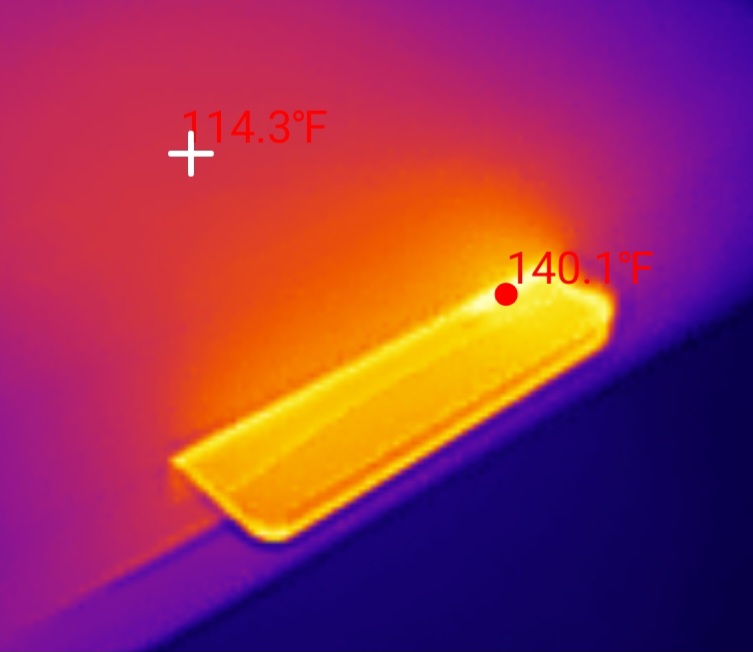
Nothing thermal cost anything measurable. The write curve is flat from the first second to the last, the longest single blocked write was 105 milliseconds, and there is no throttling signature anywhere in the run.
It got warm. It did not slow down.
The coolest of the four SanDisk endurance cards on this bench, though it is also doing the least work · Run SanDisk-MAX-Endurance-128GB_2026-09-04_082739 · cardcheck v0.8.3 · ProGrade PGM0.5 microSD slot
How it scores on the CKBench rubric
SanDisk MAX Endurance 128GB (SDSQQVR-128G-GN6IA)
Scored against the CKBench rubric. Five dimensions, each out of 5.
That averages 4.4 and publishes as 4.5 out of 5. Nothing on the label is missed, and the half point comes off for a card that is outrun by its own cheaper sibling on the one thing both boxes describe identically.
Frequently Asked Questions
Is SanDisk MAX Endurance better than High Endurance?
For lifespan, yes: MAX Endurance is rated for 60,000 hours of recording against High Endurance's 10,000, and carries a 10-year warranty against 2 years. For speed, no. On the same bench the High Endurance card wrote 39.5% faster and held a V60 video speed class where the MAX Endurance held V30, even though both packages print the same 100 MB/s read and 40 MB/s write.
Is the SanDisk MAX Endurance 128GB fast enough for a 4K dash cam?
Yes, comfortably. It held 51.6 MB/s through its worst ten seconds of continuous writing, and 4K30 dash cam recording needs about 6 MB/s. That is more than eight times the margin required, and it clears 4K60 by more than four times.
Does the SanDisk MAX Endurance really reach 100 MB/s?
I measured 96.5 MB/s, and that figure is the ceiling of the UHS-I bus mode the card uses rather than a limit of the card itself. Five different cards tested here land within 0.7% of each other at that same point, so this bench cannot separate a card that would reach 100 from one that would not. Treat it as unproven rather than failed.
What does 60,000 hours of endurance actually mean?
The fine print on the back of the package defines it as Full HD video recorded at 26 Mbps, which works out to about 702 TB written, or roughly 5,500 complete fills of a 128 GB card. It is a manufacturer figure and no review can verify it, so treat it as stated rather than proven. The cheaper High Endurance line quotes 10,000 hours at that same bitrate, so the 6x difference in hours is a genuine 6x difference in data.
Does the SanDisk MAX Endurance have an A1 or A2 app rating?
No. Neither SanDisk endurance line prints an app performance class, and this card claims none. It happens to clear the A1 thresholds in my testing at 1721 read and 634 write IOPS, but that is an observation rather than a rating the card holds, and A2 cannot be tested properly through a USB card reader at all.
Buy it for the rating, not for the speed
Judged on its own terms this is a very good card. It delivers its capacity, beats its printed write speed, holds every class mark on the package, has no cache to run out of, stays cool, and writes at one steady rate from the first byte to the last. If you are putting it in a dash cam or a security camera, which is exactly what the front of the box says it is for, you will get a card that does its job and a rating and warranty that no competitor at this capacity matches. It is one of the two cards I recommend in my COXPAL A17D review, since that camera ships without one.
The thing to know before you buy is the part no spec sheet will tell you: the cheaper card in the same brand's own range is meaningfully faster, and both boxes describe themselves identically. Whether that matters depends entirely on what you need. If you need the rating, this is the card and the premium is buying something real. If you need throughput, you would be spending more for the slower option, and now at least you know.
One honest caveat to close on. I tested one MAX Endurance card and one High Endurance card. That is enough to compare these two units with every variable held steady, and it is not enough to describe two product lines. Cards from the same model number do vary, and I have measured a 15% spread within a single SKU on this bench before. If a second unit lands here, its numbers get published too.
Every card I have run through this bench, with the full method and the raw numbers behind each one, lives on the CKBench hub. The closest comparisons to this card are the SanDisk High Endurance 128GB it is measured against here and the VIOFO High Endurance cards, which are the budget end of the same idea.
Disclosure: I bought this card myself at retail; nobody sent it to me and no brand had any input into this review. This post also contains affiliate links. As an Amazon Associate I earn from qualifying purchases, at no extra cost to you. Affiliate links like these and my YouTube channel are what keep the site running.