
SanDisk High Endurance 512GB: the stall a speed class cannot see
A used dash cam card that keeps every promise on its face. It reads 180 MB/s, verifies all 511.8 GB twice, holds V60 against a printed V30, and stops writing for about two seconds every few minutes. I reproduced that on two readers, and no other card on this bench has ever done it.
Prefer to watch a review?
No video for this lab run yet, but I cover dash cams, storage, and the gear around them on the channel. Subscribe to catch the next test the moment it goes live.
The short version
On paper this card is excellent. It reads 180.4 MB/s against a stated 100, commits writes at 135.0 MB/s against a stated 40, and held 68.1 MB/s through its worst ten seconds, which is V60 territory on a card that prints V30. All 511.8 GB wrote and read back with zero errors, twice. Then, in the middle of a steady 140 MB/s stream, it stopped accepting data for 3.6 seconds. It did the same thing on a second card reader with a different chip inside, and it did it eleven more times across two whole-card fills. That is the failure a dash cam reports as a slow card, and it is invisible to every speed class on the label. This is one used unit with real dash cam service history, so it says nothing about the 512GB model as a whole. My rating: 4/5, scored against the CKBench rubric, which now carries a rule written for exactly this card: a dead stop reproduced on a second reader caps a card at 4, whatever class it holds.
Verdict: 4/5, keeps every printed promise and stalls anywayWho this card is for
- YesAnyone who needs half a terabyte of loop recording and has a camera that buffersIts worst ten seconds run about ten times what the VIOFO A229 Plus it came out of writes across both channels, and a two-second stop at that camera's average rate is roughly 13 MB it has to hold in its own memory, nearer 19 MB at its busiest second. Some cameras can. This one reported a slow card.
- YesAnyone who wants capacity they can trustEvery free byte was written with unpredictable data and read back and compared, on two separate days. Zero mismatches, zero read errors, the same 511,802,474,496 bytes both times.
- NoA camera that has already thrown a slow-card error with one of theseThis unit came out of a VIOFO A229 Plus that had been flagging a slow card, it is a plausible cause of exactly that warning, and no speed test will show it: it passed every class on every run while stalling.
- NoAnyone reading this as a verdict on the modelOne used card. Whether the stall is wear or design needs a fresh 512GB unit, and I do not have one yet.
511.8 GB of usable space is roughly 23 hours 40 minutes of single-channel 4K at 6 MB/s, or about 47 hours of 1080p60 at 3 MB/s, before the loop starts overwriting. Work out your own numbers in the dash cam storage calculator.
Why a used card is the most interesting High Endurance card I have tested
Every other endurance card on this bench arrived fresh. This one arrived with a history: it spent months in my VIOFO A229 Plus, a camera that had been flagging a slow card intermittently, with this card and with others before it, and only then went on the bench. That makes it the closest this bench can get to the question the High Endurance line is actually sold on, and it comes with a confound that has to be said up front. A weak result on a used card can be use rather than design, so every number here belongs to this unit and none of them transfer to the model. It joins CKBench, the running index of every card on the bench, alongside the SanDisk High Endurance 128GB, three fresh units of which give this card its comparison set, the SanDisk MAX Endurance 128GB, the tier above it, and the Vantrue Endurance PRO 128GB, the other card here that needed two readers to settle.
One unit, used, tested on August 25 and 26, 2026, and published September 15. Six runs across two independent card readers, four of them complete, two of them whole-card fills. The card face is the only claim source I have, because a used card comes with no box; the 100 and 40 MB/s figures and the 40,000-hour rating come from SanDisk's own datasheet.
Why my write numbers read lower than other reviews. Every write here is committed to the card and confirmed before the clock stops, the way a dash cam actually writes, so my figures land below burst benchmarks like CrystalDiskMark that measure a few seconds of the card's RAM buffer. That rule, and the decimal MB/s and binary MiB conventions used throughout, are set out on the how we test and score page.
What the card claims, and what it did
The card face prints the capacity, C10, U3, the UHS-I mark and V30, and nothing else: no speed figure, no model code. The read and write speeds and the endurance rating are SanDisk's datasheet figures, and the table says so on each row. Every claim is met. Read the table knowing that none of its rows can see the stall, because a claim is a floor and a floor is a ten-second average.
| Claim | Printed | Measured | Verdict |
|---|---|---|---|
| Capacity | 512GB (card face) | 511.8 GB written and verified twice, 99.96% of label | VERIFIED |
| Read speed | Up to 100 MB/s (datasheet; nothing printed) | 180.4 MB/s (SanDisk QuickFlow SDDR-B751), 180.5 MB/s (ProGrade PGM0.5 microSD slot) | BEATEN |
| Write speed | Up to 40 MB/s (datasheet; nothing printed) | 135.0 MB/s committed sequential, 133.1 MB/s steady state | BEATEN |
| Speed class | C10 (card face) | 68.1 MB/s worst ten seconds, 52.0 on the weakest run | HELD |
| UHS speed grade | U3 (card face) | 68.1 MB/s worst ten seconds, 52.0 on the weakest run | HELD |
| Video speed class | V30 (card face) | 68.1 MB/s worst ten seconds, clears the V60 floor on three of four complete runs; 52.0 on the fourth | BEATEN |
| App performance class | Nothing printed | 1,810 read / 731 write IOPS at queue depth 1 | NOT CLAIMED |
| Endurance rating | Up to 40,000 hours of Full HD recording (datasheet, 512GB row). No bitrate condition stated | n/a | NOT TESTABLE |
| Operating temperature | Temperature proof. No range given | n/a | NOT CLAIMED |
| Warranty term | 2-year limited (SanDisk's line term; this unit had no packaging to read it from) | n/a | NOT A PERFORMANCE CLAIM |
The read figure is attributed to the SanDisk QuickFlow because that reader has produced 203 MB/s on another card, so 180.4 there is the card's own limit. The ProGrade's microSD slot tops out at about 181, so its 180.5 could have been the reader; the two agreeing settles it. The A-class row is not a failure. The High Endurance line prints no A mark, and A2 is untestable on any USB reader for any card in any case.
What is on the card, and what its registers add
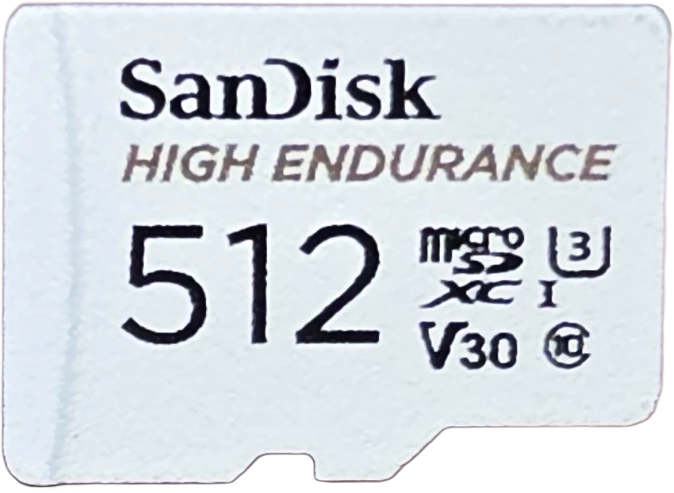
A used card has no box, so everything printed is on the face: SanDisk, High Endurance, 512, the microSDXC logo, U3, the UHS-I mark, V30 and a circled 10. No read or write figure, no model code, no lot code. The registers fill in what the print leaves out. This card reports itself as product name SN512, revision 8.5, built August 2025, which is the same silicon generation as the third of my three High Endurance 128GB units, the one that reads 175 MB/s where the other two read 97. So a read near 180 is what this generation does, not a surprise and not a shortfall, and the full table is in the identity appendix at the end.
Why does a card that holds V60 throw a slow-card error?
Because it stops. The bench logs the longest single blocked write of every five-minute sustained test. On my primary reader, a ProGrade PGM0.5, one block of this card's stream took 3,636 milliseconds to land. I put the card in a SanDisk QuickFlow, a reader with a different controller chip on a different USB path, and ran the same test: 3,266 milliseconds. Both stalls happened at a chunk boundary, both were the only block over half a second in their run, both show up in the one-second samples as two consecutive seconds at exactly 0 MB/s, and both have the same shape. The write rate collapses over three or four seconds, the card sits dead for two, and then it is back at full speed inside a second.
SanDisk QuickFlow 143.7 141.6 144.7 141.6 89.1 8.4 0.0 0.0 5.2 27.3
Two readers matter more than any number on this page. A stall seen on one reader cannot be separated from that reader, and this bench has been burned by exactly that: one session where a sensor utility polling the reader produced five-second stalls on three healthy cards, all since voided. A fault caused by the host follows the session. This one followed the card to a second host and reproduced to within ten percent. It is a property of this card.
It is not a one-off, either. The two whole-card fills record only a throughput sample every second, so a dead stop shows up there as consecutive seconds at zero. The first fill has five of those clusters and the second has six, spread through the hour it takes to write 511.8 GB. Across everything this card wrote under the bench, about 1.4 TB over three hours, that is thirteen dead stops of a second or more: one every five to seven minutes of continuous writing. Underneath the dead stops there is a milder rhythm as well, slow patches of five to seven seconds at 15 to 25 MB/s that on the QuickFlow arrived about every 30 seconds. The worst ten seconds of every run is one of those patches, which is why the class figure moved between 52.0 and 68.1 MB/s across four complete runs and why one run fell to V30.
The V-class system cannot see any of this, and that is the point worth taking away. A two-second stop inside a ten-second window on a card averaging 140 MB/s still leaves the window comfortably above 60. The run containing the 3.6 second dead stop scored 68.1 through its worst ten seconds and holds V60, a full class above the V30 printed on it. Nothing in the rating measures the instantaneous floor. A dash cam does. It has a small buffer and a continuous stream, and when the card stops accepting data for long enough the camera reports a slow card. That is the warning my A229 Plus had been showing with this card in it, and this stall is a plausible cause of it. Plausible, not proven: no camera was on the bench. One more thing the runs say about where it lives: the 30-minute wear probe, which rewrote one region in place, produced no dead stop at all, while every leg that grew new files did. Within this card the trigger is allocating new space. Across the bench the discriminator is the card: every other card's fill grows files the same way, and none of them stopped.
Is it alone? Yes. I scanned every run file on this bench, 68 runs across 42 cards, for the longest blocked write. No other card has a single block over one second on any reader, and none over two. The next-worst genuine card that holds its label, a Newegg TeamGroup, tops out at 221 milliseconds, which makes this card's stall 16 times longer than anything a genuine card here has produced. The three fresh High Endurance 128GB units I own top out at 168 milliseconds between them with zero blocks over half a second.
How fast is it when the writing does not stop?
This is the number that decides a video speed class, and it is always the worst ten-second window rather than an average, because a camera does not get to record over the mean. Five minutes of continuous committed writing with the cooling fan off, sampled once a second. The panel below is the primary run, and you can watch the stall happen at 2:34.
SanDisk High Endurance 512GB
V60 on three runs out of four, and V30 was never in danger
Away from the patches this card is fast and flat: 133.1 MB/s steady state, no cache cliff anywhere, and a write rate that ended the five minutes fractionally above where it started. The verdict window came in at 68.1 MB/s on the primary run, 66.0 on the second reader, 62.7 on an earlier run, and 52.0 on the one run where a slow patch stretched to seven seconds. Three of the four hold V60. The lowest worst-ten-seconds this card produced on any run is 52.0, which is 1.7 times the V30 floor it prints, so the printed class was never at risk. What was at risk was the recording.
One disclosure about the primary run. It was launched without the settle pre-pass, so its sustained test started on a controller still busy from the random-write test before it. That did not set the number: its worst window is the highest of the four complete runs and sits at 2:58, not in the first minute. The second reader's run was settled and stalled the same way.
Does a used endurance card fade under the writes loop recording makes?
Loop recording is not one long write. It is thousands of small scattered writes as the camera overwrites old clips, and a card that was not built for it gives up random-write speed pass after pass. Three 20-second passes of random 4 KB writes, compared to the reference card that collapsed 71% on the same test.
One minute of loop-recording abuse
This card: run SanDisk-High-Endurance-512GB_2026-08-26_090851 · reference card: lab baseline, same bench, same test · cardcheck v0.8.3
It does not fade, and its last pass was its fastest
728, 728 and 738 write IOPS across the three passes: no fade at all, on a card that has already spent months being written to in a dash cam. A 30-minute wear probe run afterward, rewriting one 1 GiB region in place 204 times on the full card, moved 0.41% between its first and last rewrite and verified clean. Nothing here says the card is wearing out. What the wear probe did show is the shape of the fault: seven blocks over half a second inside those 30 minutes, but no dead stop, where streaming across the card produced one every few minutes. The stall seems to belong to writing new ground, not to rewriting old.
Is all 512 GB really there?
The only test that catches a fake, and on a used card it is also the strongest statement the bench can make: whatever the card has been through, every cell still holds what it is told. Every free byte written with unpredictable data, every byte read back and compared.
Every byte, written and read back
511.8 GB, verified twice, zero errors
511,802,474,496 bytes written and the same number verified, zero mismatched bytes and zero read errors, and the fill the day before returned exactly the same byte count with the same clean result. That is 99.96% of the 512 GB label, the top of the range genuine cards occupy on this bench, and the 0.2 GB shortfall is what the exFAT volume itself costs. Your computer will display it as about 476 GB because it counts in binary. Write speed at the start, middle and end of the card sat within 3.8% of each other, and read within 1.0%, which is one consistent piece of silicon end to end. The dead stops live in this leg too: six clusters of zero-throughput seconds across the 66-minute fill.
How hot does it get, and does it slow down?
Peak temperature at the end of five minutes of uncooled writing, read at the reader slot, with the write speed drawn beside it so a throttle would show as a bend.
It got warm. It did not slow down.
All four complete runs returned 174 °F independently. No infrared frame on file for this unit, so treat the figure as a floor rather than a card-surface peak · Run SanDisk-High-Endurance-512GB_2026-08-26_090851 · cardcheck v0.8.3 · ProGrade PGM0.5 microSD slot
Hot, third-hottest on the bench, and it never slowed down
174 °F, which is 78.9 °C, at a 76 °F ambient, and all four complete runs returned that same reading independently. Only one card I have tested runs hotter, the Samsung P9 Express, and the SanDisk Extreme 512GB ties it. The write rate never bent: the five-minute trace ends marginally above where it started, and the whole-card fill held 135.9 MB/s for over an hour. So this is a headroom finding rather than a throttling one, and the headroom is 6 °C to the roughly 85 °C these parts are typically rated for, measured in an air-conditioned room. It is doing a lot of work for that heat, which is why it lands mid-pack on heat per unit of throughput, but a card sold to sit behind a windshield has less margin than almost anything else here.
How does a used High Endurance card compare to three fresh ones?
I own three fresh High Endurance 128GB units, all benched, so the comparison the used card was bought for is available. One caveat sits on top of it: a 512 GB card has more flash dies to write to at once than a 128 GB card, so its throughput is expected to be higher and says nothing about wear. What the fresh units can answer is narrower. Do fresh High Endurance cards stall? Across four runs between them, their longest blocked write is 168 milliseconds, with zero blocks over half a second.
One more caution about reading a used card, learned after this review on a different card. The Gigastone High Endurance Pro 128GB, bought new, halved its sustained floor once it had been written end to end and got it back after a full SD erase from a native host, with no wear involved: its controller was reclaiming space it did not know was free. A used card's floor can be its history rather than its health, and only an erase-and-rerun separates the two. Why a used card tests slower, and what a format does and does not reset, is written up on its own.
| Every number from the unit's own run file | Unit A, fresh | Unit B, fresh | Unit C, fresh | 512GB, used |
|---|---|---|---|---|
| Silicon generation | SA128, rev 8.7 | SN128, rev 8.5 | SA128, rev 8.7 | SN512, rev 8.5 |
| Sequential read, MB/s | 96.8 | 174.9 | 96.8 | 180.5 |
| Sequential write, MB/s | 89.7 | 107.6 | 89.7 | 135.0 |
| Random 4K write, IOPS | 1,030 | 716 | 1,020 | 731 |
| Worst ten seconds, MB/s | 88.0 | 100.8 | 88.0 | 68.1 |
| Video class held | V60 | V90 | V60 | V60 |
| Verified, % of label | 99.97 | 99.87 | 99.97 | 99.96 |
| Longest blocked write, ms | 51.8 | 86.9 | 71.8 | 3,636.4 |
| Blocks over 500 ms | 0 | 0 | 0 | 1, plus 11 dead stops in the fills |
| Heat under load, °F | 151 | 157 | 155 | 174 |
The used 512 GB is not slower than any fresh 128 GB unit on any throughput metric, its churn is flat, its capacity is byte-perfect, and it is the only card of the four that stalls. Whether that stall is wear or design is the one question this table cannot answer, because the cards differ in capacity as well as in history. A fresh 512 GB unit is the experiment that settles it.
What does 40,000 hours actually mean on a 512GB card?
SanDisk's datasheet opens with "up to 40,000 hours" and puts the qualifier in a footnote: that is the 512GB figure, the top of a ladder that runs 2,500, 5,000, 10,000, 20,000 and 40,000 hours for 32, 64, 128, 256 and 512 GB. This card is the capacity the headline actually belongs to. Divide every rung by its capacity and the ladder is exactly linear at 78.125 hours per gigabyte, so the rating is the capacity times a line constant rather than a per-capacity measurement, and the endurance-rating explainer does the same division on SanDisk's MAX line and on Samsung's and gets the same shape every time. The number that gives it meaning, the recording bitrate, is printed on the High Endurance retail box and appears nowhere in the datasheet. A used card has no box, so this one carries no bitrate at all. If the line's 26 Mbps condition applies, 40,000 hours works out to about 468 TB written, or roughly 914 complete fills of this card. The same datasheet warrants it for two years; at 24/7 the rating implies 4.6 years.
None of that is a measurement and I claim none of it. Nothing done in a session tests 40,000 hours. What the bench measures are proxies, sustained write, churn and heat, and on this card it found a behavior the rating does not describe at all: a card can be rated for 40,000 hours of continuous recording and stop accepting the recording for two seconds every few minutes.
Why this review has six runs instead of one
The first two runs stopped inside the sequential test and are excluded, though the first is worth a line: its warm-up write ran at 14 MB/s and its read at 16, and forty minutes later the same card in the same reader ran at 138 and 177. I cannot explain a tenfold cold start that never came back, so it is recorded and not published as a finding. Runs three and four completed the day before the two runs the figures come from. Run three held V60 with a 723-millisecond block; run four fell to V30 and verified the whole card. Run five, the primary, is the full suite with the fill, the verify and the wear probe, and it carries the 3.6-second stall. Run six is the same card in the second reader the same afternoon, and it carries the stall too. The scores use run five, with run six as the confirmation that the fault belongs to the card.
The card did not arrive at the bench empty; I emptied it. Before the first run I pulled every clip off it, from a card the camera had filled almost to the last clip pair, which is where the A229 Plus review gets its numbers on locked clips and on what a driving hour costs in storage. Then I formatted it, because a format is the first thing anyone tries against a slow-card warning, and the bench saw a clean exFAT volume. So the history was read before it was erased, and the runs measured the card in the state a troubleshooting owner leaves it in.
How the 4 breaks down, and the rule this card added
SanDisk High Endurance 512GB
Scored against the CKBench rubric. Five dimensions, each out of 5.
Final score: 4 out of 5. A card that keeps every promise printed on it and still fails the job it is sold for, on this one used unit, in a way no printed promise covers. The five rows were restated on the September 2026 scoring tables on 19 September 2026: endurance moved to 5 because the tables score fade and recovery, and the stall is counted once, in the sustained row. The mean of the five dimensions is 4.0, and this card also added a rule to the rubric: a card that stops writing outright during continuous writing, reproduced on a second reader, is capped at 4 whatever class it holds. Both routes land on the same number. The stall section above is what you actually need to know.
Frequently Asked Questions
Is the SanDisk High Endurance 512GB good for a dash cam?
This unit is fast enough and its capacity is real, but it stalls. It held 68.1 MB/s through its worst ten seconds of continuous writing, which clears the V60 floor and is about fourteen times what a four-channel dash cam writes, and all 511.8 GB verified twice with zero errors. It also stopped accepting data for 3.6 seconds in the middle of a write, reproduced on a second reader, and did so eleven more times across two whole-card fills. That is the behavior a dash cam reports as a slow card. It is one used unit, so I cannot tell you whether a fresh one does the same.
Why does my dash cam say slow card with a SanDisk High Endurance?
Because a card can pass every speed class and still stop for a couple of seconds at a time. The video speed classes are ten-second averages, and a two-second dead stop inside a ten-second window on a fast card still leaves the average well above the floor, so no speed test will flag it. A dash cam sees the instantaneous floor: it has a small buffer and a continuous stream, and when the card stops accepting data for long enough it reports a slow card. The card I tested here came out of a VIOFO A229 Plus that had been showing exactly that warning, and the bench caught a 3.6 second stall on two different readers.
How fast is the SanDisk High Endurance 512GB?
I measured 180.4 MB/s read on a SanDisk QuickFlow reader and 180.5 on a ProGrade PGM0.5, 135.0 MB/s committed sequential write, and a sustained write floor of 68.1 MB/s over five minutes on the primary run. SanDisk's datasheet says up to 100 MB/s read and 40 MB/s write, so both are beaten comfortably. The read figure needs a reader that supports the DDR200-class UHS-I mode; on a standard UHS-I reader this generation of card reads about 96 MB/s.
Is the SanDisk High Endurance 512GB actually 512GB?
Yes. I filled every free byte with unpredictable data and read all of it back, on two separate days: 511,802,474,496 bytes written and verified each time, zero mismatched bytes and zero read errors. That is 99.96% of the 512 GB label, the top of the range genuine cards occupy on this bench, and the shortfall is the exFAT volume's own overhead. Your computer will show it as about 476 GB because it counts in binary.
What does the 40,000 hour rating on the SanDisk High Endurance 512GB mean?
It is the top rung of a ladder that runs 2,500 hours at 32GB to 40,000 at 512GB, and every rung is exactly 78.125 hours per gigabyte, so the figure is capacity times a constant rather than a measurement of the 512GB card. It assumes Full HD recording, and the bitrate that makes it meaningful, 26 Mbps, is printed on the retail box rather than in the datasheet. A used card has no box, so this unit carries no bitrate at all. Nothing done in a test session can verify 40,000 hours, and I do not claim to.
Does the SanDisk High Endurance 512GB get too hot?
It gets hot but it does not slow down. I measured 174 °F (78.9 °C) at the end of five minutes of uncooled writing, on all four complete runs, at a 76 °F ambient. Only the Samsung P9 Express has run hotter on this bench, and the write speed never bent. The concern is margin: that reading is a floor, it leaves about 6 °C to the roughly 85 °C these parts are typically rated for, and a parked car in summer is a great deal hotter than my bench.
The bottom line
Bottom line: this is a genuine 512 GB card that beats every figure SanDisk publishes for it, holds a video class above the one it prints, does not fade under churn after months of dash cam service, and stops writing for about two seconds every few minutes. I reproduced the stall on a second card reader, which is what makes it the card's fault rather than my bench's, and I found nothing like it in 68 runs across 42 other cards. It is a plausible explanation for the slow-card warning my A229 Plus kept showing with this card in it. It is also one used unit, and I will not tell you the 512GB model does this until a fresh one either does or does not. If yours has thrown that error, the card can be the cause even when every speed test says it is fine, and a full write of the card is the only test that will show it.
Device identity: what this card reports about itselfReference data from the August 25 register capture, taken before the first run. Open it to check a card of your own against this unit, or to see which of the two High Endurance silicon generations you have.
| Raw CID register | 035344534e35313285…019800 (serial digits elided) |
| Manufacturer ID (MID) | 0x03 (SanDisk / Western Digital) |
| OEM / application ID (OID) | 0x5344, ASCII "SD" |
| Product name (PNM) | SN512 |
| Product revision (PRV) | 8.5 |
| Serial number (PSN) | 0xd4…77 (truncated) |
| Manufacture date (MDT) | August 2025 |
| Model code | Not printed on the card, and no packaging to read it from |
| Declared capacity (from CSD) | 999,743,488 sectors of 512 bytes = 511,868,665,856 bytes, 99.97% of the label |
| Raw CSD register | 400e0032db79000ee5b77f800a404000 |
| Raw SCR register | 0245848700000000 (SD_SPEC 2, SD_SPEC3 1: the UHS-I mark is legitimately declared) |
| Raw SD status (SSR) | 0000000008000000040090000f05391e000800000002fc0003000000000000000000000000000000000000000000000000000000000000000000000000000000 |
| Captured on | Raspberry Pi 4 native SD host, no USB bridge in the path · 2026-08-25 |
Everything above except the serial and the date is model-level: another unit of this generation should match it. The product name is the useful row. SanDisk ships the High Endurance line in two silicon generations under one model code, SA and SN, and they differ by 81% on read speed and a full video class; this card is SN, like my High Endurance 128GB unit B and my SanDisk Extreme 512GB. The serial is unique to this unit, so it appears truncated here and its digits are elided from the raw CID hex. The manufacture date publishes in full because it is batch-level and diagnostic: it puts this card at about a year old when it was benched.
A caution that this table can damn but cannot clear: the counterfeit I autopsied presents a complete forged SanDisk identity carrying these model-level values. Matching this table is necessary for a genuine card, never sufficient. The only physical proof remains a full write-and-verify of every byte, which is why this card got two.
Disclosure: I bought this card myself, some months before this test, and ran it in my own VIOFO A229 Plus for months before it went on the bench. It is a used unit and is described as one throughout. This post contains affiliate links. As an Amazon Associate I earn from qualifying purchases, at no extra cost to you. Affiliate links like these and my YouTube channel are what keep the site running.