
VIOFO High Endurance: two cards, two different factories
I bought the VIOFO High Endurance in 32GB and 128GB expecting one product at two sizes. Six bench runs and two identity dumps later, they turned out to share a name, a package and four certification marks, and almost nothing else. The 128GB misses the write figure printed on its box. The 32GB, on a September re-test, keeps every promise on its own.
Prefer to watch a review?
No video for this lab run yet, but I cover dashcams, storage, and the gear around them on the channel. Subscribe to catch the next test the moment it goes live.
The short version
Both cards are genuine, both hold their stated capacity, and both are usable in a dash cam. Neither is what its box says. The 128GB writes 57.0 MB/s committed against a printed 80 MB/s, which is 70% of its own claim, but it holds its V30 rating without ever wobbling. The 32GB beats its printed 30 MB/s write and, on two September re-runs, holds its V30 badge without conditions; the July result that said otherwise was its first-ever run and is corrected below. They also come from two different manufacturers, which the packaging gives no hint of. My rating: 3.5/5 for the 128GB and 4/5 for the 32GB, scored against the CKBench rubric (3/5 and 3.5/5 until 19 September 2026; the second update note below says what moved). I would buy the 128GB for a dash cam. I would not buy either for a phone.
Verdict: 3.5/5 and 4/5, one name covering two unrelated cardsUpdated 15 September 2026. The 32GB's verdict has changed, and its score with it. In July its first run dropped to 14.9 MB/s for about 75 seconds and I attributed that to the random small writes the suite runs just before the sustained test. Two full re-runs of the suite in September, on two different card readers, hold V30 from the first second with the same random writes in front of them: 34.3 and 34.2 MB/s through the worst ten seconds, not one of 600 samples under the 30 MB/s floor, and the A1 floors met on both readers. The July result was the card's first-ever run, and the slowdown had in fact begun during the sequential test, before any random writes ran, which the run's own variance flag recorded and I missed. What caused it I cannot prove. It fits a first-writes phase on this card's platform, which a second card built on the same Longsys platform has since shown on its own first run and never again. It also fits a transient load on my bench machine, which recorded no host telemetry at the time and has since had background processes found and removed. Either way it was not the card's steady behavior. The clean runs did expose something the slow one hid: the card loses 16 to 19% of its random-write rate inside a minute of scattered writes on both readers, the largest such fade on this bench, so the endurance dimension does not move. The corrected passages are rewritten below and marked, the July curve stays on the page as the record of what I saw, and the 32GB's score moves from 3 to 3.5 out of 5. The 128GB is unchanged. The line's third capacity, the 64GB, arrived in September and has its own review: it is the 128GB's platform, and it out-wrote both of these.
Updated 19 September 2026: both scores move, the 128GB from 3 to 3.5 and the 32GB from 3.5 to 4, and not one measurement changed. In September every CKBench score was re-derived on fixed scoring tables, and these two cards were among six whose published score the tables set differently. On the 128GB the row that carries the missed write claim, 57.0 MB/s against a printed 80, stays exactly where it was; the endurance row now scores the measured fade (none) and recovery (ten seconds), and the thermal row reads 13.9 °C of headroom rather than a ranking. On the 32GB the sustained row drops to 3 on the absolute ladder (34.2 MB/s is a thin margin over V30 however you look at it), the endurance row rises half a point on the same 16% fade, and the thermal row rises to 4 because heat per unit of work is now reported rather than scored. The rows in each card's score block say what each one reads and why.
Who these cards are for
- YesDash cam, either capacityBoth clear 4K30 dash cam duty with room to spare. This is the job they are built for.
- YesHome security cameraContinuous sequential recording is the workload both cards handle best.
- NoPhone or tablet storageBoth print an A2 badge, which no USB reader can test. The 32GB clears the lower A1 floors on both of my readers; the 128GB did not in July. Neither is built for the job.
- NoRaspberry Pi or an OS driveRandom performance is ordinary on both. Pick a genuine A2 card or an SSD.
Rough capacity math: at the 6 MB/s a 4K30 dash cam writes, the 128GB holds a little under six hours before it loops over the oldest clips, and the 32GB holds about ninety minutes. Your camera's bitrate is the variable that matters, so work out your own numbers in the dash cam storage calculator. If you are running one of VIOFO's own cameras, my VIOFO A229 Plus review covers the camera side.
Why I bought two of the same card
Every card review you read tests one capacity and then talks about the product line. That has always bothered me, because a 32GB card and a 128GB card of the same name are not the same piece of hardware. They have different numbers of memory chips inside, which changes how fast they can write, and manufacturers are free to change suppliers between capacities without changing a word on the box.
So this time I bought both, ran the full CKBench suite on each, and read the identity register out of both. It is the first time this bench has tested two capacities of one line as a matched pair, and the result was more interesting than I expected. VIOFO's own packaging already tells you something is different: the 128GB claims up to 80 MB/s write and the 32GB claims up to 30 MB/s, on otherwise identical certification marks and an identical 100 MB/s read claim. That is a 2.67 times gap inside one product line, printed by the manufacturer.
Both cards are scored the same way as every other card on the bench, against the same published rubric. Previous runs worth comparing against: the SanDisk High Endurance 128GB, which beat almost every number on its own box, and the Kioxia Exceria G2 128GB that came bundled with a dash cam and quietly keeps four gigabytes for itself, and the bundled Botslab 128GB, whose write speed never sits still for more than three seconds.
Why my write numbers read lower than other reviews. Every write here is committed to the card and confirmed before the clock stops, the way a dash cam actually writes, so my figures land below burst benchmarks like CrystalDiskMark that measure a few seconds of the card's RAM buffer. That rule, and the decimal MB/s and binary MiB conventions used throughout, are set out on the how we test and score page.
What the boxes claim, and what the cards did
Both packages print the same certification marks: C10, U3, V30 and A2. Both claim up to 100 MB/s read. Only the write figure differs. Here is every printed claim on each card against what the bench measured, with the reader named, because a read figure without a reader attached is a meaningless number.
VIOFO High Endurance 128GB
| Claim | Printed | Measured | Verdict |
|---|---|---|---|
| Capacity | 128 GB | 124.63 GB, 97.4% of label | VERIFIED |
| Read speed | up to 100 MB/s | 96.7 MB/s (ProGrade MSD PGM0.5) | MET, at the UHS-I ceiling |
| Write speed | up to 80 MB/s | 57.0 MB/s sequential, 55.5 to 55.9 sustained | FAILS, 70% of claim |
| Speed class | C10 | 55.8 MB/s worst ten seconds | HELD |
| UHS speed grade | U3 | 55.8 MB/s worst ten seconds | HELD |
| Video speed class | V30 | 55.8 MB/s worst ten seconds, 1.86 times the floor | HELD |
| App performance class | A2 | 1230 read / 700 write IOPS | NOT TESTABLE |
| Endurance rating | none printed | n/a | NOT CLAIMED |
| Operating temperature | icon only, no numbers | n/a | NOT CLAIMED |
| Warranty term | none printed | n/a | NOT A PERFORMANCE CLAIM |
VIOFO High Endurance 32GB
| Claim | Printed | Measured | Verdict |
|---|---|---|---|
| Capacity | 32 GB | 31.71 GB, 99.1% of label | VERIFIED |
| Read speed | up to 100 MB/s | 97.7 MB/s (ProGrade MSD PGM0.5) | MET, at the UHS-I ceiling |
| Write speed | up to 30 MB/s | 35.2 MB/s across the whole card | BEATEN, 117% of claim |
| Speed class | C10 | 34.3 MB/s worst ten seconds, two readers | HELD |
| UHS speed grade | U3 | 34.3 and 34.2 MB/s worst ten seconds, two readers | HELD, corrected Sep 2026 |
| Video speed class | V30 | 34.3 and 34.2 MB/s worst ten seconds, two readers | HELD, corrected Sep 2026 |
| App performance class | A2 | 1759 and 2253 read IOPS, two readers; A1 floors met | NOT TESTABLE |
| Endurance rating | none printed | n/a | NOT CLAIMED |
| Operating temperature | icon only, no numbers | n/a | NOT CLAIMED |
| Warranty term | none printed | n/a | NOT A PERFORMANCE CLAIM |
The card says something different from the box
Before any of the numbers, the names, because the packaging cannot keep its story straight even there. You can read this through the blister without opening anything. The packaging calls this line High Endurance. The card itself is printed Industrial next to its capacity: "128 Industrial" on one, "32 Industrial" on the other.
Neither word is defined by anybody. "High endurance" has no certification behind it and no test you can point at. It is a marketing category that usually implies a card built for continuous recording, and when SanDisk uses it they attach 10,000 hours and a bitrate to it, which makes the claim checkable. "Industrial" normally means something more specific again: a part rated for a wider temperature range and a longer service life, sold with published numbers for both. On these cards there are no numbers for either term. Two different unquantified promises, on the two faces of the same product.
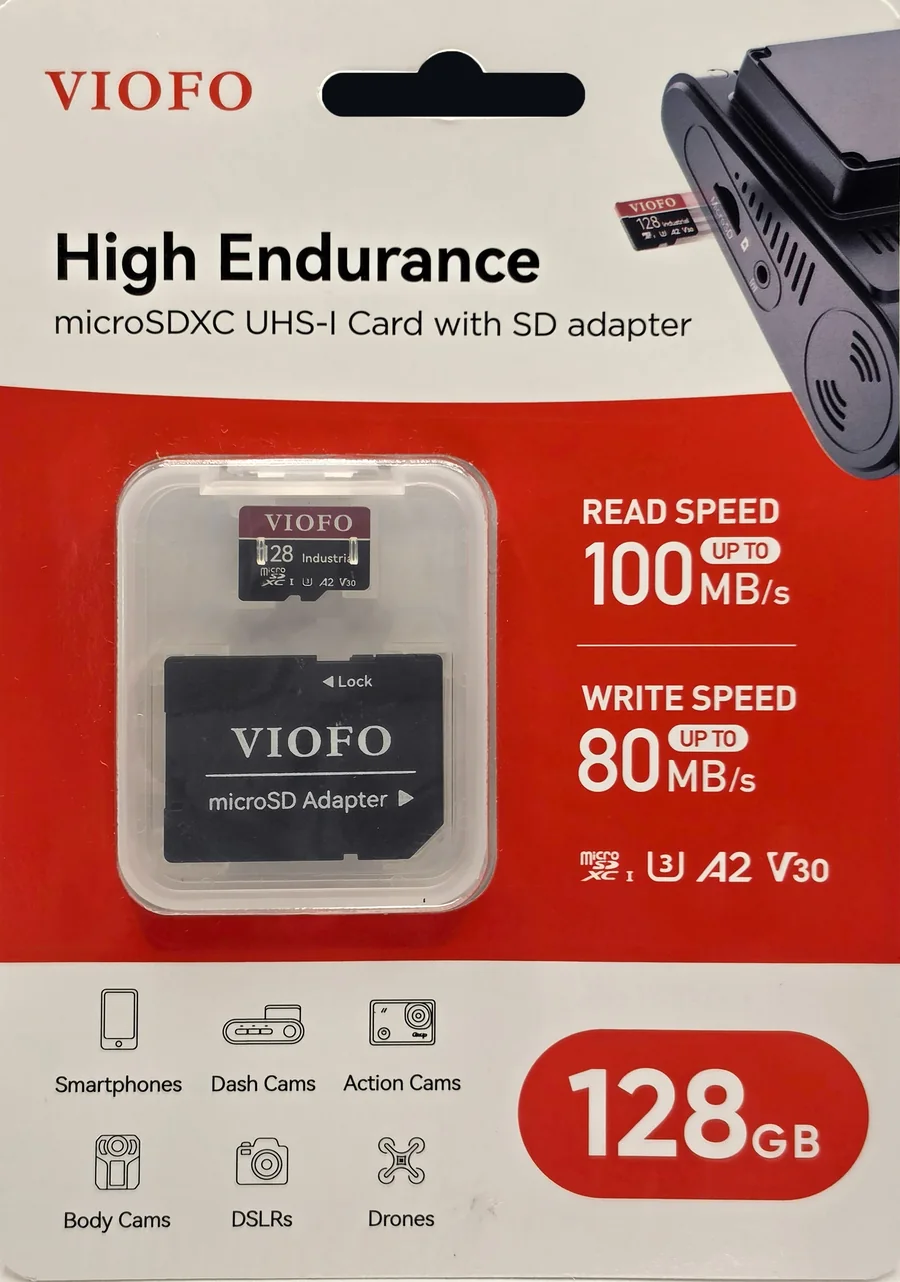
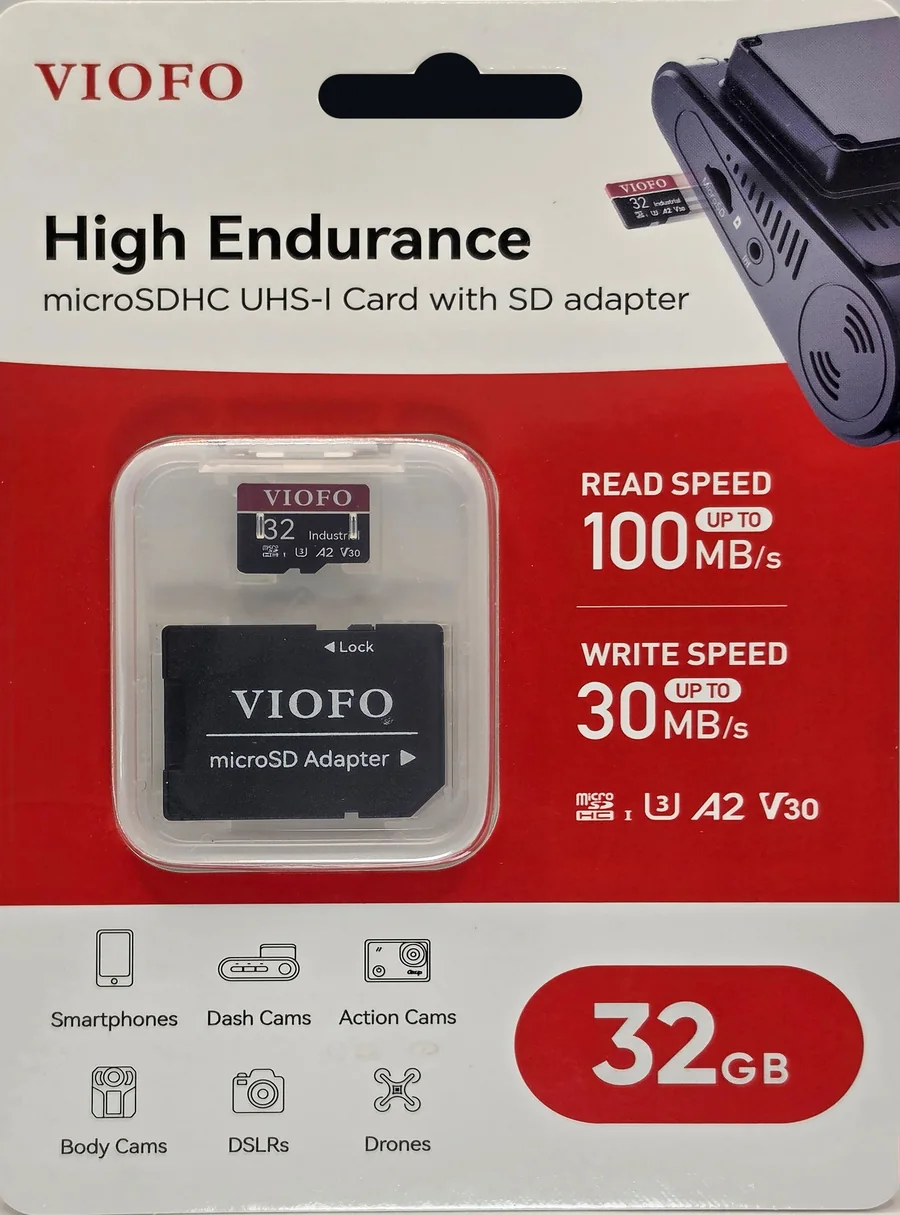
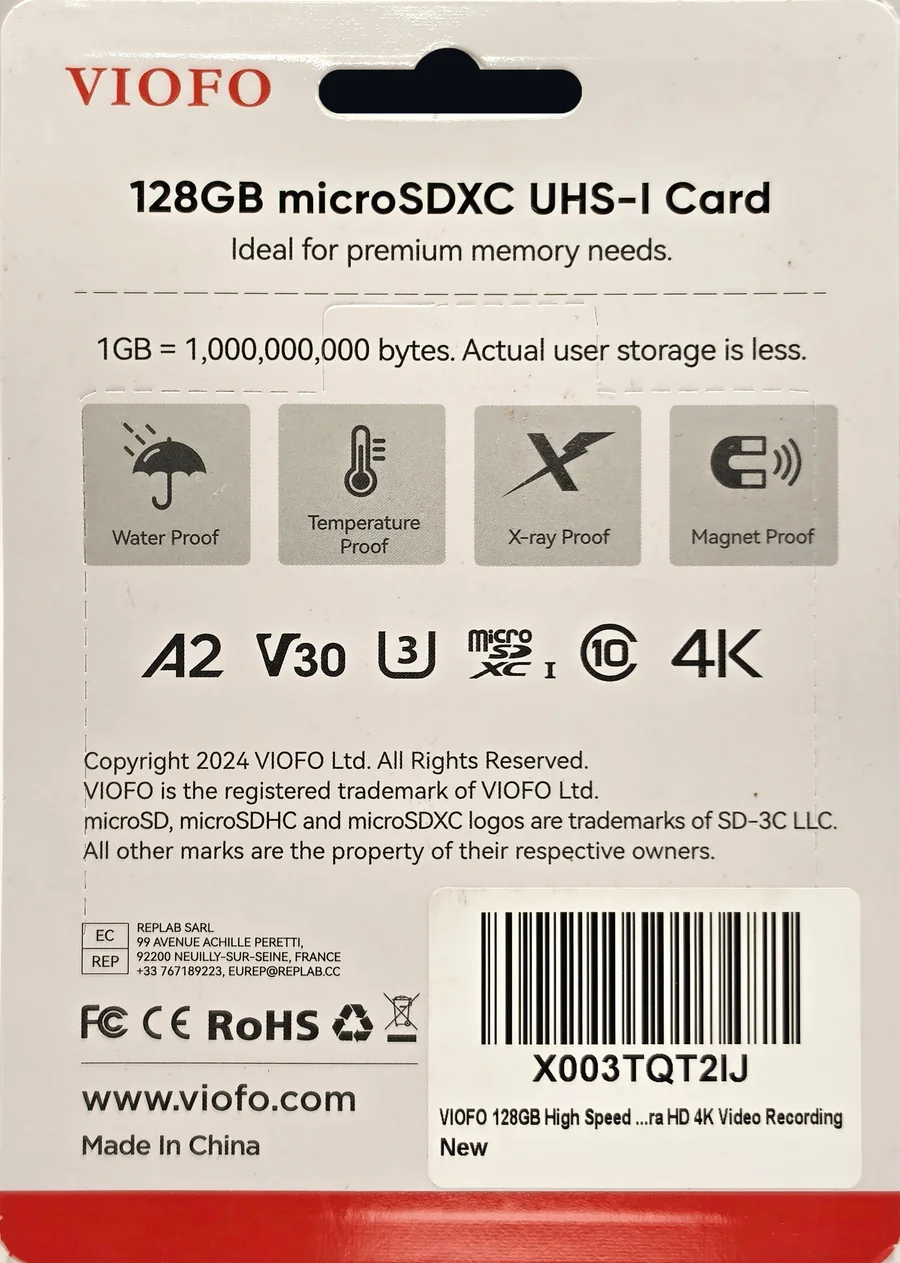
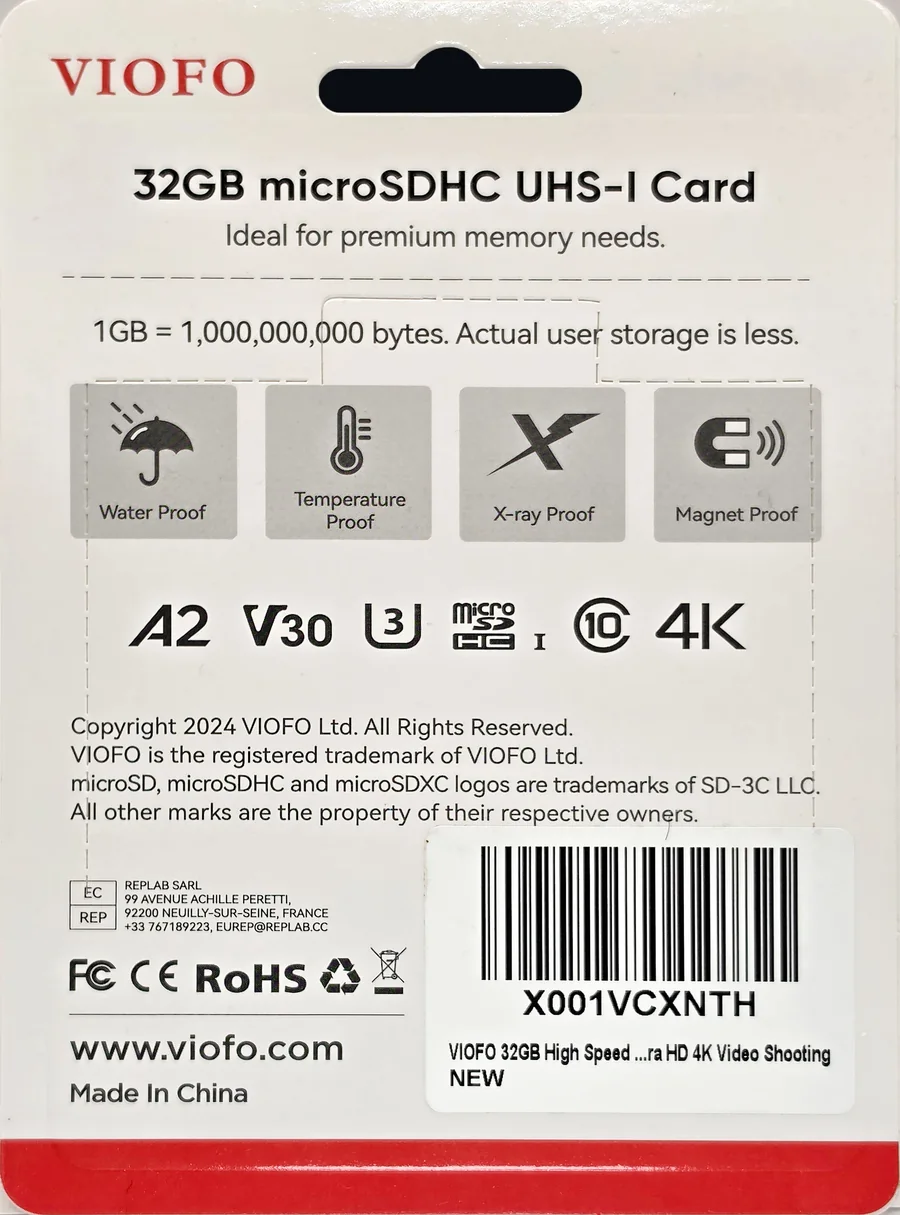
Now the numbers, or rather the ones that are missing. Four rows on each table read NOT CLAIMED or NOT A PERFORMANCE CLAIM, and those absences are worth pausing on. Neither card prints an endurance rating of any kind. No hours, no terabytes written, no bitrate condition, on a product line whose name is High Endurance. VIOFO is not alone in this: the Vantrue Endurance PRO 128GB puts the word on the card face and prints no rating on the card or the box either, which makes it two independent brands rather than one brand's quirk. For comparison, the SanDisk High Endurance 128GB prints 10,000 hours and gives its exact benchmark condition in the fine print on the back: Full HD at 26 Mbps. That figure can be checked. It works out to about 117 TB written, roughly 914 complete fills of the card. VIOFO's endurance claim cannot be checked, because there is no claim to check.
The same goes for the temperature icons. Both backs carry a Temperature Proof pictogram beside Water Proof, X-ray Proof and Magnet Proof, with no numbers attached to any of the four. Those are marketing icons, not specifications, and none of them is something a bench can test. Neither package states a warranty term at all.
The box vs the bench: 128GB
The box vs the bench: 32GB
These two cards were not made in the same factory
Every SD card carries a small read-only register called the CID, written at the factory, which names the manufacturer, an OEM code, a product name, a revision and a manufacturing date. It is the closest thing a memory card has to a birth certificate. I read it out of both cards on a Raspberry Pi rig, because a USB card reader cannot reach it.
The two cards do not match on a single field.
32GB
Built by Longsys, December 2024
Manufacturer ID 0xAD, OEM code LS, product name USD00, revision 1.0.
0xAD is Longsys, a large Chinese flash manufacturer that owns Lexar and supplies the same manufacturer ID seen on Amazon Basics cards, Kodak cards and the official Raspberry Pi cards. This is a known, traceable supplier, though not a universal one across the brand: a Lexar that does not report 0xAD at all turned up later, carrying an ID that appears on no other card I have dumped.
128GB
Built by an unlisted maker, April 2026
Manufacturer ID 0xB5, OEM code MV, product name METOR, revision 0.0.
That signature does not appear in any public manufacturer-ID registry I can find. The SD Association does not publish these assignments, so an unlisted code is not evidence of anything improper. A fresh April 2026 date with a revision of 0.0 is exactly what a recently assigned supplier looks like.
Different manufacturer, different OEM code, different product name, different revision, and seventeen months apart in manufacturing date. They do not even reserve the same proportion of their flash: the 32GB hands over 99.1% of its label and the 128GB hands over 97.4%.
None of that is illegal or even unusual. Brands buy from whoever can supply them, and the badge on the front is the brand's promise rather than a factory's. But it does mean that reading a review of one capacity tells you very little about the other, which is the entire reason this test exists. If you read a glowing review of the VIOFO 128GB and buy the 32GB on the strength of it, you are buying a card from a different company.
Why the 128GB cannot reach its own 80 MB/s
The front of the box says up to 80 MB/s write. Across three separate runs, the card wrote 57.0 MB/s in the sequential test and held between 55.5 and 55.9 MB/s in five-minute sustained tests. The most generous number I can give it is 55.9 against a claimed 80, which is 69.9% of its own claim. There is no test in this set, on either filesystem, in any conditioning state, where it comes close. The Silicon Power Superior Pro 128GB makes the same 80 MB/s claim and comes out the opposite way: it meets the 80, at 85.4 MB/s committed, but only for its first 4.7 GB, and then writes 39 MB/s, well under the 55.8 this card holds for as long as it writes.
That is a real miss, and it is worth being precise about what kind of miss it is. An "up to" figure is a marketing number, and manufacturers are entitled to quote a best case measured on equipment you do not have. What makes this one hard to defend is the size of the gap. A 30% shortfall is not a measurement difference or a reader limitation, and the card's own consistency proves it: this card writes at the same speed no matter what you ask of it. Across the entire 124.6 GB capacity fill the write rate never varied by more than 0.4% from one end of the card to the other. It has one gear.
The good news is that the gear it has is a decent one. Its worst ten seconds of sustained writing was 55.8 MB/s, which holds its V30 rating at 1.86 times the required floor, and it comes third out of seven cards on this bench. It missed a V60 rating by 4.2 MB/s. The card is fine. The number on the box is the problem.
The 32GB holds V30. In July it looked like it did not, and here is what changed
The first run on the 32GB failed its V30 rating badly. A V30 mark certifies that sequential writing never drops below 30 MB/s, and the worst ten seconds of that run measured 14.9 MB/s, less than half the floor. On the bench's standard verdict rule that makes it a V10 card wearing a V30 badge.
But the failure sat entirely in the first fifteen seconds of a five-minute test. After that the card settled at 34.6 MB/s and never dipped again. That is not how a card that simply cannot hold its class behaves, so I ran two more tests in July, and then, in September, the whole suite twice more on two different card readers.
| Test | What ran before it | Worst ten seconds | Verdict |
|---|---|---|---|
| Full suite, 31 July, the card's first-ever run | sequential and random 4K writes | 14.9 MB/s | V10 |
| Settle run, 31 July | nothing | 34.2 MB/s | V30 |
| Clean run, 31 July | nothing at all | 34.3 MB/s | V30 |
| Full suite, 15 September, second reader | sequential and random 4K writes | 34.2 MB/s | V30 |
| Full suite, 15 September, primary reader | sequential and random 4K writes | 34.3 MB/s | V30 |
Corrected 15 September 2026. When this review was published, the two July follow-ups seemed to settle it: the slow state appeared only when random small writes ran first, so I wrote that random writes trigger it and that the card needs about 75 seconds to climb back out. The two September runs put the same random writes in front of the sustained test, on two readers, and the card wrote 34.6 MB/s from the first second both times. Not one of the 600 timed samples fell below the floor. The churn explanation was wrong, and the evidence that it was wrong was already in the July run: its sequential write had fallen to 14 MB/s on the second and third passes, before any random writes had run, which the tool flagged as write variance and I read past.
What the card actually does after a burst of random writes is much smaller. On both September runs the untimed warm-up that precedes the sustained test dipped to about 21 MB/s for eleven seconds, then returned to 34.6 and stayed there, and the timed test began more than a minute later. That is real, it is brief, and it is why the warm-up exists.
What the July run was, I cannot prove. It was the card's first-ever write, and a second card built on the same Longsys platform did the same thing on its own first run and never again, which fits a card that behaves differently for its first few gigabytes. It also fits a transient load on my bench machine, which recorded no host telemetry then and has since had background processes found and removed. I am not choosing between them. What I can say is that five later runs on two readers, including two with the full random-write burst in front, all agree, and that is the card's behavior.
Withdrawn, 15 September 2026: "the two badges on this card work against each other." That framing rested on the July run, and it does not survive the re-test. Using the card the way its A2 badge advertises does not cost it its V30. It also now clears the lower A1 floors on both of my readers, 1759 and 2253 read IOPS against a 1500 requirement, where the July run had measured 419. A2 itself remains untestable on any USB reader, so it is still not scored either way.
One thing the clean runs did show that the slow one had hidden: under a minute of scattered 4K writes, the card's random-write rate falls by 16 to 19% between the first pass and the third, on both readers, the largest fade of any card on this bench. A dash cam never issues that workload, and it does not touch the video rating, but it is a real sensitivity to churn and it is scored where it belongs, in endurance behavior.
Five minutes at full throttle, both cards at once
Your 128GB card arrives in the wrong format
This one surprised me. The 128GB card came formatted as FAT32 from the factory. Cards above 32 GB are supposed to arrive as exFAT, and that is not a technicality: it is what the SD specification assigns to that capacity class. VIOFO ships this one FAT32 anyway.
The reason is almost certainly sensible. A lot of dash cams read FAT32 and nothing else, and VIOFO sells dash cams. Formatted the way it ships, this card works in the widest possible range of cameras, including old ones.
The cost is that FAT32 cannot store a single file larger than 4 GB. Out of the box, this 128 GB card cannot hold one file bigger than 4 GB. A dash cam never notices, because loop recording writes short clips by design. A phone, a drone or a camera shooting a long 4K clip hits that wall in the middle of recording. The package lists Smartphones, Action Cams, Body Cams, DSLRs and Drones alongside Dash Cams, and for most of those the shipped format is the wrong one. Reformatting to exFAT fixes it in under a minute, and nothing on the packaging tells you to.
I also checked whether the shipped format was costing the card any speed, by running the same test twice and changing only the filesystem. On exFAT the card came out 0.76% faster on its worst ten seconds, which is noise. The format costs you the file size limit and nothing else.
One small bonus if you do reformat: exFAT hands back about 25 MB more usable space than FAT32 on this card. That is much the smaller of the two reasons to do it.
Are they really 32 GB and 128 GB? Every byte, verified
This is the test a counterfeit cannot survive. I write every free byte on the card with data that cannot be guessed, then read all of it back and compare. A card lying about its size fails loudly at its real capacity. Both VIOFO cards passed with zero mismatched bytes and zero read errors, across 156.3 GB written and verified between them.
Before anyone panics about the missing gigabytes: this is normal and it is not the same thing as a fake card. Every memory card sets aside some of its flash for spare blocks and internal bookkeeping, and separately, Windows counts in binary while card labels count in decimal. That is why an honest 128 GB card shows up as roughly 119 GB in Windows. What matters is that the card holds what it says, and both of these do. For contrast, the counterfeit SanDisk I tested delivered 26.8% of its label while passing every speed test thrown at it.
The gap between the two VIOFO cards is still worth reporting. The same brand, bought at the same time, hands over 99.1% of the label at one capacity and 97.4% at the other. On this bench the SanDisk High Endurance delivered a full 100.0% and the Kioxia delivered 96.7%, so the VIOFO pair sit mid-table, in two different places.
I also checked each card's own declared capacity against what it actually delivered, and both matched to within normal filesystem overhead. Neither card overstates itself, which is exactly the check the counterfeit failed.
How much of the label you actually get
How hot do they get?
Both cards were shot with a thermal camera the moment the five-minute write stopped, fan off, at an ambient of 76 F or 24.4 C. When this was published in July they were the two hottest cards this bench had measured; several faster cards have since run hotter, and the 32GB read the same 153 F again on both readers in September.
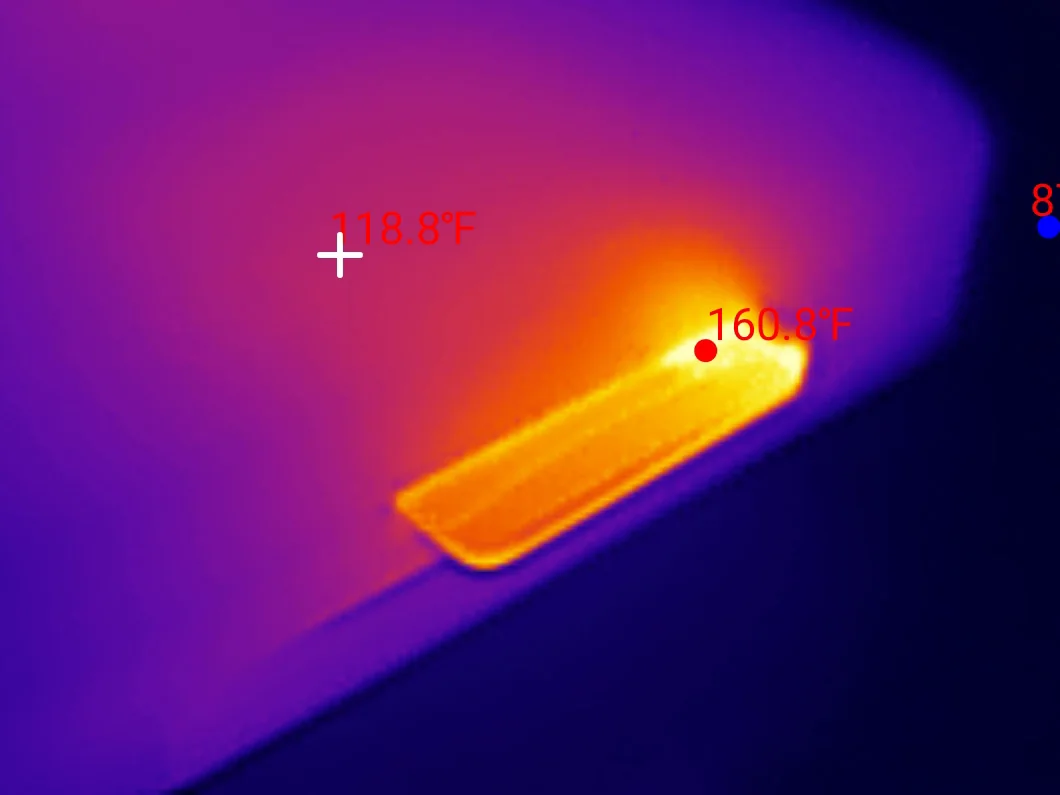
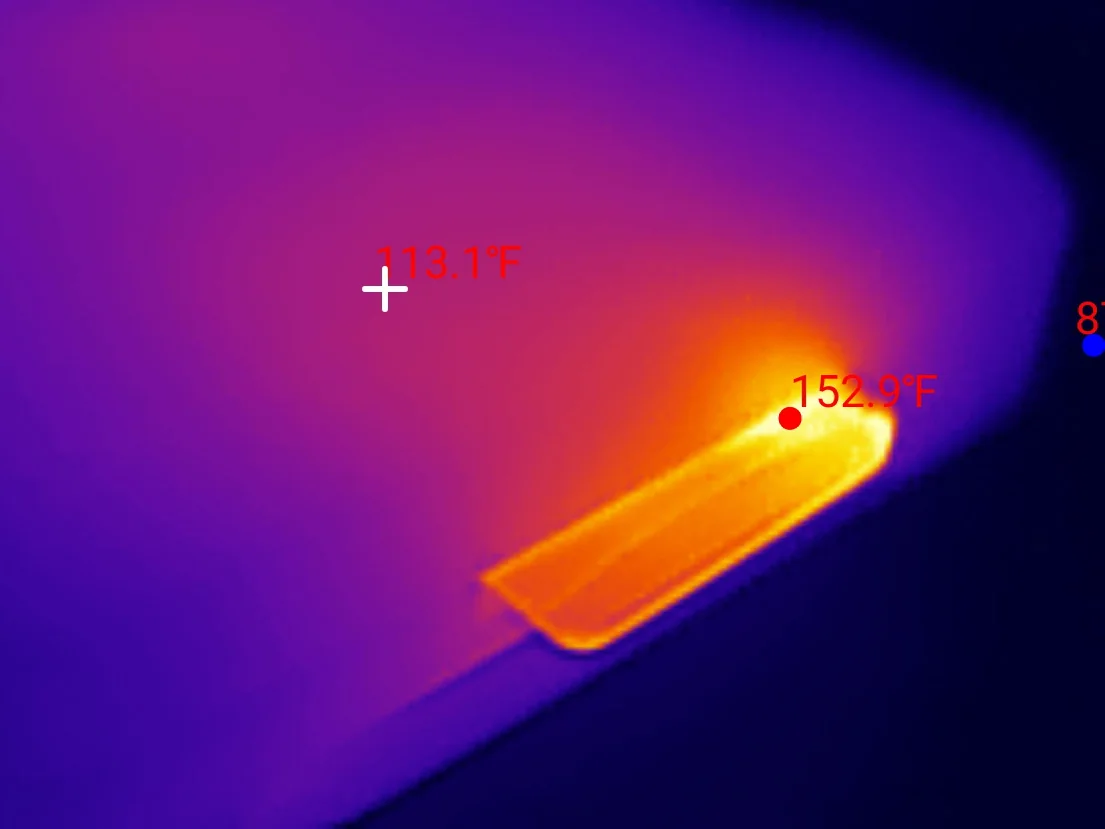
| Card | Peak | Rise over ambient |
|---|---|---|
| VIOFO High Endurance 128GB | 160 F / 71.1 C | +84 F / +46.7 C |
| VIOFO High Endurance 32GB | 153 F / 67.2 C | +77 F / +42.8 C |
| SanDisk High Endurance 128GB | 151 F / 66.1 C | +75 F / +41.7 C |
| Kioxia Exceria G2 128GB | 143 F / 61.7 C | +67 F / +37.2 C |
The comparison that matters is the first two rows against the third. The VIOFO 128GB runs 9 F or 5 C hotter than the SanDisk High Endurance while writing 32 MB/s slower. More heat for less work is the part worth knowing about in a card sold for a device that lives on a windscreen in the sun.
That said, do not let the raw number alarm you. Flash tolerates these temperatures, and the bench deliberately generates a thermal load no dash cam will ever impose: it writes flat out for five minutes, where a 4K30 dash cam writes about 6 MB/s, roughly one-ninth of this workload. Neither card throttled. The practical advice is the same as always: give the camera some air and keep it out of direct sun where you can.
Peak temperature, every card on the bench
What can these cards actually record?
Every row is judged against the worst ten seconds of the run, never the average, because your camera does not get to record over the average. The 32GB column shows its video-duty figure of 34.2 MB/s, which is what a dash cam will actually see.
| Workload | Needs (MB/s) | 128GB (55.8) | 32GB (34.2) |
|---|---|---|---|
| 1080p30 dash cam | 1.5 | PASS, 37.2× | PASS, 22.8× |
| 1080p60 dash cam | 3.0 | PASS, 18.6× | PASS, 11.4× |
| 4K30 dash cam | 6.0 | PASS, 9.3× | PASS, 5.7× |
| 4K60 consumer camera | 12.0 | PASS, 4.7× | PASS, 2.9× |
| 4K120 / high-bitrate video | 35.0 | PASS, 1.6× | FAIL |
| V30 class floor | 30.0 | PASS, 1.86× | PASS, 1.14× |
| V60 class floor | 60.0 | FAIL | FAIL |
For the job both cards are sold for, they are comfortable. A 4K30 dash cam needs 6 MB/s and the smaller card delivers nearly six times that under video duty. The caveats in this review are about honesty on the box, not about whether these cards can record your commute.
Two scores, one recommendation
VIOFO High Endurance 128GB
Scored against the CKBench rubric. Five dimensions, each out of 5.
Final score: 3.5 out of 5. The five dimensions average 3.7. A genuinely competent card that misses its own headline number by 30% and ran hotter than anything else on file. The rows were restated on the September 2026 scoring tables on 19 September 2026: endurance rose to 5 because the tables score fade and recovery, thermal rose to 3.5 on the headroom table, and the claim-accuracy row that carries the missed write figure did not move. Published at 3 out of 5 from July to September 2026; the second update note at the top says what moved and why.
VIOFO High Endurance 32GB
Scored against the CKBench rubric. Five dimensions, each out of 5.
Final score: 4 out of 5. The five dimensions average 4.0. Honest on capacity, faster than its printed claim, and on re-test a V30 card without conditions, held back by a real sensitivity to scattered writes. The rows were restated on the September 2026 scoring tables on 19 September 2026: sustained moved to 3 on the absolute ladder, endurance to 3.5 on the fade and recovery tables, and thermal to 4 on the headroom table, because heat per unit of work is now reported rather than scored. Published at 3 out of 5 from July to 15 September 2026 and at 3.5 from then until 19 September; the two update notes at the top say what moved each time and why.
The 32GB now outscores the 128GB, and the 128GB still gets the only buy link below. That is deliberate, and it is worth explaining rather than leaving it to look like an inconsistency. The score measures how well a card does what it claims. The link is about who should actually buy one. The 32GB earns its 3.5 honestly, because every number on its box holds, but a dash cam card's job is retention, and 32 GB is a short loop that a 4K30 dash cam at 6 MB/s overwrites in about an hour and a half; there are better ways to spend that money. The 128GB has a worse claim-accuracy problem and still earns the recommendation, because for the one job it is bought for it does the work without ever wobbling.
Frequently Asked Questions
Is the VIOFO High Endurance card good for a dash cam?
Yes, both capacities are. A 4K30 dash cam needs about 6 MB/s and the 128GB delivers 55.8 MB/s at its worst, while the 32GB delivers 34.2 MB/s under video duty. Dash cams write sequentially, which is the workload both cards handle best, and neither throttled during a five-minute flat-out write.
Does the VIOFO High Endurance 128GB really write at 80 MB/s?
No. Across three separate runs I measured 57.0 MB/s in the sequential test and 55.5 to 55.9 MB/s sustained, which is about 70% of the printed claim. The card is consistent and holds its V30 rating comfortably, but it does not reach the number on its box in any test I ran.
Is the 32GB VIOFO card the same as the 128GB?
No. They are made by two different manufacturers. The 32GB reports a Longsys manufacturer ID and was built in December 2024; the 128GB reports an unlisted manufacturer ID and was built in April 2026. They share a brand, a package design and four certification marks, and nothing else.
Why does my 128GB card show as 119 GB?
That is normal and it does not mean the card is fake. Card labels count in decimal, where 1 GB is 1,000,000,000 bytes, while Windows counts in binary. Cards also reserve some flash for spare blocks and internal bookkeeping. This card delivered 124.63 GB of usable space and verified every byte of it.
Should I reformat the VIOFO 128GB card?
If you are using it in anything other than a dash cam, yes. It ships formatted FAT32, which cannot store any single file larger than 4 GB. Reformatting to exFAT removes that limit and costs no speed. If it is going in a dash cam, leave it alone, because FAT32 is the format with the widest camera support.
Are these cards A2 rated for phone use?
Both print an A2 badge, and the proper A2 test needs a feature that USB card readers do not support, so I do not score it either way. On re-test in September 2026 the 32GB clears the lower A1 floors on both of my readers; the 128GB did not in July. I originally wrote that app-style random writes cost the 32GB its V30 rating. That was wrong, and the update at the top of this review explains what the July run was.
How do I know if a memory card is fake?
The only test a counterfeit cannot pass is a full fill and verify: write every free byte with data that cannot be predicted, then read all of it back. A card lying about its capacity fails loudly at its real size. Both VIOFO cards verified every byte with zero mismatches.
Bottom line: buy the big one, for the one job
The VIOFO High Endurance 128GB is a card I would put in a dash cam without hesitating. It writes 55.8 MB/s at its worst, holds its V30 rating with margin to spare, delivers every byte it promises, and never once varied across a full 124.6 GB write. What it does not do is reach the 80 MB/s printed on its own front, and it runs hotter than any card I have measured. Buy it for what it is rather than what the box says, and reformat it to exFAT unless it is going straight into a camera.
The 32GB is a harder card to recommend, not because it is bad but because it is small. It beats its own printed write speed, hands over more of its label than the big one does, and on re-test holds every mark on its face, which its first run in July had made me doubt. For a dash cam it works, for as long as 32 GB of loop lasts. For anything that leans on scattered writes, it is the card here that fades the most under them.
The bigger lesson is the one the identity registers gave up. Two cards, one name, two manufacturers, seventeen months apart. Whatever you read about one capacity of a card line, including this review, do not assume it carries over to another.
Both cards now sit on CKBench alongside the SanDisk High Endurance, the Kioxia Exceria G2, the counterfeit ImageMate and the SanDisk Ultra Fit, all scored the same way.
Device identity: what these two cards report about themselvesBoth register captures from July 31, collapsed because most people do not need them. Open it to check a card of your own against these, or to see the raw evidence behind the two-factories finding above.
VIOFO High Endurance 32GB
| Raw CID register | ad4c53555344303010…018c00 (serial digits elided) |
| Manufacturer ID (MID) | 0xAD (Longsys) |
| OEM / application ID (OID) | 0x4C53, ASCII "LS" |
| Product name (PNM) | USD00 |
| Product revision (PRV) | 1.0 |
| Serial number (PSN) | 0x35…fc (truncated) |
| Manufacture date (MDT) | December 2024 |
| Model code (from the package) | none printed; VIOFO publish no manufacturer SKU on either face |
| Declared capacity (from CSD) | 61,952,000 sectors of 512 bytes = 31,719,424,000 bytes, 99.1% of the label |
| Raw CSD register | 400e0032db790000ec537f800a400000 |
| Raw SCR register | 0235848700000000 |
| Raw SD status (SSR) | 000000000500000004ff900100fd391e000800000002fc0000000000000000000000000000000000000000000000000000000000000000000000000000000000 |
| Captured on | Raspberry Pi 4 native SD host, no USB bridge in the path · 2026-07-31 |
VIOFO High Endurance 128GB
| Raw CID register | b54d564d45544f5200…21a400 (serial digits elided) |
| Manufacturer ID (MID) | 0xB5 (not listed in any public registry) |
| OEM / application ID (OID) | 0x4D56, ASCII "MV" |
| Product name (PNM) | METOR |
| Product revision (PRV) | 0.0 |
| Serial number (PSN) | 0x30…15 (truncated) |
| Manufacture date (MDT) | April 2026 |
| Model code (from the package) | none printed; the X003TQT2IJ barcode on the back is an Amazon fulfillment code, not a part number |
| Declared capacity (from CSD) | 243,507,200 sectors of 512 bytes = 124,675,686,400 bytes, 97.4% of the label |
| Raw CSD register | 400e0032db790003a0e77f800a400000 |
| Raw SCR register | 0205848300000000 |
| Raw SD status (SSR) | 00000000000000000400900008113a1e000800000002fc0000000000000000000000000000000000000000000000000000000000000000000000000000000000 |
| Captured on | Raspberry Pi 4 native SD host, no USB bridge in the path · 2026-07-31 |
Everything above except the serials and the dates is model-level: another unit of the same SKU should match it, which is what makes these tables worth publishing. Put the two side by side and the finding in the body of this review is simply there in the hex. The serials are unique to my units, so they appear truncated and their digits are elided from the raw CID strings; publishing a genuine serial in full would mostly help whoever wants to clone it onto a counterfeit. Manufacture dates publish in full because they are batch-level and diagnostic.
Each card's declared capacity matches what it actually delivered, to within normal filesystem overhead. That is the check the counterfeit ImageMate failed, declaring 127.87 GB on both buses while holding a fraction of it. A caution that cuts the other way too: that same counterfeit presented a complete and coherent forged SanDisk identity. Matching a table like this is necessary for a genuine card and never sufficient. The only physical proof is a full write and verify of every byte, which both of these cards passed.
What is missing: no register reaches the flash controller or the memory chip part numbers, which need vendor tooling. And on the 128GB, the 0xB5 manufacturer ID is absent from every public registry I checked, including the maintained community list that identifies 0xAD as Longsys. The SD Association does not publish these assignments, so I can tell you what the card says and not who made it. If you recognize that signature, I would like to hear from you.
Disclosure: I bought both cards at retail with my own money; VIOFO had no involvement in this test and no editorial input. This post contains affiliate links. As an Amazon Associate I earn from qualifying purchases, at no extra cost to you. Affiliate links like these and my YouTube channel are what keep the site running.