
Silicon Power Superior Pro 128GB: 85 MB/s for 4.7 GB, then 39
Silicon Power’s everyday microSD prints no speed on its blister at all, and its website promises up to 100 MB/s read and 80 MB/s write. I filled it, ran it on two readers and read its identity registers on a Raspberry Pi. The 80 is real, for the first 4.7 GB after the card has had a rest. After that it writes 39 MB/s for as long as you keep writing, which still holds its V30 mark with a quarter to spare. Its identity register had a surprise of its own.
No video for this bench run
Everything on this page came off the bench, not a camera. The channel covers the dash cams, phones and readers these cards end up in; subscribe and the next one lands in your feed the day it goes up.
The short version
It keeps both of its speed promises, by the letter. Silicon Power’s product page says up to 80 MB/s write, and I measured 85.4 MB/s committed on two different readers, so the claim is met. But the card only writes that fast into a cache of about 4.7 GB. On both readers the cache ran out 54 seconds into a continuous write, and from then on the card wrote 38.9 to 39.1 MB/s, flat, for as long as I kept writing: five minutes in the timed test, 52 minutes to fill the whole card. That is 49% of the 80. It is also 26% above the V30 floor, which is the sustained promise the card actually prints, so V30 holds on both readers. The read, 97.2 MB/s, is the ceiling of the UHS-I bus, so its 100 is met too. Every one of its 124.4 GB came back byte for byte, and it peaked at 123.7 °F (50.9 °C). My rating: 4/5, scored against the CKBench rubric. It loses its points on the 39 MB/s floor, on declaring 97.2% of its label, and on a 70 °C rating that leaves less room than most.
Verdict: 4/5, a 4.7 GB sprint, then a steady V30 cardWho this card is for
- YesPhones, tablets and cameras that write in burstsAnything that writes a few gigabytes and then pauses lands in the cache at 85 MB/s: a burst of photos, the day’s pictures, a short clip. 4.7 GB is about 2,000 photos at the 2.39 MB each the pack’s own table assumes, and the card refilled about 0.6 GB of cache in a sixteen-second pause.
- YesDash cams and 4K cameras that ask for V3037.8 MB/s through the worst ten seconds on my primary reader and 38.8 on the second, 26% above the V30 floor, and it held 39 for the whole 52-minute fill. A 4K dash cam writes about 6 MB/s.
- NoCopying large files onto it from a computerPast the first 4.7 GB it writes 39 MB/s. On these numbers a 20 GB copy averages about 45 MB/s, and filling the whole card took 52 minutes.
- NoAnything that needs V60, or more than 39 MB/s for longIt misses V60 by a wide margin on both readers. A camera that wants V60 for high-bitrate 4K will outrun it within the first minute of recording.
124.4 GB of usable space is roughly 5 hours 46 minutes of single-channel 4K at 6 MB/s, or about 11 hours 31 minutes of 1080p60 at 3 MB/s, before a dash cam loop starts overwriting. Work out your own numbers in the dash cam storage calculator.
Is the Silicon Power Superior Pro any good?
Silicon Power is a Taiwanese maker of memory cards, flash drives and SSDs that sells under a stylized SP logo, and the Superior Pro is its everyday microSD line. The blister prints the capacity and the class marks, microSDXC, UHS-I, U3, V30 and A1, and no speed figure of any kind. Silicon Power’s own product page, which lists this exact model number, supplies the numbers the box leaves out: up to 100 MB/s read and 80 MB/s write. By my bench’s rules a maker’s published figure counts as the claim when the card and the box print none, so the 80 is what this card is judged against. It is the same 80 that the VIOFO High Endurance 128GB claims and missed on this bench, which made it the number to test.
I bought one at retail, sealed, and ran it the way every card here runs: the full suite on my primary reader with a fill of every byte, then the suite again on a second reader. I read its identity registers on a Raspberry Pi. The answer to the heading is yes, with one thing about how it writes that no product page would show you, and one thing about who made it that I did not expect. It joins CKBench, the running index of every card on the bench, alongside the PNY Premier-X, Amazon Basics and Gigastone High Endurance Pro 128GB cards I tested before it.
Every write figure on this page is a committed write: the data is on the flash before the clock stops, with no operating-system cache in the way. That is why the numbers here read lower than a marketing sheet or a quick benchmark; the methodology page explains the difference and why it is the one that matters for recording.
What Silicon Power claims, and what the card did
| Claim | Printed or published | Measured | Verdict |
|---|---|---|---|
| Capacity | 128 GB (card face and blister; no GB definition anywhere) | 124.4 GB written and verified, zero errors; the card declares 97.2% of its label | VERIFIED |
| Read speed | Up to 100 MB/s (Silicon Power’s product page; nothing on the pack) | 97.2 MB/s (ProGrade PGM0.5); 97.3 MB/s (SanDisk QuickFlow SDDR-B751). Both at the UHS-I SDR104 ceiling, where every 100 MB/s card measures here | MET |
| Write speed | Up to 80 MB/s (product page) | 85.4 MB/s committed on both readers, for the first 4.7 GB after a rest; 38.9 to 39.1 MB/s after that | MET, FOR 4.7 GB |
| Speed class | Not printed (the card declares C10 to a host) | 37.8 MB/s worst ten seconds (ProGrade); 38.8 (QuickFlow) | NOT CLAIMED |
| UHS speed grade | U3 | 37.8 MB/s worst ten seconds (ProGrade); 38.8 (QuickFlow) | HELD |
| Video speed class | V30 | Holds V30 on both readers with 26% in hand; misses V60 on both | HELD |
| App performance class | A1 (the card declares A2 to a host) | 2,117 read / 1,299 write IOPS at QD1 on the ProGrade, 2,824 / 1,555 on the QuickFlow, against A1’s 1,500 / 500; the SD procedure differs and USB readers do not queue, so this is indicative only | NOT TESTABLE |
| Bus | UHS-I | Declares SD specification 6.x with the UHS bit set; reads at the SDR104 ceiling on two readers | CONSISTENT |
| Endurance rating | None printed or published; not an endurance line | n/a | NOT CLAIMED |
| Operating temperature | 0 °C to 70 °C (product page) | 50.9 °C (123.7 °F) at the hot spot after five minutes of uncooled writing in a 73 °F room; 52.6 °C normalized to the bench’s 76 °F, 17.4 °C of headroom | NOT A PERFORMANCE CLAIM |
| Warranty term | 5-year limited (blister and product page) | n/a | NOT A PERFORMANCE CLAIM |
Three rows need their reasoning attached. The speed claims come from Silicon Power’s website, not the box, because the box prints none; the pack does carry a footnote that qualifies a speed it never states, which the next section comes back to. The write is met as a burst. 85.4 MB/s is the committed rate of three one-gigabyte passes, which is how every write claim on this bench is judged, and it beats the 80 on both readers. It holds for about 4.7 GB; after that the card writes 39, and the section after next is about exactly that. The read is met, not beaten, and could not have been beaten here: a standard UHS-I card runs a bus mode whose practical ceiling on a card reader is about 97 MB/s, and this card measured 97.2 and 97.3 on two readers, one of which can drive a faster mode the card does not speak. A1 is not testable on any USB card reader, mine included, because its floors assume a command queuing mode that USB readers do not perform; the card cleared A1’s floors at queue depth one on both readers, which is indicative and nothing more, and its identity register declares A2, which I come back to below.
A blister with no speed on it, and a footnote for one
The Superior Pro comes sealed in a white retail blister with an SD adapter. The front carries the SP logo, Superior Pro, microSDXC UHS-I Card, 128 GB, a 4096x2160 Ultra HD badge, and the marks: microSDXC, V30, UHS-I, U3 and A1 App Performance. The card face repeats them and adds 3D NAND. The back prints Silicon Power’s Taipei address, a 5-year limited warranty, a voltage range of 2.7 to 3.6 V, Assembled in Taiwan, and a 2023 copyright date on the artwork. The model number, SP128GBSTXDU3V20AB, appears on Amazon’s inventory label rather than in Silicon Power’s own printing.
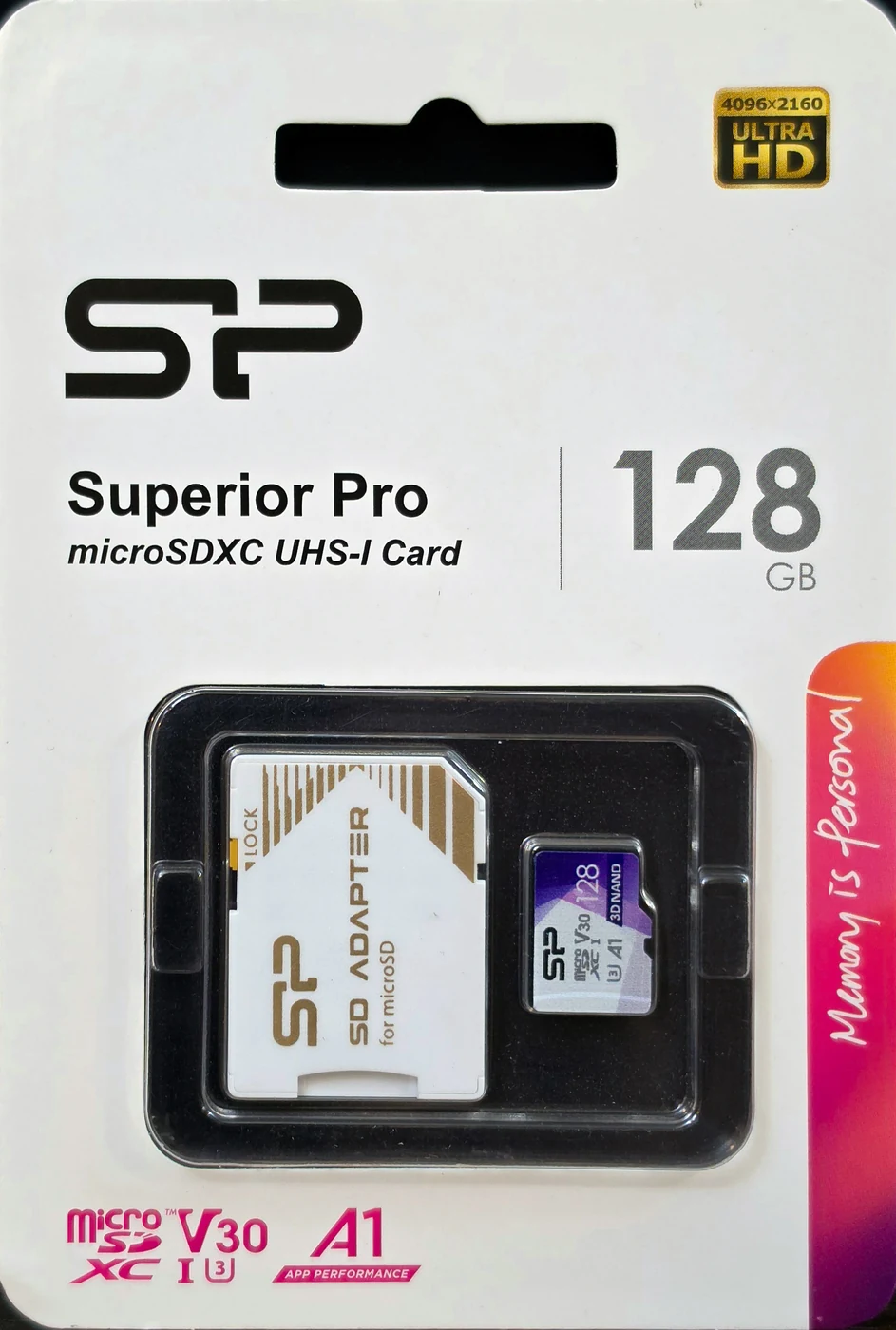
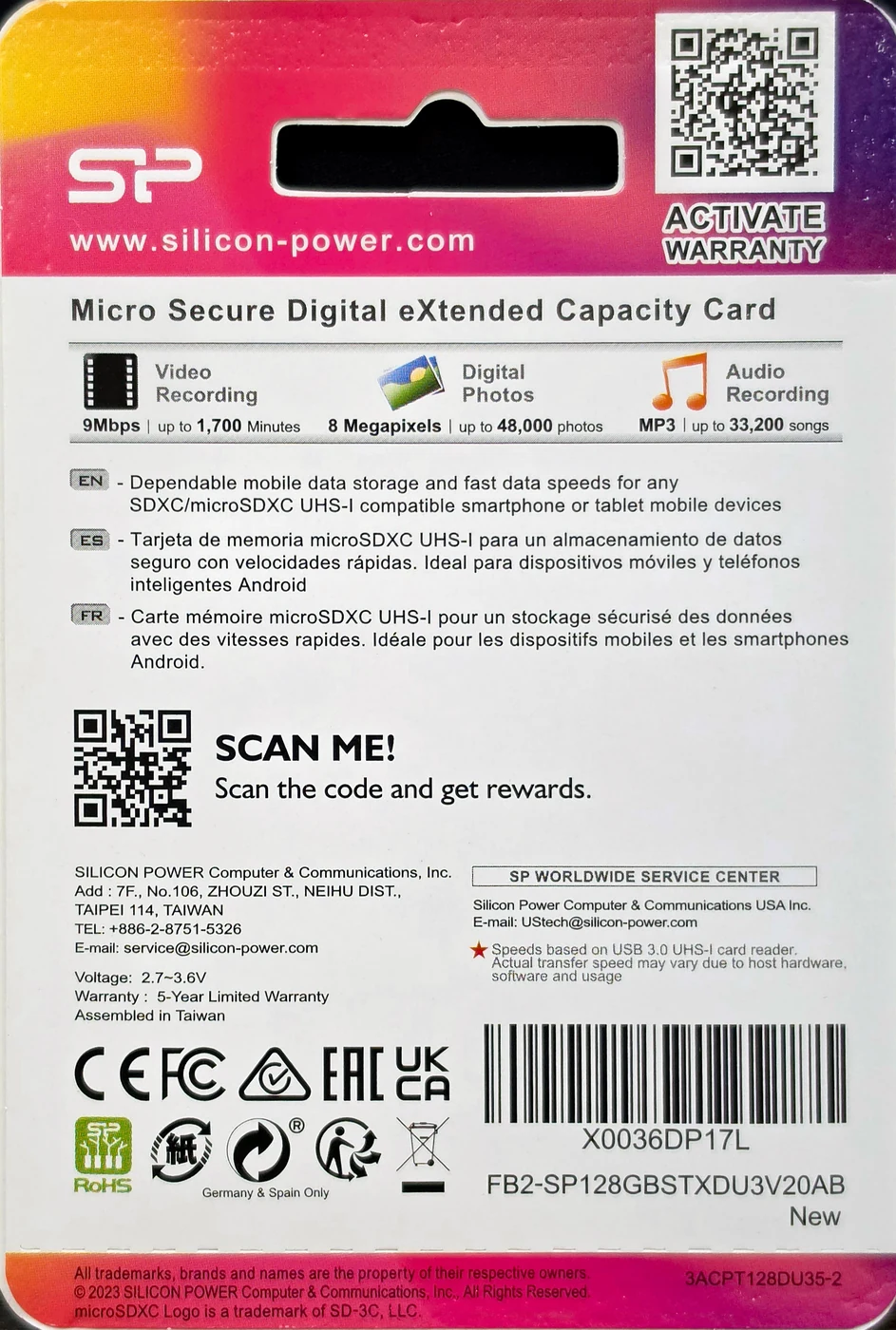
Two things on that back panel are worth a sentence each. The first is a footnote, marked with a star: Speeds based on USB 3.0 UHS-I card reader. Actual transfer speed may vary due to host hardware, software and usage. There is no speed anywhere on the pack for it to qualify. The ordinary explanation is shared artwork across a range where some cards do print a figure, and I am not reading anything more into it than that. The second is the capacity table, the usual strip of how much fits, and this one earns a paragraph because it adds up.
It says 1,700 minutes of 9 Mbps video, 48,000 eight-megapixel photos, or 33,200 MP3 songs. Nine megabits a second for 1,700 minutes is 114.75 GB; divide that by 48,000 and a photo comes out at 2.39 MB, and by 33,200 a song at 3.46 MB, both entirely ordinary sizes. The three rows describe one card of about 115 GB, which is conservative against the 124.4 GB this card actually holds. That matters because the last capacity table I checked, on three fake 128GB cards, printed rows that contradicted each other and ended in a literal 1.00 GB. A capacity table can be done properly, and this is one. The card face’s 3D NAND is true of almost every flash chip made today and says nothing about how many bits each cell stores, so I neither test nor score it. The card arrived sealed, formatted exFAT with 128 KB clusters, with no volume label and nothing on it.
Eighty megabytes a second, for 54 seconds
This is the heart of the review. The test that decides a write claim on my bench writes a one-gigabyte file three times over, with reads in between, and on this card it measured 85.4 MB/s on both readers. That is a real, committed figure. It is also a figure the card can only keep up for a while, because the Superior Pro writes into a fast cache first, and a gigabyte at a time never fills it: the whole sequential test, preparation included, writes 4.36 GB with pauses for reading between the passes, and the third pass was as fast as the first.
What fills it is the step that runs before every timed write on my bench: an untimed warm-up that writes until the speed stops changing, so that the five minutes that decide the video class start on a settled card. On this card the warm-up is where the whole story is. On both readers it wrote at 86 to 89 MB/s for exactly 54 seconds, then dropped, inside a single second, to 39, and stayed there.
SP-Superior-Pro-128GB_2026-09-27_102455 (ProGrade PGM0.5, the sealed card’s first run) and _120225 (SanDisk QuickFlow SDDR-B751, straight after a whole-card fill). The dashed lines are Silicon Power’s 80 MB/s write claim and the V30 floor.That is a cache of about 4.7 GB: 4.80 on the first reader, 4.68 on the second. Everything the card writes until the cache is full goes in at 85 MB/s or better, and everything after it goes in at 39. Nothing I had tested before it did this, and one card since has, the SUNEAST Ultimate Pro 128GB, with a fast stage more than three times the size. Across the 71 warm-ups from every other card run in my archive, the biggest drop from the first ten seconds to the last thirty is 22%, a gentle slope on an SD Express card; this card drops 56%, and does it in one second. It also gives the Superior Pro the widest gap on my bench between its committed write and its sustained floor: 85.4 against 37.8, a factor of 2.26. The nearest cards got there by other routes: a stall on the SanDisk High Endurance 512GB, and on the SUNEAST and the Gigastone, a floor measured after the card’s first fill.
Two more measurements make the cache concrete. It refills when the card is idle: the whole-card fill started sixteen seconds after the timed write ended, and in that pause the card had cleared about 0.6 GB, which it wrote at 83 to 86 MB/s before dropping back to 39. At that pace a full refill takes a couple of minutes, though that is one pause, so treat it as an estimate. And it does not shrink when the card is full. The second reader’s run came straight after the whole card had been written, and a USB reader cannot tell a card which of that data was deleted, so the card went into the warm-up believing it was completely full. The cache was 4.68 GB, against 4.80 on the empty card. The SUNEAST’s did not survive the same treatment: its fast stage, about 15.7 GB, was gone after one fill and never came back.
What it means in practice is simple. A burst of photos, the day’s pictures from a phone, a clip of a few gigabytes: all of it goes in at 85, and the card has refilled its cache before you take the next one. A 20 GB folder copied from a computer would average about 45 on these numbers, because the first 4.7 GB are fast and the next 15 are not; a card with no cache at all, like the LinkMore XV23 Lite 128GB, writes the same folder at about 80 from start to finish. And a recording device that writes continuously is running on the 39 within the first minute, which is why the video class is judged on the 39, and why the next panel is flat.
Five minutes at 38.9 MB/s: V30 with a quarter in hand
The timed write starts after the warm-up, so on this card all five minutes come after the cache. The trace below is the scored run, one sample a second, with the speed-class floors marked, and it is about as flat as a card gets. The first thirty seconds averaged 38.9 MB/s, the whole five minutes 38.9, the worst ten seconds 37.75 at 2:13, and the one-second samples stayed close to the average, with a standard deviation under 2% of it. The longest single write the card took was 65 milliseconds; the bench flags anything over half a second, and there was nothing close. On the second reader the same five minutes read 39.1 steady and 38.8 through the worst ten seconds.
Silicon Power Superior Pro 128GB
37.8 is 26% above the V30 floor of 30 MB/s, so V30 holds with room to spare; V60 is not close on either reader, and the card does not claim it. For scale, the cards around it on my bench: the Newegg TeamGroup 128GB floors at 35.5, the PNY Premier-X at 47.1, the VIOFO High Endurance 128GB at 55.8, and the Kioxia Exceria G2 that anchors the lower end of my control band at 62.6. Among the genuine 128 GB cards I have tested, this one sits fourth from the bottom, above only the TeamGroup and two cards measured after their first fill, the Gigastone and the SUNEAST. A 4K dash cam writes about 6 MB/s, so none of that is a problem for recording; it is the number that matters when you write a lot at once.
124.4 GB, every byte verified, and the cache came back once
The capacity test wrote 116 files of unpredictable, dedup-proof data until the card was full, 124,381,429,760 bytes, then read every one of them back and compared. Zero mismatched bytes. Zero read errors. The fill took 52 minutes and 16 seconds and the read-back 22 minutes. Across the first, middle and last tenth of the fill the write speed spread by 1.7% and the read by 0.1%, which is what a genuine card looks like; the fakes on this bench spread by 10 to 23%.
Every byte, written and read back
The fill has one feature I have not seen before, and it is easier to show than to describe. For 46 minutes the card wrote at 39 MB/s. Then, 107.8 GB in, with no pause of any kind, it went back to 81 MB/s for 52 seconds, wrote 4.22 GB, and dropped back to 39 for the last 12 GB.
SP-Superior-Pro-128GB_2026-09-27_102455. The flick at the very start is the 0.6 GB of cache the sixteen-second pause before the fill had refilled.4.22 GB at 81 MB/s is the cache again: the same size and the same speed as in the warm-up. Of the 41 other whole-card fills in my archive, none has a burst like it. The only other fill with fast stretches in the middle was a used card, fresh out of a dash cam, working its way back to full speed across one long fill, which is a different thing. How the card found room for its cache in the middle of a continuous write, I cannot tell from this data. I have a candidate explanation and a test that would settle it, and until that test runs the explanation stays off this page. For a buyer it changes nothing: outside that minute the fill held its 39, with only four one-second samples in 52 minutes under 35 MB/s.
124.4 GB of usable space is 97.2% of the 128 GB on the label. The card declares 124,415,639,552 bytes, which is ordinary provisioning overhead inside the 96.7% to 100.1% every genuine card on my bench occupies, at the lower middle of it, and a byte count no other card on the bench declares. Windows will show you about 116 GB, because it counts in binary; that is arithmetic, not a shortfall, and the methodology page has the conversion. The capacity row of the rubric scores the declared share of the label, and 97.2% is a 4.
What scattered writes do to it
Loop recording is a long write interrupted constantly by small ones, and random 4K writes are the bench version of that: three twenty-second passes, and the question is whether the third is as fast as the first. It is. The scored run did 1,301, 1,297 and 1,298 write IOPS, a fade of 0.2%, and the second reader did 1,553, 1,556 and 1,555. Afterwards the card was back at full speed inside the first ten seconds of continuous writing, because it went straight into its cache.
One minute of loop-recording abuse
This card: run SP-Superior-Pro-128GB_2026-09-27_102455 · reference card: lab baseline, same bench, same test · cardcheck v0.8.3
At 5.3 MB/s of random 4K on my primary reader, this card is quick for its class: tenth of 43 microSD runs on that reader, and the nine runs ahead of it are all A2 cards apart from the SD Express P9. Two cautions go with that. The random figures move with the reader: the second reader measured 20% more write IOPS and 33% more read IOPS, which is normal here and is part of why the A classes cannot be tested on a USB reader. And a minute of random writes adds up to about a third of a gigabyte, which fits inside a 4.7 GB cache many times over, so a flat result on this card may partly be the cache doing its job. The rubric scores what the test measures, and here that is a 5.
123.7 °F, against a 70 °C rating
Silicon Power publishes an operating range of 0 to 70 °C for this card, which is lower than the 85 °C most of the industry quotes, and the rubric scores heat against the maker’s own maximum whenever there is one. At the end of five minutes of uncooled writing in a 73 °F room, the thermal imager read 123.7 °F (50.9 °C) on the exposed part of the card. Normalized to my bench’s usual 76 °F, that is 52.6 °C: 17.4 °C under the rating, which scores a 4. The second reader’s run read 124 °F in a 74 °F room, which is the same thing.
It got warm. It did not slow down.
The second reader’s run read 124 °F at 74 °F ambient · Run SP-Superior-Pro-128GB_2026-09-27_102455 · cardcheck v0.8.3 · ProGrade PGM0.5
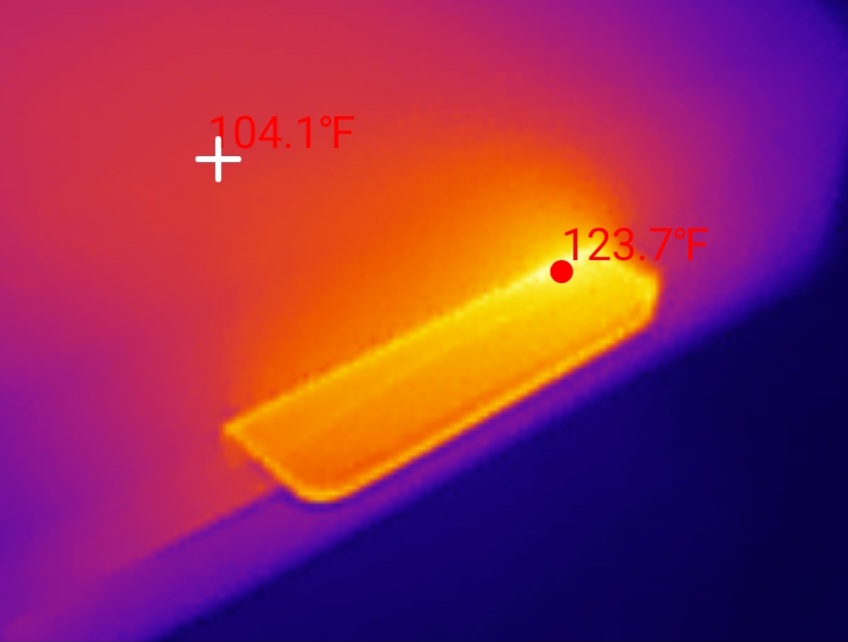
It did not throttle: the last thirty seconds of the timed write ran at 39.0 MB/s against 38.9 for the first thirty. Two honest footnotes. The card runs cool mostly because it is not writing very fast: the fastest UHS-I cards on my bench, doing three to five times the work in the same readers, peak between 158 and 174 °F. And the thermal row is a 4 only because Silicon Power publishes a 70 °C maximum; if it published nothing, the rubric would assume 85 °C and this card would score a 5. I would rather have the rating than the point.
Two readers, one answer
Every card I review runs on my primary reader, a ProGrade PGM0.5, and again on a SanDisk QuickFlow SDDR-B751, which drives the fast non-standard UHS-I mode at a higher clock and has lifted two cards from the mid-150s to about 188 MB/s sustained. The Superior Pro went on it second, straight after its whole-card fill.
| Measurement | ProGrade PGM0.5 (primary) | SanDisk QuickFlow SDDR-B751 | Difference |
|---|---|---|---|
| Card at the start of the run | sealed, first run | just written end to end | |
| Sequential read | 97.2 MB/s | 97.3 MB/s | same |
| Sequential write, committed | 85.4 MB/s | 85.4 MB/s | same |
| Cache, before the drop | 4.80 GB in 54 s | 4.68 GB in 54 s | same |
| Sustained write, steady state | 38.9 MB/s | 39.1 MB/s | same |
| Sustained write, worst ten seconds | 37.8 MB/s | 38.8 MB/s | +2.8% |
| Random 4K read / write | 2,117 / 1,299 IOPS | 2,824 / 1,555 IOPS | +33% / +20% |
| Video class held | V30 | V30 | same |
| Peak temperature | 123.7 °F at 73 °F ambient | 124 °F at 74 °F ambient | same |
| Blocks over 500 ms | 0 | 0 | same |
This card is not reader-limited: it speaks standard UHS-I and nothing faster, and it writes at under half what either reader can carry, so the reader you own changes nothing about it but the random figures. The pair also answers a question the Gigastone raised, where a card wrote much slower after being filled once. This one does not: its second run started on a card that had just been written end to end, and it matched the first run on every write figure. If you have read my reader tiers post and wondered whether it applies here, a plain UHS-I reader gets everything this card has.
Who makes the Silicon Power Superior Pro?
Every SD card carries identity and capability registers, written at the factory, that a USB reader cannot show you but a native SD host can, and I read this card’s on a Raspberry Pi. The product name field is the first thing that jumps out, because it is not a product name. It reads SPCC: the initials of Silicon Power Computer & Communications, the company on the back of the blister. Whoever programmed this card wrote the brand’s own initials into it.
The manufacturer ID is the surprise. It reads 0x9F, with the OEM field TI, and it is the first 0x9F on my bench. The SD Association keeps these assignments confidential, so every public list of them is compiled by people reading cards, and the most-cited one gives Silicon Power 0x31, not 0x9F. The Linux kernel, which has to recognize cards to work around their bugs, names 0x9F KINGSTON_SD, and the one workaround it carries for that ID is for a Kingston Canvas Go! Plus card from 2019, identified by the same OEM field, TI. So this Silicon Power card carries the manufacturer ID and OEM pair the Linux kernel associates with Kingston. What that means, I cannot tell you. The ID names whoever assembled the card, rather than the brand on the box or the controller inside it, and whether that is Kingston’s own manufacturing, a contract factory both brands use, or something else, the bench cannot see. I am not going to guess. The card is in my manufacturer ID register now, as the first 0x9F, and the identity explainer covers what these fields can and cannot tell you.
The capability registers have one more thing to say. The card declares its classes to a host, and every mark it prints matches: U3, V30, and a bus declaration of SD specification 6.x, which is what makes a UHS-I mark legitimate. Except one. The card prints A1, and its register declares A2, the higher app class. Every other card on my bench that prints an A mark declares exactly what it prints; this is the only one that prints a lower class than it declares. That is the conservative direction, and it is not a mark against the card. It does mean that a phone which reads the register will treat this as an A2 card, and neither class is something a USB reader can test. No register on this card matches any other card I have read, byte for byte, so whatever platform this is, it is a new one to the bench.
Superior Pro, PNY Premier-X or VIOFO?
Two cards on my bench make the useful comparisons. The PNY Premier-X is another entry-price branded 128GB card I have tested, and the VIOFO High Endurance 128GB makes the same 80 MB/s write claim.
| Silicon Power Superior Pro 128GB | PNY Premier-X 128GB | VIOFO High Endurance 128GB | |
|---|---|---|---|
| Write claim | 80 MB/s (maker’s product page) | none printed | 80 MB/s |
| Committed write | 85.4 MB/s, for the first 4.7 GB | 53.6 MB/s | 57.0 MB/s |
| Sustained floor, worst 10 s | 37.8 MB/s | 47.1 MB/s | 55.8 MB/s |
| How it writes | a 4.7 GB cache, then 39 flat | a four-second cache cycle | flat, no cache the bench can see |
| Video class held | V30 | V30 | V30 |
| Declared capacity | 97.2% of label, verified | 97.7% of label, verified | 97.4% of label, verified |
| Peak temperature | 123.7 °F | 129 °F | 160.8 °F |
| Score | 4 | 4.5 | 3.5 |
The same 80 on two cards has come out two opposite ways. The VIOFO missed its 80 on the committed test, 57.0 against 80, and loses points for it, but it sustains 55.8 MB/s for as long as it writes. The Superior Pro meets its 80 and sustains 37.8. Both are honest by the rules I score to: “up to” describes a peak, and the video class is the sustained promise, which both cards keep. Which one writes faster depends entirely on how long you write for. Against the PNY the trade is the same shape: the Superior Pro is 59% faster for the first 4.7 GB and has a 20% lower floor after it, and the PNY is the only one of the three with no write claim at all.
How the 4 breaks down
Silicon Power Superior Pro microSDXC 128GB
Scored against the CKBench rubric. Five dimensions, each out of 5, every row read off its published table.
Final score: 4 out of 5. The five dimensions average 4.2. A card that meets every claim it makes and verifies every byte, and gives back points for a 39 MB/s floor, a 97.2% declaration and a 70 °C rating.
The claim-accuracy 5 deserves a plain-language footnote, because it rests on the cache. My bench judges a write claim on the committed sequential test, three one-gigabyte passes, and on this card that test fits inside the cache. By that rule the 80 is met, and I think the rule is right: “up to” describes a peak, and the card’s sustained promise is its V30 mark, which it keeps. The sustained row is where the 39 is scored, and it is a 3.
Frequently Asked Questions
Is the Silicon Power Superior Pro 128GB a good microSD card?
Yes, within limits. It met Silicon Power’s 80 MB/s write claim at 85.4 MB/s committed on two readers, but only for the first 4.7 GB; after that it writes 39 MB/s, which holds its V30 mark with 26% to spare. Its 100 MB/s read is met at the UHS-I bus ceiling, every one of its 124.4 GB verified with zero errors, and it peaked at 123.7 °F (50.9 °C). It scores 4 out of 5. It suits phones, cameras and V30 dash cams, and it is a poor choice for copying large files from a computer.
What is the write speed of the Silicon Power Superior Pro 128GB?
About 85 MB/s for the first 4.7 GB, then 39 MB/s. I measured 85.4 MB/s committed sequential write on both a ProGrade PGM0.5 and a SanDisk QuickFlow reader, which beats the 80 MB/s on Silicon Power’s product page. The card writes that fast into a cache that ran out 54 seconds into a continuous write on both readers; after that it wrote 38.9 to 39.1 MB/s steadily, with a worst ten seconds of 37.75 MB/s.
Is the Silicon Power Superior Pro good for a dash cam?
Yes, for a V30 dash cam. Its worst ten seconds of continuous committed writing were 37.75 MB/s, 26% above the V30 floor, and it held about 39 MB/s through a 52-minute whole-card fill. A 4K dash cam writes about 6 MB/s. It is not an endurance-rated card and Silicon Power makes no endurance claim for it, and its published operating range tops out at 70 °C, lower than many cards, so treat it as a general-purpose card that copes with dash cam bitrates.
Is the Silicon Power Superior Pro A1 or A2?
It is sold as A1, and its SD Status register declares A2. The card face and blister print A1; the register that tells a phone what the card supports says A2, which makes it the only card on my bench that prints a lower app class than it declares. Neither class can be tested on a USB card reader. At queue depth one it measured 2,117 read and 1,299 write IOPS on a ProGrade PGM0.5 and 2,824 and 1,555 on a SanDisk QuickFlow, above A1’s 1,500 and 500 floors, which is indicative only.
Is the Silicon Power Superior Pro 128GB really 128GB?
Yes. I filled every free byte with unpredictable data and read it all back: 124,381,429,760 bytes written and verified, zero mismatched bytes, zero read errors. The card declares 124,415,639,552 bytes, 97.2% of the 128 GB label, which is ordinary provisioning overhead for a genuine card. Windows shows it as about 116 GB because Windows counts in binary.
Who makes Silicon Power microSD cards?
The Superior Pro 128GB’s identity register carries Silicon Power’s initials, SPCC, in its product name field, with manufacturer ID 0x9F and the OEM field TI. The public lists give Silicon Power a different ID, 0x31, and the Linux kernel names 0x9F as Kingston’s SD card ID. The ID names whoever assembled the card, and the bench cannot tell who that is; the blister says Assembled in Taiwan.
Silicon Power Superior Pro or PNY Premier-X?
It depends on how long you write. The Superior Pro writes 85.4 MB/s for its first 4.7 GB against the PNY’s 53.6, but its sustained floor is 37.75 MB/s against the PNY’s 47.1. Both hold V30, both verified every byte, and the PNY scores 4.5 to the Superior Pro’s 4. For bursts of photos and short clips the Superior Pro is faster; for continuous recording the PNY has more in hand.
The bottom line
The Silicon Power Superior Pro 128GB does exactly what it promises and not a megabyte a second more. Its box promises nothing but class marks and keeps all of them; its website promises 80 MB/s and delivers 85, for 54 seconds, which is exactly what “up to” allows. After that it is a steady 39 MB/s card: honest, verified to the byte, and 26% clear of the V30 floor it prints.
If you shoot photos, record short clips, or want a card for a phone or a V30 dash cam, it will do the job well, and the cache will make it feel faster than it is. If you copy big folders onto cards from a computer or need anything above V30, the 39 is the number that matters, and there are faster cards on this bench for that job. Its identity register, carrying Silicon Power’s initials on an ID the Linux kernel files under Kingston, is the most interesting thing about it and the least important to a buyer.
Sample size: one unit, purchased retail from Amazon on 23 September 2026, sealed. Two runs on two readers on 27 September 2026 under CKBench protocol v1.22.
Device identity: what this card reports about itselfFor anyone checking their own card or tracking silent hardware revisions
| Raw CID register | 9f5449535043432007…719700 (serial digits elided) |
| Manufacturer ID (MID) | 0x9F, the only one on this bench; the Linux kernel names it KINGSTON_SD, and the most-cited public list gives Silicon Power 0x31 |
| OEM / application ID (OID) | 0x5449, “TI” |
| Product name (PNM) | SPCC, Silicon Power Computer & Communications’ initials |
| Product revision (PRV) | 0.7 |
| Serial number (PSN) | 0x7094… (per unit, truncated; a ten-digit count, as major-brand cards carry) |
| Manufacture date (MDT) | 07/2025 |
| Declared capacity (from CSD) | 242,999,296 sectors of 512 bytes = 124,415,639,552 bytes, 97.20% of the label; no other card on this bench declares the same count |
| SD specification (from SCR) | SD_SPEC 2 with SD_SPEC3 = 1, SD_SPEC4 = 1 and SD_SPECX = 2 (specification 6.x), so the UHS-I, U3 and V30 marks are legitimately declared |
| Declared classes (from SD Status) | Class 10, U3, V30 and A2, where the card prints A1; no other card on this bench shares this register |
| Factory format | exFAT, 128 KB clusters, no volume label, no user files present |
| Captured on | Raspberry Pi 4 native SD host, no USB bridge in the path · 2026-09-27 |
The MID, OEM ID, product name and revision are model-level: another Superior Pro 128GB with the model number SP128GBSTXDU3V20AB should report the same four, and a different revision or a different MID would be the first sign that the card under the same blister has changed. The serial and the manufacture date are per unit. This one was made in July 2025, two years after the copyright date on its packaging, and sold to me in September 2026.
Disclosure: I bought this card at retail from Amazon on 23 September 2026. Silicon Power had no involvement in or knowledge of this review, saw no result before publication, and had no opportunity to influence any number on this page. This post contains affiliate links. As an Amazon Associate I earn from qualifying purchases, at no extra cost to you. Affiliate links like these and my YouTube channel are what keep the site running.