
PNY Premier-X 128GB: an honest card at the entry price
PNY’s entry-tier microSD prints a read speed, declines to print a write speed, and, when I bought it, cost less per gigabyte than any other branded 128GB card I had bought for this bench. I filled it twice, ran it on two readers and read its identity registers on a Raspberry Pi. It keeps every promise on the blister. It also writes in a four-second heartbeat the box never mentions, and the silicon behind the PNY logo turns out to be a platform I have met four times before under other names.
No video for this bench run
The numbers on this page come from the bench, not a camera. The channel covers the dash cams and readers these cards end up in; subscribe and the next one lands in your feed the day it goes up.
The short version
It is an honest card, and a slow one, and it knows it. The blister prints 128GB, 100 MB/s read, C10, U3, V30 and A1, and a footnote that says the write speed is lower without saying how much. I measured 96.8 MB/s read on a ProGrade PGM0.5 and 96.9 on a SanDisk QuickFlow, which is the ceiling of the bus this card speaks, so the 100 is met. The write it declines to print is 53.6 MB/s committed, and through its worst ten seconds of a five-minute write it never dropped below 47.4, so V30 holds with 57% in hand. Every one of its 125.1 GB came back byte for byte, twice. It peaked at 129 °F (53.9 °C) writing, among the coolest cards I have measured. What the box does not tell you is how it writes: in a four-second cycle that fills a cache at 81 MB/s and then stops almost dead for a second and a half while it empties, over and over, 71 times in five minutes. The average of that is a fine V30 card. My rating: 4.5/5, scored against the CKBench rubric, and the half point is the speed, not the honesty.
Verdict: 4.5/5, keeps every promise on the blister, and writes in a heartbeatWho this card is for
- YesAny dash cam or camera that asks for V3047.4 MB/s through the worst ten seconds on both readers is 57% above the V30 floor, and the whole-card fill held the same rate from the first file to the last. A 4K dash cam writes about a fifth of that.
- YesAnyone who wants a name-brand card with a real part number and a lifetime warranty at the entry priceThe blister prints a model number, a country of origin, a capacity definition and a warranty term, which is more than several cards costing more print. The bench could not fault a single claim on it.
- YesPhone or tablet storage for photos, video and musicReads at the full UHS-I rate on any reader, verifies its capacity, and runs cool. It declares A1 for apps, which this bench cannot test; the random-write numbers below say not to expect much from it as an app card.
- NoAnyone who fills big cards and offloads them oftenFilling it took 39 minutes and reading it all back took 22, on either reader. The card has no faster bus mode to offer a better reader, so those times are what you get.
- NoAnything that needs V60, or a smooth writeIt misses V60 by a wide margin on both readers, and its write is a saw-tooth: 81 MB/s for under three seconds, then close to zero for a second and a half, repeating. Every ten-second average clears every format in the table, but a device writing above 30 MB/s with a small buffer would feel the pauses.
125.1 GB of usable space is roughly 5 hours 47 minutes of single-channel 4K at 6 MB/s, or about 11 hours 35 minutes of 1080p60 at 3 MB/s, before a dash cam loop starts overwriting. Work out your own numbers in the dash cam storage calculator.
Is the PNY Premier-X any good?
PNY is the brand you find on the peg next to the SanDisk, a little cheaper, in a blister that looks like it was designed in 2020 because, according to the copyright line on the back, it was. The Premier-X is the entry line: 128GB, a 100 MB/s read on the front, C10, U3, V30 and A1, and on the back the sentence that made me buy it: Up to 100MB/s read speed, write speed is lower. No figure. That makes PNY the third vendor on my bench to state a read and decline to state a write, after SanDisk on the Ultra line and Lexar on the Blue, and across those cards the unstated write has turned out to be anywhere from 13% of the read claim to 96% of it. The footnote is true of all of them and tells a buyer nothing about which one they are holding.
So I bought one, the same day I bought an Amazon Basics 128GB, as a deliberate pair: two 128GB microSD cards, both C10 U3 V30, a few dollars apart, one from a brand that prints a lot on its box and one from a brand that prints almost nothing. I ran the PNY four times in one day, twice with a fill of every byte on my primary reader, once more on the same reader, and once on a second reader that can drive cards faster than the first. I read its identity registers on a Raspberry Pi. This review is what came back, and the answer to the question in the heading is yes, with one thing you should know about how it writes and one thing I did not expect to find about who built it.
Every write figure on this page is a committed write: the data is on the flash before the clock stops, with no operating-system cache in the way. That is why the numbers here read lower than a marketing sheet or a quick benchmark; the methodology page explains the difference and why it is the one that matters for recording.
What the card claims, and what the card did
| Claim | Printed | Measured | Verdict |
|---|---|---|---|
| Capacity | 128GB (card face and blister; footnote: 1GB = 1 billion bytes, user-available storage may be less) | 125.1 GB written and verified, twice, 97.7% of label, zero errors | VERIFIED |
| Read speed | Up to 100 MB/s (blister, footnoted “based on PNY internal testing”) | 96.8 MB/s (ProGrade PGM0.5); 96.9 MB/s (SanDisk QuickFlow SDDR-B751). Both readers sit at the UHS-I SDR104 ceiling, which is where every 100 MB/s card measures here | MET |
| Write speed | “Write speed is lower”, no figure | 53.6 MB/s committed (ProGrade); 53.9 MB/s (QuickFlow); 54% of the read figure | NOT CLAIMED |
| Speed class | C10 | 47.4 MB/s worst ten seconds (ProGrade); 47.1 (QuickFlow) | HELD |
| UHS speed grade | U3 | 47.4 MB/s worst ten seconds (ProGrade); 47.1 (QuickFlow) | HELD |
| Video speed class | V30 | Holds V30 on both readers with 57% in hand; misses V60 on both | HELD |
| App performance class | A1 | 1,453 read / 452 write IOPS at QD1 on the ProGrade, 1,759 / 475 on the QuickFlow, against A1’s 1,500 / 500; the SD procedure differs and USB readers do not queue, so this is indicative only | NOT TESTABLE |
| Bus | UHS-I | Declares SD specification 6.x with the UHS bit set; reads at the SDR104 ceiling on two readers | CONSISTENT |
| Endurance rating | None printed, none published; not an endurance line | n/a | NOT CLAIMED |
| Operating temperature | “Temperature proof” icon, no range printed | 129 °F (53.9 °C) peak on the card body under five minutes of uncooled writing, scored against an assumed 85 °C maximum | NO RANGE TO TEST |
| Warranty term | Lifetime limited warranty (blister) | n/a | NOT A PERFORMANCE CLAIM |
Two rows need their reasoning attached. The read is met, not beaten, and could not have been beaten on this hardware. A standard UHS-I card runs a bus mode called SDR104 whose practical ceiling on a card reader is about 97 MB/s; every card on my bench that claims 100 measures 96.4 to 96.9 on it, and the SD Association’s own figure is the bus, not the flash. This card measured 96.8 and 96.9 on two readers, one of which can drive a faster non-standard mode and took the Amazon Basics to 206 the same morning, so there is no faster mode hiding in the PNY. The 100 is the honest number for the bus it speaks. A1 is not testable on any USB card reader, mine included: its floors assume a command queuing mode that USB readers do not perform. The card is neither credited nor penalised for it, and the numbers in the row are there because they are the closest thing this bench can measure, not because they decide anything.
A blister that prints more than cards costing twice as much
The Premier-X comes in a sealed retail blister with an SD adapter in a clear cradle. The front carries the marks: 128GB, 100 MB/s, C10, V30, U3, UHS-I, A1, 4K Ultra HD. The back is where PNY earns a paragraph. In three languages it prints the read-speed footnote, the capacity definition, the A1 line, the choking-hazard line and a photo-recovery software offer, then a warranty term (lifetime, limited), a model number (P-SDU128V31100PX-GE), the UPC, addresses for New Jersey, France and Taiwan, technical support numbers, and Made in Taiwan. Four proof icons sit along the bottom, temperature, shock, magnet and water, with no ranges attached to any of them.
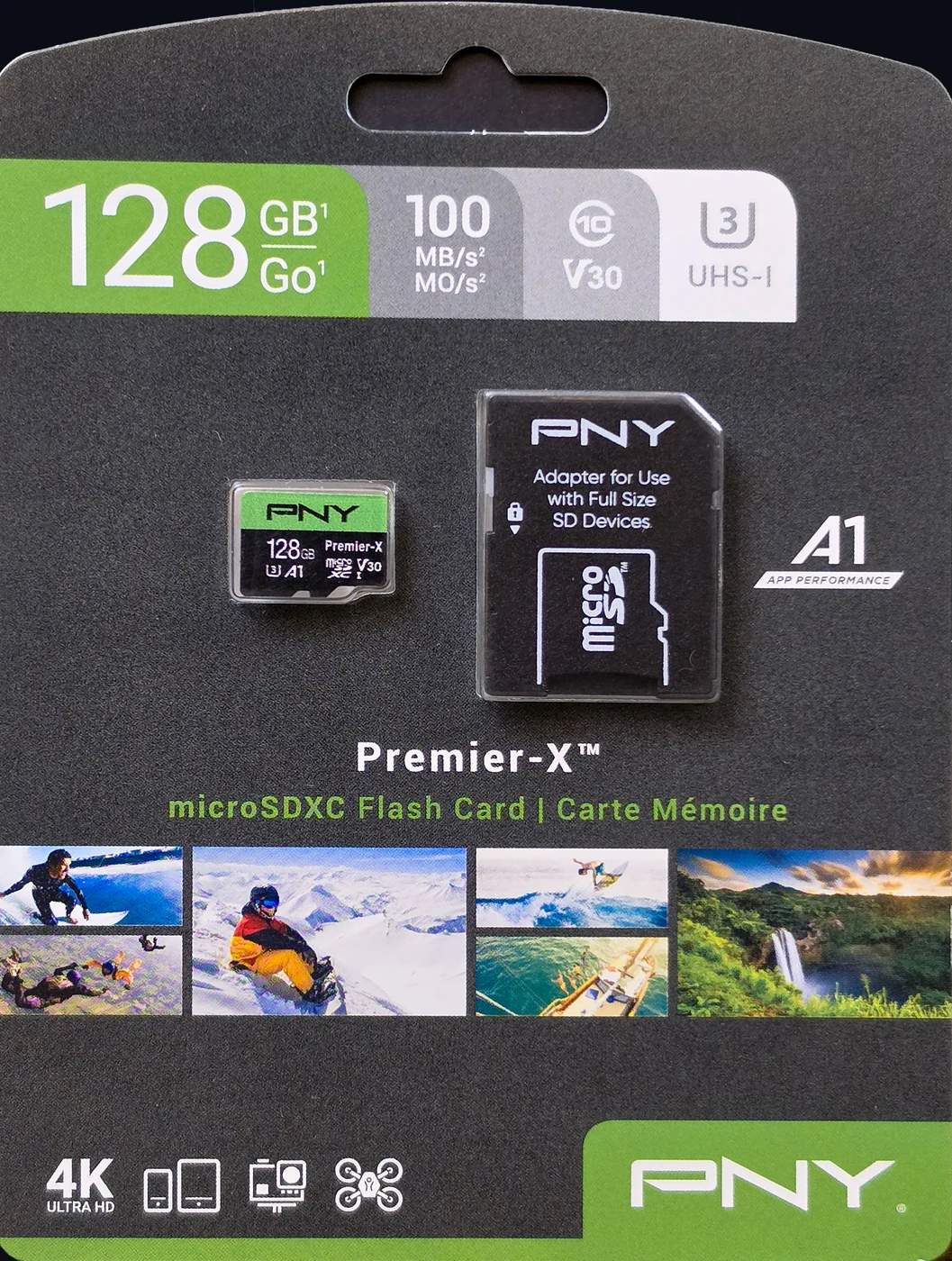
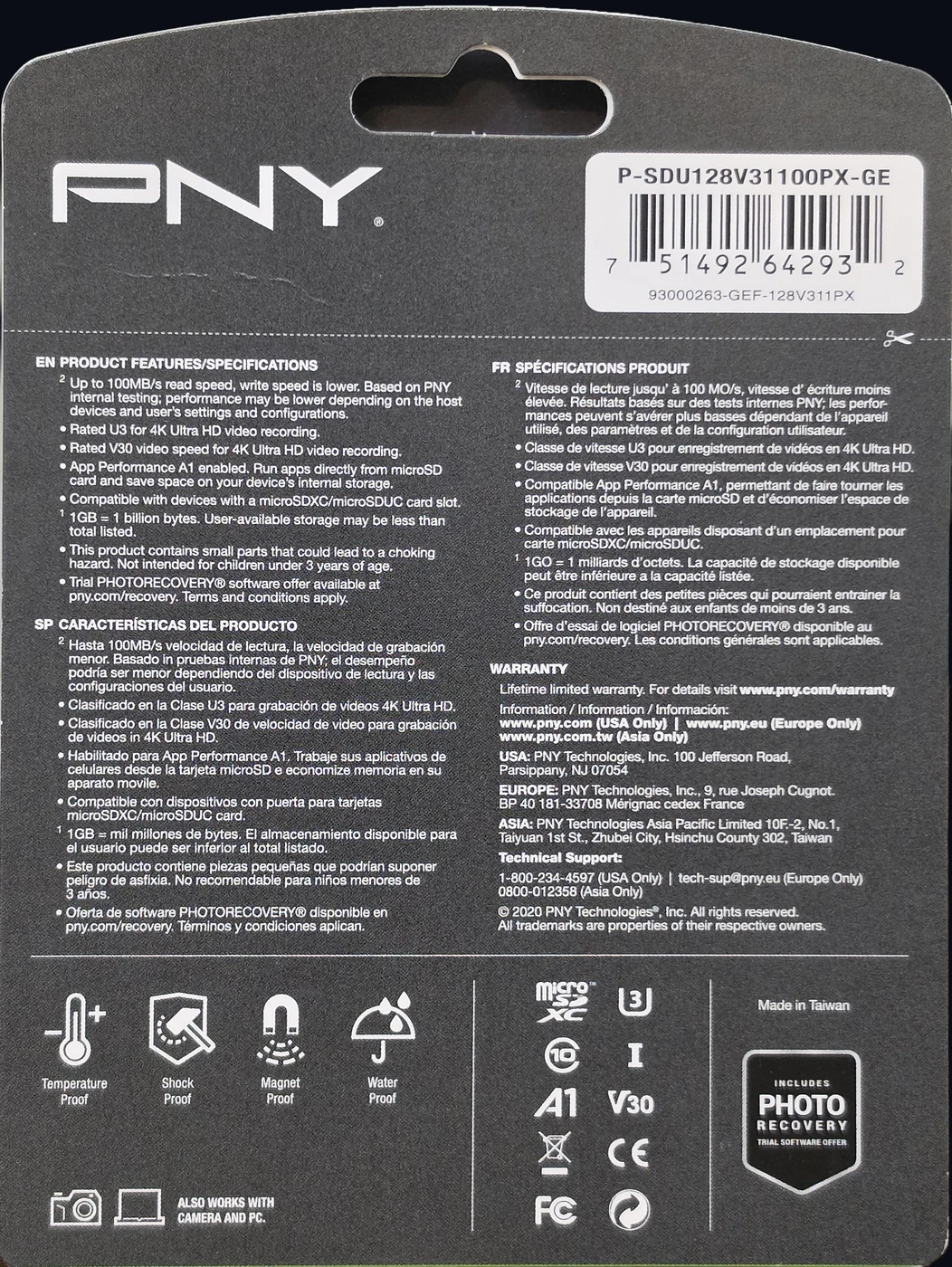
I keep a running comparison of what cards print against what they cost, and this one is the low end of an inversion that keeps showing up: the least expensive branded 128GB card on my bench when I bought it has the most complete back panel of the recent arrivals. That is worth exactly nothing if the card fails, and the corpus has cheap cards that did both ways: the Newegg TeamGroup was honest on capacity and failed its speed claim, and the three generic cards were all fakes. So the box gets noted and the bench decides. The card arrived formatted exFAT with 128 KB clusters, no volume label, and nothing on it.
Five minutes at 54.9 MB/s, in four-second heartbeats
This is the panel that decides a video class, and on this card it is the one to watch rather than read. The trace below is the scored run: five minutes of committed writing, one sample a second, with the speed-class floors marked. Most cards draw a line. This one draws a comb. It writes at 80.7 MB/s, a rate well above its own average, for a little under three seconds, then drops to about 3 MB/s for a second and a half, then does it again, every 4.2 seconds, 71 times in five minutes. The average across all of it is 54.9 MB/s, the burst in the first 30 seconds is 53.3, and the worst ten seconds average 47.4. Three more runs, one of them on a different reader, put the worst ten seconds at 47.2, 47.4 and 47.1. This card is nothing if not repeatable.
PNY Premier-X 128GB
What you are looking at is a write cache. The card accepts data into a fast buffer of roughly 220 MB at 81 MB/s, and when the buffer is full it stops taking new data, almost completely, while it moves what it holds into the main flash. On this card that pause is short and hard: for about a second and a half it accepts one megabyte roughly every third of a second, which is where the run’s longest single block, 355 milliseconds, comes from, and then the buffer is clear and the next burst starts. Nothing in the five minutes came close to a real stall; the bench flags any block over half a second, and there were none on any of the four runs. The pattern held for the entire whole-card fill too, all 125 GB of it, with the speed across each minute of the fill sitting between 53.2 and 54.1 MB/s from the second minute to the last.
Two things follow for anyone deciding whether to buy it. The first is that the ten-second averages the speed classes are built on, and the worst of them, are honest about this card: 47.4 is what a recording device sees if it buffers even a few seconds of video, and every dash cam and camera does. The second is that the gap between the worst ten seconds and the average is not a slow patch somewhere in the run. It is the phase of the cycle: a ten-second window covers about two and a half heartbeats, and sometimes it catches three pauses instead of two. The best ten seconds of the same run average 60.1, and any full minute of it averages 53.5. I score the worst ten, as the rubric says, and it lands in the same band either way. For scale, the Botslab 128GB that came bundled with a dash cam floors at 53.9 on this bench, the SanDisk MAX Endurance at 51.6, and the Kioxia Exceria G2 that anchors the lower end of my control band at 62.6. This card is a step below all three, and a step above the FitcamX at 43.8 and the Newegg TeamGroup at 35.6. The Silicon Power Superior Pro 128GB, the other entry-price card on this bench, is faster than this one for its first 4.7 GB, at about 85 MB/s, and slower after it, with a floor of 37.8.
What scattered writes do to it
Loop recording is not one long write. It is a long write interrupted constantly by small ones: event clips, directory updates, overwrites of the oldest file. Random 4K writes are the bench version of that abuse, three twenty-second passes of it, and the question is whether the third pass is as fast as the first. On the scored run the answer is yes: 457, 433 and 465 write IOPS, which is a 7% dip in the middle pass and a third pass that was the best of the three. The card came out of the churn leg and back to its full media rate inside the first ten seconds of continuous writing. Those are small numbers, and I will come back to that.
One minute of loop-recording abuse
This card: run PNY-Premier-X-128GB_2026-09-17_133234 · reference card: lab baseline, same bench, same test · cardcheck v0.8.3
Now the small numbers. 452 write IOPS is 1.85 MB/s of random 4K writing, which puts this card in the bottom cluster of my bench alongside the Botslab (1.87) and the Newegg TeamGroup (1.89), where a SanDisk High Endurance manages about 4 and the Amazon Basics 8.5 on the same reader. At that level the fade measurement is mostly noise: the difference between a good pass and a bad one is a tenth of a megabyte a second, and across the four runs the first-to-third change read minus 2%, 5%, 13% and 7%. The rubric scores the primary reader’s scored run, which is the first of those, and the row is a 5; the other three runs would put it at 4.5, 4 and 4.5, and the overall score is 4.5 whichever run you pick, because the mean never moves far enough to change the rounding. I am telling you all four so the row does not read as more precise than the test is. What the four runs agree on is the part that matters for a dash cam: churn does not leave this card slower than it found it, and it is back at full speed within seconds.
Every byte, written and read back, twice
The bench wrote 117 files of unpredictable, dedup-proof data until the card was full, 125,062,610,944 bytes, then read every one of them back and compared. Zero mismatched bytes. Zero read errors. Then, four hours later, it did the whole thing again with a fresh random seed: 125,063,135,232 bytes that time, the difference being where the last file landed, and again zero mismatches and zero read errors. The write speed across the first, middle and last tenth of the card spread by 3%, all of it from a slow first minute as the card cleared its housekeeping from the five-minute leg before it, and the read spread by 0.3%. There is no slow region, no cache running out partway through, and the fill ran the same four-second heartbeat for all 125 GB.
Every byte, written and read back
125.1 GB is 97.7% of the 128 GB on the label. PNY’s own footnote says user-available storage may be less than listed, and it is, by 2.9 GB, which is ordinary provisioning overhead and sits inside the 96.7% to 100.1% range every genuine card on this bench occupies. It is at the lower end of that range: SanDisk declares 99.9 to 100.1, the Longsys-made cards 98.2 to 99.1, and this card’s exact declared byte count, 125,069,950,976, matches one other card on my bench to the byte, the Gigastone High Endurance Pro 128GB, which the identity section explains. Windows will show you about 116 GB, because it counts in binary; that is not a shortfall, it is arithmetic, and the methodology page has the conversion. The capacity row of the rubric scores the declared share of the label, and 97.7% is a 4.
129 °F, and no rating to measure it against
PNY prints a temperature-proof icon and no range, so there is no published maximum to hold this card to; the rubric assumes 85 °C (185 °F) for a card that publishes nothing, which is the figure most of the industry uses. Against that, the card is comfortable. At the end of five minutes of uncooled writing in a 76 °F room the thermal imager read 129 °F (53.9 °C) on the card body at the reader’s slot mouth on the scored run, and 125 °F (51.7 °C) on the two later runs, one on each reader. That is 31 °C of headroom, and it puts the Premier-X among the coolest cards I have measured: the Amazon Basics bought the same day peaked at 171 °F, the SanDisk MAX Endurance at 140, the Botslab at 135.
It got warm. It did not slow down.
The two later runs read 125 °F on each reader · Run PNY-Premier-X-128GB_2026-09-17_133234 · cardcheck v0.8.3 · ProGrade PGM0.5
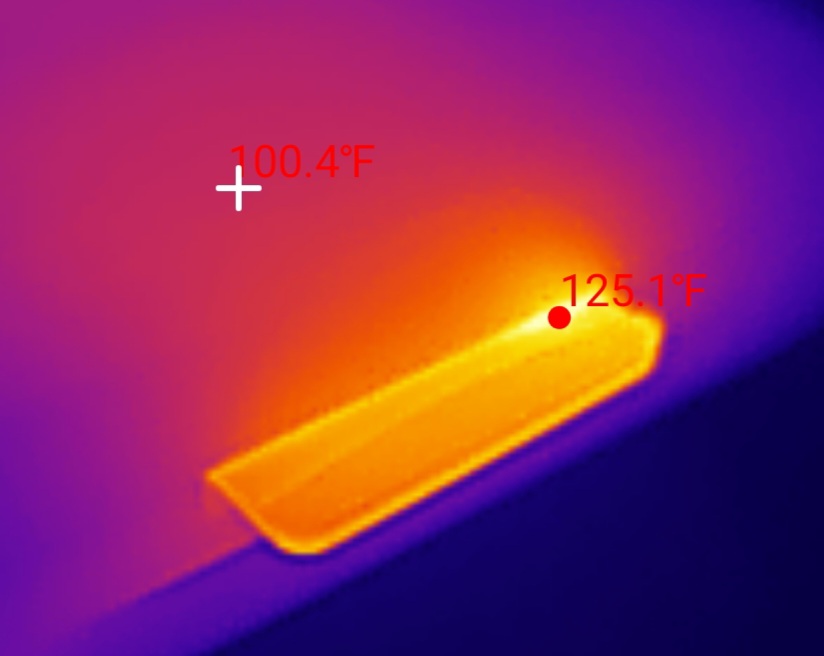
It did not throttle. The last thirty seconds of the scored run averaged 55.7 MB/s against 53.3 for the first thirty, and the cache cycle at the end of the run is the same shape as at the start. The reading is a floor rather than a ceiling, because the imager sees the part of the card outside the slot and the controller is inside it, but a card that is writing at 55 MB/s and sits at 129 °F on the surface is not working hard. In a dash cam on a summer windshield the temperature it reaches will have more to do with the car than with anything in this test; what this test says is that the card brings a lot of room to that situation.
Two readers, one answer
Every card I review runs on my primary reader, a ProGrade PGM0.5, and any card that might be limited by it runs again on a SanDisk QuickFlow SDDR-B751, which drives the fast non-standard UHS-I mode at a higher clock and took the Amazon Basics from 156 MB/s sustained to 188 the same morning. The PNY went on it last. Here is the same card, the same day, on both.
| Measurement | ProGrade PGM0.5 (primary) | SanDisk QuickFlow SDDR-B751 | Difference |
|---|---|---|---|
| Sequential read | 96.8 MB/s | 96.9 MB/s | same |
| Sequential write, committed | 53.6 MB/s | 53.9 MB/s | same |
| Sustained write, steady state | 54.9 MB/s | 54.9 MB/s | same |
| Sustained write, worst ten seconds | 47.4 MB/s | 47.1 MB/s | same |
| Random 4K read / write | 1,453 / 452 IOPS | 1,759 / 475 IOPS | +21% / +5% |
| Video class held | V30 | V30 | same |
| Peak temperature | 129 °F (scored run); 125 °F (third run) | 125 °F | same |
| Blocks over 500 ms | 0 | 0 | same |
This is what a card that is not reader-limited looks like. The PNY speaks standard UHS-I and nothing faster, it writes at half the rate either reader can carry, and so the reader you own changes nothing about it except the random-read figure, which moves with the reader on every card I have tested. If you have read my reader tiers post and wondered whether it applies to a card like this, the answer is that a plain UHS-I reader will get everything this card has. The reader guide still matters for the faster cards in the same slot.
Who actually makes the PNY Premier-X
Every SD card carries a set of identity and capability registers, written at the factory, that a USB reader cannot show you but a native SD host can. I read this card’s on a Raspberry Pi. The identity register is the interesting one, and not for the reason I expected. Its manufacturer ID is 0x74, the OEM field reads J`, the product name field reads simply SD, and the revision is 6.1. The manufacturer ID is one PNY does not appear on any public list under; the lists that exist, all of them compiled by hobbyists reading cards because the SD Association keeps the assignments confidential, attribute 0x74 to Transcend, another Taiwanese company. PNY’s blister says the card was made in Taiwan and gives an office in Zhubei. Whether that means Transcend assembles the Premier-X for PNY, or PNY’s Taiwan operation writes an ID a list has filed under a different name, I cannot tell from here, and I am not going to guess. The register is now in my manufacturer ID register as what it is: the first 0x74 on the bench. What it shares with four cards that report 0xFE, byte for byte, is the mirror-image case in the identity explainer.
The other three registers are where the surprise is. The capability registers, the ones that describe the card’s capacity, its bus support and the classes it declares to a host, are written by the controller firmware rather than by whoever prints the label, and on this card they are byte-for-byte identical to a family of cards I have tested before under four other names: the Newegg TeamGroup 128GB, the Botslab 128GB, the FitcamX 64GB and the Gigastone High Endurance Pro 128GB, all of which report manufacturer ID 0xFE. The SD Status register matches all four of them across all 64 bytes, including two fields that no other card on my bench sets to those values. The bus register matches the Botslab, FitcamX and Gigastone exactly. The capacity register matches the Gigastone’s to the last byte, which no two cards on that platform had managed before: the Gigastone review notes that its four cards declare four different capacities, and this fifth card declares the Gigastone’s. The product name, SD, is the TeamGroup’s and the Gigastone’s string. Even the serial number fits the family: every major-brand card I have dumped carries a nine or ten digit serial, and these cards carry four and five digit ones. And then the card writes exactly the way that family writes.
| Card | Identity (MID / OEM / name) | Cache burst | The fold | Steady | Worst 10 s |
|---|---|---|---|---|---|
| Newegg TeamGroup 128GB | 0xFE / 0x3432 / SD | 80 to 82 MB/s | to about 5 MB/s, long | 40.2 MB/s | 35.6 MB/s |
| FitcamX 64GB (bundled) | 0xFE / SZYL | 80 to 82 MB/s | to about 8 MB/s | 47.1 MB/s | 43.8 MB/s |
| Botslab 128GB (bundled) | 0xFE / SZYL | 80 MB/s | to about 52 MB/s, 9.5 s cycle | 58.5 to 59.1 MB/s | 51.3 to 53.9 MB/s |
| Gigastone High Endurance Pro 128GB | 0xFE / 0x3432 / SD | 82 MB/s | to about 52 MB/s, 9 s cycle, fresh; 1 to 6 s reclaim pauses once filled | 61.3 MB/s fresh | 59.6 MB/s fresh; 31.0 filled |
| PNY Premier-X 128GB | 0x74 / J` / SD | 80.7 MB/s | to about 3 MB/s, 1.4 s, 4.2 s cycle | 54.9 MB/s | 47.4 MB/s |
All five cards take data into the same size of cache at the same 80-odd MB/s. What separates them is what happens when the cache folds into the main flash: the TeamGroup drops to 5 MB/s and stays there for most of its cycle, the Botslab and the Gigastone drop to a second, slower rate of about 52, and the PNY stops almost dead but only for a second and a half, which is why its average lands between them. One more difference is worth naming because the Gigastone review makes so much of it: that card’s floor gave way after its first whole-card fill, from 59.6 to 31.0, until a native erase restored it. The PNY’s did not. Its third run, after two whole-card fills and 299 GB written, read the same 47.4 as its first. Whether that is firmware, the number of flash dies, or the grade of the flash, the bench cannot tell, and I am not claiming it can. What the registers do establish is narrower and, I think, more useful: the identity register names the company that assembled the card, not the platform inside it, and this is the first card on my bench where those are visibly two different things.
PNY Premier-X or Amazon Basics?
I bought these two cards together to answer one question: what does the step up from the entry-price branded card to the house-brand card buy you? Both are 128GB microSDXC, both print C10, U3 and V30, and they were tested on the same day on the same two readers under the same protocol. They score the same, 4.5, and they get there from opposite directions.
| PNY Premier-X 128GB | Amazon Basics 128GB | |
|---|---|---|
| Read claim on the box | 100 MB/s, met at the bus ceiling | 200 MB/s, beaten, on a reader that speaks DDR200 |
| Write claim | none printed (“lower”) | 150 MB/s, listing only, beaten |
| Sustained write, worst 10 s | 47.4 MB/s (both readers) | 155.9 MB/s ProGrade; 188.1 MB/s QuickFlow |
| Video class held | V30 | V90 |
| Random 4K write | 1.85 MB/s | 8.5 MB/s ProGrade; 10.7 MB/s QuickFlow |
| Declared capacity | 97.7% of label, verified | 98.2% of label, verified |
| Peak temperature | 129 °F (53.9 °C) | 171 °F (77.2 °C), 2.8 °C under its rating |
| Model number, origin, warranty on the pack | all three | none of the three |
| Silicon | the 0xFE-family platform under a PNY identity | Longsys, the maker of Lexar |
| Score | 4.5 (5 / 4 / 5 / 4 / 5) | 4.5 (5 / 5 / 5 / 4.5 / 2) |
The step up buys a great deal of speed: three and a half times the sustained write and twice the read on a reader that can drive the Amazon card, three times the write and 1.7 times the read on a plain one, and four to six times the random-write rate. It also buys a card that runs 42 °F hotter against a lower published limit, and a box that tells you less. If your device writes V30 video and you never offload a full card in a hurry, the PNY gives up nothing you would notice and runs cool doing it. If you offload often, shoot above V30, or want the fastest UHS-I card you can put in a phone or a drone, the Amazon Basics is the better card and it is not close. The PNY loses its points on speed and capacity; the Amazon Basics loses its on heat. Which of those you would rather live with is the whole decision.
How the 4.5 breaks down
PNY Premier-X microSDXC 128GB
Scored against the CKBench rubric. Five dimensions, each out of 5, every row read off its published table.
Final score: 4.5 out of 5. The five dimensions average 4.6. A card that meets every claim it prints, verifies every byte and runs cool, and gives back a point for being an upper-V30 card and a point for declaring 97.7% of its label.
One line in that block deserves a plain-language footnote. This is the first review scored entirely on the fixed tables that the methodology page published this month, with no judgment call in any row, and it shows what those tables do: a modest card that keeps its promises scores three 5s and two 4s, and the two 4s are exactly the two things a buyer would want to know about it.
Frequently Asked Questions
Is the PNY Premier-X 128GB a good microSD card?
Yes, for what it claims to be. It met its 100 MB/s read claim at the UHS-I bus ceiling on two readers, held V30 with its worst ten seconds of committed writing at 47.4 MB/s, delivered every one of its 125.1 GB with zero errors on two separate fills, and peaked at 129 °F (53.9 °C). It scores 4.5 out of 5. It is a slow card by the standards of the fast UHS-I cards, and its write runs in a four-second cache cycle, but nothing on its blister is untrue.
What is the write speed of the PNY Premier-X 128GB?
PNY does not print one; the blister says only that the write speed is lower than the 100 MB/s read. I measured 53.6 MB/s committed sequential write on a ProGrade PGM0.5 and 53.9 on a SanDisk QuickFlow, a five-minute sustained average of 54.9 MB/s, and a worst ten seconds of 47.4 MB/s. The write is not smooth: the card accepts data at about 81 MB/s for under three seconds, then pauses for about a second and a half while its cache empties, every 4.2 seconds.
Who makes PNY memory cards?
The Premier-X 128GB’s identity register reports manufacturer ID 0x74, which the public lists attribute to Transcend, with the OEM field J` and the product name SD; the blister says Made in Taiwan. Its capability registers are byte-for-byte identical to the cards sold as Newegg TeamGroup, Botslab, FitcamX and Gigastone High Endurance Pro, which all report a different manufacturer ID, and it writes the way those cards write. The registers name the company that assembled the card, not the platform inside it, and the bench cannot tell which company that is.
Is the PNY Premier-X 128GB actually 128GB?
Yes. I filled every free byte with unpredictable data and read all of it back, twice: 125,062,610,944 bytes written and verified the first time, 125,063,135,232 the second, zero mismatched bytes and zero read errors on both. That is 97.7% of the 128 GB label, ordinary provisioning overhead inside the range genuine cards occupy, and PNY’s own footnote says user-available storage may be less than listed. Windows will show it as about 116 GB because it counts in binary.
Is the PNY Premier-X good for a dash cam?
Yes. It holds V30 with 57% in hand on both readers, its worst ten seconds never dropped below 47.1 MB/s across four runs, it ran the same speed for an entire whole-card fill, and it peaked at 129 °F under a five-minute uncooled write, among the coolest cards on my bench. A 4K dash cam writes about 6 MB/s. It is not an endurance-rated card and PNY makes no endurance claim for it, so treat it as a general-purpose card that happens to be comfortable at dash cam bitrates.
Does the PNY Premier-X support A1 app performance?
It declares A1 in its SD Status register and prints it on the card, and this bench cannot test it: A1’s floors are defined by an SD procedure that USB card readers do not perform. The closest indication I can give is random 4K at queue depth one, where the card measured 1,453 read and 452 write IOPS on a ProGrade PGM0.5 and 1,759 and 475 on a SanDisk QuickFlow against A1’s 1,500 and 500 floors. Its random-write rate, 1.85 MB/s, is in the bottom cluster of the cards I have tested, so I would not choose it as an app card.
PNY Premier-X or Amazon Basics 128GB?
Both score 4.5 on my bench. The Amazon Basics sustains 155.9 MB/s on a ProGrade reader and 188.1 on a SanDisk QuickFlow against the PNY’s 47.4 on either, reads 206 on the right reader against the PNY’s 97, and writes random 4K four to six times faster, but it peaked at 171 °F against an 80 °C rating where the PNY peaked at 129 °F. For V30 video and occasional offloads the PNY gives up nothing you would notice. For frequent offloads, anything above V30, or the fastest card in a phone, the Amazon Basics is the better card.
The bottom line
The PNY Premier-X 128GB is the kind of card that makes a review like this one feel almost unnecessary, which is the highest compliment the bench can pay a blister. It prints six claims and keeps all six, it declines to print the one number it would have had to be modest about, it verifies its capacity twice over, and it stays cool under load, peaking at 129 °F with 31 °C to spare against the 85 °C a card with no printed range is held to. It is also slow in a specific, measurable, repeatable way that no marketing sheet would ever show you: a four-second heartbeat of burst and pause, averaging out to an upper-V30 card, on a platform I have now met under five names.
If your device asks for V30, and most do, this card has it with room to spare and a name on it with a lifetime warranty behind it. If you want the fastest card the slot can take, or you fill and empty cards for a living, the same money and a little more buys a great deal more speed from the card I tested alongside it. Neither answer is a mark against the PNY. It is what its box says it is, and on this bench that turns out to be rarer than it should be.
Sample size: one unit, purchased retail from Amazon on 15 September 2026, sealed. Four runs on two readers on 17 September 2026 under CKBench protocol v1.21.
Device identity: what this card reports about itselfFor anyone tracking silent hardware revisions
| Raw CID register | 744a6053440000006100…019200 (serial digits elided) |
| Manufacturer ID (MID) | 0x74, the only one on this bench; the public lists attribute it to Transcend, and PNY appears on none of them |
| OEM / application ID (OID) | 0x4A60, “J`” |
| Product name (PNM) | SD (the same string as the Newegg TeamGroup 128GB) |
| Product revision (PRV) | 6.1 |
| Serial number (PSN) | 0x0000… (per unit, truncated; a four-digit count, where major-brand cards carry nine or ten digits) |
| Manufacture date (MDT) | 02/2025 |
| Declared capacity (from CSD) | 244,277,248 sectors of 512 bytes = 125,069,950,976 bytes, 97.71% of the label; CSD byte-identical to the Gigastone High Endurance Pro 128GB’s, the only such match on this bench |
| SD specification (from SCR) | SD_SPEC 2 with SD_SPEC3 = 1 and SD_SPECX = 2 (specification 6.x), so the UHS-I, U3 and V30 marks are legitimately declared; SCR byte-identical to the Botslab 128GB, FitcamX 64GB and Gigastone High Endurance Pro 128GB |
| Declared classes (from SD Status) | Class 10, U3, V30, A1; all 64 bytes identical to the Newegg TeamGroup 128GB, Botslab 128GB, FitcamX 64GB and Gigastone High Endurance Pro 128GB |
| Factory format | exFAT, 128 KB clusters, partition at a 1 MiB offset, volume serial A55F-BBA5, no label, no user files present |
| Captured on | Raspberry Pi 4 native SD host, no USB bridge in the path · 2026-09-17 |
The MID, OEM ID, product name and revision are model-level: another Premier-X 128GB with the part number P-SDU128V31100PX-GE should report the same four, and a different revision or a different MID would be the first sign that PNY’s supplier has changed the card under the same blister. The serial and the manufacture date are per unit. This one was made in February 2025, five years after the copyright date on its packaging, and sold to me in September 2026.
Disclosure: I bought this card at retail from Amazon on 15 September 2026. PNY had no involvement in or knowledge of this review, saw no result before publication, and had no opportunity to influence any number on this page. This post contains affiliate links. As an Amazon Associate I earn from qualifying purchases, at no extra cost to you. Affiliate links like these and my YouTube channel are what keep the site running.