
FitcamX 64GB microSD: the card that looked broken
Its speed chart is the wildest thing on my bench. It is also one of the steadiest cards I have tested, and those two facts are the same fact.
Prefer to watch a review?
No video for this lab run yet, but I cover dashcams, storage, and the gear around them on the channel. Subscribe to catch the next test the moment it goes live.
The short version
The microSD card that ships inside the FitcamX dash cam is a generic, unbranded unit with a look-alike SD logo, and I expected it to be junk. It is not. It holds every byte of its 64GB label, it writes a steady 47.1 MB/s in the way a dash cam actually writes, and it ran cooler under a full-card load than any other card I have put on this bench. Its live speed graph looks like it is falling apart twice a second, and that is the sampling interval interfering with a rhythm inside the card rather than a fault in either. The same recording held enough detail to reconstruct exactly what the card was doing between readings. My rating: 4/5, scored against the CKBench rubric.
Verdict: 4/5, a genuinely good card in a badly printed jacketWho this card is for
- YesAnyone who already owns the FitcamX and wondered whether to bin the bundled cardLeave it in. It clears the 30 MB/s bar its U3 mark promises with room to spare, it holds its full capacity, and it runs cool in a windscreen mount. There is no performance reason to replace it.
- Yes1080p and 4K dash cam duty, front and rearIts worst ten second stretch still delivers roughly 44 MB/s, which is more than seven times what a 4K30 dash cam stream asks for.
- NoAnything that runs apps off the card, like a phone or a Raspberry PiRandom 4K writes come in at 2.1 MB/s and 511 IOPS. The card prints no A1 or A2 mark and it should not be asked to do that job.
- NoBuyers who need a warranty or a written endurance ratingThis card carries neither, because it was never sold at retail. If a failed card means lost footage you care about, buy one with a paper trail.
62.3 GB of usable space is roughly 17 hours of 1080p60 dash cam footage at a typical 12 Mbps, or about 8 hours at 4K. Work out your own numbers in the dash cam storage calculator.
Why test a card nobody chose to buy?
Almost every dash cam arrives with a memory card already in the box, and almost nobody knows whether that card is any good. It has no packaging, no spec sheet, and usually no brand that means anything. The advice you find online is to throw it away and buy a real one, which is easy to say and costs you money that may not need spending. The best card on this whole bench, retail ones included, is one that came free in a dash cam box. This is the third bundled card I have run through the full bench, so it is becoming possible to answer the question properly rather than guess. It joins CKBench, the running index of every card on the bench, alongside the Botslab 128GB that shipped with a four channel camera, the Kioxia Exceria G2, and the counterfeit ImageMate that shows what a genuinely bad card looks like.
This one came inside the FitcamX, the tidy little screen-free camera I reviewed here. One unit, tested on 2 August 2026. It was not bought separately, because it cannot be.
Why my write numbers read lower than other reviews. Every write here is committed to the card and confirmed before the clock stops, the way a dash cam actually writes, so my figures land below burst benchmarks like CrystalDiskMark that measure a few seconds of the card's RAM buffer. That rule, and the decimal MB/s and binary MiB conventions used throughout, are set out on the how we test and score page.
What the card claims, and what the card did
There is no box, so every claim below was read off the face of the card itself. That is a shorter list than usual, and the gaps are as informative as the entries: this card prints no speed figure of any kind, no V-class mark, and no A-class mark. The only sustained throughput promise it makes anywhere is U3, which asserts a 30 MB/s floor.
| Claim | Printed on the card face | Measured | Verdict |
|---|---|---|---|
| Capacity | 64GB | 62.3 GB usable, verified byte for byte | VERIFIED |
| Read speed | No figure printed | 92.9 MB/s (ProGrade MSD PGM0.5 reader) | NOT CLAIMED |
| Write speed | No figure printed | 47.1 MB/s committed, sustained | NOT CLAIMED |
| Speed class | C10, a 10 MB/s floor | 43.8 MB/s worst ten seconds | BEAT, by 4.4x |
| UHS speed grade | U3, a 30 MB/s floor | 43.8 MB/s worst ten seconds | HELD |
| Video speed class | No V mark on the face | 43.8 MB/s worst ten seconds | NOT CLAIMED |
| App performance class | No A mark on the face | 1407 read / 511 write IOPS | NOT CLAIMED, and not testable here |
| Endurance rating | None printed | n/a | NOT CLAIMED |
| Operating temperature | None printed | 131 °F peak at 76 °F ambient | NOT CLAIMED |
| Warranty term | None printed | n/a | NOT A PERFORMANCE CLAIM |
Two things follow from that table. There is no headline speed claim to check, which is unusual here and means the card cannot be caught over-promising: it never promised. And the absent V and A marks are not failures. A card is only judged against what it claims, and this one claims C10, U3 and UHS-I. It meets all three.
One caution on the U3 row, because it is easy to misread. Clearing a 30 MB/s floor is exactly what a V30 rating would also require, but this card carries no V30 mark and I am not awarding it one. The measurement is real; the certification is not something a bench can grant.
Does the 64GB card actually hold 64GB?
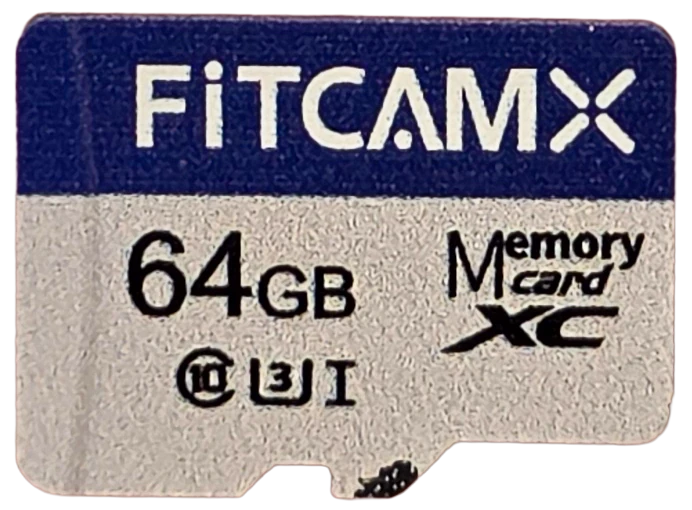
Yes, and this was the first thing I checked rather than the last. The card face does not carry the SD Association's microSDXC logo. In the exact spot where that mark belongs, set in the same layout and typeface, is a substitute that reads "Memory card" over "XC", with the SD swoosh replaced by the word card. That is a transcription of what is printed, not an accusation. Bundled cards are commonly generic, and the SD logo is licensed, so a supplier filling a camera box has little reason to pay for it.
But it does remove the one cheap assurance a retail package normally gives you, so the card earned a full destructive capacity fill before anything else was measured. I wrote every usable byte, read all of it back, and compared. The result: 62.3 GB written and verified, zero mismatches, zero errors. The card holds what it says it holds.
Every byte, written and read back
Run FitcamX-64GB_2026-08-02_163015 · cardcheck v0.8.0 · ProGrade MSD PGM0.5
If you plug this card in and Windows says 58 GB, nothing is wrong. Card labels count a gigabyte as a billion bytes, and Windows counts it as 1,073,741,824. The same 62.3 GB of real space gets printed as 64GB on the label and displayed as 58.0 GB by your computer. It is two ways of writing one number. A fake card looks completely different: it reports a size it does not have and then silently destroys anything written past the real end, which is what happened with the counterfeit ImageMate I tested. This card does the honest thing.
Why did the speed chart look broken?
Here is where this card got interesting. Watching the sustained write test run live, the graph did not look like a card slowing down or speeding up. It looked like it was tearing itself apart: a fast zigzag between roughly 8 and 83 MB/s, with the size of that zigzag itself swelling and collapsing every half minute. A sawtooth inside a sawtooth. Nothing else on this bench has ever drawn that.
Taken at face value, the numbers are alarming. Across 300 one-second samples, 84 of them, 28 percent, fall below 30 MB/s. The slowest reads 8.4 MB/s. If that were the whole story this card would be unusable.
It is not the whole story, and the giveaway is that averaging just two neighboring seconds together removes about nine tenths of the variation, while averaging three seconds together makes it worse. Only one thing behaves like that: a signal that flips back and forth roughly every two seconds, recorded once per second.
My bench records at one-second resolution on purpose. The verdict on any card here rests on its worst continuous ten seconds, and one-second samples are what that measurement is built from. What no sampling rate can do, though, is draw a rhythm that lands close to its own interval. It is the same reason a spoked wheel appears to stand still or spin backwards on film: when the thing you are watching repeats at nearly the rate you are watching it, you see the interference between the two rather than the motion itself. At 2.13 seconds per cycle there are barely two readings per cycle, so the raw trace shows that interference, not the card's actual output.
Because my sample clock and the card's rhythm drift slowly against each other, I could fold all 300 samples back onto a single cycle and recover what the card is really doing between my readings. The lower panel below is that reconstruction.
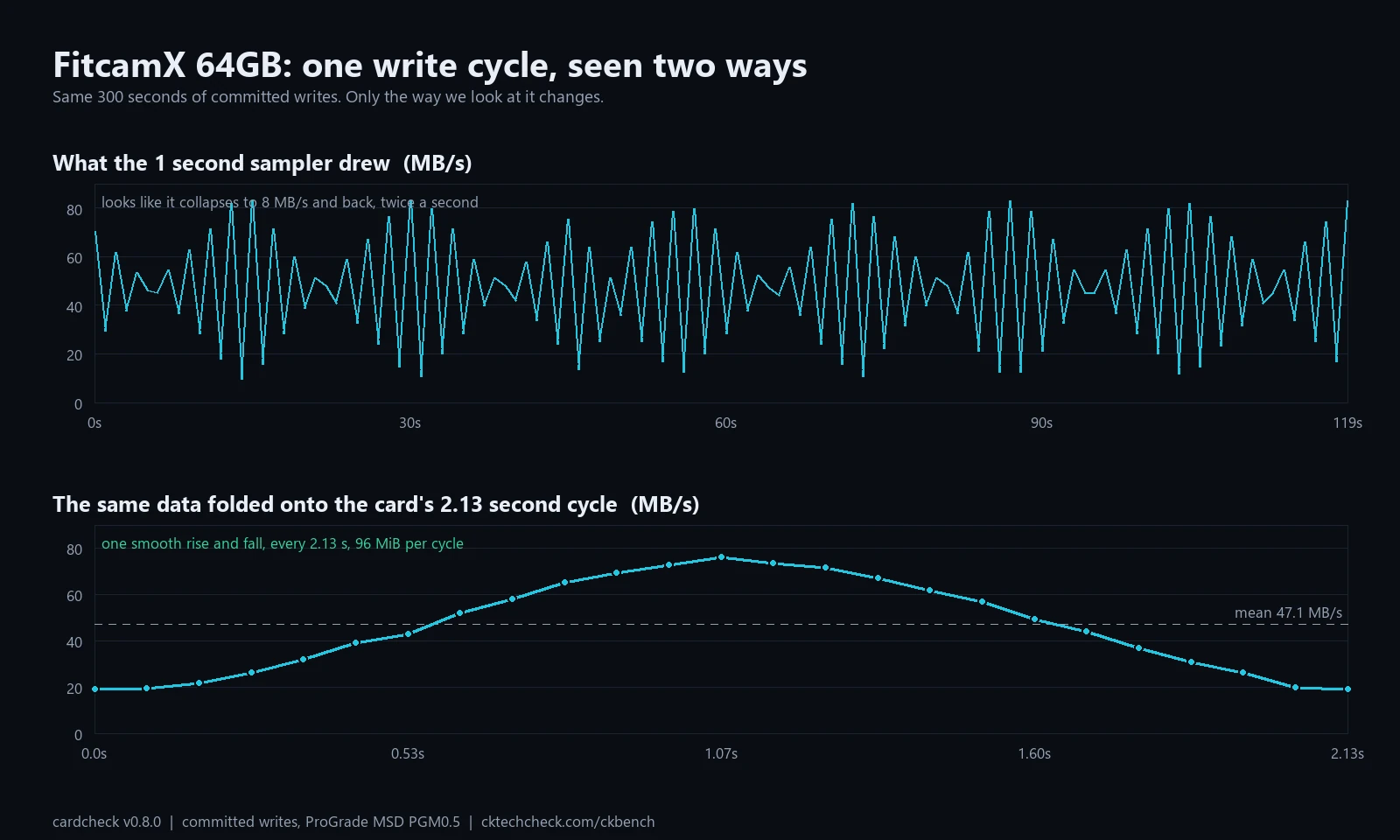
The card runs on a cycle of 2.13 seconds. Within each cycle its speed rises and falls once, smoothly, and then it does it again. What makes this more than a curiosity is what stays constant: every cycle commits very close to 96 MiB, regardless of how fast the card happens to be running. I split the full-card fill into six separate stretches and measured each one. The average speed moved by 1.4 percent between them and the cycle length moved by 1.2 percent, but they moved in opposite directions, and the amount written per cycle held to within half a percent: 96.05 MiB, give or take 0.19. When the card slows down, the cycle stretches to match. It is counting bytes, not seconds.
That number is a fixed chunk of the card's internal housekeeping, the block size it works in when it tidies up and moves data around. I will not pretend to know which mechanism it is from the outside. What I can say is that the bench measured a repeating 96 MiB unit of work, and that no memory card I have tested has ever exposed one this clearly.
FitcamX 64GB · the alias
300 one-second samples · worst 10 s at 4:10 · knee scan outcome NO_KNEE_STABLE · Run FitcamX-64GB_2026-08-02_163015
One last point that matters more than any of it: the card never actually stalls. Across 13,489 individual one-megabyte writes, the slowest single write took 154 milliseconds, and not one exceeded half a second. There is no freeze, no dropout, no moment where the card stops accepting data. It is smoothly modulating how fast it accepts writes, not pausing.
Does any of that matter in a dash cam?
No, and it is worth being concrete about why. The slow part of each cycle lasts under a second. Every dash cam buffers video in RAM before writing it, precisely so that a brief dip cannot drop a frame. A dip that short, on a card averaging 47.1 MB/s, is invisible to the camera.
The measurement that decides the verdict is the worst ten second stretch of the whole test, because ten seconds is long enough that no buffer saves you. That figure is 43.8 MB/s. A 4K30 dash cam needs about 6 MB/s. Even the most demanding format I test against, high bitrate 4K120, needs 35. The card clears all of them.
I will add one honest caveat that applies only to this card. Because its cycle is 2.13 seconds long, a ten second window does not contain a whole number of cycles, so exactly where that window lands changes the answer a little: a nine second window gives 41.1 MB/s and an eleven second window gives 41.9. The verdict does not move, since all of those clear 30 MB/s comfortably, but the honest way to state the result is "roughly 44 MB/s" rather than a figure carrying decimal places it has not earned.
Does the bundled card overheat?
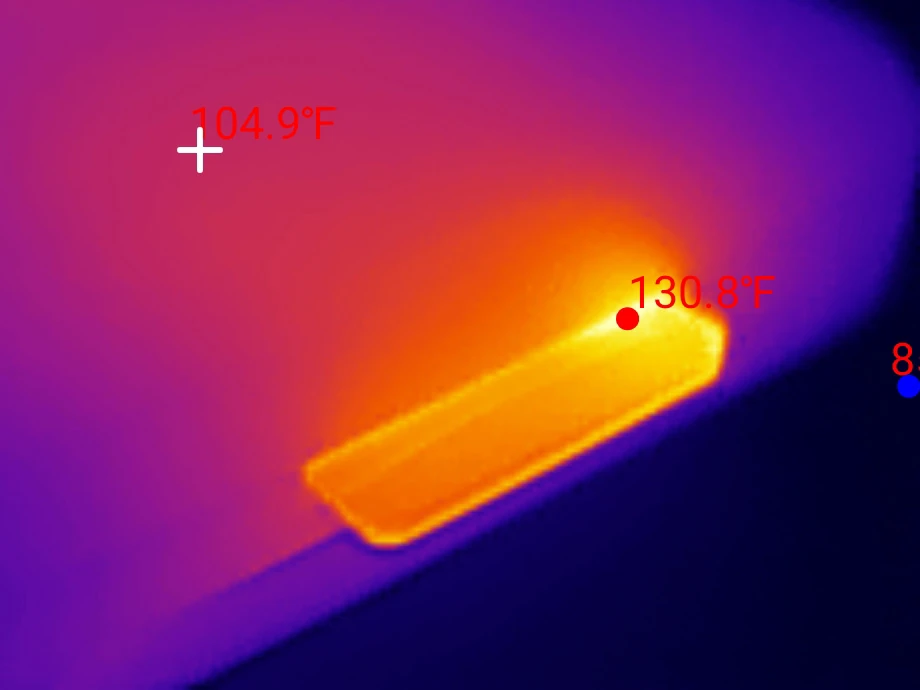
It runs cooler than anything else I have measured. Under a continuous full-card write with the ambient at 76 °F, it peaked at 131 °F. For comparison, the two VIOFO High Endurance cards are the hottest on file at 160 °F and 153 °F, the Kioxia reached 142 °F, and the Botslab 135 °F. That is a 55 °F rise over ambient here, and a dash cam on a sunlit windscreen is a hot place to live, so a card that does not add much of its own heat is doing you a favor.
The coolest card on this bench
A 4K30 dash cam writes about 6 MB/s, roughly an eighth of this workload · Run FitcamX-64GB_2026-08-02_163015
One minute of loop-recording abuse
This card: run FitcamX-64GB_2026-08-02_163015 · reference card: lab baseline, same bench, same test
Consistency across the physical card was also excellent. Writing to the first, middle and last tenth of the card gave 47.3, 47.0 and 46.7 MB/s, a spread of 1.2 percent, and reads varied by 0.8 percent. Speed did not fall off as the card filled. There was also no cache collapse: many cheap cards write quickly into a small fast buffer and then fall off a cliff once it is full, and this one simply did not, holding its rate all the way through a full 62.3 GB fill. After the random-access tests had churned it, it returned to full speed within 90 seconds.
Who actually made this card?
Every SD card carries a small identity register that names its manufacturer, and reading it needs a real SD host rather than a USB adapter, so I read this one on a Raspberry Pi wired directly to the card. The answer is not a household name. The manufacturer ID comes back as 0xFE, which my system's lookup table does not recognize, and the product name is the four character string SZYL. Combined with the unlicensed logo, the picture is a white-label supplier rather than a flash vendor you have heard of.
The more interesting result came from comparing it with the Botslab 128GB I tested the same day, a card from a completely different camera brand. Both report the same manufacturer ID of 0xFE and the same product name, SZYL. They differ in their OEM code and were made a month apart, and they deliver almost identically honest capacity: 97.33 percent of label here against 97.37 percent there. A third card reporting the same 0xFE has since been tested, and that one is sold at retail rather than bundled with anything: the Newegg TeamGroup 128GB, whose SD Status register matches both of these byte for byte. Two unrelated dash cam brands, buying bundled cards from the same supplier. A fourth card joined them in September 2026, the Gigastone High Endurance Pro 128GB, sold at retail with TLC printed on its face and carrying the TeamGroup's identity string; its review has all four cards side by side. A fifth followed the same month under a different manufacturer ID, 0x74: the PNY Premier-X 128GB, a retail card whose capability registers match these four byte for byte.
None of that is evidence of anything dishonest, and it is worth saying plainly because unfamiliar identity fields set off alarm bells they should not. Both cards passed a full capacity verification. The counterfeit in this corpus went the other way entirely: it wore a flawless SanDisk identity and was lying about its size. A scruffy label and an honest card are perfectly compatible, and that is exactly what this is.
How the FitcamX 64GB scores
FitcamX 64GB
Scored against the CKBench rubric. Five dimensions, each out of 5.
Final score: 4 out of 5. A card that would be unremarkable if it had a proper label, which is the highest compliment a bundled card can be paid. The rows were restated on the September 2026 scoring tables on 19 September 2026: endurance rose to 5 because the tables score fade and recovery, not the absence of a rating. They average 4.2, still 4.
Frequently Asked Questions
Should I replace the microSD card that came with my FitcamX?
No, not for performance reasons. The bundled 64GB card holds its full advertised capacity, sustains 47.1 MB/s of committed writing, and clears the 30 MB/s floor its U3 mark promises with room to spare. The only reasons to replace it are wanting more space than 62.3 GB or wanting a card that comes with a warranty and a written endurance rating, neither of which this one has.
Why does my 64GB card only show 58 GB in Windows?
Because the label and your computer count a gigabyte differently. Card makers use one billion bytes per gigabyte, while Windows uses 1,073,741,824. The same real space appears as 64GB on the label and 58.0 GB on screen. This is normal and is not a sign of a fake card.
Is the FitcamX bundled card a fake?
No. It carries a look-alike logo instead of the licensed SD Association mark, which means it is an unlicensed generic card, but I wrote and verified every usable byte and found 62.3 GB of real storage with zero errors. An unlicensed label and a fraudulent card are different things, and this one is honest about its size.
Why does the write speed graph swing between 8 and 83 MB/s?
That swing is mostly an artifact of measuring once per second. The card runs on an internal 2.13 second cycle, writing about 96 MiB per cycle, and sampling that barely twice per cycle produces a chaotic looking graph from an orderly signal. The card never stalls: across 13,489 individual writes the slowest took 154 milliseconds, and its worst ten second stretch still averaged roughly 44 MB/s.
Who makes the FitcamX memory card?
The card reports a manufacturer ID of 0xFE and a product name of SZYL, which does not correspond to any well known flash brand. The same manufacturer ID and product name appear on the bundled card from a Botslab dash cam that I tested the same day, so the two camera brands are sourcing their bundled cards from the same white-label supplier.
Can this card record 4K dash cam video?
Yes, comfortably. A 4K30 dash cam stream needs about 6 MB/s and this card's worst measured ten second stretch delivers roughly 44 MB/s, more than seven times the requirement. It also clears the 35 MB/s needed for high bitrate 4K120 recording.
The bottom line on the FitcamX 64GB
I went into this expecting to tell you to throw the bundled card away. Instead it holds every byte it claims, writes faster and more evenly than the card in a rival camera, runs the coolest of anything on my bench, and never once stalled across a full-card write. The thing that looked like a fatal flaw, that violently swinging speed graph, turned out to be the most interesting engineering detail I have found on a memory card: a fixed 96 MiB unit of internal work, repeating every 2.13 seconds, visible from the outside only because my sampling rate happened to collide with it.
What it lacks is paperwork. No warranty, no endurance rating, no licensed SD logo, no manufacturer you can hold to anything, and no way to buy a replacement that is guaranteed to be the same card. If the footage on it might one day matter to an insurer, that absence is a real reason to buy something with a name on it. If you just want to know whether the card in the box is quietly letting you down, this one is not.
Device identity: what this card reports about itselfFor readers who want to check their own unit
| Raw CID register | fe3470535a594c0020000000de019b00 (serial digits elided) |
| Manufacturer ID (MID) | 0xFE, not recognized by the kernel's manufacturer table |
| OEM / application ID (OID) | 0x3470 |
| Product name (PNM) | SZYL |
| Product revision (PRV) | 2.0 |
| Serial number (PSN) | 0x0000… (per-unit, elided) |
| Manufacture date (MDT) | November 2025 |
| Declared capacity (from CSD) | 121,729,024 sectors of 512 bytes = 62,325,260,288 bytes, 97.33 percent of the label |
| Captured on | Raspberry Pi 4 native SD host, no USB bridge in the path · 2026-08-02 |
The MID, OID, PNM and PRV are model-level fields: every unit of this card should report the same values, so you can compare yours against them. The serial number and manufacture date are per-unit and yours will differ. Note also what this register cannot tell you: it does not reach the flash controller or the NAND part numbers, which need a vendor-specific tool, so this table identifies the card without fully identifying what is inside it.
Disclosure: The card was not bought or sent to me on its own. It arrived inside a FitcamX dash cam that I purchased myself, and it was tested destructively, which is why there is no unit to return. This post contains affiliate links. As an Amazon Associate I earn from qualifying purchases, at no extra cost to you. Affiliate links like these and my YouTube channel are what keep the site running.