
The capacity is real. The 50 MB/s is not
A cheap 128GB microSD card, filled and verified byte by byte. Nothing about it is fake. It is simply the slowest honest 128GB card this bench has measured, and its registers point at a maker the package never names.
Prefer to watch a review?
No video for this lab run yet, but I cover dashcams, storage, and the gear around them on the channel. Subscribe to catch the next test the moment it goes live.
Updated 19 September 2026: the score moves from 2.5 to 3.5, and not one measurement changed. In September every CKBench score was re-derived on fixed scoring tables, and this card was one of six whose published score the tables set differently. The row that carries the missed write claim, 39.8 MB/s against a printed 50, stays exactly where it was. What moved is what the August score docked twice or docked for the label: the sustained row now reads the worst ten seconds, 35.5 MB/s, on one fixed ladder (the 2.7-second swing stays in the write-curve section, where a one-second sampler can describe it but not score it); the endurance row scores the measured fade, 2.0%, and the ten-second recovery, and reports the missing endurance rating, the one-year warranty and the narrow operating range in the claim table instead; and the thermal row reads 13.9 °C of headroom against the card's own 70 °C rating. Every number in the review is the August measurement, and so is the verdict: real card, slow card.
The short version
This card costs a fraction of what a name-brand 128GB card costs right now, which is exactly the kind of listing that deserves suspicion. It does not deserve it. I wrote 123.72 GB of unique, seeded data to it, read every byte back, and got zero mismatches. The space is completely real. What it is not is fast: committed sequential write measured 39.76 MB/s against a printed claim of 50, and its worst ten seconds of a five minute flat-out write came in at 35.5 MB/s. That holds the V30 rating it prints, but only just, and it is the lowest figure any genuine 128GB card has posted on this bench. My rating: 3.5/5, scored against the CKBench rubric (2.5/5 from August to September 2026; the update note below says what moved).
Verdict: 3.5/5, real card, slow card, honest about neither speed nor its own makerWho this card is for
- YesPhones, tablets, handheld consoles and general photo storageNothing in that list asks for more than 35 MB/s sustained, and the capacity is genuine, which is the part that actually matters when you are storing things you cannot re-shoot.
- Yes4K30 and 4K60 cameras and drones4K60 consumer video needs about 12 MB/s. This card floors at 35.5, roughly three times over, and it held that across a full-card write without a single stall.
- NoDash cams and windshield mountsNot because of speed. Because the package rates it for 0 °C to 70 °C (32 °F to 158 °F) operating, which a windshield leaves on any freezing morning and most hot afternoons.
- NoHigh bitrate video, or anything that needs the 50 MB/s on the boxIt clears the 35 MB/s high bitrate row by 1.6%, which is a coin flip rather than a pass, and it never sustains 50 MB/s on a file of any real size.
At its worst ten seconds this card sustains about 35 MB/s, which is roughly six times what a 4K30 dash cam actually writes. Work out your own numbers in the dash cam storage calculator.
Why buy a card that looks too cheap to be real?
Memory card prices have roughly doubled since early 2025, with NAND flash being pulled toward AI datacenter demand, so a 128GB card that used to be pocket change now is not. Against that backdrop this one sits at roughly half the going rate for its class. That is the single most common question I get about storage listings: is this cheap because it is a bargain, or cheap because it is a lie? The bench answers that question the same way every time, by writing to every last block and reading it all back. It joins CKBench, the running index of every card on the bench, alongside the Botslab 128GB, the FitcamX 64GB and the Kioxia Exceria G2 128GB, which is the card I keep as the corpus benchmark for what a good mainstream 128GB part looks like.
One unit, purchased retail on July 30, 2026. Everything below comes from a single full suite run on that unit, and three passes of a test are an indicator, never a lifetime.
Why my write numbers read lower than other reviews. Every write here is committed to the card and confirmed before the clock stops, the way a dash cam actually writes, so my figures land below burst benchmarks like CrystalDiskMark that measure a few seconds of the card's RAM buffer. That rule, and the decimal MB/s and binary MiB conventions used throughout, are set out on the how we test and score page.
What the box claims, and what the card did
| Claim | Printed | Measured | Verdict |
|---|---|---|---|
| Capacity | 128GB (front, card face) | 123.72 GB written, read back and verified | VERIFIED |
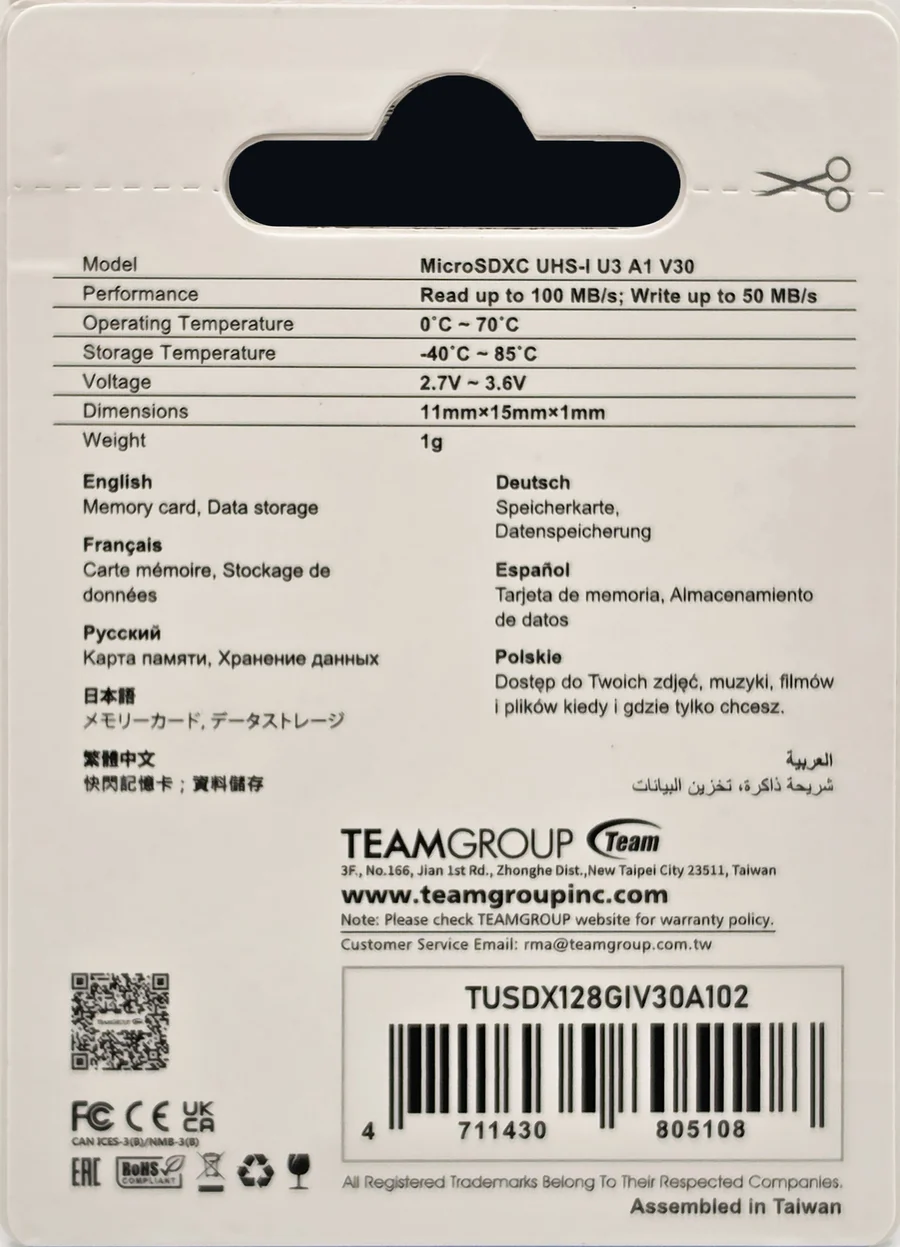
| Read speed | Up to 100 MB/s (back panel, card face) | 96.85 MB/s (ProGrade MSD PGM0.5, at the UHS-I bus ceiling) | MET (97%, at the bus ceiling) |
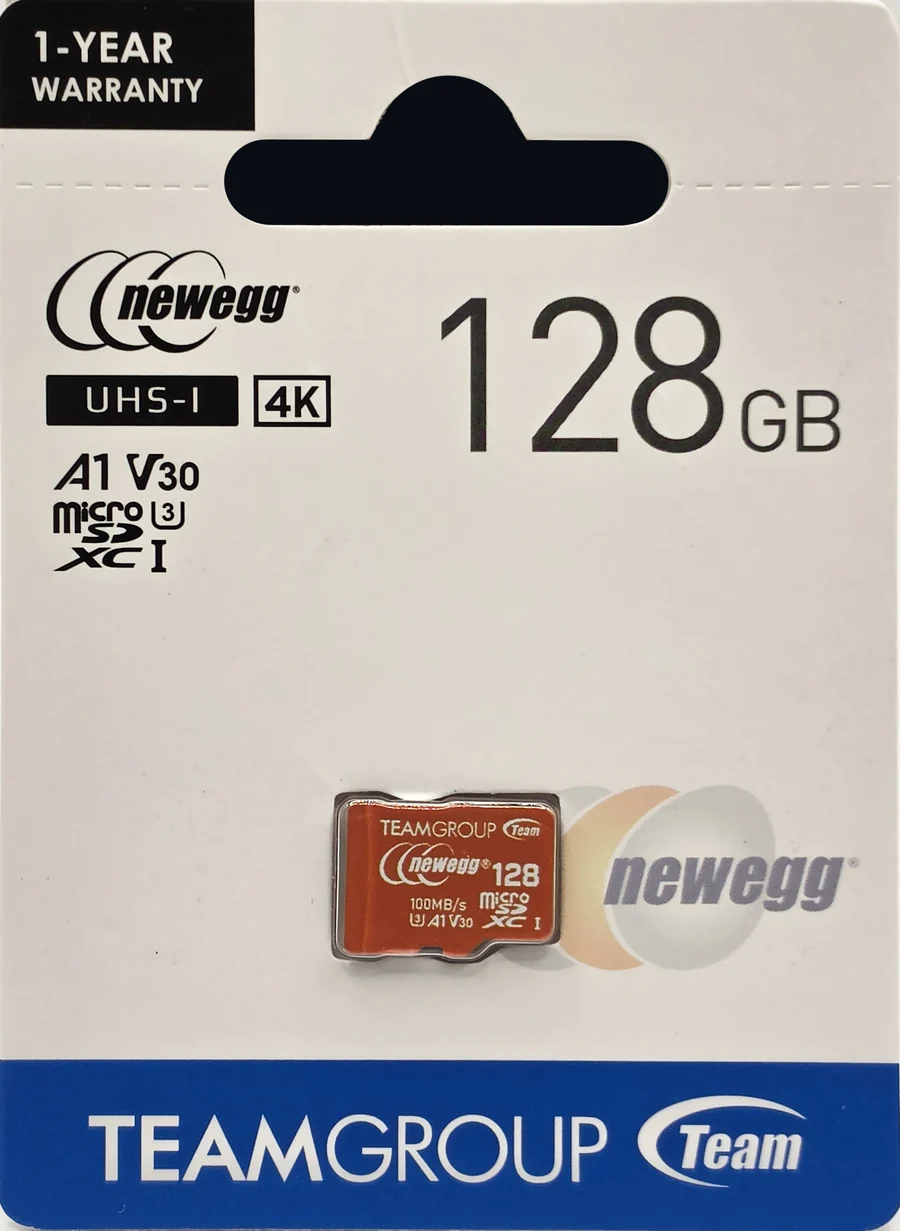
| Write speed | Up to 50 MB/s (back panel) | 39.76 MB/s committed, three passes agreeing within 0.15% | FAILS (80% of claim) |
| Speed class | Not printed anywhere | 35.5 MB/s worst ten seconds, and the card's own register declares C10 | NOT CLAIMED |
| UHS speed grade | U3 (front, card face) | 35.5 MB/s worst ten seconds against a 30 MB/s floor | HELD |
| Video speed class | V30 (front, card face) | 35.5 MB/s worst ten seconds against a 30 MB/s floor | HELD |
| App performance class | A1 (front, card face) | 1521 read / 462 write IOPS at queue depth 1 | NOT TESTABLE |
| Endurance rating | None printed. No hours, no TBW, no bitrate condition | n/a | NOT CLAIMED |
| Operating temperature | 0 °C to 70 °C (back panel) | 56.1 °C at the hot spot under a flat-out write, 13.9 °C of headroom | NOT A PERFORMANCE CLAIM |
| Warranty term | 1 year (front badge). The back panel states no term at all | n/a | NOT A PERFORMANCE CLAIM |
Two rows there are worth pausing on. The card prints no Class 10 mark anywhere, not on the package, not on the card face, and not in the back panel's own model string. That is unusual enough that I checked twice. It does not matter in substance, because the U3 mark it does print asserts the same 30 MB/s floor, but a verdict cannot be given for a claim that was never made, so that row reads NOT CLAIMED even though the card's internal register happily declares Class 10 anyway.
The warranty is the one that would catch a buyer out. The front of the package carries a 1-YEAR WARRANTY badge. The back declines to state a term at all, saying only to check the TEAMGROUP website. Both of the seller's own product listings advertise a lifetime limited warranty covering parts and labor. I re-read the live listing on the day I published this and the gap is still there. The package is the less generous of the two sources, and the package is the thing that arrives in your hand.
Does a cheap card mean a fake card?
Not here, and this is the result that justified buying it. A fake card is one whose controller has been told to report a capacity the flash cannot back. Ask it for 128GB and it says yes, accepts everything you send, and quietly throws away or overwrites whatever will not fit. You find out when you go looking for the files.
The only way to settle it is to fill the entire card with data you can recognize afterward. Every block written here carries a unique seeded stamp, so a controller cannot cheat by noticing repeated data and storing it once. The run wrote 116 files totalling 123,724,890,112 bytes, then read all of it back and compared: zero mismatched bytes and zero read errors. The space is there.
Every byte, written and read back
Run Newegg-TeamGroup-128GB_2026-08-07_054608 · cardcheck v0.8.1 · ProGrade MSD PGM0.5
So why does a 128GB card show up as 119GB?
This is the single most common false alarm in memory cards, and it has nothing to do with fraud. Card makers count a gigabyte as 1,000,000,000 bytes. Windows counts it as 1,073,741,824. Same card, same bytes, two different rulers, and the Windows ruler always reads about 7% smaller. A completely honest 128GB card shows roughly 119GB in File Explorer. If yours does, that is not a problem.
What is worth noticing is a second, separate gap. Before any of that arithmetic, this card only exposes 123.72 GB of its 128GB label, which is 96.7%. Every card holds some flash back as spare area for wear levelling and bad blocks, but the amount varies, and this one holds back more than most. On this bench the SanDisk, Samsung, Lexar and ProGrade cards all deliver essentially 100% of their label. The Botslab and VIOFO cards give 97.4%. At 96.7% this is the lowest ratio of any honest card I have measured, about 4.27 GB you paid for and do not get. More spare area is not automatically a fault, and it can even be a reliability choice on cheaper flash. It is simply never mentioned: unlike Kioxia, which publishes an explicit usable figure, this package makes no arithmetic promise at all.
Why does the write speed swing from 5 to 83 MB/s?
Five minutes of continuous committed writing, fan off, sampled once a second. The average is a flat and unremarkable 40.20 MB/s. The individual seconds are anything but: they run from 5.24 MB/s to 82.84 MB/s, which is the widest swing of any card on this bench, two and a half times wider than the Botslab that previously held that title.
It is not instability and it is not a stall. Underneath it is a metronome. Fitting a two level cycle to the 300 samples returns a period of 2.70 seconds: about 1.25 seconds writing at roughly 80 MB/s, then about 1.45 seconds crawling at roughly 6 MB/s, moving about 95 MiB in each fast phase. The fit tracks the real trace closely, and refitting it independently across the 52 minute whole-card write returns the same period every time, holding to within 0.7% from the first gigabyte to the last.
What you are watching is a very small write cache filling and emptying. The card absorbs a burst into fast single-bit flash, then has to fold that data down into slower, denser storage, and while it folds, incoming writes crawl. Most cards do this once, at a cache cliff, after several gigabytes. This one does it 22 times a minute. That is why the cache analysis reports no cliff anywhere in a full-card fill: there is no cliff to fall off, because the card is already at the bottom of it from about the second second onward.
It also explains why every write figure on this card agrees. Sequential 39.76, burst 39.85, steady state 40.20, whole-card fill 40.68. A card with a real cache posts a high burst and a lower sustained number. This one has no burst advantage to give you at all, on anything bigger than about 96 MiB.
Newegg TeamGroup 128GB · the stutter
300 one-second samples · worst 10 s at 2:12 · knee scan outcome NO_KNEE_STABLE · Run Newegg-TeamGroup-128GB_2026-08-07_054608
Does it still hold the V30 rating it prints?
Yes, and that is the number that decides what the card is safe to record. The verdict here is never an average, it is the worst ten second window of the whole five minutes, because a video recorder does not care what your card averaged, it cares whether it ever dropped below the bitrate for long enough to lose a frame. That window came in at 35.5 MB/s against the 30 MB/s floor V30 requires, so the rating holds with about 18% to spare.
There is a caveat specific to a card that cycles this fast. A ten second window spans only about 3.7 of this card's cycles, so exactly where the window lands nudges the answer: measured at nine, ten and eleven second windows the worst case reads 36.6, 35.5 and 39.5 MB/s. Read 35.5 as "about 36" rather than a figure good to two decimals. The V30 verdict itself is not in doubt at any of those widths, and the standard ten second window happens to be the harshest of them, so the published number errs in the right direction.
Where I would not lean on it is the high bitrate row. The format table clears 4K120 and similar formats by 1.6%, which is inside run to run noise. Treat that as a fail rather than a pass.
The good-to-great band
The band is a comparison, never a score: cards are still judged against the job they are sold for. Read speed is deliberately absent, because every UHS-I card here reads at about 96 MB/s and that is the reader's ceiling rather than the card's.
Who actually made this card?
Every SD card carries a small identity register called the CID, burned in at manufacture, holding a manufacturer ID, an OEM ID, a product name, a revision and a manufacture date. I read this one on a Raspberry Pi with the card in a native SD slot, so nothing is filtered through a USB bridge. It reports manufacturer ID 0xFE.
That number was already on file here. It is the same manufacturer ID reported by the two no-name cards that ship free in the box with a FitcamX and a Botslab dash cam, and it appears on no public manufacturer list I have been able to reach. A retail card, in a printed hang tag package, sold under a named Taiwanese company's branding, is reporting the same maker ID as the giveaway cards.
Update, September 2026: a fourth card has reported it, and that one matches this card field for field. The Gigastone High Endurance Pro 128GB, a retail endurance card with TLC printed on its face, reports the same 0xFE, the same OEM code 42, the same product name SD and the same revision 2.0, built twenty-one months after this one, with the same SD Status register. On that platform it is the best-behaved card of the four: where this card drops to 5 MB/s when its cache is full, the Gigastone holds about 50. A fifth, the PNY Premier-X 128GB, carries the same SD Status register and the same 80 MB/s cache under a different manufacturer ID, 0x74, and folds the way this card does, to about 3 MB/s, but for only a second and a half at a time.
On its own that would be weak evidence. An uncatalogued ID could easily be a default value that several unrelated module houses never bothered to change. What makes it stick is a different register entirely. Alongside the CID, every card publishes an SD Status register: not an identity field but a specification sheet the card writes about itself, listing its speed class, UHS grade, video class, app class, allocation unit size and erase timings. Across these three cards, in two different capacities, sold by three different companies, that register is byte for byte identical. Every other card I have read differs somewhere in that block, as parts with different controllers should. These three do not differ anywhere. One field is especially telling: all three declare a PERFORMANCE_MOVE of 4 MB/s where every other card on the bench reports zero.
The write curve agrees, independently, which is what makes it worth stating rather than speculating about. These three cards are the only ones on this bench whose sustained write runs on a repeating two level cycle at all. Fit the same model to the Kioxia or the SanDisk High Endurance and it finds a high level and a low level within 5% of each other, which is the model's way of reporting that there is no cycle there. Two completely different measurements, a register field and a physical behavior, pick out the same three cards. There is more on all of this in the running CID register.
None of that is an accusation. All three cards passed full capacity verification. The finding is narrower and more useful than fraud: the brand on the front of a memory card tells you very little about who built it, and the registers tell you a great deal.
The date the package could not tell me
The same register carries a manufacture date, and this one reads February 2024. The seller's own product page lists the card as first available in April 2026. So this is not new production built to hit a low price during a shortage. It is flash that was made about two years before it was listed, which is a far simpler explanation for the price than anything clever about sourcing. Nothing on the package could have told you that: there is no lot code and no date code printed anywhere on it. Worth keeping in proportion, though, since a manufacture date is a programmed field rather than a measurement, and on a card whose maker ID appears on no list there is no external authority to check it against.
Does it get hot, and does it slow down when it does?
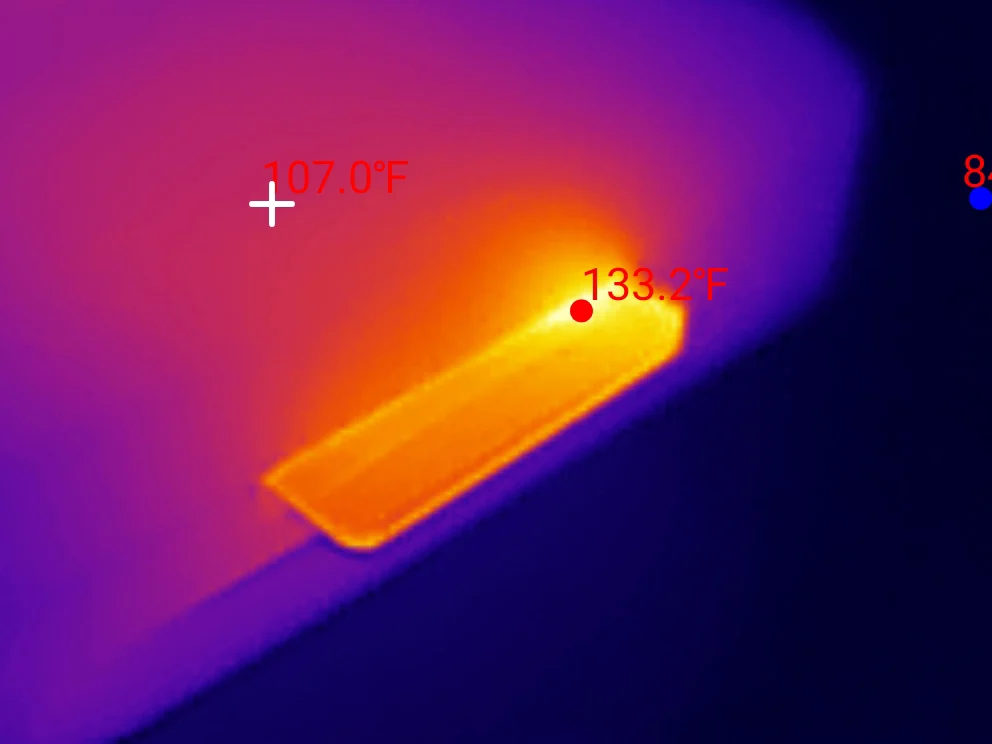
No, and no. With the fan off for the full five minutes it peaked at 133.2 °F (56.2 °C) against a 76 °F (24.4 °C) room, a rise of about 57 °F (31.7 °C). It did not throttle: the write rate at the end of the five minutes matches the start, and the 52 minute whole-card write that followed held the same cycle from beginning to end. In absolute terms that is the coolest 128GB microSD card I have measured.
The rubric asks a harder question than the absolute number, though, which is how much heat a card produces for the work it does. At about 1.6 °F of temperature rise for every MB/s it sustains, this is the worst ratio of any genuine 128GB card here, against 1.1 for the Botslab, 1.1 for the Kioxia and 0.9 for the SanDisk High Endurance. It runs cool because it is barely working, not because it is efficient.
The other half is the card's own rating. 56.2 °C is comfortable against the 85 °C most cards in this corpus are rated to, but this card is rated to 70 °C, which leaves under 14 °C of headroom measured in a mild room. That, rather than speed, is the real reason I would keep it off a windshield.
It stayed cool. It also stayed slow.
Rated 0 °C to 70 °C, so under 14 °C of headroom · Run Newegg-TeamGroup-128GB_2026-08-07_054608
What does loop recording actually do to it?
Loop recording, and app use generally, is not one long tidy write. It is scattered small writes: file table updates, event saves, overwrites of the oldest clip. The bench approximates that with random 4K writes, which means writing 4 kilobyte chunks to random places rather than one continuous stream, run as three back to back passes so you can see whether the card degrades as its internal map gets churned up.
It holds up well. Across the three passes it measured 481, 434 and 472 write IOPS, which is operations per second: a dip in the middle pass and then a recovery, ending 1.8% below where it started. For comparison, the unbranded Class 4 reference card this bench keeps as its floor collapses by 71% across the same three passes. This card does not do that. In absolute terms 462 IOPS averaged is modest, and it is the reason the A1 row in the claim table cannot be settled here at all: the A-class specification is measured with command queuing that USB card readers do not perform, so an A1 result on this bench would be measuring the reader, not the card.
Worth being clear about what this does not prove. Three passes over a minute is a churn indicator. It is not an endurance test, and nothing in a single session can tell you whether a card will still be working in three years. This card also prints no endurance rating of any kind, so there is not even a manufacturer claim to check it against.
One minute of loop-recording abuse
This card: run Newegg-TeamGroup-128GB_2026-08-07_054608 · reference card: lab baseline, same bench, same test
How the Newegg TeamGroup 128GB scores
Newegg TeamGroup 128GB microSDXC
Scored against the CKBench rubric. Five dimensions, each out of 5.
Final score: 3.5 out of 5. An entirely genuine card that is honest about its capacity and dishonest about its speed, held back by being the slowest real 128GB card on this bench and by a printed write figure it cannot reach on any file worth the name. The five rows were restated on the September 2026 scoring tables on 19 September 2026: sustained rose to 3 on the absolute ladder, endurance to 5 because the tables score fade and recovery rather than the absence of a rating, thermal to 3.5 on the headroom table; the claim-accuracy row, the one that carries the missed write figure, did not move. They average 3.6, rounded to 3.5. Published at 2.5 out of 5 from August to September 2026; the update note at the top says what moved and why.
Frequently Asked Questions
Is the Newegg TeamGroup 128GB microSD card fake?
No. I wrote 123.72 GB of uniquely seeded data to it, read every byte back and compared, and got zero mismatched bytes and zero read errors. The capacity is completely genuine. It is a slow card, not a fake one.
Does it really write at 50 MB/s?
No. Committed sequential write measured 39.76 MB/s, which is 80% of the printed claim, and three passes agreed within 0.15% of each other. The card can briefly exceed 50 MB/s inside its small write cache, but that cache is only about 96 MiB, so any file larger than that averages around 40 MB/s.
Why does my 128GB card only show 119GB?
Because card makers count a gigabyte as 1,000,000,000 bytes and Windows counts it as 1,073,741,824. The card is not lying and nothing is missing. A completely honest 128GB card shows about 119GB in File Explorer. This particular card exposes 123.72 GB before that conversion, which is 96.7% of its label.
Is this card good enough for a dash cam?
On speed, easily: it sustains about 35 MB/s at its worst, and a 4K30 dash cam writes about 6 MB/s. The problem is temperature. The package rates it for 0 °C to 70 °C operating, and a windshield goes outside that range on a freezing morning and on a hot afternoon. I would use a card rated to 85 °C instead.
Why does its speed jump between 5 and 83 MB/s every second?
It has a very small write cache, about 96 MiB, that fills and empties on a 2.70 second cycle. It absorbs a burst at roughly 80 MB/s for about 1.25 seconds, then crawls at roughly 6 MB/s for about 1.45 seconds while it moves that data into slower storage. Averaged over any ten second window it is a steady 35 to 43 MB/s.
Who actually manufactures this card?
Its manufacturer ID register reads 0xFE, which appears on no public list, and which is the same ID reported by the unbranded cards bundled with FitcamX and Botslab dash cams. All three cards return a byte for byte identical SD Status register and share a write pattern no other card on this bench shows, so they are one controller platform sold under three different names.
Is the warranty one year or lifetime?
The package front says 1-YEAR WARRANTY and the package back states no term at all, while both of the seller's own product listings advertise a lifetime limited warranty. That contradiction was still live when I published this. The package is the less generous source and it is the one you physically receive.
The bottom line on the Newegg TeamGroup 128GB
It is real, it is cheap, and it is slow. Those three things are the entire review. I bought this card expecting to find something wrong with it, because a 128GB card at roughly half the going rate during a flash shortage is exactly the profile of a scam. Nothing is wrong with it. Every byte of the space is there and verified, it holds every speed class mark it prints, it never stalled once across a full-card write, and it does not throttle when it gets warm.
What you give up is real too. It is the slowest genuine 128GB card this bench has measured, it misses its own printed write speed by 20%, it hands back less of its label than any other honest card here, and it carries no endurance rating and a one year warranty against a lifetime one advertised online. For a phone, a tablet, a handheld console, a drone or a 4K60 camera, none of that will ever bother you and the card is a perfectly sensible buy. For a dash cam, a security camera, or anything that needs the number on the front of the box, buy the card that actually posts it.
If you want a straight upgrade in the same capacity, the Kioxia Exceria G2 128GB sustains 62.6 MB/s at its worst against this card's 35.5, and the SanDisk High Endurance 128GB sustains 88.0 and is rated to 85 °C. Both cost more. Both are more card.
Device identity: what this card reports about itselfFor anyone checking a card they already own
| Raw CID register | fe343253440000002000_______018200 (serial digits elided) |
| Manufacturer ID (MID) | 0xFE, on no public list. Shared with the FitcamX and Botslab bundled cards |
| OEM / application ID (OID) | 0x3432, which reads as "42" in ASCII |
| Product name (PNM) | SD, two characters where the specification allows five |
| Product revision (PRV) | 2.0 |
| Serial number (PSN) | Truncated. A low four-figure counter value, which is itself unusual |
| Manufacture date (MDT) | February 2024 |
| Declared capacity (from CSD) | 241,664,000 sectors of 512 bytes = 123,731,968,000 bytes, 96.7% of the label |
| SD Status register | 000000000800000004049000080a391e000800000001, identical byte for byte to the FitcamX and Botslab cards |
| Captured on | Raspberry Pi 4 native SD host, no USB bridge in the path · 2026-08-07 |
The manufacturer ID, OEM ID, product name and revision are model-level fields: they are the same on every unit of this product, which is what makes them worth publishing, because you can read your own card and compare. The serial number is per-unit and is truncated here, and its digits are elided from the raw register above for the same reason. These registers do not reach the flash controller or the NAND part numbers, which need a vendor tool, so this table is a description of what the card says about itself rather than a complete parts list.
Disclosure: I bought this card at retail with my own money. Newegg and TEAMGROUP had no involvement in this test and no editorial input, and neither knew it was happening. This post contains affiliate links. As an Amazon Associate I earn from qualifying purchases, at no extra cost to you. Affiliate links like these and my YouTube channel are what keep the site running.