
SUNEAST Ultimate Pro 128GB: fast until you fill it once
208 MB/s on the box, 181 on SanDisk’s own reader, and a V10 card after one fill. I bought this Japanese-brand microSD card on Amazon, filled every byte, ran it four times on two readers, tried to reset it on a Raspberry Pi and in a dash cam, and read its identity registers. It is quick on its first day. What it does after that is the review.
No video for this bench run
Everything on this page came off the bench, not a camera. The channel covers the dash cams, phones and readers these cards end up in; subscribe and the next one lands in your feed the day it goes up.
The short version
The SUNEAST Ultimate Pro 128GB is fast until you fill it once. On its first run it wrote 159 MB/s for about 15.7 GB, then fell to about 35, and held V30 with 3.5% to spare. After one write of the whole card it never got its speed back: 53 MB/s instead of 159, worst ten seconds of 27.6, a V10 card, on both of my readers. Neither a Raspberry Pi’s own SD slot nor a Vantrue dash cam’s format undid it. Its headline 208 MB/s read, which the box ties to a DDR225 reader, came in at 181 on my ProGrade and on SanDisk’s own QuickFlow, a reader that has given other cards 206. Every byte of its 124.6 GB verified. My rating: 3.5/5, scored against the CKBench rubric in the state a full card leaves it in. If you want the steady version of this card, the LinkMore XV23 Lite 128GB carries the same identity registers and holds V60 full or empty.
Verdict: 3.5/5, a V30 card that becomes V10 for goodWho this card is for
- YesFast offloads on a reader that speaks a faster UHS-I modeIt read 181 MB/s on both of my readers, nearly twice the standard UHS-I ceiling, and filling the card did not touch that.
- Yes4K at ordinary bitrates, even once it is fullIts worst ten seconds after a fill were 27.6 MB/s, about twice the 12.5 MB/s that 4K at 100 Mbps writes.
- NoAnyone buying it for the V30 badgeOne write of the whole card, which a looping dash cam does in days, drops it to V10, and nothing I tried brought it back. The LinkMore XV23 Lite is the steady alternative.
- NoAnyone expecting 208 MB/s reads181 on SanDisk’s own fastest microSD reader, and no reader I could find is rated above 200 in the mode the box names.
124.6 GB of usable space is roughly 5 hours 46 minutes of single-channel 4K at 6 MB/s, or about 11 hours 32 minutes of 1080p60 at 3 MB/s, before a dash cam loop starts overwriting. Work out your own numbers in the dash cam storage calculator.
What is the SUNEAST Ultimate Pro?
SUNEAST, one word, is the brand of Kyokuto Electronics, a Japanese memory and storage company with offices in Tokyo and Osaka, founded in 2017. The Ultimate Pro is its S225 GOLD series, and the box says Made in Taiwan. I bought this one on Amazon on 6 October 2026. The top of the box was not sealed, there were no stickers on it, and the card was empty with its factory format intact, so nothing suggested earlier use. It is the first SUNEAST card on my bench.
What makes it worth testing is the read claim. The box prints “Read speed up to 208MB/s”, the highest UHS-I read claim on any card I have tested, and it is the first box I have seen that names the bus mode behind it: “208MB/s (DDR225 mode)”, with a footnote that “A UHS-I DDR225 mode-compatible card reader is required.” It prints no write speed at all. The card is now in CKBench, the running index of every card on my bench, next to the other fast UHS-I cards I have read at 200 and above, the Amazon Basics 128GB and the Lexar Silver Plus 128GB.
Every write figure on this page is a committed write: the data is on the flash before the clock stops, with no operating-system cache in the way. That is why the numbers here read lower than a marketing sheet or a quick benchmark; the methodology page explains the difference and why it is the one that matters for recording.
What the SUNEAST Ultimate Pro claims, and what it did
| Claim | Printed | Measured | Verdict |
|---|---|---|---|
| Capacity | 128 GB (box front, card face; no GB definition printed) | 124.6 GB written and verified, zero errors; the card declares 97.39% of its label | VERIFIED |
| Read speed | “Read speed up to R: 208 MB/s” (box front); “208MB/s (DDR225 mode)”, with a DDR225 reader required (box back) | 181.8 MB/s (ProGrade PGM0.5); 181.3 MB/s (SanDisk QuickFlow SDDR-B751), 87.2% of the claim, on a reader that has read other cards at 206 | NOT SETTLED (181 on both readers) |
| Write speed | None on the card, the box or SUNEAST’s product page (the Amazon listing alone says 115 MB/s) | 159.1 MB/s committed on the first run, inside its cache; 52.4 to 57.7 after one fill | NOT CLAIMED |
| Speed class | C10 (box front only; not on the card face) | 27.6 MB/s worst ten seconds even after a fill, far above C10’s 10 | HELD |
| UHS speed grade | U3 (box, card face) | 31.0 MB/s worst ten seconds fresh; 27.6 after one fill, on both readers, under U3’s 30 | LOST AFTER ONE FILL |
| Video speed class | V30 (box, card face) | 31.0 MB/s worst ten seconds fresh, 3.5% to spare; 27.6 after one fill on both readers, and 27.8 after a dash cam’s format: V10 | LOST AFTER ONE FILL |
| App performance class | A2 (box, card face) | 2,316 read / 1,600 write IOPS at queue depth one on the ProGrade, above A1’s floors; A2’s floors need command queuing that USB readers do not perform | NOT TESTABLE |
| Bus | UHS-I (box, card face) | One row of eight contacts; declares SD specification 6.x; reads at 181 in a faster UHS-I mode on two readers | CONSISTENT |
| 4K video badge | “4K VIDEO” (box front) | 27.6 MB/s worst ten seconds after a fill, about twice what 4K at 100 Mbps writes | MET, AT ORDINARY BITRATES |
| Photo and video estimates | A table on the box back, e.g. 6,550 photos or 5 hours 50 minutes of 1080p at 50 Mbps for 128 GB | Every row assumes 131.07 GB of space; the card declares 124.66 | OVERSTATED BY 5% |
| Endurance rating | None printed | n/a | NOT CLAIMED |
| Operating temperature | Not on the box; −25 to 85 °C on SUNEAST’s product page | 140.0 °F (60.0 °C) at the hot spot after five minutes of uncooled writing in a 76 °F room, 25.0 °C of headroom | NOT A PERFORMANCE CLAIM |
| Warranty term | “Five-Year Global Warranty” (box front); five years (box back) | SUNEAST’s own site says five years within Japan; see below | NOT A PERFORMANCE CLAIM |
The row that decides this card is the video class. It holds V30 on its first run, by 1.04 MB/s, and loses it the moment the card has been filled once, on both readers, and it stays lost; the next section is about that. The read is the other headline: the box conditions its 208 on a DDR225 reader, I do not own a reader proven to read above 208, and the 181 it reached on SanDisk’s own reader is reported here rather than scored. The box prints no write figure, so there is no write claim to test, though the 159 MB/s it wrote on its first run beats the 115 the Amazon listing gives it. A2 is not testable on any USB card reader; the card cleared the lower A1 floors at queue depth one, which is indicative and nothing more.
A Japanese retail box that names its bus mode
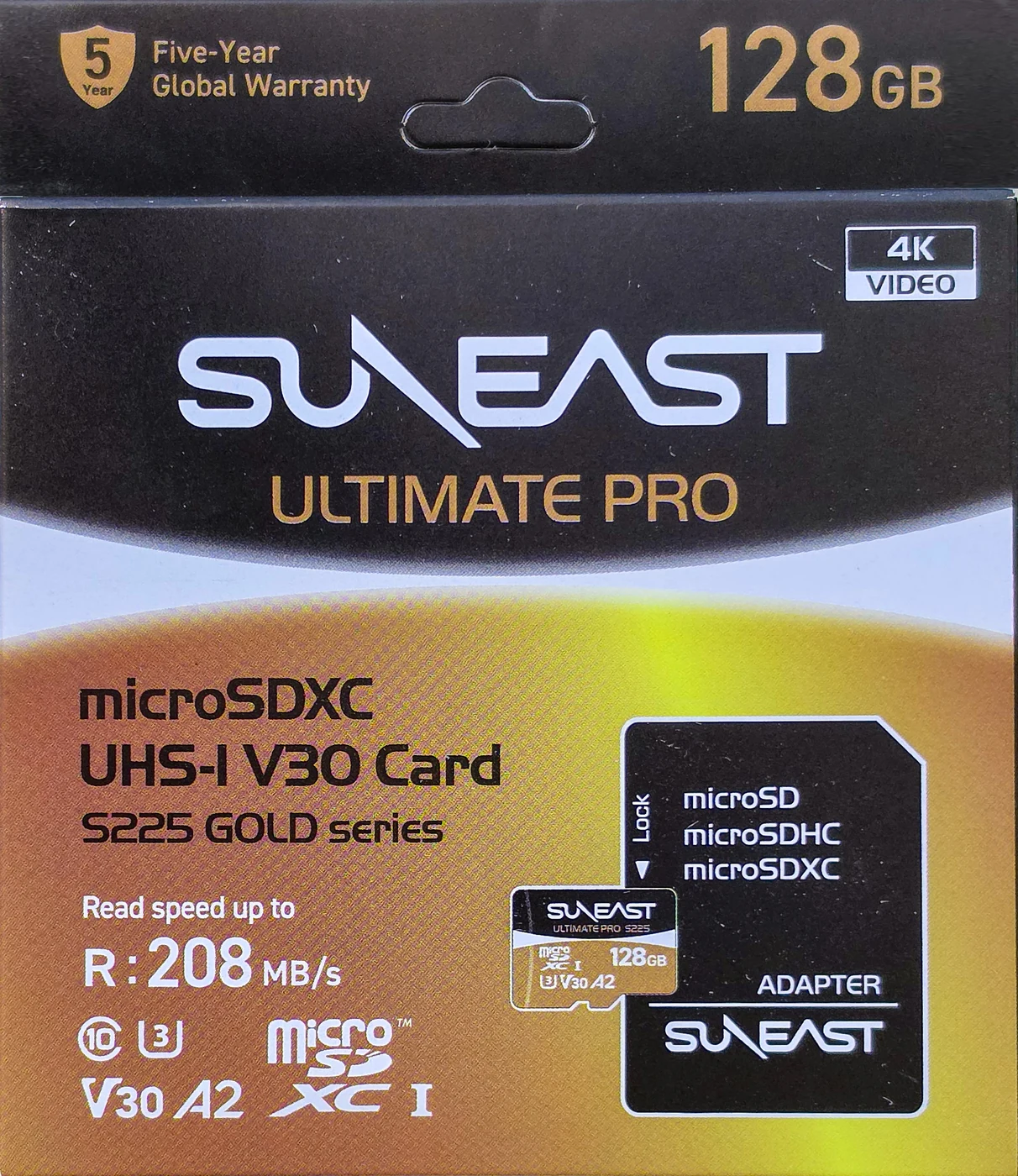
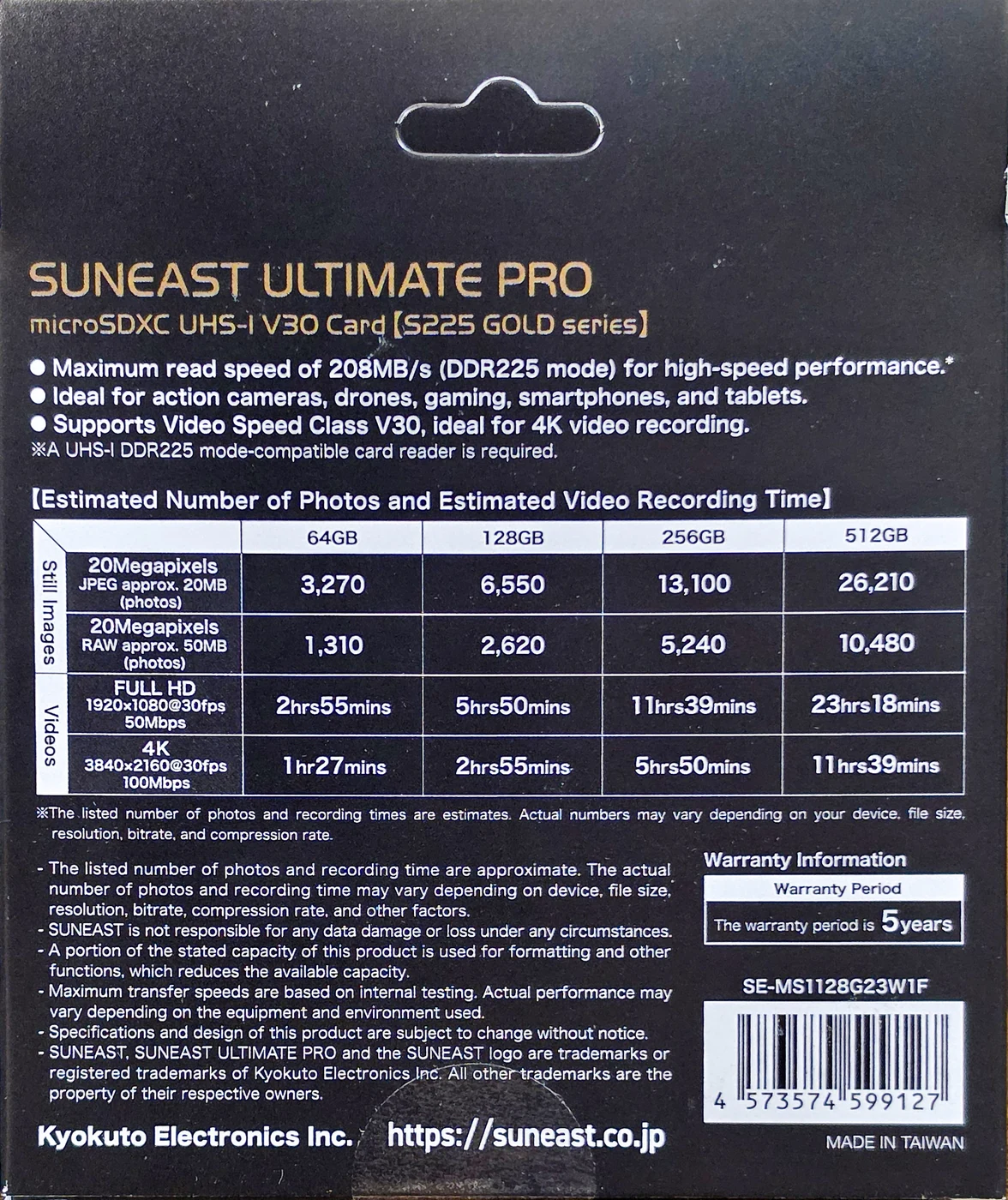
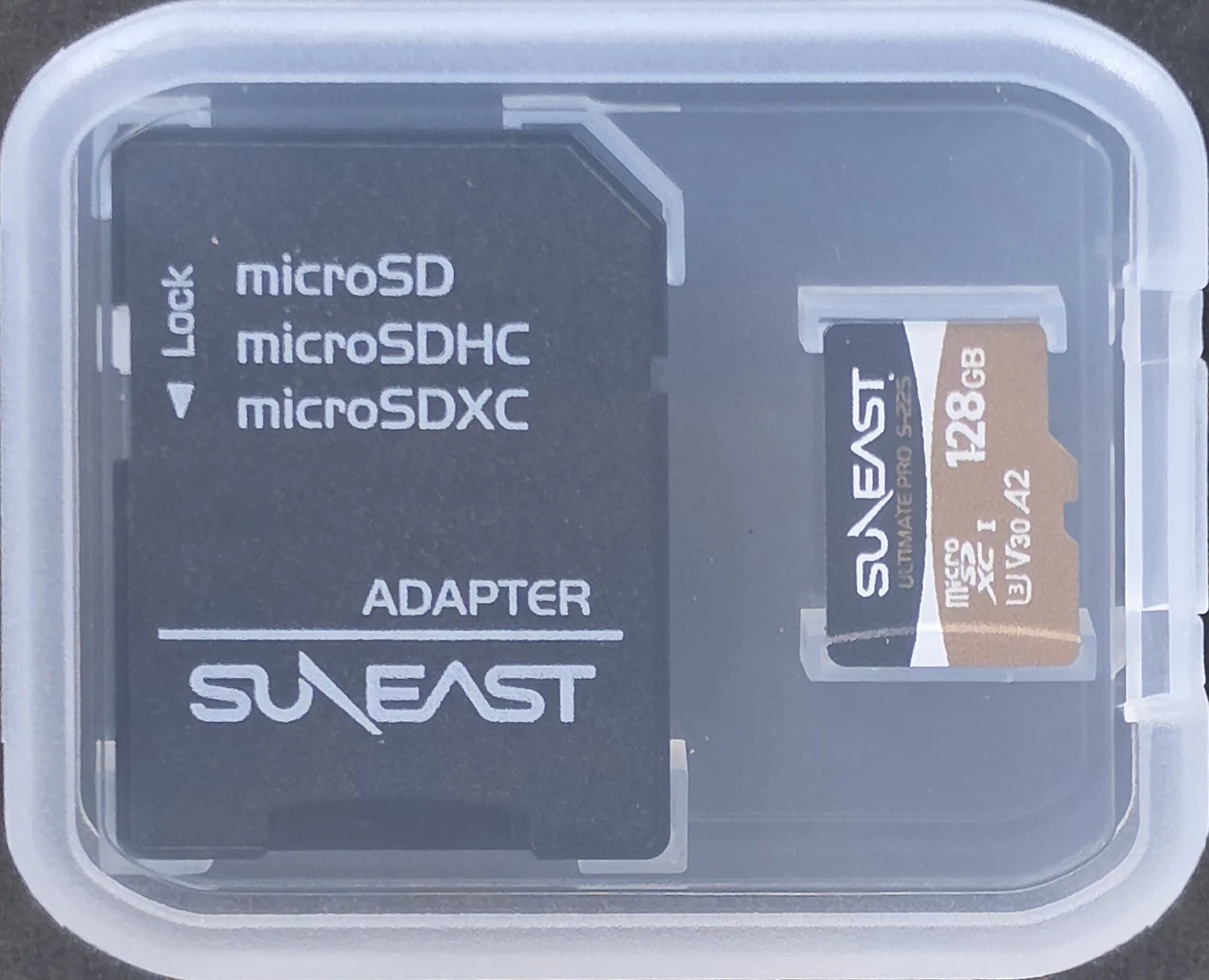
The Ultimate Pro comes in a printed retail box with a full-size SD adapter. The barcode is a Japanese one and the box is the domestic Japanese pack, in English, sold here through Amazon. The front leads with the read speed and the warranty; the back explains the read (“Maximum read speed of 208MB/s (DDR225 mode)”), names the reader it needs, and adds a table of how many photos and how many hours of video fit. That table has a quiet error: every row is the label’s capacity times 1,024 megabytes, 131.07 GB for the 128 GB card, before any formatting, on the same panel that warns part of the capacity is used for formatting. The card declares 124.66 GB, so the table promises about 5% more than the card can hold.
After one fill, a V10 card for good
My first run ends with the capacity test, which writes every free byte of the card and reads it back. The next suite started 58 seconds later, on the second reader, and the card had changed: its first test write, 152 MB/s on the first run, came in at 35.8. I ran it again on the primary reader the same afternoon, and again nine days later after formatting it in a dash cam. Same answer every time.
SUNEAST-Ultimate-Pro-128GB_2026-10-07_142321; after one fill, run SUNEAST-Ultimate-Pro-128GB_2026-10-07_173627.| Run | Reader | Card at the start | First test write | Sequential write | Worst ten seconds | Video class |
|---|---|---|---|---|---|---|
| 1 | ProGrade PGM0.5 | first writes, as shipped | 152.0 MB/s | 159.1 MB/s | 31.04 MB/s | V30 |
| 2 | SanDisk QuickFlow | 58 s after the fill | 35.8 MB/s | 52.4 MB/s | 27.58 MB/s | V10 |
| 3 | ProGrade PGM0.5 | used | 33.1 MB/s | 53.5 MB/s | 27.58 MB/s | V10 |
| 4 | SanDisk QuickFlow | after a Vantrue P2’s format, nine days later | 33.4 MB/s | 57.7 MB/s | 27.79 MB/s | V10 |
Runs 2 and 3 agree to two decimals on the worst ten seconds, 27.58 on each reader, so this is the card, not the reader. On the same reader, fresh against used, sequential writes fall 2.98 times and the worst ten seconds by 11.1%. Reads do not move at all: 181.3 used against 181.8 fresh. Used, the card writes about 28 MB/s most of the time and spends 87% of its timed seconds under 30. A dozen burst seconds, seven of them above 100, lift its five-minute average to 31.6, and none of them helps a camera that needs 30 every second.
This is the used state I wrote up in why a used microSD card tests slower. Deleting files tells the computer the space is free; it does not tell the card. A card that has been written end to end still holds every block as live data, and on some cards, this one included, that leaves no room for the fast cache. A card reader on a USB port cannot send the signal that would tell it otherwise. An SD erase from a native SD host can, and for the Gigastone High Endurance Pro it worked: a Raspberry Pi’s own slot erased it in 26.5 seconds and its speed came back.
Not this card. The Pi’s Linux kernel works out how much it may erase at once, partly from what the card declares about its own erase timing, and for this card it worked out zero: it will not send it an erase at all. I have not established why. So I tried what an owner would actually do: I formatted the card in a Vantrue P2 dash cam, which put back the factory layout and a new volume serial, and ran it again. Run 4’s first test write was 33.4 MB/s and its worst ten seconds 27.79. The format did nothing. That is one dash cam, not every device there is, but it is the reset most owners have, and between it and the Pi I have nothing left that restores this card.
So this review scores the card the way it will spend its life in a dash cam: my rubric judges a card’s printed speed classes in its used state when nothing available restores the fresh one, and on this card that turns V30 and U3 into fails. It is the only card on my bench where that has happened.
Fresh: 159 MB/s for 15.7 GB, then a 4.5 times drop
For the record, here is the card at its best. The timed write starts after an untimed warm-up that runs until the speed stops changing, and on this card the warm-up stopped changing at 158.9 MB/s after 60 seconds, still inside the cache, having written 9.51 GB. The timed leg then ran at 156 to 160 for another 40 seconds, about 6.2 GB more, and fell at 0:39: 159, 160, 118, 37, 36. So the card writes about 15.7 GB fast, counting the warm-up, and about 35 MB/s after that.
SUNEAST Ultimate Pro 128GB, first run
The worst ten seconds of the fresh run were 31.04 MB/s, at 4:16, so V30 held by 1.04 MB/s, 3.5%. One write in that run blocked for 1.03 seconds, at 4:22; it did not happen on the other reader, where no write took longer than 133 milliseconds, so the rubric treats it as the host’s and not the card’s. Among the 128 GB cards on my bench, a cache that runs out is not unusual, and the Silicon Power Superior Pro has one too: 4.7 GB at 89, then 39. But the SP held its speed after a fill, and its worst ten seconds stayed at 37.75. The SUNEAST’s cache is more than three times the size, and the card behind it is slower.
208 on the box, 181 on SanDisk’s own reader
Standard UHS-I tops out near 104 MB/s, and a card that reads faster is using one of the faster UHS-I modes card makers have added on top. SUNEAST names its mode on the box, DDR225, and the name is SanDisk’s: its QuickFlow technical brief describes “DDR225 or SanDisk QuickFlow Technology” as the mode that raises the bus clock above 208 MHz, and rates it at 200 MB/s. SanDisk’s QuickFlow microSD reader, the SDDR-B751, is one of my two test readers, so this claim got as fair a test as I can give it.
| Card | Reader | Sequential read |
|---|---|---|
| SUNEAST Ultimate Pro 128GB, fresh | ProGrade PGM0.5 | 181.8 MB/s |
| SUNEAST Ultimate Pro 128GB, used | SanDisk QuickFlow SDDR-B751 | 181.3 MB/s |
| SUNEAST Ultimate Pro 128GB, whole card | ProGrade PGM0.5 | 180.4 MB/s across all 124.6 GB |
| Amazon Basics 128GB | SanDisk QuickFlow SDDR-B751 | 206.3 MB/s |
| Lexar Silver Plus 128GB | SanDisk QuickFlow SDDR-B751 | 206.1 MB/s |
Both readers stop this card at 181, a figure that does not move with the reader, the run or the position on the card, and the same QuickFlow has read two other cards at 206. So the reader is not what holds it back. My guess is that this card and SanDisk’s reader agree on an older, slower fast mode rather than on DDR225; the tool cannot see which mode a card and reader settle on, so that stays a guess. 181 is 87.2% of the claim. Because no reader I own is proven to read above 208, the rubric leaves the claim out of the score as not settled, and I report the number instead: on the fastest microSD reader SanDisk sells, this card reads at 181. SUNEAST’s own UHS-II reader lists DDR200 and not DDR225, and no reader I could find is rated above 200 MB/s in DDR225, so a buyer has no easy way to see 208 either. My card reader tiers and reader buying guide cover why the reader changes the answer.
124.6 GB, every byte verified, at 29 MB/s
The capacity test wrote 117 files of unpredictable, dedup-proof data until the card was full, 124,628,893,696 bytes, then read every one of them back and compared. Zero mismatched bytes. Zero read errors. The read-back took 12 minutes 42 seconds. The fill took 71 minutes 9 seconds, because by the time it started the cache was spent, and the card wrote the whole thing at its slow rate.
Every byte, written and read back
The fill is the clearest picture of the card without its cache. Its one-second samples averaged 29.22 MB/s (the panel’s 29.7 divides the bytes by the 4,202 seconds spent writing alone), spent 85% of the fill under 30, and its worst ten seconds across the whole card were 27.05. By tenth of the card it ran 33.6, 28.4, 28.3, 28.2, 28.1, 28.0, 28.1, 29.2, 29.8 and 31.5 MB/s.
SUNEAST-Ultimate-Pro-128GB_2026-10-07_142321. Every byte verified afterwards.That unevenness, 33.6 at the start against 28.0 in the middle, a 16.5% spread, is wide: on my bench, spreads like it have otherwise come from fakes and from cards already stuck in a slow used state. Here it is a speed pattern and not a capacity one, because every byte came back. The card declares 124,663,103,488 bytes, 97.39% of the 128 GB on the label, ordinary overhead for a genuine card, and the capacity row of the rubric scores that share, a 4. Windows will show it as about 116 GB, because it counts in binary; that is arithmetic, not a shortfall, and the methodology page has the conversion.
What scattered writes do to it
Loop recording is a long write interrupted constantly by small ones, and random 4K writes are the bench version of that: three twenty-second passes, and the question is whether the third is as fast as the first. On this card the third was the fastest. The first run did 1,600, 1,598 and 1,602 write IOPS, 6.55, 6.55 and 6.56 MB/s, no fade at all, and the card was back at its full rate within ten seconds of continuous writing afterwards.
One minute of loop-recording abuse
This card: run SUNEAST-Ultimate-Pro-128GB_2026-10-07_142321 · reference card: lab baseline, same bench, same test · cardcheck v0.8.3
Scattered writes were never this card’s problem, used or fresh: the used-state run on the ProGrade did 2,254 read and 1,569 write IOPS against 2,316 and 1,600 fresh, within 3%. On the QuickFlow it did 3,206 and 1,799, because random figures always run higher on that reader, which is part of why the A classes cannot be tested on a USB reader. The rubric scores the first run here, a 5.
140.0 °F under load, and the drop is the cache, not the heat
SUNEAST publishes an operating range of −25 to 85 °C for this line, so the rubric scores heat against 85 °C. At the end of five minutes of uncooled writing in a 76 °F room, the thermal frame read 140.0 °F (60.0 °C) at the card’s hottest point: exactly 25.0 °C under the rating, the top band of the table. The used-state runs read 137 °F.
It got warm. The drop is the cache, not the heat.
The used-state runs read 137 °F at 76 °F ambient · Run SUNEAST-Ultimate-Pro-128GB_2026-10-07_142321 · cardcheck v0.8.3 · ProGrade PGM0.5
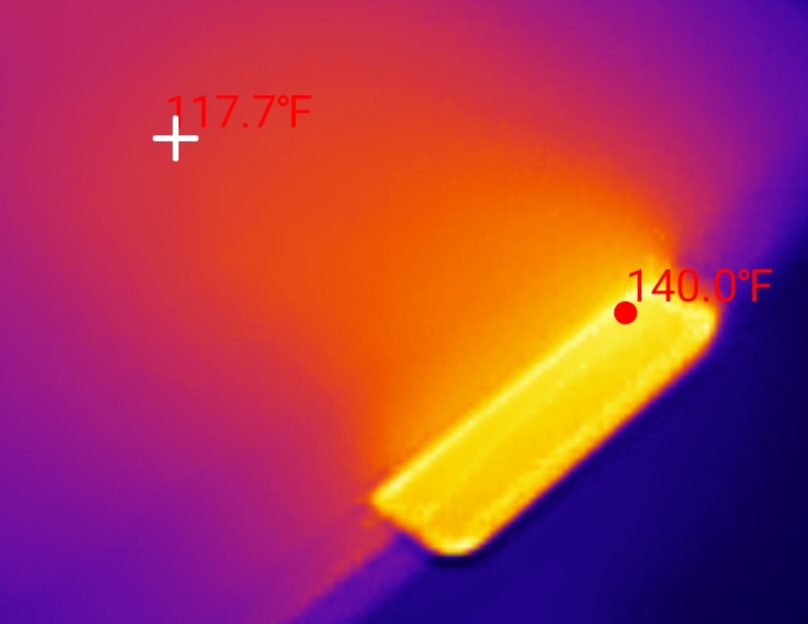
The speed trace looks like throttling and is not. The card fell from 159 to about 35 at 0:39, when the cache ran out, and then held: the last thirty seconds, at the hottest point of the run, averaged 34.9 MB/s, against 34.95 just after the cliff. Heat follows work, and a card writing at 35 MB/s for most of five minutes stays comparatively cool.
The same identity as the LinkMore XV23 Lite, and a different card
Every SD card carries registers, written at the factory, that a USB reader cannot show and a native SD host can. I read this card’s on a Raspberry Pi before its first run: manufacturer ID 0x27, which my manufacturer ID register attributes to Phison, a controller company that builds for many brands; OEM ID “PH”; the generic product name SD128; revision 6.0; built September 2025. A week later the LinkMore XV23 Lite 128GB arrived reporting the same four identity fields, the same factory volume serial, 0123-4567, and laser marks on its back in the same format.
On the bench the two could hardly be further apart. The LinkMore reads at the standard 96.8 MB/s and writes about 80 to 87 the whole time, with no cache to run out of, and its worst ten seconds were 77.28 MB/s on the same ProGrade reader: V60 against a printed V30. After a fill it was no slower. This card reads at 181, writes 159 for 15.7 GB and then about 35, and after a fill is a V10 card. The registers name the controller family a card is built on; the flash, the firmware and the settings a brand picks are what decide how it behaves, and why two identical SD cards test differently covers how far those can diverge.
“Five-Year Global Warranty”, and a Japan-only policy
The box leads with a gold badge, “Five-Year Global Warranty”. SUNEAST’s own product page gives the warranty as five years from purchase within Japan (日本国内にて5年間), and its warranty policy lists use outside Japan (日本国外で使用された場合) among the cases it does not cover. Any claim needs the warranty card and proof of purchase, and the same policy says a card bought through one of SUNEAST’s designated overseas agents carries that agent’s terms instead. I could not find whether the seller on Amazon US is one of those agents. If the five years matter to you, ask the seller before you buy; I would not count on the box’s word “Global”.
How the 3.5 breaks down
SUNEAST Ultimate Pro microSDXC 128GB
Scored against the CKBench rubric. Five dimensions, each out of 5, every row read off its published table.
Final score: 3.5 out of 5. The five dimensions average 3.5. A genuine card that verifies every byte and stays cool, marked down hard because one fill takes away the V30 it prints and nothing an owner has gives it back.
Scored on its first run alone, as most cards are, the same card would be a 4.5. The difference is the whole review: the rubric scores a card where it will spend its life, and for this one that is after the first fill.
Frequently Asked Questions
Is the SUNEAST Ultimate Pro 128GB a good microSD card?
Only until it has been filled once. Fresh, it wrote 159 MB/s for about 15.7 GB and held V30, and every one of its 124.6 GB verified. After one write of the whole card its worst ten seconds were 27.6 MB/s on two readers, a V10 card, and neither a Raspberry Pi nor a dash cam format restored it. It scores 3.5 out of 5.
Does the SUNEAST Ultimate Pro really read at 208 MB/s?
Not on any reader I own. It read 181.8 MB/s on a ProGrade PGM0.5 and 181.3 on SanDisk’s QuickFlow SDDR-B751, a reader that has read other cards at 206, and 180.4 across the whole card. The box ties the 208 to a DDR225 reader, and I found none rated above 200 MB/s in that mode.
What is DDR225 mode on a microSD card?
It is a faster UHS-I bus mode that SanDisk introduced in 2022 and sells as QuickFlow: it raises the bus clock above 208 MHz, past standard UHS-I’s 104 MB/s, and SanDisk rates it at 200 MB/s. Both the card and the reader have to support it, which is why the SUNEAST box says a DDR225 reader is required.
Why is my SUNEAST card slower after it was full?
Deleting files frees the space for the computer but not for the card, which still treats every block as data, and this card then has no room for its fast cache. After one whole-card write mine wrote 53 MB/s instead of 159, with worst ten seconds of 27.6 MB/s, on two different readers.
Does formatting fix a slow SUNEAST Ultimate Pro?
It did not on mine. A format in a Vantrue P2 dash cam put back the factory layout and left the card exactly as slow, with a first test write of 33.4 MB/s and worst ten seconds of 27.79. A quick format through a computer’s USB card reader does not send the card the erase signal either, and a Raspberry Pi’s native SD slot, which erased and restored another card, refused to erase this one.
Is the SUNEAST Ultimate Pro good for a dash cam?
It will record, but it will not stay V30. A looping dash cam writes the whole card within days, and after that this card’s worst ten seconds were 27.6 MB/s, which is still about twice what 4K at 100 Mbps needs but under the V30 floor of 30. The LinkMore XV23 Lite 128GB, with the same identity registers, held V60 full or empty.
Is the SUNEAST Ultimate Pro really 128GB?
Yes. I filled every free byte with unpredictable data and read it all back: 124,628,893,696 bytes written and verified, zero mismatched bytes, zero read errors. The card declares 124,663,103,488 bytes, 97.39% of the 128 GB label, which is ordinary overhead for a genuine card. Windows shows it as about 116 GB because Windows counts in binary.
Who makes SUNEAST microSD cards?
SUNEAST is the brand of Kyokuto Electronics, a Japanese company, and the box says Made in Taiwan. The card reports manufacturer ID 0x27, which my register attributes to Phison, a controller maker that builds for many brands, with the generic product name SD128. The LinkMore XV23 Lite 128GB reports the same identity and behaves nothing like it.
The bottom line
The SUNEAST Ultimate Pro 128GB is a genuine, cool-running card with two numbers that sell it and one that sinks it. The 181 MB/s read is real on a capable reader, though not the 208 on the box. The 159 MB/s write is real for about 15.7 GB, once. Then the card is filled, as every card in a dash cam or a camera eventually is, and it becomes a V10 card that writes about 28 MB/s and nothing an owner has will bring back its speed. For 4K at ordinary bitrates that is still enough. For the V30 printed on it, it is not.
If you want this card’s identity without its decline, the LinkMore XV23 Lite 128GB reports the same registers, holds V60 on a box that only promises V30, and writes the same speed full or empty. It is the card I would buy instead.
Sample size: one unit, purchased at retail from Amazon on 6 October 2026. Four runs on two readers on 7 and 16 October 2026, scored under CKBench protocol v1.27.
Device identity: what this card reports about itselfFor anyone checking their own card or tracking silent hardware revisions
| Raw CID register | 275048534431323860…019900 (serial digits elided) |
| Manufacturer ID (MID) | 0x27, attributed to Phison in my register, a controller maker that builds for many brands |
| OEM / application ID (OID) | 0x5048, “PH” |
| Product name (PNM) | SD128, a generic name, the same as the LinkMore XV23 Lite 128GB |
| Product revision (PRV) | 6.0 |
| Serial number (PSN) | 0xDA81… (per unit, truncated) |
| Manufacture date (MDT) | 09/2025 |
| Declared capacity (from CSD) | 243,482,624 sectors of 512 bytes = 124,663,103,488 bytes, 97.39% of the label |
| SD specification (from SCR) | SD_SPEC 2 with SD_SPEC3 = 1, SD_SPEC4 = 1 and SD_SPECX = 2 (specification 6.x), so the UHS-I, U3 and V30 marks are legitimately declared |
| Declared classes (from SD Status) | Class 10, U3, V30 and A2; DISCARD supported |
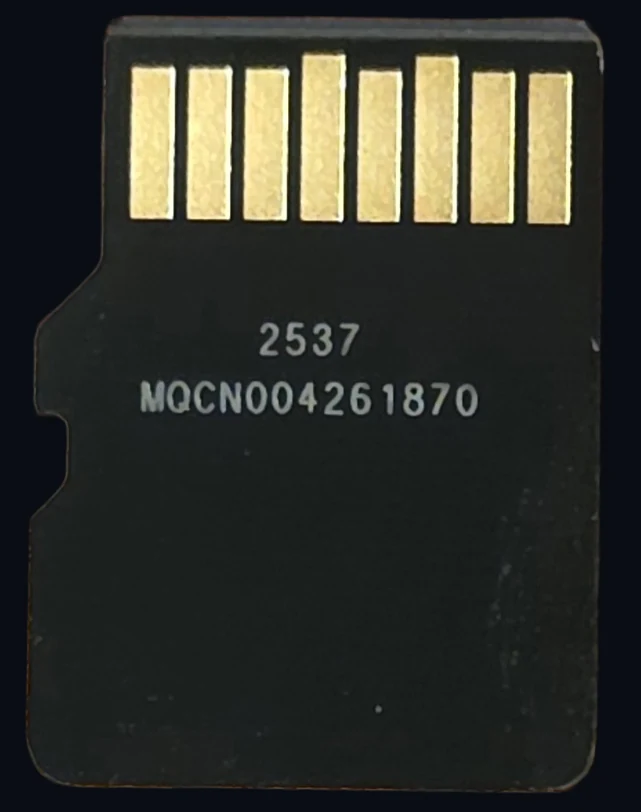
| Card back | A single row of eight contacts; the code 2537 above a per-unit serial |
| Factory format | exFAT, 128 KB clusters, a partition at 16 MiB, no volume label, no user files present |
| Captured on | Raspberry Pi 4 native SD host, no USB bridge in the path · 2026-10-07 |
The MID, OEM ID, product name and revision are model-level, but they are shared with at least one other brand’s card, so a match tells you the controller family, not the card. The serial and the manufacture date are per unit. The code 2537 on the card back reads as a year and week, 2025 week 37, which falls inside the register’s September 2025 build date.
Disclosure: I bought this card at retail from Amazon on 6 October 2026. SUNEAST and Kyokuto Electronics had no involvement in or knowledge of this review, saw no result before publication, and had no opportunity to influence any number on this page. This post contains no affiliate links. The affiliate links on my other reviews and my YouTube channel are what keep the site running.