
Amazon Basics 128GB: good, if you have the right reader
People keep asking me whether the Amazon Basics 128GB microSD, Amazon’s own-brand memory card, is any good. I bought one, found out who actually makes it, and ran it on two card readers. On one it is a solid card. On the other it is the fastest committed write I have measured on any UHS-I card, tied with a Lexar that turns out to be the same silicon. The catch is not the reader you would guess, and the card runs hot doing it.
No video for this bench run
The numbers on this page come from the bench, not a camera. The channel covers the dash cams and readers these cards end up in; subscribe and the next one lands in your feed the day it goes up.
The short version
Yes, it is good, and on the right reader it is remarkable. On a SanDisk QuickFlow it sustained 188.1 MB/s through its worst ten seconds of committed writing, read 206.1 MB/s against a 200 MB/s claim that Amazon says needs Amazon’s own reader, and did both again on a second run within half a percent. On the ProGrade PGM0.5 I use as my primary reader, the same card sits at 155.9 sustained and 168.6 read, which is that reader’s ceiling for this card rather than the card’s. Every one of its 125.6 GB came back byte for byte with zero errors. Its identity register says Longsys made it, the company that owns Lexar, and its configuration matches the Lexar Blue byte for byte. The one mark against it is heat: 171 °F on the card body at the end of the uncooled write, on both readers, which is 2.8 °C under the 80 °C maximum Amazon publishes for it. My rating: 4.5/5, scored against the CKBench rubric.
Verdict: 4.5/5, the fastest write here on the right reader, and it runs hotWho this card is for
- YesAnyone who fills big cards and offloads them a lotOn a reader that can drive it, this card wrote 188 MB/s for five minutes with no cache cliff and read back at 206. A full 125.6 GB card offloads in about twelve minutes on that reader. Nothing else on my bench with a UHS-I bus does that.
- YesAnyone who wants capacity they can trust from a house brandEvery free byte was written with unpredictable data, read back and compared. Zero mismatches, zero read errors. The card declares 98.2% of its label and Amazon’s own published floor of 116 GiB is met with room to spare.
- YesAny dash cam or camera that asks for V30It holds V90 on both readers. Your camera will use a fraction of that, and the card will never be the reason a clip drops.
- NoA hot car, if a cooler card is in front of you171 °F at the end of five uncooled minutes in a 76 °F room, with Amazon rating the card to 80 °C (176 °F). It never slowed down, so this is margin rather than a measured failure, but 2.8 °C of margin is the least of any card I have scored.
- NoAnyone who expects the box number from whatever reader they ownOn a plain UHS-I reader this card reads near 96 MB/s like every other card. On my ProGrade it reads 169 and writes 156. Only the SanDisk QuickFlow, of the readers on my bench, lets it run at its actual speed.
125.6 GB of usable space is roughly 5 hours 49 minutes of single-channel 4K at 6 MB/s, or about 11 hours 38 minutes of 1080p60 at 3 MB/s, before a dash cam loop starts overwriting. Work out your own numbers in the dash cam storage calculator.
Are Amazon Basics memory cards any good?
It is one of the questions I get most, and it is a fair one. Amazon does not make flash memory. It puts its name on a card someone else builds, prints the fewest claims it can get away with on the box, and sells it under its own listing, so there is no manufacturer page to check, no model number to look up and no datasheet. The box prints the class marks, Fast Speed Up to 200MB/s in eleven languages with no direction attached, and nothing else: no write figure, no warranty term, no operating range, no part number. The listing adds a 150 MB/s write, an operating range of minus 10 to 80 °C, and a note that the 200 MB/s read needs Amazon’s own USB-C card reader, sold separately.
So I bought one, on the standard listing, sold as new, and treated it like every other card that crosses this bench. The same order carried a PNY Premier-X 128GB as the entry-price half of a deliberate pair, and its review puts the two side by side. I read its identity register on a Raspberry Pi to find out who made it. I ran the full suite on my primary reader, including a fill of every byte. Then, because the identity register pointed somewhere interesting, I ran it twice more on a second reader. That second reader is where this review turns from “a decent house-brand card” into something I did not expect to write.
Every write figure on this page is a committed write: the data is on the flash before the clock stops, with no operating-system cache in the way. That is why the numbers here read lower than a marketing sheet or a quick benchmark; the methodology page explains the difference and why it is the one that matters for recording.
What the card claims, and what the card did
| Claim | Printed or published | Measured | Verdict |
|---|---|---|---|
| Capacity | 128GB (card face and box) | 125.6 GB written and verified, 98.2% of label, zero errors | VERIFIED |
| Read speed | Up to 200 MB/s (box, direction unstated; listing says read, conditioned on Amazon’s own reader) | 206.1 MB/s (SanDisk QuickFlow SDDR-B751); 168.6 MB/s (ProGrade PGM0.5, that reader’s ceiling) | BEATEN |
| Write speed | 150 MB/s (listing only, not on the box) | 157.3 MB/s committed (ProGrade); 189.4 MB/s (QuickFlow) | BEATEN |
| Speed class | C10 | 155.9 MB/s worst ten seconds (ProGrade); 188.1 (QuickFlow) | HELD |
| UHS speed grade | U3 | 155.9 MB/s worst ten seconds (ProGrade); 188.1 (QuickFlow) | HELD |
| Video speed class | V30 | Holds V90 on both readers, three classes above the mark | HELD |
| App performance class | A2 | 2,222 read / 2,073 write IOPS at QD1 on the ProGrade; A2’s floors need command queuing USB readers do not do | NOT TESTABLE |
| Endurance rating | None printed, none published | n/a | NOT CLAIMED |
| Operating temperature | −10 to 80 °C (listing only) | 77.2 °C peak on the card body under five minutes of uncooled writing, inside the range by 2.8 °C | MET |
| Warranty term | “Can be requested from customer service”, no term stated | n/a | NOT A PERFORMANCE CLAIM |
Two rows need their reasoning attached. A2 is not testable on any USB card reader, mine included: its floors assume a command queuing mode that USB card readers do not perform, so the card is neither credited nor penalised for it. That is a limit of every bench like this one, not a mark against the card. The 200 MB/s read is settled, and it did not need Amazon’s reader. Amazon’s listing says the figure requires its own USB-C reader; a SanDisk QuickFlow, which is about as ordinary as a fast card reader gets, cleared it on two runs. The condition Amazon attached to its own claim turns out to be a description of what DDR200 needs, not of a reader only Amazon sells.
A box with no seal, a case, and a returns sticker
The card comes in a small printed box with a plastic case inside, holding the card and an SD adapter. Nothing is sealed. There is no blister, no tamper strip, nothing that would tell you whether the box had been opened before. The panel that carries the class marks is the only product-specific print on the whole box; the rest is Amazon’s shared regulatory block, the importer addresses for Luxembourg, Sydney, Tokyo and Seattle, recycling marks for four countries, an electrical rating of 400 mA at 1.44 W, and Made in China in Arabic. No model number appears anywhere on it. The PNY Premier-X that arrived in the same order prints one, with a country of origin and a warranty term, on a blister that cost less.
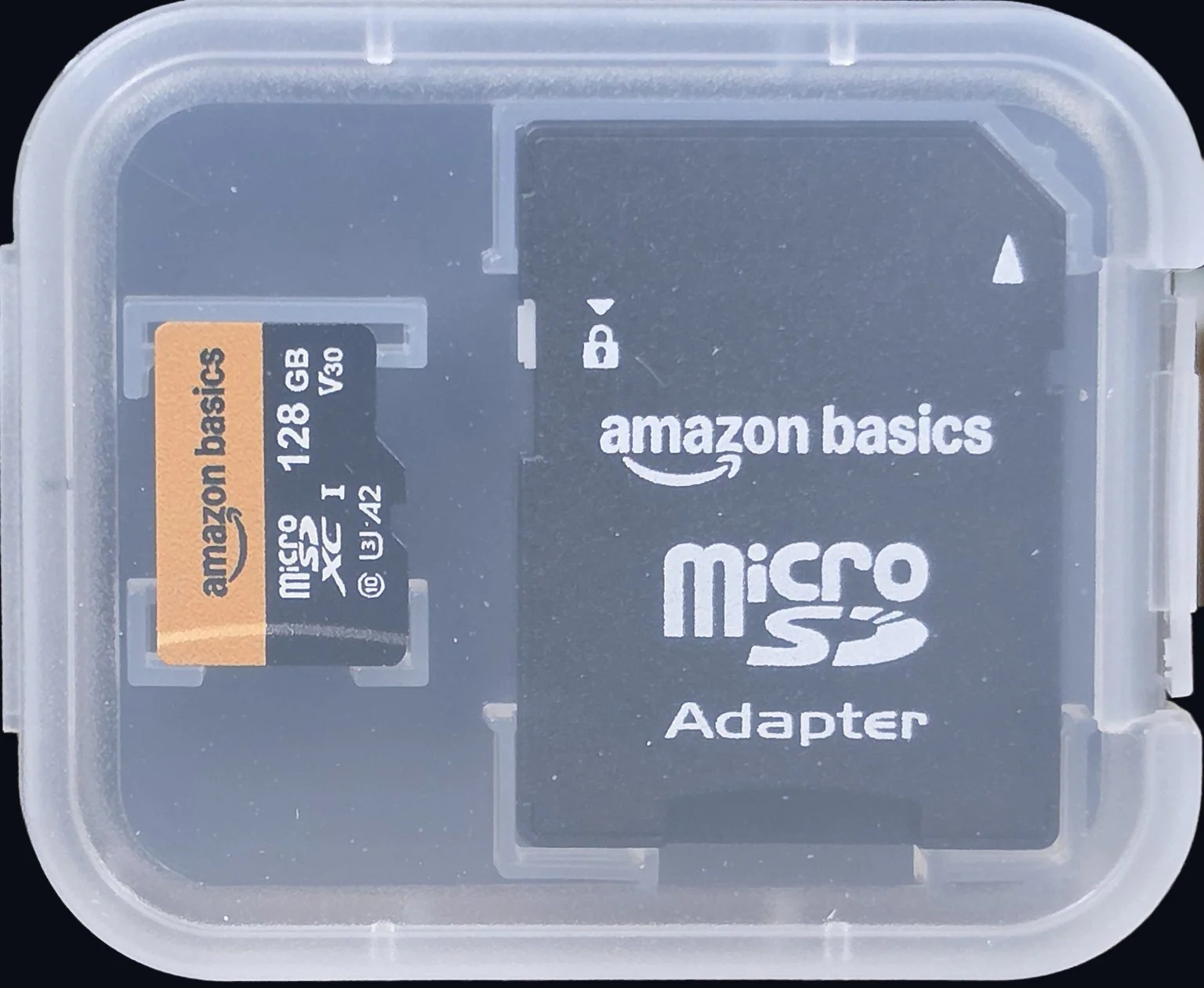
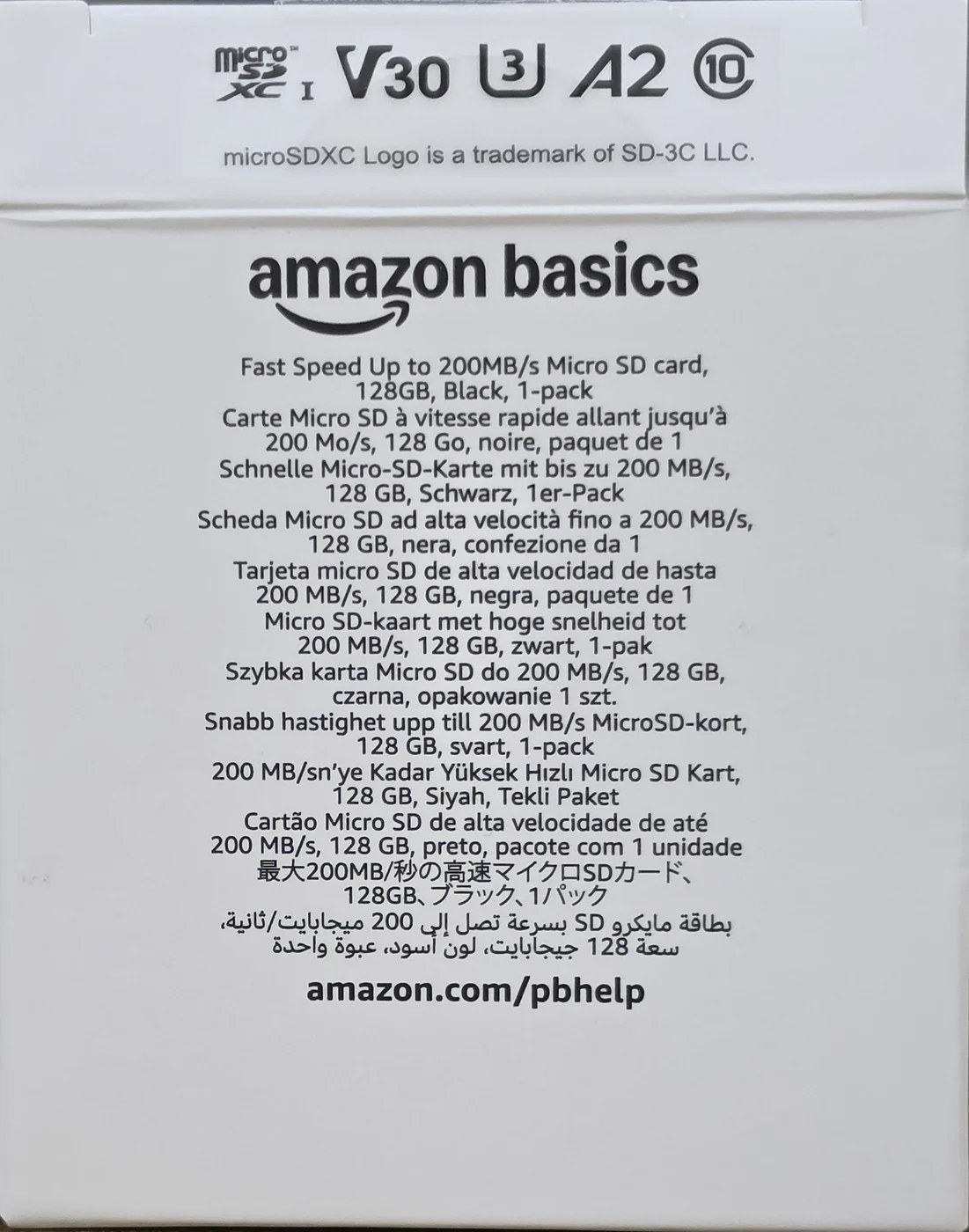
One thing on my box is worth knowing about before you buy one. Stuck over the importer block is a white barcode label printed LPN followed by a code. LPN is Amazon’s License Plate Number, the unit-level barcode its returns centers apply to individual items before grading them back into stock. My unit was sold as New on the standard listing, not from Amazon Warehouse, and it arrived with a label that says it had been through returns processing. Because nothing on the package is sealed, an opened-and-returned card and a fresh one are indistinguishable, and Amazon’s grading passed this one as New. I cannot tell you whether anyone wrote to it before I did. If they did, it left no mark this bench can see: a card’s write history can halve its write floor, and this unit’s whole-card fill ended faster than it started. What I can tell you is that it still carried the factory format, with the same volume serial number every other Longsys-made card on my bench arrived with, and not one user file on it. The numbers on this page are what the card does now; the sample-size line at the bottom of this review says prior use unknown because that is the honest phrase.
Five minutes at 188 MB/s, and a second run to prove it
This is the panel that decides a video class and it is the one that made this review. The trace below is the SanDisk QuickFlow run: five minutes of committed writing, one sample a second, with the speed-class floors marked. There is no cache cliff, no saw-tooth, no decay. Ten consecutive thirty-second blocks land between 188.5 and 189.3 MB/s, the worst single second in the run is 182.5, and the worst ten seconds average 188.1. A second run on the same reader forty minutes later put its worst ten seconds at 188.6 and its steady state at 189.5, within half a percent of the first. The two runs agree on every leg.
Amazon Basics 128GB
For scale: the SanDisk High Endurance 128GB that anchors the top of my control band floors at 88 MB/s, and I call that great. The Samsung P9 Express, an SD Express card running in a PCIe reader, floors at 161. This card, on a USB reader that costs a fraction of that setup, floors at 188. It is tied for the highest committed sustained write I have ever measured, and the card it is tied with is the Lexar Silver Plus at 187.3 on the same reader, which, as the identity section below explains, is not a coincidence.
On my primary reader the same card draws a different line. The ProGrade PGM0.5 held it to a steady 156.6 MB/s and a worst ten seconds of 155.9, flat as a table, with 44 GB written and not a wobble in it. That is still a superb result. It is also that reader’s limit for this card and not the card’s, which took me a second reader to learn and is the subject of its own section further down. The card prints V30. It holds V90 on both.
What scattered writes do to it
Loop recording is not one long write. It is a long write interrupted constantly by small ones: event clips, directory updates, overwrites of the oldest file. Random 4K writes are the bench version of that abuse, three twenty-second passes of it, and the question is whether the third pass is as fast as the first. On the ProGrade, the scored run, the answer is yes to two decimal places: 2,068, 2,074 and 2,076 write IOPS, which is no fade at all, and the card came out of the churn leg at its full media rate within the first minute.
One minute of loop-recording abuse
This card: run Amazon-Basics-128GB_2026-09-17_093850 · reference card: lab baseline, same bench, same test · cardcheck v0.8.3
The second reader tells a fuller story, and I am reporting it rather than scoring it. On the SanDisk QuickFlow the card started the churn leg 38% faster than the ProGrade ever let it run, at 2,856 write IOPS, and then faded across the three passes to 2,398, a 16% drop, on both QuickFlow runs. On the ProGrade the same three passes sat at 8.47, 8.50 and 8.50 MB/s, a line so flat on the noisiest test on this bench that it reads as the reader’s limit rather than the card’s, and that reader’s best pass is slower than the QuickFlow’s faded third. The rubric scores this dimension on the primary reader, which is the rule as written, and the row is a 5. If you are the sort of person who reads the numbers rather than the row, the honest summary is that the card does fade a little under churn when a reader lets it run flat out, it fades to a level the ProGrade never reached at all, and it is back at full sustained rate within a minute either way.
Every byte of a house-brand card, written and read back
This is the test I would run on any card with a store’s name on it before I trusted it with anything. The bench wrote 118 files of unpredictable, dedup-proof data until the card was full, 125,637,623,808 bytes, then read every one of them back and compared. Zero mismatched bytes. Zero read errors. The write speed across the first, middle and last tenth of the card spread by 0.7%, so there is no slow region and no cache running out partway through, and the whole-card fill held 155.9 MB/s on the ProGrade from the first file to the last.
Every byte, written and read back
125.6 GB is 98.2% of the 128 GB on the label, which is ordinary provisioning overhead and sits inside the 96.7% to 100.1% range every genuine card on this bench occupies. It lands squarely in the band the other Longsys-made cards declare, 98.2 to 99.1%, where SanDisk declares 99.9 to 100.1 and Kioxia 96.7. Amazon is one of only two vendors on my bench to publish a usable figure: the listing says higher than 116GB, in a sentence about measurement standards, which I read as 116 GiB, or 124.55 GB. The card clears it by about a gigabyte. Windows will show you roughly 117 GB, because it counts in binary.
171 °F, on a card rated to 176
Amazon publishes an operating range for this card, minus 10 to 80 °C, which is more than most vendors do and it is the reason this section carries the review’s only low score. At the end of five minutes of uncooled writing the thermal imager read 171 °F, or 77.2 °C, on the card body at the reader’s slot mouth. Both readers returned it: 171 on the ProGrade, 171 and 170 on the two QuickFlow runs. That is 2.8 °C under the maximum Amazon rates the card for, the smallest margin of any card I have scored.
It got hot. It did not slow down.
The ProGrade returned 171 °F independently · Run Amazon-Basics-128GB_2026-09-17_103034 · cardcheck v0.8.3 · SanDisk SDDR-B751
It did not throttle. The QuickFlow trace ends where it started, at 189 MB/s, and the ProGrade trace is flat at 156.6 for its full five minutes, so on the test that matters most, heat cost this card nothing. What it cost is margin. The thermal row of the rubric scores headroom under the rated maximum, and a card that peaks 2.8 °C under its own limit in a 76 °F room lands in the lowest band a card can occupy without exceeding its rating. Two things are worth holding alongside that. The reading is a floor, not a ceiling: the imager sees the part of the card outside the slot, and the controller is inside it. And the number is a product of the work: this card was writing at 189 MB/s when it hit 171 °F, which is more than double what most cards on this bench were doing when they peaked. The Lexar Blue, the same silicon at a slower bus mode, peaked at 162 °F writing 155.
In a dash cam, where the card will be writing single-digit megabytes a second in a housing on a summer windshield, the temperature it reaches will have little to do with this test and a lot to do with the car. What this test says is that the card has less room than any other I have measured before it is outside the range its maker publishes for it. I would not put it in the hottest slot I own.
Why the cheaper reader is the right one
Every number in this review comes in two versions, and the gap between them is the most useful thing on this page. Here is the same card, the same day, on two readers.
| Measurement | ProGrade PGM0.5 (primary) | SanDisk QuickFlow SDDR-B751 | Difference |
|---|---|---|---|
| Sequential read | 168.6 MB/s | 206.1 MB/s | +22% |
| Sequential write, committed | 157.3 MB/s | 189.4 MB/s | +20% |
| Sustained write, steady state | 156.6 MB/s | 188.9 MB/s | +21% |
| Sustained write, worst ten seconds | 155.9 MB/s | 188.1 MB/s | +21% |
| Random 4K write, three passes | 8.47 / 8.50 / 8.50 MB/s | 11.70 / 10.47 / 9.82 MB/s | flat vs 16% fade |
| Video class held | V90 | V90 | same |
| Peak temperature | 171 °F | 171 °F | same |
| Blocks over 500 ms | 0 | 0 | same |
The ProGrade PGM0.5 is the better reader. It has a true UHS-II full-size slot, it is the primary host for every card on this bench, and I have written about what it does for cards that speak UHS-II. But this is a UHS-I card, and UHS-I cards above about 104 MB/s are running a non-standard mode called DDR200 that the card and the reader negotiate between themselves. My ProGrade’s microSD slot runs DDR200 at a clock that tops out near 170 MB/s read for every Lexar and Samsung I have put in it, and, as this card is the first to show, near 157 write. The SanDisk QuickFlow, a small USB-C reader built for SanDisk’s own DDR200 cards, drives the same mode faster: 206 read and 189 write here. Nothing on the bench had ever written faster than 157 on the ProGrade, three cards sat within 3% of that line, and I had taken it for a card limit. It is the reader’s.
Two consequences follow. If you own a fast card and a plain UHS-I reader, you will see about 96 MB/s from either this card or a cheap one, and the reader guide is where to start. And if you already own a good reader, which one it is now matters in a way it did not for the slower cards: the Lexar Silver Plus I reviewed on the ProGrade in August was re-run on the QuickFlow the same evening as this card and went from 153 to 187 sustained, settling a 205 MB/s read claim I had called untestable. Its review carries a dated update. The Lexar Blue, on the same evening, did not move at all, and that is the identity story.
Who actually makes the Amazon Basics card
Every SD card carries a 128-bit identity register, written at the factory, that a USB reader cannot show you but a native SD host can. I read this card’s on a Raspberry Pi. The manufacturer ID is 0xAD and the OEM field reads LS: Longsys, the Shenzhen flash maker that has owned the Lexar brand since 2017. The product name field reads USD00, and that is the same part name I have read off the Vantrue Endurance PRO and the VIOFO High Endurance 32GB. Longsys sells a white-label microSD line, and Amazon, Vantrue and VIOFO all buy from it. The 200 MB/s on Amazon’s box is a different firmware revision of the same catalogue entry: this card reports revision 2.1 where the Vantrue and VIOFO report 1.0, and 1.0 is a standard UHS-I card that reads 96.
The more surprising match is the Lexar Blue. Its capability registers, the three that describe capacity, bus support and declared classes, are byte-for-byte identical to this card’s, the only complete match in the thirty-six cards I have dumped. On the ProGrade the two cards even benchmark alike, 155.1 and 155.9 sustained. I wrote “same card, different sticker” in my notes, and the QuickFlow proved me wrong: the Blue reads 168 on that reader too, while this card reads 206. Same platform, one firmware revision apart (the Blue reports 2.0), and the revision is the difference between the slow DDR200 mode and the fast one. The Lexar Silver Plus, which reports revision 2.1 like this card, runs the fast mode and lands within half a percent of it. Here is the whole family as it stands on my bench.
| Card | Longsys part | Revision | Read, QuickFlow | Worst 10 s, QuickFlow | Read claim |
|---|---|---|---|---|---|
| Vantrue Endurance PRO 128GB | USD00 | 1.0 | 96.5 MB/s | 83.4 MB/s | none printed |
| VIOFO High Endurance 32GB | USD00 | 1.0 | 96.7 MB/s | 34.2 MB/s | 100 MB/s |
| Lexar Blue 128GB | MSSD0 | 2.0 | 168.7 MB/s | 155.0 MB/s | 160 MB/s |
| Lexar Silver Plus 128GB | LX128 | 2.1 | 206.1 MB/s | 187.3 MB/s | 205 MB/s |
| Amazon Basics 128GB | USD00 | 2.1 | 206.1 MB/s | 188.1 MB/s | 200 MB/s |
Two things I am careful not to say. The revision field tracks the bus mode on all five cards, but five cards is a pattern to test on the next Longsys card that crosses this bench, not a rule. And the Lexar Blue’s manufacturer ID is 0xC9 rather than Longsys’s 0xAD, so the identity registers put it in a different column even as everything else says the same platform; my manufacturer ID register carries both entries. What the evidence does support is the practical version: Amazon did not design a memory card. It bought a good one, from the company that makes Lexar’s, and put its name on the box.
How the 4.5 breaks down
Amazon Basics microSDXC 128GB
Scored against the CKBench rubric. Five dimensions, each out of 5, every row read off its published table.
Final score: 4.5 out of 5. The five dimensions average 4.3. A card that beats every claim on its box and its listing, verifies every byte, and gives back a full point and a half for running within three degrees of the limit its maker sets.
One line in that block deserves a plain-language footnote. The rubric reads the sustained and endurance rows off the primary reader, and it reads the read claim off whichever reader on the bench can actually reach it, because a claim above a reader’s ceiling is not evidence against the card. That combination is written into the protocol, and this card is the one that forced the write-side half of it to be written: until this week, the rule only knew that read could be reader-limited.
Frequently Asked Questions
Are Amazon Basics microSD cards any good?
The 128GB one is. It sustained 188.1 MB/s through its worst ten seconds of committed writing on a SanDisk QuickFlow reader and 155.9 on a ProGrade PGM0.5, holds V90 against a printed V30 on both, has no cache cliff anywhere across its full capacity, and delivered every one of its 125.6 GB with zero errors. It scores 4.5 out of 5, and the half point it loses is for heat: it peaks 2.8 °C under the 80 °C maximum Amazon rates it for.
Who makes the Amazon Basics memory card?
Longsys, the Shenzhen flash manufacturer that owns the Lexar brand. The card’s identity register reports manufacturer ID 0xAD with the OEM field LS and the product name USD00, which is the same white-label part name the Vantrue Endurance PRO and VIOFO High Endurance 32GB report, at a newer firmware revision. Its capability registers match the Lexar Blue 128GB byte for byte, and its speed on a fast reader matches the Lexar Silver Plus within half a percent.
Do I need Amazon’s own card reader to get 200 MB/s?
No. Amazon’s listing says the 200 MB/s read requires its own USB-C reader, but the card read 206.1 MB/s on a SanDisk QuickFlow on two separate runs. What you do need is a reader that drives DDR200, the non-standard UHS-I mode fast cards use, at a high enough clock. On my ProGrade PGM0.5, which also supports DDR200, the same card read 168.6, and on a plain UHS-I reader it will read about 96 like any other card.
Is the Amazon Basics 128GB actually 128GB?
Yes. I filled every free byte with unpredictable data and read all of it back: 125,637,623,808 bytes written and verified, zero mismatched bytes and zero read errors. That is 98.2% of the 128 GB label, ordinary provisioning overhead inside the range genuine cards occupy, and it clears the 116 GiB floor Amazon publishes on the listing by about a gigabyte. Windows will show it as roughly 117 GB because it counts in binary.
Does the Amazon Basics 128GB get too hot?
It gets closer to its rating than any card I have measured. I read 171 °F (77.2 °C) on the card body at the end of five minutes of uncooled writing, on both readers, against the 80 °C maximum Amazon publishes. The write speed never dropped, so this is about margin rather than performance, and it reached that temperature writing 189 MB/s, which is more work than most cards do. In a dash cam it will write far slower and the car will set the temperature; I would still keep it out of the hottest slot you own.
Is the Amazon Basics card the same as the Lexar Blue?
Same platform, not the same card. The two share identical capacity, bus and class registers and the same factory format, and on a ProGrade reader they benchmark within half a percent of each other. On a SanDisk QuickFlow the Lexar Blue stays at 168 MB/s read and 155 sustained while the Amazon Basics goes to 206 and 188. The Amazon card reports firmware revision 2.1 and the Blue reports 2.0, and that revision is the difference between the slow DDR200 mode and the fast one.
Why does the box say 200MB/s but not which direction?
Because Amazon prints as little as it can on the box. The panel says Fast Speed Up to 200MB/s in eleven languages with no read or write attached; the listing is where 200 becomes read and 150 becomes write. Both figures were beaten on my bench: 206.1 read and 189.4 committed write on the SanDisk QuickFlow, 168.6 and 157.3 on the ProGrade. The card’s own class marks, V30, U3, A2 and C10, are on both the box and the card face.
The bottom line
Amazon Basics cards are good, this one at least, and on the right reader it is as fast a UHS-I card as I have measured, tied with a Lexar that costs more and is the same silicon. It beats the read claim on the box without the reader Amazon says you need, beats the write claim on the listing on both readers, holds V90 on a card printed V30, and gave back every byte. If you want a 128 GB card you can trust from a store brand, this is one.
Two things should shape whether you buy it. The first is the reader you own, because the speed you get from this card depends on it more than on anything Amazon controls: a plain reader gets a plain 96, my ProGrade gets 156, and a SanDisk QuickFlow gets 188. The second is heat. It never slowed down, but it ran within three degrees of the limit its own maker publishes, and that is the thinnest margin on my bench. Neither is a reason to avoid it. Both are reasons to know what you are buying, which, with a card that prints nothing on its box, is the whole point of a review like this.
Sample size: one unit, sold as New by Amazon on 15 September 2026, carrying an Amazon returns-processing label; prior use unknown. Three runs on two readers on 17 September 2026 under CKBench protocol v1.21.
Device identity: what this card reports about itselfFor anyone tracking silent hardware revisions
| Raw CID register | ad4c53555344303021…a19200 (serial digits elided) |
| Manufacturer ID (MID) | 0xAD (Longsys; also reported by the Lexar Silver Plus, Lexar Professional 1667x, Vantrue Endurance PRO and VIOFO 32GB on this bench) |
| OEM / application ID (OID) | 0x4C53, “LS” |
| Product name (PNM) | USD00 |
| Product revision (PRV) | 2.1 |
| Serial number (PSN) | 0x5401… (per unit, truncated) |
| Manufacture date (MDT) | 02/2025 |
| Declared capacity (from CSD) | 245,452,800 sectors of 512 bytes = 125,671,833,600 bytes, 98.18% of the label; byte-identical CSD, SCR and SD Status to the Lexar Blue 128GB |
| SD specification (from SCR) | SD_SPEC 2 with SD_SPEC3 = 1 and SD_SPECX = 2 (specification 6.x), so the UHS-I, U3 and V30 marks are legitimately declared |
| Factory format | exFAT, volume serial 4A21-0000, the serial every Longsys-made card on this bench arrived with; no user files present |
| Captured on | Raspberry Pi 4 native SD host, no USB bridge in the path · 2026-09-17 |
The MID, OEM ID, product name and revision are model-level: another Amazon Basics 128GB of this listing should report the same four, and a different revision would be the first sign that Amazon’s supplier has changed the card under the same box. The serial and the manufacture date are per unit. This one was made in February 2025 and sold to me in September 2026. Amazon also sells an older 128GB card under near-identical naming rated at 100 MB/s; the 200 on this box is what tells the two apart.
Disclosure: I bought this card at retail from Amazon on 15 September 2026. Amazon had no involvement in or knowledge of this review, saw no result before publication, and had no opportunity to influence any number on this page. This post contains affiliate links. As an Amazon Associate I earn from qualifying purchases, at no extra cost to you. Affiliate links like these and my YouTube channel are what keep the site running.