
Two V60 cards that both hold V90
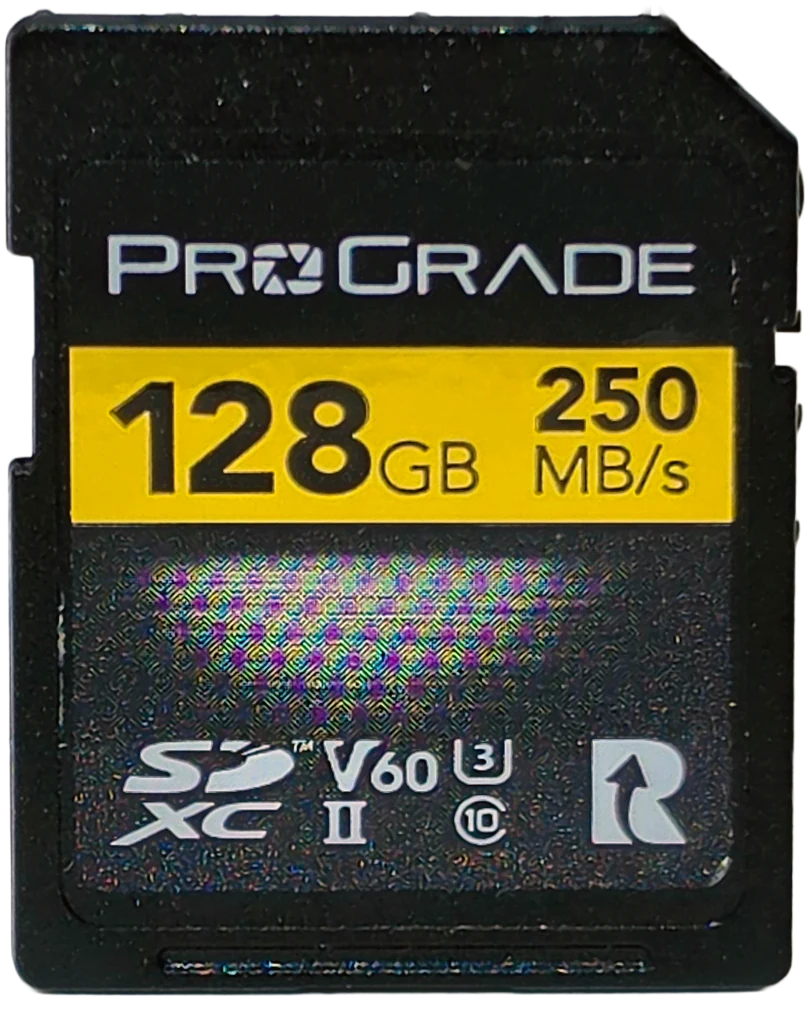
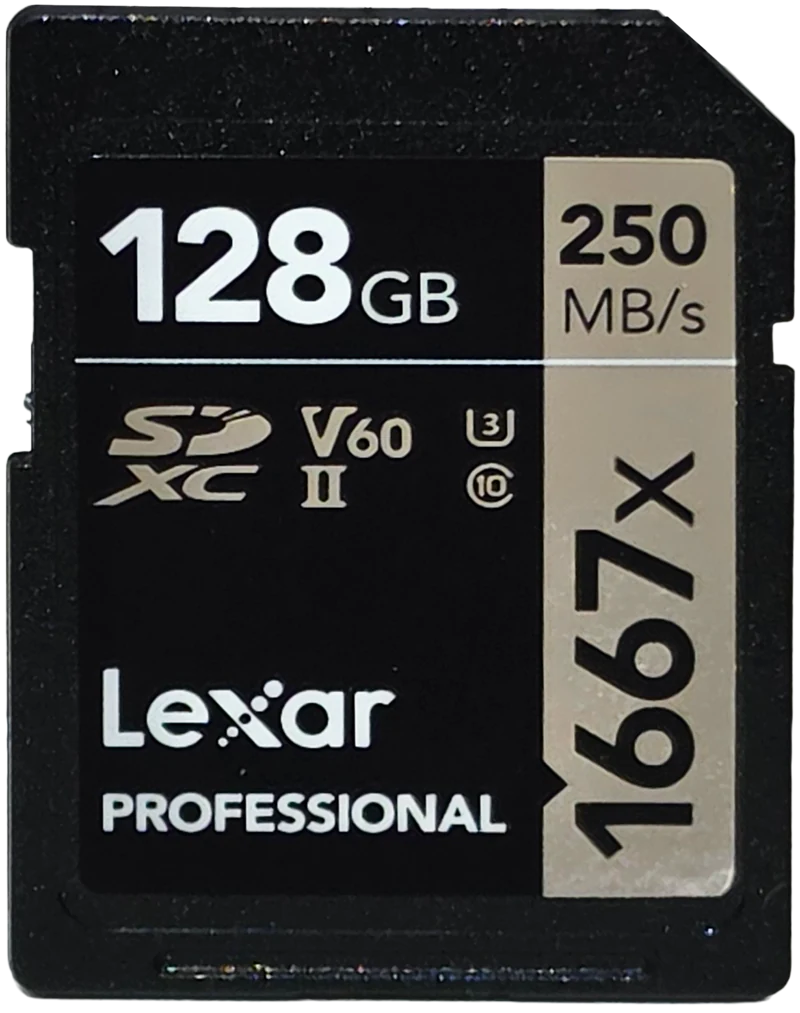
The ProGrade SDXC UHS-II V60 and the Lexar Professional 1667x, same reader, same afternoon, every byte committed and verified. Both sustain a full video class above the one printed on them. Only one of them hits its own write claim.
Prefer to watch a review?
No video for this lab run yet, but I cover dashcams, storage, and the gear around them on the channel. Subscribe to catch the next test the moment it goes live.
The short version
Both of these cards are badged V60 and both sustained V90 on the bench, which is a full video class above what is printed on them. Neither has a cache cliff anywhere in a complete 128 GB fill, neither stalled once, and both delivered every byte of their stated capacity. The difference is honesty about write speed: the Lexar claims 120 MB/s and effectively delivers it, while the ProGrade claims 130 MB/s and tops out around 108. My rating: 4/5 for the ProGrade and 4.5/5 for the Lexar, scored against the CKBench rubric.
Verdict: ProGrade 4/5, Lexar 4.5/5, both quietly better than their badgeWho these cards are for
- YesCameras with a UHS-II slot, shooting high-bitrate videoBoth cards sustain over 100 MB/s indefinitely, which clears the V90 floor with room to spare. That is the ceiling of what full-size SD does before you get into CFexpress.
- NoAny camera or reader that is UHS-I onlyOn a UHS-I host the ProGrade drops to 95.0 MB/s read and 88.5 write, which is what a good UHS-I card does for a fraction of the money. The second row of pins is the entire product, and a UHS-I slot cannot see it.
At 128 GB, these hold roughly 3,000 RAW frames from a 42 MB camera, or about 2 hours 40 minutes of 100 Mbps video. Work out your own numbers in the dash cam storage calculator.
Why test two cards that look identical on paper
These two arrived as a deliberate pair. Same form factor, same UHS-II interface, same 128 GB capacity, same printed V60, and the same 250 MB/s read claim on the face. If two cards agree on every number a shopper can read, the only thing left to separate them is a bench. They ran on the same reader, on the same afternoon, under the same protocol. They join CKBench, the running index of every card on the bench, alongside the SanDisk High Endurance 128GB and the Kioxia Exceria G2 128GB.
Why my write numbers read lower than other reviews. Every write here is committed to the card and confirmed before the clock stops, the way a dash cam actually writes, so my figures land below burst benchmarks like CrystalDiskMark that measure a few seconds of the card's RAM buffer. That rule, and the decimal MB/s and binary MiB conventions used throughout, are set out on the how we test and score page.
What the cards claim, and what they did
Read figures come from the ProGrade PGM0.5, a dual-slot UHS-II reader. Every read number on this site names the reader that produced it, because the reader changes the answer.
ProGrade SDXC UHS-II V60 128GB
| Claim | Printed | Measured | Verdict |
|---|---|---|---|
| Capacity | 128 GB | 128.08 GB written and verified, 100.06% | VERIFIED |
| Read speed | 250 MB/s | 296.9 MB/s (ProGrade PGM0.5) | MET |
| Write speed | 130 MB/s, from the spec sheet, not the card | 108.4 MB/s sequential, 104.0 sustained | MISSED |
| Speed class | C10 | 102.8 MB/s worst ten seconds | HELD |
| UHS speed grade | U3 | 102.8 MB/s worst ten seconds | HELD |
| Video speed class | V60 | 102.8 MB/s worst ten seconds, which also clears V90 | HELD |
| App performance class | none printed | 2,087 read and 1,102 write IOPS | NOT TESTABLE |
| Endurance rating | none printed | n/a | NOT CLAIMED |
| Operating temperature | -12 to 72 C, from the spec sheet | n/a | NOT CLAIMED |
| Warranty term | 3 year | n/a | NOT A PERFORMANCE CLAIM |
Lexar Professional 1667x 128GB
| Claim | Printed | Measured | Verdict |
|---|---|---|---|
| Capacity | 128 GB | 128.01 GB written and verified, 100.01% | VERIFIED |
| Read speed | 250 MB/s, which is what 1667x means | 267.1 MB/s (ProGrade PGM0.5) | MET |
| Write speed | 120 MB/s, from the spec sheet, not the card | 119.3 MB/s average, best pass 120.9 | MET |
| Speed class | C10 | 109.5 MB/s worst ten seconds | HELD |
| UHS speed grade | U3 | 109.5 MB/s worst ten seconds | HELD |
| Video speed class | V60 | 109.5 MB/s worst ten seconds, which also clears V90 | HELD |
| App performance class | none printed | 2,042 read and 1,224 write IOPS | NOT TESTABLE |
| Endurance rating | none printed | n/a | NOT CLAIMED |
| Operating temperature | 0 to 70 C, from the spec sheet | n/a | NOT CLAIMED |
| Warranty term | limited lifetime | n/a | NOT A PERFORMANCE CLAIM |
The spec sheet vs the bench: ProGrade V60
The spec sheet vs the bench: Lexar 1667x
Both cards are badged one class below what they deliver
The video speed class on a card is a floor, not an average. A V60 card promises that its worst ten seconds under sustained writing will never drop below 60 MB/s. That is the number that matters when a camera is recording, because a single dip below the floor is a dropped frame or a stopped clip.
The ProGrade's worst ten seconds landed at 102.8 MB/s. The Lexar's landed at 109.5. Both are comfortably past the 90 MB/s V90 floor, so both cards would qualify for a badge one full step above the one they carry. The ProGrade clears V90 by 14 percent and the Lexar by 22 percent.
That is not a mistake by either manufacturer. Certifying to a higher class means guaranteeing it across every unit, every temperature, and the whole warranty period, and a card that scrapes V90 on a good day is safer sold as a V60. What it does mean for a buyer is that the badge is a promise rather than a description, and the real number can sit well above it.
The card that claims less is the one that delivers it
Neither card prints a write speed on its face. Both numbers come from the manufacturer's own product page, and that is where the two part company.
Lexar claims 120 MB/s. Across three passes the card averaged 119.3, with the best pass at 120.9. That is a card doing exactly what it said it would do, and the small shortfall on the average is inside the noise of the measurement.
ProGrade claims 130 MB/s. The card averaged 108.4 across the same three passes, and held 104.0 once the write was sustained. That is 17 percent under the claim, and it is not a bus limitation: 108 MB/s is nowhere near the ceiling the same card's 296.9 MB/s read is pressed against. The card simply does not write as fast as the spec sheet says.
It is worth being precise about what that does and does not mean. The ProGrade is still a fast card that holds a class above its badge. But of the two, the one that made the more modest claim is the one that kept it.
What happens if you put a UHS-II card in a UHS-I slot
UHS-II cards carry a second row of contacts behind the first. That second row is the entire reason the card costs what it does, and a UHS-I host cannot use it. The card still works, because UHS-II is backward compatible, but it falls back to the older bus.
I measured that directly. The same ProGrade card, minutes apart, on a UHS-I only reader: 95.0 MB/s read and 88.5 MB/s write, against 296.9 and 108.4 on the UHS-II reader. Reading, that is a factor of 3.1 from the host alone, with the card unchanged.
The practical version: if your camera body is UHS-I, a UHS-II card buys you nothing at all. It will perform like a good UHS-I card, because for the duration it is one. Check the slot before you buy the card. I went into what the reader alone is worth in the ProGrade PGM0.5 reader review.
Neither card has a cache cliff, and neither one stalled
Plenty of cards start fast and collapse once a small fast buffer fills. That collapse is the single most common way a card that benchmarks well fails in a camera, and it only shows up if you keep writing.
I wrote to both cards until they were full. The ProGrade began its sustained run at 104.5 MB/s and finished the entire 128 GB at 104.2. The Lexar began at 112.2 and ended at 111.1. Neither curve has a knee in it anywhere. Speed measured at the first, middle and last tenth of the card varied by 0.28 percent on the ProGrade and 0.83 percent on the Lexar, which is to say not at all.
Neither card produced a single write block longer than 500 milliseconds. Across nearly 30,000 blocks on the ProGrade the longest pause was 52 milliseconds, and across nearly 32,000 on the Lexar it was 56. For recording, that steadiness matters more than any peak figure.
Five minutes at full throttle, both cards at once
How hot do they get, and why I had to reshoot it
Both cards run hot under a sustained write. Pulled from the reader the moment the write stopped, with the room at 76 F, the ProGrade measured 145.1 F and the Lexar 142.7 F on the card body.
Getting those numbers honestly took two attempts, and the first one was wrong in a way worth explaining. A full-size SD card disappears almost entirely into this reader. Shooting it in place, the only hot spot the thermal camera can see is through the slot opening, and those readings came in at 134.8 F and 132.3 F. That looked like a reasonable card temperature. It was not. It was the hottest thing visible through a gap, and the actual card was 10 to 14 F hotter than the gap suggested.
The fix is unglamorous: end the write, eject the card, and photograph the card itself. The lesson generalizes, and it is the same one a USB drive taught this bench earlier. A thermal camera reports the hottest point it can see, which is not the same as the hottest point there is.
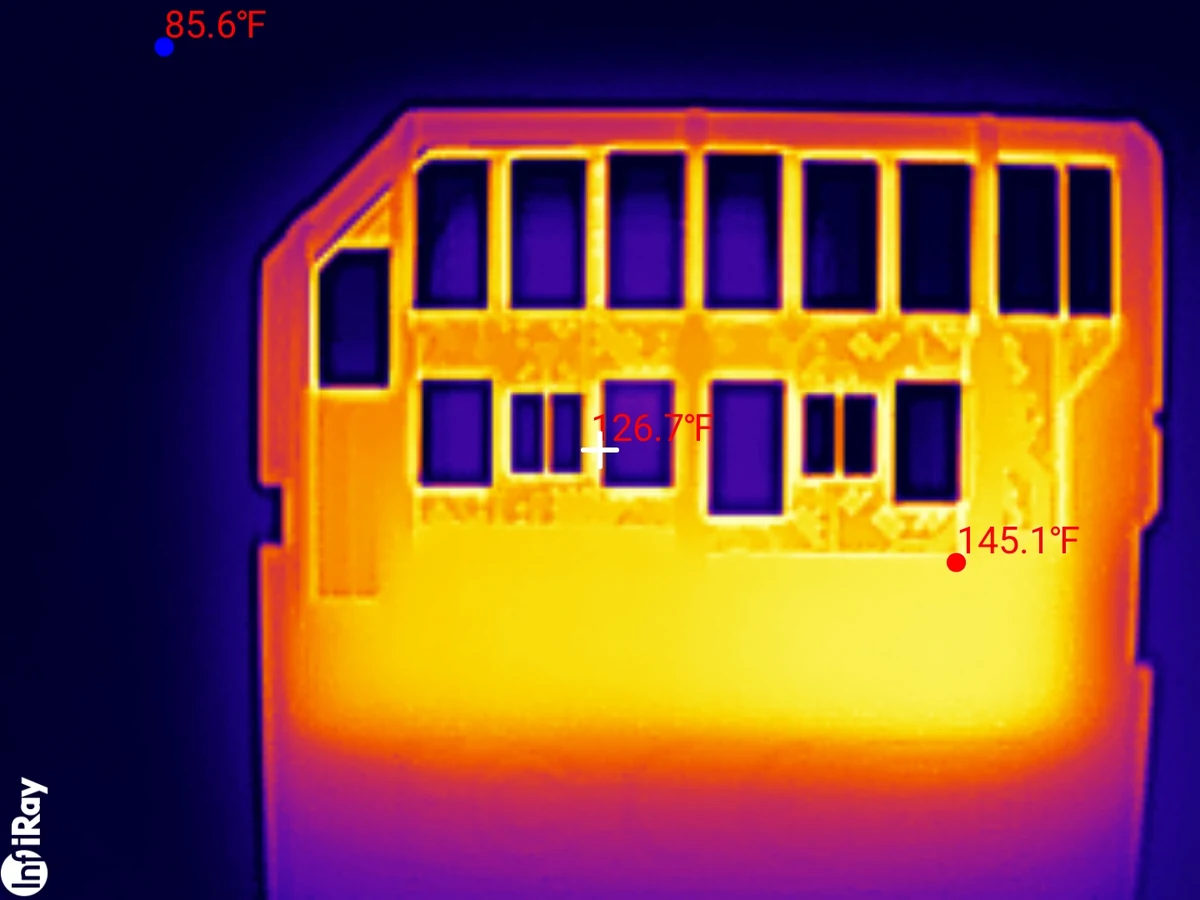
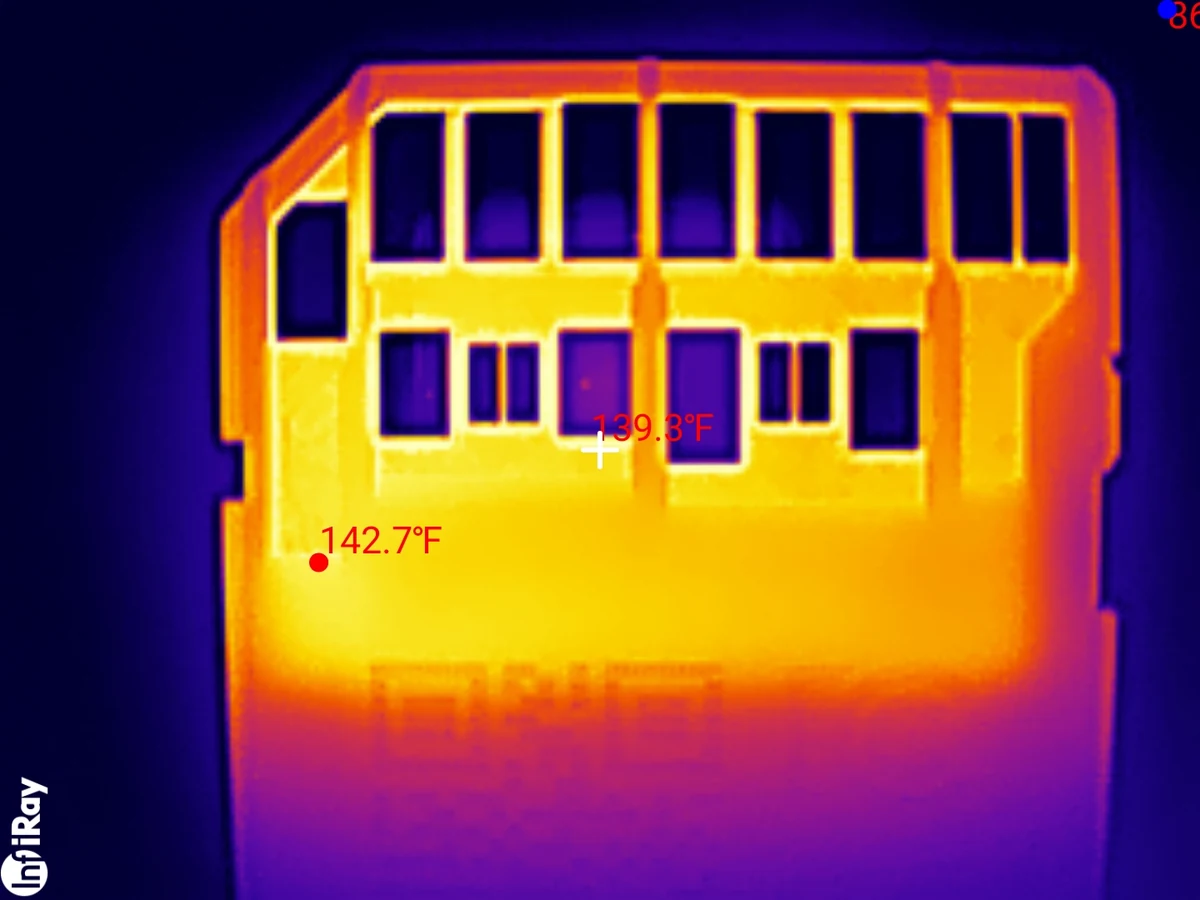
Neither card lost any speed as it heated, which is the part that actually matters. Hot is only a problem if it costs you throughput, and across every run here it did not.
Peak temperature, every card on the bench
Are they really 128 GB? Every byte, verified
The capacity test fills the card with verifiable data, reads every byte back, and compares. It is slow and it is the only test that catches a fake.
Both cards passed with nothing to argue about. The ProGrade delivered 128.08 GB and the Lexar 128.01 GB, against a 128 GB label, with zero mismatched bytes and zero read errors on either. Both are marginally over their stated size rather than under.
Lexar is unusual in publishing its own definition, stating that 1 GB means 1 billion bytes and warning that usable storage may be less than stated. Measured, there is no shortfall at all. If your computer shows about 119 GB, that is the same 128 billion bytes counted in binary units, not a card that came up short.
How much of the label you actually get
Neither card is made by the company on the label
Every SD card carries a small identity register that names who actually built it. Reading both cards on a Raspberry Pi, with no USB bridge in the path, gives an answer that is normal for this industry and still a little surprising.
The ProGrade reports manufacturer ID 0x27, which is Phison, a contract manufacturer that builds for many brands. The Lexar reports 0xAD with an OEM code of LS, the Longsys signature, which is consistent with Lexar having passed from Micron to Longsys ownership. Neither is a red flag. Almost nobody who sells memory cards operates their own fab, and a brand is a specification and a warranty rather than a factory.
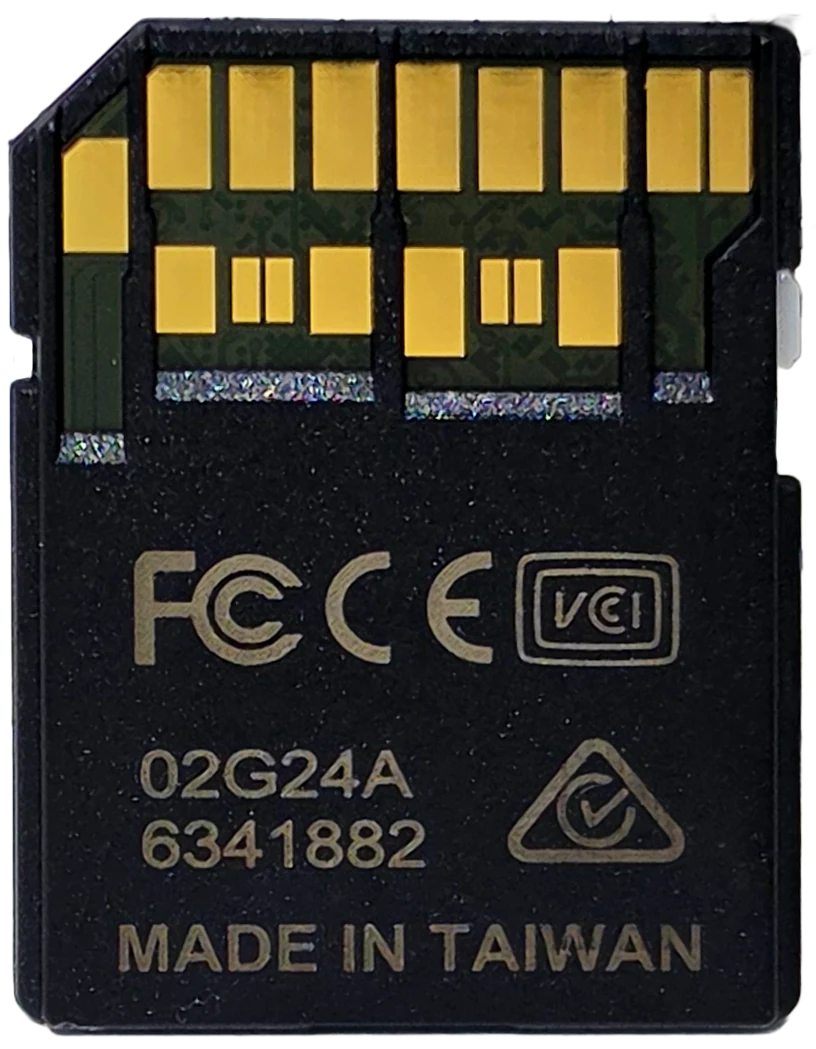
It is worth knowing because a mismatch between the brand and the manufacturer ID is also the signature of a counterfeit. The difference is coherence: these two report exactly what their real manufacturers should report, with manufacture dates that line up with the codes printed on the cards. A fake tries to report the brand it is pretending to be. I took one apart in this teardown of a counterfeit SanDisk.
Two scores, one recommendation
ProGrade SDXC UHS-II V60 128GB
Scored against the CKBench rubric. Five dimensions, each out of 5.
Final score: 4 out of 5. An excellent card held back by a write claim its own maker did not need to make.
Lexar Professional 1667x 128GB
Scored against the CKBench rubric. Five dimensions, each out of 5.
Final score: 4.5 out of 5. Faster where it counts, honest about what it promised, and it carries a lifetime warranty.
Frequently Asked Questions
Is a V60 card fast enough for 4K video?
Yes, comfortably. V60 guarantees 60 MB/s sustained, which is 480 Mbps, and consumer 4K tops out well below that. Both of these cards actually sustain over 100 MB/s, so they clear even high-bitrate 4K and 4K120 with room left over.
Will a UHS-II card work in a UHS-I camera?
Yes, it works, but it runs at UHS-I speed. I measured the ProGrade at 296.9 MB/s read on a UHS-II reader and 95.0 MB/s on a UHS-I one. The card is unchanged, so the second row of contacts that UHS-II adds is simply unused, and you paid for it.
Which is better, the ProGrade V60 or the Lexar Professional 1667x?
The Lexar, narrowly. It writes faster in sustained use, 109.5 MB/s against 102.8 at the worst ten seconds, it meets its own write claim where the ProGrade misses its by 17 percent, and it carries a limited lifetime warranty against ProGrade's three years. The ProGrade is the steadier card on random writes.
What does 1667x mean on a Lexar card?
It is an old way of writing read speed. One x is 150 KB/s, so 1667x is about 250 MB/s. It is the same claim as the 250 MB/s figure, not a second, separate specification.
Why does my 128 GB card show as 119 GB?
Because the card is counted in decimal and your computer displays binary. 128 billion bytes is about 119 binary GB. Both of these cards delivered slightly more than their stated 128 billion bytes, so nothing is missing.
The bottom line on both cards
These are two good cards, and the bench separates them by less than their marketing does. Both sustain a video class above the one printed on them, both verified every byte of their capacity, neither has a cache cliff and neither stalled once. If you have a UHS-II camera and you want a card that will not surprise you in the middle of a take, either one does the job.
The Lexar edges it, on two grounds that have nothing to do with peak speed. It writes meaningfully faster in sustained use, and it kept the promise it made, where the ProGrade fell 17 percent short of a 130 MB/s write figure it chose to publish. The lifetime warranty does not hurt either. The ProGrade answers with the steadier random-write behavior of the two, by a factor of ten.
The bigger caution applies to both: check that your camera actually has a UHS-II slot before buying either one. Without it, both of these cards perform like ordinary UHS-I cards, and a good UHS-I card costs a great deal less per gigabyte.
Device identity: what these cards report about themselvesFor anyone checking a card against a counterfeit
| ProGrade, manufacturer ID (MID) | 0x27, Phison |
| ProGrade, OEM / application ID (OID) | 0x5048, PH |
| ProGrade, product name (PNM) | PGD, revision 6.0 |
| ProGrade, manufacture date (MDT) | 01/2024, matching the 02G24A code on the card |
| ProGrade, declared capacity (from CSD) | 250,216,448 sectors of 512 bytes = 128.11 GB, 100.09% of the label |
| Lexar, manufacturer ID (MID) | 0xAD, Longsys |
| Lexar, OEM / application ID (OID) | 0x4C53, LS |
| Lexar, product name (PNM) | LX128, revision 1.0 |
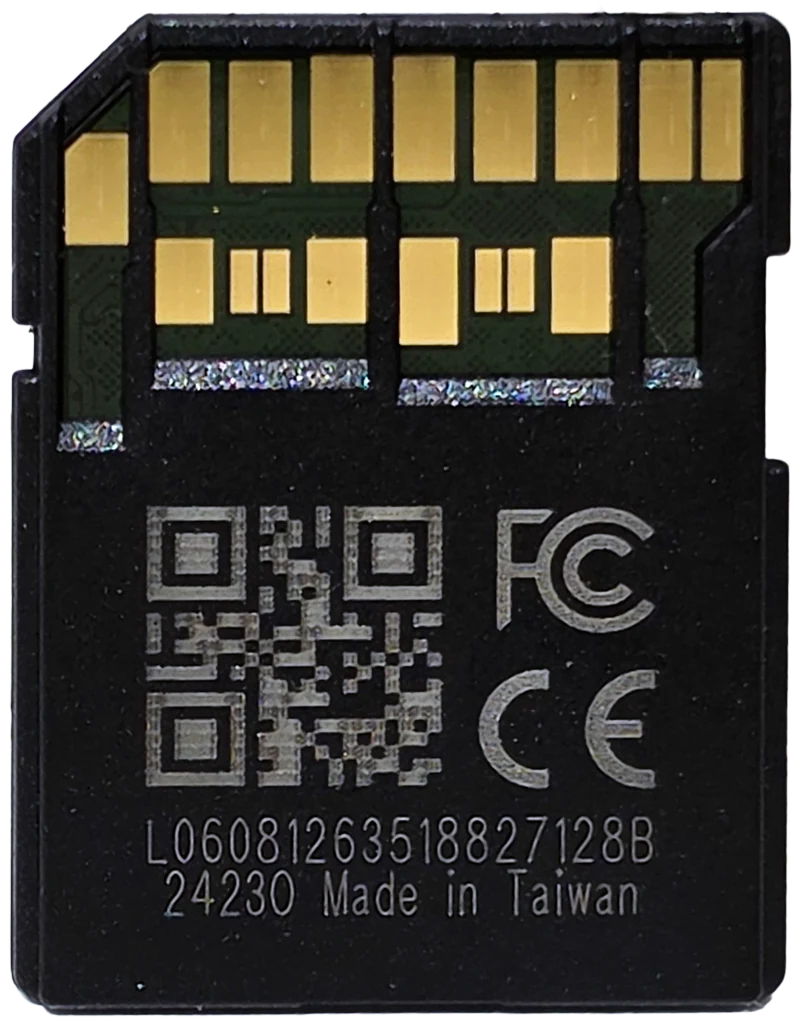
| Lexar, manufacture date (MDT) | 07/2023 |
| Lexar, declared capacity (from CSD) | 250,068,992 sectors of 512 bytes = 128.04 GB, 100.03% of the label |
| Captured on | Raspberry Pi 4 native SD host, no USB bridge in the path · 2026-08-04 |
Manufacturer ID, OEM code, product name and manufacture date are model-level values, identical on every card of the same production run, so they are safe to publish in full. Each card's serial number is unique to the individual unit and is deliberately left out. A counterfeit typically reports the brand it is imitating rather than its real manufacturer, which is what makes these two coherent rather than suspicious.
Disclosure: I bought both of these cards myself, at retail, and no manufacturer had any involvement in the testing or saw this review before it published. This post contains affiliate links. As an Amazon Associate I earn from qualifying purchases, at no extra cost to you. Affiliate links like these and my YouTube channel are what keep the site running.