
Metorage Industrial 64GB: the VIOFO 64GB under another name
This is the microSD card that comes in the box with the Mercylion G401 dash cam, from a Shenzhen maker most people have never heard of. I read its identity registers on a Raspberry Pi expecting to settle a question about who makes it. They settled that, and they also showed it is the same card as the VIOFO High Endurance 64GB I reviewed in September, field for field. Then I ran it on two readers, and it measured the same as well.
No video for this bench run
Everything on this page came off the bench, not a camera. The channel covers the dash cams, phones and readers these cards end up in; subscribe and the next one lands in your feed the day it goes up.
The short version
The Metorage Industrial 64GB is a good V30 dash cam card, and it is the VIOFO High Endurance 64GB with a different label. Its identity, capability and capacity registers match the VIOFO’s apart from the serial number and the build date, and on the same reader the two cards’ sustained writes land within 0.4% of each other. It prints no speed figure at all, only U3, V30 and A2. I measured 60.5 MB/s committed write and 96.7 MB/s read, the ceiling of the UHS-I bus, and a worst ten seconds of continuous writing of 59.6 MB/s on my primary reader and 59.7 on the second. That holds V30 with 98% in hand and misses V60 by less than half a megabyte a second, which on a full-card write is a real miss, not a rounding one. Every one of its 62.4 GB came back byte for byte, and it ran hot: 172.1 °F (77.8 °C) on the thermal frame. My rating: 4/5, scored against the CKBench rubric, the same five rows as its VIOFO twin.
Verdict: 4/5, a solid V30 card that sits a hair under V60Who this card is for
- YesMercylion G401 owners, and anyone who found it in a dash cam boxIt is a genuine 64 GB card that holds V30 with twice the floor in hand. A 4K dash cam writes about 6 MB/s; this card’s worst ten seconds were 59.6.
- YesAnyone deciding on the VIOFO High Endurance 64GBThe VIOFO unit I tested was this card, register for register, so this review is a second unit of the same product measured on the same bench. It is also the version you can buy on its own.
- NoCameras that ask for V60It averages 60.4 MB/s, but V60 is judged on the worst ten seconds, and this card’s were 59.6. Across a whole-card write they were 57.9. Close is not held.
- NoAnyone who wants a warranty in writingNeither the card nor Metorage’s product page states a warranty term, and there is no retail box to carry one.
62.4 GB of usable space is roughly 2 hours 53 minutes of single-channel 4K at 6 MB/s, or about 5 hours 46 minutes of 1080p60 at 3 MB/s, before a dash cam loop starts overwriting. Work out your own numbers in the dash cam storage calculator.
Where did the Metorage Industrial 64GB come from?
Mercylion sent me its G401 dash cam for review, and this card was inside the retail box, so it is the card every G401 buyer gets. The face says Metorage, 64 GB, Industrial, V30, U3, A2, microSDXC and the UHS-I mark, plus a small R-I by the logo. There is no speed figure anywhere on it, and there is no packaging, so the card face is the whole claim. Metorage is the brand of a Shenzhen company that makes industrial and automotive storage, eMMC, SD and microSD cards and SSDs, and Mercylion’s own web shop sells Metorage cards. Its product page lists an RITF series whose product photo prints the same R-I and Industrial as this card, rated for -25 to 85 °C, with no speed figure there either.
I had a reason to want this card on the bench before it had written a byte. Two of the VIOFO High Endurance cards I had already tested report a manufacturer ID, 0xB5, that appears on no public list, and one of them carries the product name METOR, which is what “Metorage” looks like cut down to the five letters the field allows. A card with Metorage’s own name on the front was the obvious test. It is in CKBench now, the running index of every card on the bench, and the review below is the full set: two readers, a fill of every byte, and the registers read on a Raspberry Pi.
Every write figure on this page is a committed write: the data is on the flash before the clock stops, with no operating-system cache in the way. That is why the numbers here read lower than a marketing sheet or a quick benchmark; the methodology page explains the difference and why it is the one that matters for recording.
What the card claims, and what it did
| Claim | Printed or published | Measured | Verdict |
|---|---|---|---|
| Capacity | 64 GB (card face; no box, no GB definition) | 62.4 GB written and verified, zero errors; the card declares 97.47% of its label | VERIFIED |
| Read speed | Not printed, and Metorage publishes none for this series | 96.7 MB/s (ProGrade PGM0.5); 96.4 MB/s (SanDisk QuickFlow SDDR-B751). Both at the UHS-I SDR104 ceiling | NOT CLAIMED |
| Write speed | Not printed, and none published | 60.5 MB/s committed (ProGrade); 61.0 MB/s (QuickFlow) | NOT CLAIMED |
| Speed class | Not printed (the card declares C10 to a host) | 59.6 MB/s worst ten seconds, far above C10’s 10 | NOT CLAIMED |
| UHS speed grade | U3 (card face) | 59.6 MB/s worst ten seconds (ProGrade); 59.7 (QuickFlow) | HELD |
| Video speed class | V30 (card face) | Holds V30 on both readers with 98.5% in hand; misses V60 by 0.44 MB/s (ProGrade) and 0.34 (QuickFlow) | HELD |
| App performance class | A2 (card face) | 1,943 read / 1,744 write IOPS at queue depth one on the ProGrade, 2,533 / 2,160 on the QuickFlow, above A1’s floors; A2’s floors need command queuing that USB readers do not perform | NOT TESTABLE |
| Bus | UHS-I (card face) | Declares SD specification 6.x with the UHS bit set; reads at the SDR104 ceiling on two readers | CONSISTENT |
| “Industrial” | Card face | No SD Association definition; Metorage files the RITF series as an industrial line with a temperature range and a cycle count, neither printed on the card | NOT A PERFORMANCE CLAIM |
| Endurance rating | None printed; Metorage’s series page states 3,000 program/erase cycles, not an hours rating | n/a | NOT TESTABLE |
| Operating temperature | -25 °C to 85 °C (Metorage’s RITF series page) | 172.1 °F (77.8 °C) on the thermal frame after five minutes of uncooled writing in a 76 °F room; 173 °F (78.3 °C) on the second reader, 6.7 °C under the maximum | NOT A PERFORMANCE CLAIM |
| Warranty term | None printed or published | n/a | NOT CLAIMED |
A card that prints no speed has made no speed promise, so the read and write rows are measured and reported rather than passed or failed. That leaves the class marks as the whole testable claim, and the one that matters for recording is V30: a minimum of 30 MB/s through continuous writing. This card clears it by 98%. The read, 96.7 MB/s, is where every standard UHS-I card lands on a card reader, because that is the ceiling of the bus mode it speaks, and the QuickFlow, which can drive a faster mode on cards that support one, read it at 96.4. A2 is not testable on any USB card reader, mine included, because its floors assume a command queuing mode that USB readers do not perform; the card cleared the lower A1 floors at queue depth one on both readers, which is indicative and nothing more. One thing worth knowing next to its twin: VIOFO prints “up to 40 MB/s write” on the box of the same card, which it beats by half. Metorage prints nothing, and its customers get exactly the same 60.
A black card and nothing else
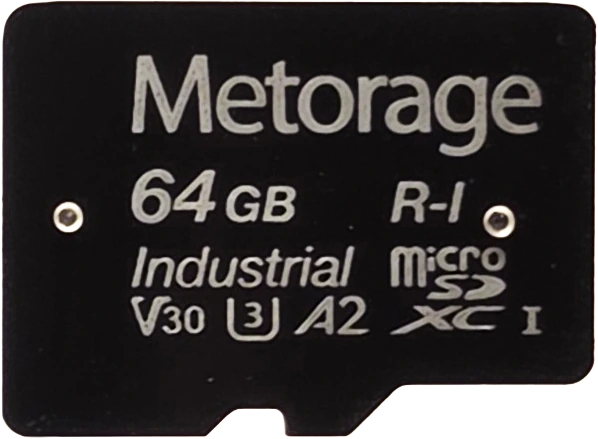
The card arrived empty and formatted exFAT, with 128 KB clusters and no volume label, which is a clean factory layout rather than anything a camera wrote. The VIOFO version of the same card shipped as FAT32, which dash cams often ask for, so the two brands format the same card differently. That is the only difference between them I could find, and on this bench the filesystem is worth well under 1% either way. The Industrial on the face is a marketing word: the SD Association defines no industrial grade, and VIOFO prints the same word on its cards, including a 32GB that is made by somebody else entirely. Metorage backs the word on its website with a temperature range and a cycle count, which is more than most brands do, but none of it is printed on the card, and none of it is something a review bench can verify.
The same card as the VIOFO High Endurance 64GB
Every SD card carries a set of registers, written at the factory, that a USB reader cannot show you and a native SD host can. One names the card: manufacturer ID, OEM ID, product name, revision, serial and build date. The others describe it: how big it is, which SD specification it follows, which speed classes it declares. I read this card’s on a Raspberry Pi and laid them next to the VIOFO High Endurance 64GB’s.
| Register field | Metorage Industrial 64GB | VIOFO High Endurance 64GB | Match |
|---|---|---|---|
| Manufacturer ID / OEM ID | 0xB5 / “MV” | 0xB5 / “MV” | SAME |
| Product name / revision | FM606 / 0.0 | FM606 / 0.0 | SAME |
| Build date | May 2026 | November 2025 | PER UNIT |
| Serial number | 0x2070… | 0x2170… | PER UNIT |
| Declared capacity (CSD) | 62,377,689,088 bytes | 62,377,689,088 bytes | SAME, TO THE BYTE |
| Whole CSD register | 400e0032db790001d0bf7f800a400000 on both | SAME | |
| SD specification (SCR) | 6.x, identical byte for byte | SAME | |
| SD Status, all 64 bytes | Identical; declares C10, U3, V30 and A2 | SAME | |
Everything that can match does. The only fields that differ are the two that must differ between any two cards, the serial and the build date, and the build dates say this product was being made from at least November 2025 to May 2026. Two of the matches carry more weight than the rest, because on my bench nothing else shares them: the 64-byte SD Status block, and a four-bit field in the identity register that the specification reserves and that every other card I have read leaves at a different value. Those two only turn up on cards with this manufacturer ID.
Registers are the evidence here, and the bench numbers are the check on them. They agree: on the same ProGrade reader, five minutes of continuous writing averaged 60.42 MB/s on this card and 60.22 on the VIOFO, with worst ten seconds of 59.56 and 59.45.
Metorage-Industrial-64GB_2026-10-03_081023 and VIOFO-High-Endurance-64GB_2026-09-15_130705. The vertical axis starts at 54 MB/s so the V60 line is visible; on a zero-based axis the two lines are indistinguishable.Every write figure lands within 1.2% of the VIOFO’s run on the same reader: sequential write 60.5 against 61.2, random write 1,744 against 1,734 IOPS, steady state 60.4 against 60.2. Matching numbers on their own would prove nothing, because every card on one bus lands on the same handful of whole-megabyte rates, and the VIOFO shipped FAT32 where this one shipped exFAT, a difference worth under 1% on this bench. So I am not ranking either card above the other. The registers say they are one product, and the bench says that product behaves the same under both labels, built five months apart.
Who makes the Metorage card, and the VIOFO?
Before reading this card’s registers I wrote down what each answer would mean. If it reported 0xB5, the unlisted ID on the two VIOFO cards would finally have a maker. If it reported anything else, the METOR on the VIOFO 128GB was a coincidence. It reported 0xB5, with the same OEM ID, and, more than the test asked for, the VIOFO 64GB’s own product name.
A brand’s card carrying an ID is not proof on its own that the brand owns the ID: plenty of brands carry their supplier’s, and VIOFO’s own 32GB carries Longsys’s. What settled it was Metorage’s own paperwork. Its product specification for its FM3 series, hosted by an electronics distributor, lays out the identity register field by field: manufacturer ID B5h, OEM ID 4D56h, which is “MV”, and product name METOR. Its part numbers start with RITF, the series this card’s R-I marks. And it gives the 128GB part’s usable capacity as 121,753,600 KB, which is 124,675,686,400 bytes, the exact count the VIOFO High Endurance 128GB declares.
So the 0xB5 cards are Metorage’s. The VIOFO High Endurance line is Longsys at 32GB and Metorage at 64GB and 128GB, and this card, sold under Metorage’s own name inside somebody else’s dash cam, is the VIOFO 64GB exactly. The SD Association’s licensing body keeps the assignment of manufacturer IDs confidential, so nobody outside it can show the assignment itself, but the maker stating what its cards report is as close to a primary source as this subject gets. My manufacturer ID register now names 0xB5 as Metorage on that basis, and the identity explainer covers what these fields can and cannot tell you.
Five minutes at 60.4 MB/s, and 0.44 short of V60
The timed write starts after an untimed warm-up that runs until the speed stops changing, so the five minutes that decide the video class start on a settled card. On this card the warm-up settled at the earliest point the tool can declare, 60 seconds, at 60.6 MB/s. The trace below is the scored run, one sample a second, with the speed-class floors marked. The first thirty seconds averaged 60.8 MB/s and the last thirty 60.3, the whole five minutes 60.4, and the worst ten seconds were 59.56, at 1:09. The longest single write the card took was 45 milliseconds; the bench flags anything over half a second. On the second reader the same five minutes read 60.4 steady and 59.66 through the worst ten seconds.
Metorage Industrial 64GB
59.56 is 98.5% above the V30 floor of 30 MB/s, so V30 holds with room to spare. V60 is the interesting one. The card averages 60.4, which reads like V60, but a video class is held only if the slowest ten seconds stay above the floor, and they did not: 59.56 on the primary reader and 59.66 on the second, against a floor of 60.00.
That is close enough to ask whether it is real, and it is. The tool samples once a second, and on this card each sample lands on one of a few whole-mebibyte steps, almost all of them 57 or 58 MiB a second, which are 59.77 and 60.82 MB/s. The V60 floor, 60.00 MB/s, falls between them, and this card writes right on that line, with 123 of its 300 samples below 60. Twenty of the run’s ten-second windows dipped under 60. The whole-card fill settles it independently: across all 62.4 GB the worst ten seconds were 57.88 MB/s, and the worst ten seconds of every two-and-a-half-minute slice of the fill sat between 57.9 and 58.6, with no slowdown from the first gigabyte to the last.
Metorage-Industrial-64GB_2026-10-03_081023 and VIOFO-High-Endurance-64GB_2026-09-15_130705. The vertical axis starts at 54 MB/s. Neither card slows anywhere across the card, and neither holds 60 through it.So it is a V30 card that writes right at the V60 line and just under it, which is exactly what its twin did: 59.45 on the same reader. On my bench it sits in a cluster of three genuine cards within 0.21 MB/s of each other just below that line, with the VIOFO at 59.45 and the older of my two SanDisk Ultra 128GB units at 59.66. For a dash cam none of that matters, because a 4K dash cam writes about 6 MB/s; it matters for a camera that asks for V60, and for scoring, where the line between 59.56 and 60.00 is the line between a 4 and a 4.5 on sustained performance. The other 64 GB card on my bench, the FitcamX’s bundled card, floors at 43.8.
62.4 GB, every byte verified
The capacity test wrote 59 files of unpredictable, dedup-proof data until the card was full, 62,356,979,712 bytes, then read every one of them back and compared. Zero mismatched bytes. Zero read errors. The fill took 17 minutes 43 seconds and the read-back 11 minutes 7 seconds. Across the first, middle and last tenth of the card the write speed spread by 0.9% and the read by 1.2%, which is what a genuine card looks like; the fakes on this bench spread by 10 to 23%.
Every byte, written and read back
The card declares 62,377,689,088 bytes, 97.47% of the 64 GB on the label, which is ordinary provisioning overhead inside the 96.7% to 100.1% every genuine card on my bench occupies, and it is the VIOFO 64GB’s count to the byte. Windows will show you about 58 GB, because it counts in binary; that is arithmetic, not a shortfall, and the methodology page has the conversion. The capacity row of the rubric scores the declared share of the label, and 97.47% is a 4.
What scattered writes do to it
Loop recording is a long write interrupted constantly by small ones, and random 4K writes are the bench version of that: three twenty-second passes, and the question is whether the third is as fast as the first. On this card it was faster. The scored run did 1,735, 1,738 and 1,759 write IOPS, 7.10, 7.12 and 7.21 MB/s, a fade of -1.55%, which means it sped up, and the card was back at its full sequential rate within ten seconds of continuous writing afterwards.
One minute of loop-recording abuse
This card: run Metorage-Industrial-64GB_2026-10-03_081023 · reference card: lab baseline, same bench, same test · cardcheck v0.8.3
The second reader tells the same story more loudly: 1,883, 2,244 and 2,354 write IOPS, 25% faster by the third pass, with 30% more read IOPS and 24% more write IOPS than the ProGrade overall. Random figures move with the reader on this bench, which is part of why the A classes cannot be tested on a USB reader, and the rubric scores the primary reader’s run, where this is a 5. The VIOFO 64GB did the same on the same two readers.
172.1 °F, the hot end of the bench
Metorage rates this series for -25 to 85 °C, which is the industrial part of the name, and the rubric scores heat against the maker’s own maximum. At the end of five minutes of uncooled writing in a 76 °F room, the thermal imager read 172.1 °F (77.8 °C) on the exposed part of the card, and the second reader’s run read 173 °F (78.3 °C). The rubric takes the hotter of the two: 6.7 °C under the rating, which scores a 3.
It got hot. It did not slow down.
The second reader’s run read 173 °F at 76 °F ambient · Run Metorage-Industrial-64GB_2026-10-03_081023 · cardcheck v0.8.3 · ProGrade PGM0.5
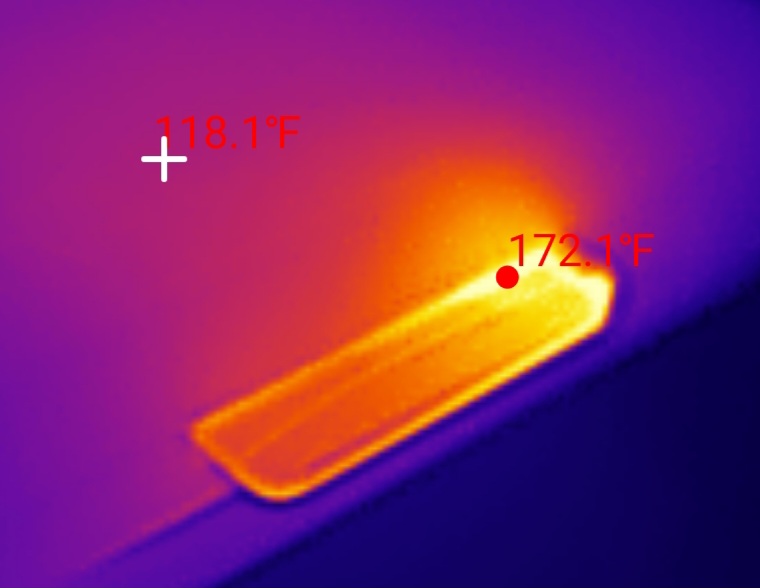
It did not throttle: the last thirty seconds of the timed write ran at 60.3 MB/s against 60.8 for the first thirty, a difference inside the bench’s own noise. The heat is the card’s one weak row, and it is shared: the VIOFO 64GB read 174.4 °F on its frame on the same reader. A card reader with a fan switched off is a harder place than a dash cam mount on a cool day, and an easier one than a windshield in summer, so treat 6.7 °C of margin in a 76 °F room as a reason to keep this card out of a camera that already runs hot.
Two readers, one answer
Every card I review runs on my primary reader, a ProGrade PGM0.5, and again on a SanDisk QuickFlow SDDR-B751, which can drive a faster bus mode on cards that support one. This card went on the QuickFlow second, straight after its whole-card fill.
| Measurement | ProGrade PGM0.5 (primary) | SanDisk QuickFlow SDDR-B751 | Difference |
|---|---|---|---|
| Card at the start of the run | fresh, first run | just written end to end | |
| Sequential read | 96.7 MB/s | 96.4 MB/s | same |
| Sequential write, committed | 60.5 MB/s | 61.0 MB/s | same |
| Sustained write, steady state | 60.4 MB/s | 60.4 MB/s | same |
| Sustained write, worst ten seconds | 59.56 MB/s | 59.66 MB/s | same |
| Random 4K read / write | 1,943 / 1,744 IOPS | 2,533 / 2,160 IOPS | +30% / +24% |
| Video class held | V30 | V30 | same |
| Peak temperature | 172.1 °F (frame) | 173 °F | same |
| Blocks over 500 ms | 0 | 0 | same |
This card speaks standard UHS-I and nothing faster, so the reader you own changes nothing about it but the random figures. The pair also answers a question one other card raised, where a card wrote much slower after being filled once: this one does not, and its second run, on a card that had just been written end to end, matched the first on every write figure. If you have read my reader tiers post and wondered whether it applies here, a plain UHS-I reader gets everything this card has.
How the 4 breaks down
Metorage Industrial microSDXC 64GB
Scored against the CKBench rubric. Five dimensions, each out of 5, every row read off its published table.
Final score: 4 out of 5. The five dimensions average 4.2. A card that keeps every claim it prints and verifies every byte, and gives back points for missing V60 by a hair, declaring 97.47% of its label and running close to its temperature rating.
These are the same five rows the VIOFO High Endurance 64GB scored, row for row, which is what one product should do. They were not copied across: every row comes off the published tables from this card’s own runs, and the scoring rules forbid scoring one card from another.
Frequently Asked Questions
Is the Metorage Industrial 64GB a good microSD card?
Yes, for V30 work. It wrote 60.5 MB/s committed and held 59.6 MB/s through its worst ten seconds of continuous writing on two readers, twice the V30 floor it prints, and every one of its 62.4 GB verified with zero errors. It misses V60 by less than half a megabyte a second and runs hot, peaking at 172.1 to 173 °F in a 76 °F room. It scores 4 out of 5.
Is the Metorage Industrial 64GB the same as the VIOFO High Endurance 64GB?
The units I tested are. Both report manufacturer ID 0xB5, OEM ID MV and product name FM606 at revision 0.0, and their capacity, specification and SD Status registers are identical byte for byte; only the serial and build date differ. On the same reader their sustained writes land within 0.4% of each other. A future batch of either could change, so the registers are the way to check a card you own.
Who makes Metorage microSD cards?
Metorage is the brand of a Shenzhen maker of industrial and automotive storage. Its cards report manufacturer ID 0xB5, which appears on no public list, and Metorage’s own FM3-series datasheet lists that ID with OEM ID MV and product name METOR. The same ID is on VIOFO’s High Endurance 64GB and 128GB cards, so Metorage makes those as well.
Is the Metorage Industrial 64GB good for a dash cam?
Yes. Its worst ten seconds of continuous committed writing were 59.6 MB/s, about ten times what a 4K dash cam writes, and it held 57.9 MB/s or better through a whole-card fill. It ran hot in the reader, 172.1 °F with the fan off, against an 85 °C rating, so it is a better fit for a camera that runs cool than one that already runs hot. Its 62.4 GB holds about 2 hours 53 minutes of 4K at 6 MB/s.
Is the Metorage Industrial 64GB V60?
No. It prints V30 and holds V30. It averages 60.4 MB/s, but V60 requires the slowest ten seconds to stay at 60 MB/s or more, and they measured 59.56 on a ProGrade reader and 59.66 on a SanDisk QuickFlow. Across a whole-card write the worst ten seconds were 57.88.
Is the Metorage Industrial 64GB really 64GB?
Yes. I filled every free byte with unpredictable data and read it all back: 62,356,979,712 bytes written and verified, zero mismatched bytes, zero read errors. The card declares 62,377,689,088 bytes, 97.47% of the 64 GB label, which is ordinary overhead for a genuine card. Windows shows it as about 58 GB because Windows counts in binary.
What does Industrial mean on a microSD card?
Nothing standard. The SD Association defines no industrial grade, so the word is the maker’s. Metorage backs it on its website with an operating range of -25 to 85 °C and a 3,000-cycle program and erase rating for the series, but neither is printed on the card and neither is something a short bench test can verify. VIOFO prints the same word on its High Endurance cards.
The bottom line
The Metorage Industrial 64GB is a solid V30 card that writes right at the V60 line without holding it, verifies every byte, and runs hot. If it came in your dash cam box, it is a good card to leave in there. It prints no speed promise to break, keeps the class marks it does print, and its 62.4 GB are all real.
It is also the clearest case on my bench of a brand being a label. The VIOFO High Endurance 64GB is this card, and the VIOFO High Endurance 128GB comes from the same maker; Metorage’s own datasheet is what finally named it. If you want this card on its own, the VIOFO is how you buy it, and its review is the same story told first, with a box that says 40 MB/s.
Sample size: one unit, the card supplied in the retail box of a Mercylion G401 dash cam that Mercylion sent for review. Two runs on two readers on 3 October 2026 under CKBench protocol v1.23.
Device identity: what this card reports about itselfFor anyone checking their own card or tracking silent hardware revisions
| Raw CID register | b54d56464d36303600…21a500 (serial digits elided) |
| Manufacturer ID (MID) | 0xB5, Metorage: on no public list, and listed in Metorage’s own FM3-series datasheet |
| OEM / application ID (OID) | 0x4D56, “MV” |
| Product name (PNM) | FM606, the same as the VIOFO High Endurance 64GB |
| Product revision (PRV) | 0.0 |
| Serial number (PSN) | 0x2070… (per unit, truncated) |
| Manufacture date (MDT) | 05/2026 |
| Reserved bits | The four reserved bits ahead of the date read 2, as on both VIOFO 0xB5 cards and on no other card on this bench |
| Declared capacity (from CSD) | 121,831,424 sectors of 512 bytes = 62,377,689,088 bytes, 97.47% of the label; the CSD is identical to the VIOFO 64GB’s |
| SD specification (from SCR) | SD_SPEC 2 with SD_SPEC3 = 1, SD_SPEC4 = 1 and SD_SPECX = 2 (specification 6.x), so the UHS-I, U3 and V30 marks are legitimately declared |
| Declared classes (from SD Status) | Class 10, U3, V30 and A2; the 64-byte register is identical on all three 0xB5 cards and on no other card on this bench |
| Factory format | exFAT, 128 KB clusters, no volume label, no user files present |
| Captured on | Raspberry Pi 4 native SD host, no USB bridge in the path · 2026-10-03 |
The MID, OEM ID, product name and revision are model-level: another Metorage Industrial 64GB, or another VIOFO High Endurance 64GB of the same build, should report the same four, and a different product name or MID would be the first sign that the card under the label has changed. The serial and the manufacture date are per unit.
Disclosure: Mercylion sent me its G401 dash cam for review, and this card came inside the camera’s retail box, the same card every G401 buyer gets. I did not buy it. Neither Mercylion nor Metorage had any editorial input, saw any result before publication, or had any opportunity to influence any number on this page. This post contains no affiliate links. The affiliate links on my other reviews and my YouTube channel are what keep the site running.