
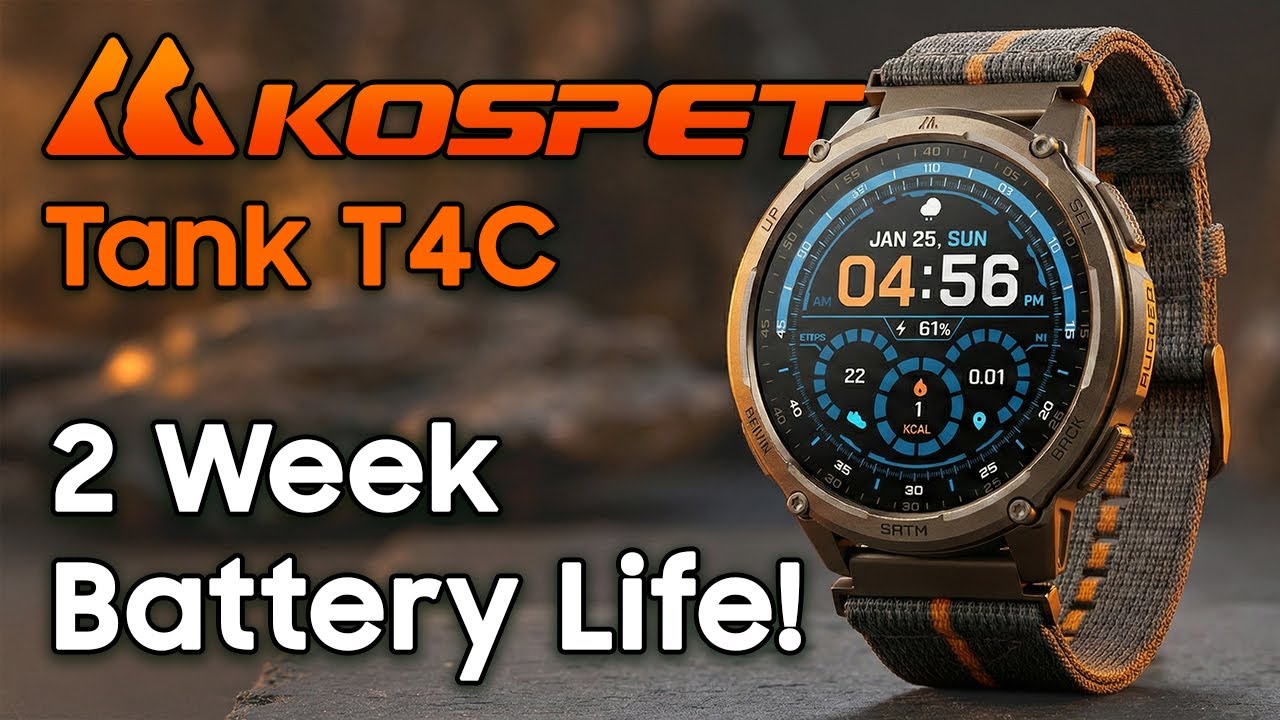
KOSPET Tank T4C Review: 12 Days on One Charge
A genuinely rugged smartwatch with military-grade durability and battery life that shames watches twice its price. The catch is almost entirely in the software.
Plays via YouTube. Google may set cookies when the player loads. Privacy policy
The short version
KOSPET nailed the hardware. The Tank T4C is built like a tank, the 1,000-nit AMOLED is easy to read outdoors, the built-in LED flashlight is genuinely useful, and it ran for twelve days on a single charge. The frustrations are almost all software: workout modes lock you out of everything else, and some activities quietly leave their steps out of your daily total. Buy it for the build and battery, and choose your workout modes carefully. If you would rather trade the tactical look for something dressier without losing the toughness, KOSPET's Tank T4 Special Edition is worth a look too.
Verdict: great hardware, mind the softwareWho the Tank T4C is really for
Physically, this thing is big, bold, and unapologetic. The round face is larger than most mainstream smartwatches, the bezel stands out, and it absolutely looks like something built for abuse. That lines up with who this watch is really designed for:
- Outdoor workers
- DIY and construction
- Mechanics
- People who care more about durability than polish
And at a launch price of $159.99, it is clearly going after value.
Disclosure: KOSPET sent this unit to me free of charge for review. They saw the video as a courtesy but had no editorial control over what I say here. This post also contains affiliate links. As an Amazon Associate I earn from qualifying purchases, at no extra cost to you.
The watch tested
KOSPET Tank T4C
A rugged, GPS-equipped smartwatch with a built-in LED flashlight: the exact unit behind every impression in this review.
Built to military durability standards
Hardware-wise, this is honestly where the Tank T4C shines. It pairs a stainless steel bezel and zinc alloy body with Gorilla Glass up top, 5 atmospheres of water resistance, and IP69K dust and pressure sealing. This thing is tested to U.S. military durability standards, and it feels like it.
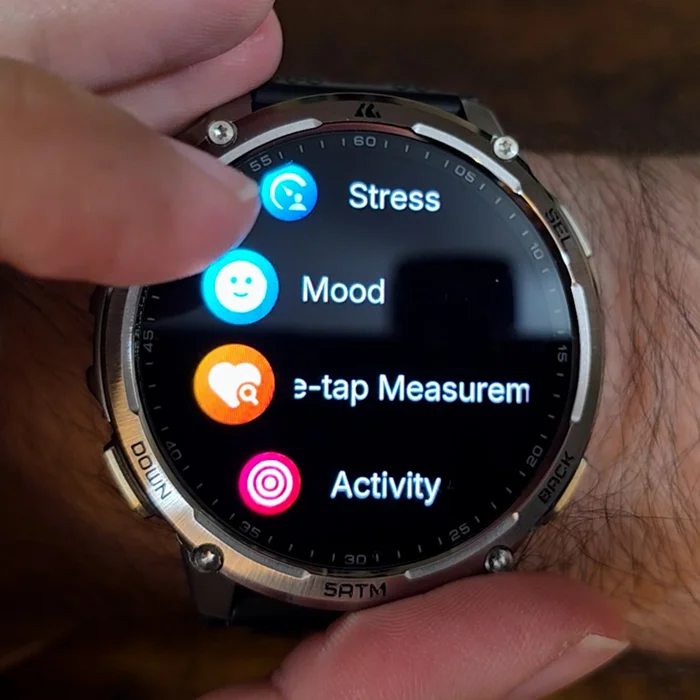
The AMOLED display is bright, easy to read outdoors, and tops out around 1,000 nits, which makes a big difference on hikes and job sites. The UI is surprisingly smooth too: menu navigation feels buttery and responsive.

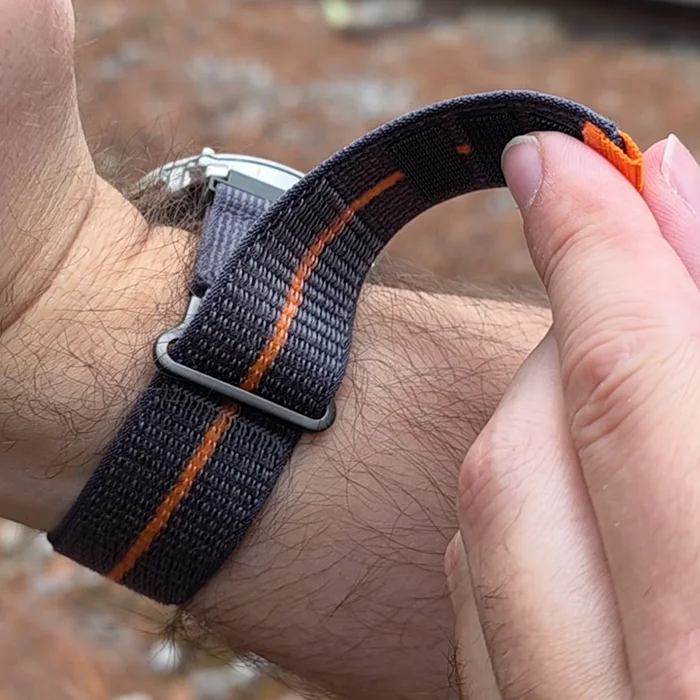
The nylon strap is the upgrade I did not expect
I also picked up their nylon braided strap, and honestly, I love it. It is easier to put on, more comfortable on long hikes, and does not have a bulky buckle digging into your wrist during the day. My fellow south paws will understand. Just know you will want to wash it occasionally after workouts.
The built-in LED flashlight is actually useful
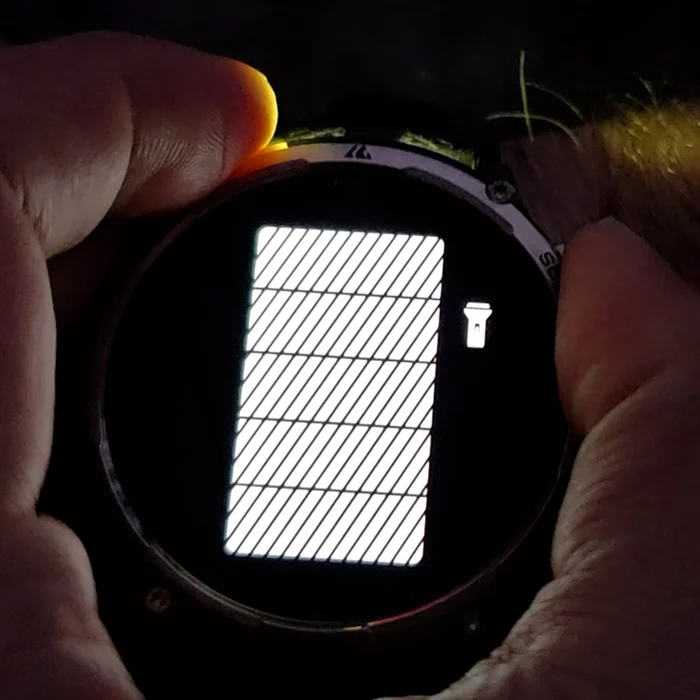
One of the standout features here is the built-in LED flashlight, and it is not a gimmick. You get five brightness levels, and in dark environments it is extremely useful. For quick repairs, checking gear, or reading a park map at night, this is one of those features you do not realize you want until you use it.
Twelve days on a single charge
One place where the Tank T4C surprised me most was the battery life. I charged it to 100% and did not plug it back in again until it hit around 20%, twelve days later. During that time it was tracking sleep every night, recording multiple workouts, handling notifications, and being used as an actual daily watch.
That is honestly impressive, especially when you compare it to more expensive smartwatches where daily charging is just part of the routine. So if battery anxiety is something you are tired of dealing with, this watch absolutely earns points here.
I charged it to 100% and did not plug it back in until it hit around 20%. Twelve days later.
Charging is the one small catch
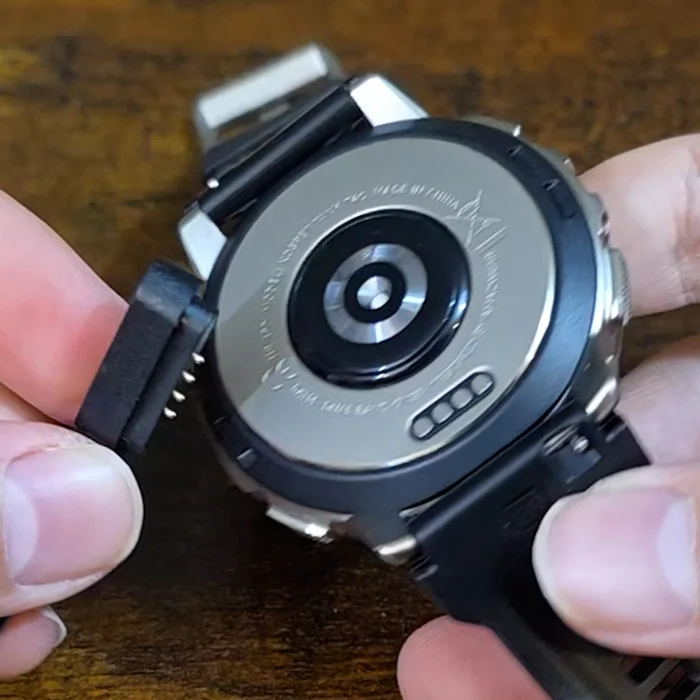
That great battery life does come with one small caveat, and that is the charging setup. The charger uses a magnetic connection with exposed pins, and while it does snap into place, the actual physical contact area is pretty small.
So if the watch or cable gets jostled even a bit, the connector can shift out of position and charging stops. It is not a deal-breaker, but compared to fully wireless magnetic pucks, you do need to be a little more careful about how you set it down and leave it alone while charging.
Set the watch down where the cable will not get bumped. A shifted connector silently stops the charge, so it is worth a quick check that it is still charging before you walk away.
Workouts lock you into one mode
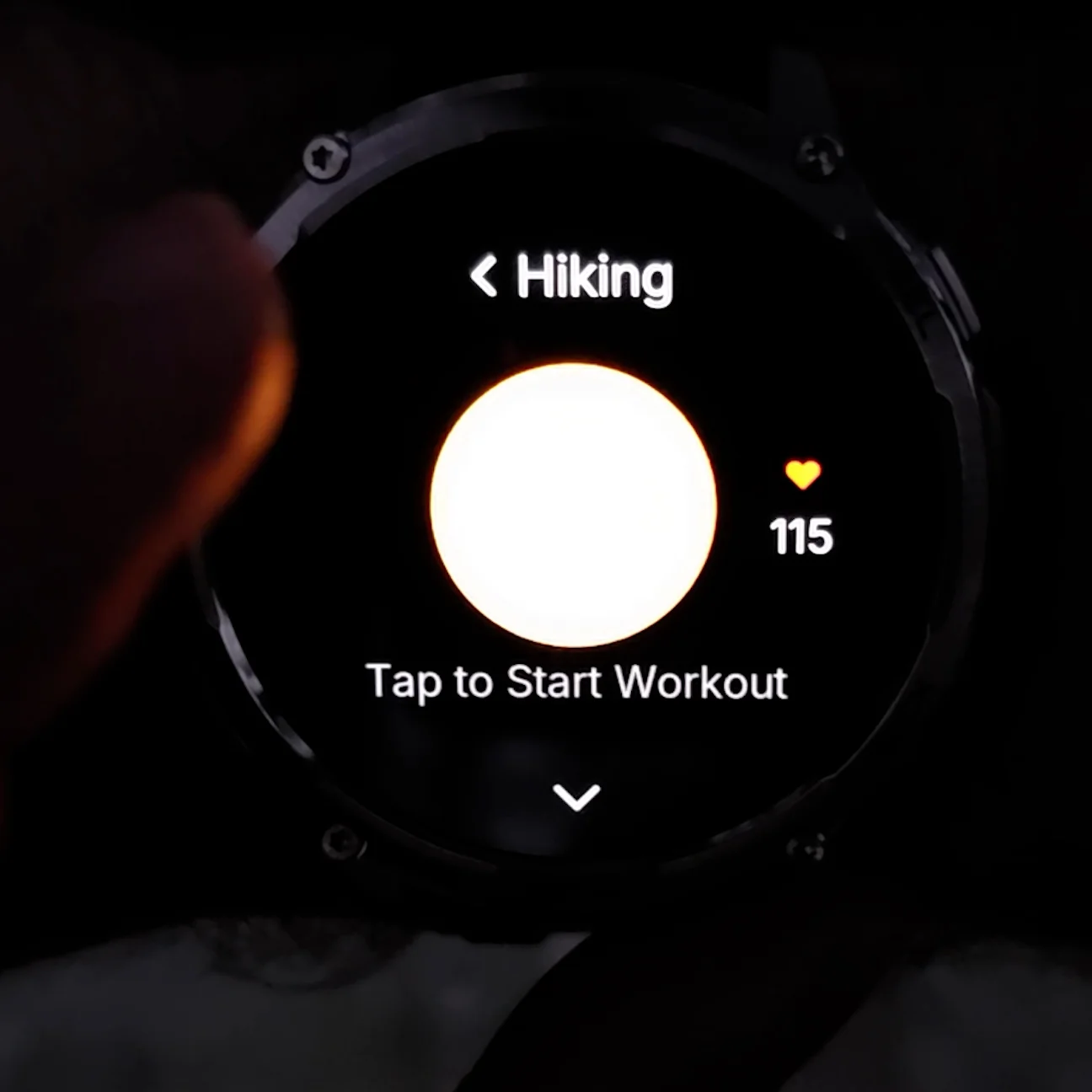
This is where my experience starts to diverge a bit from the hardware. Once you start a workout, the watch locks you into that mode. You cannot pull down quick settings, check battery life, access the flashlight, or check temperature and notifications.
For casual training, that may be fine. But for night hikes or long outdoor sessions, it feels limiting, especially on a watch whose flashlight is one of its best features.
Plan ahead on long outings: the one feature you might reach for mid-hike, the LED flashlight, is exactly what the workout lock hides.
Everything syncs through the ApexMove app
Before I get into metrics and tracking, it is worth mentioning that all of this data pairs through the ApexMove app. That is the companion app where workouts, steps, sleep, and health data get synced, reviewed, and broken down over time.

Why hiking mode records less than you would expect
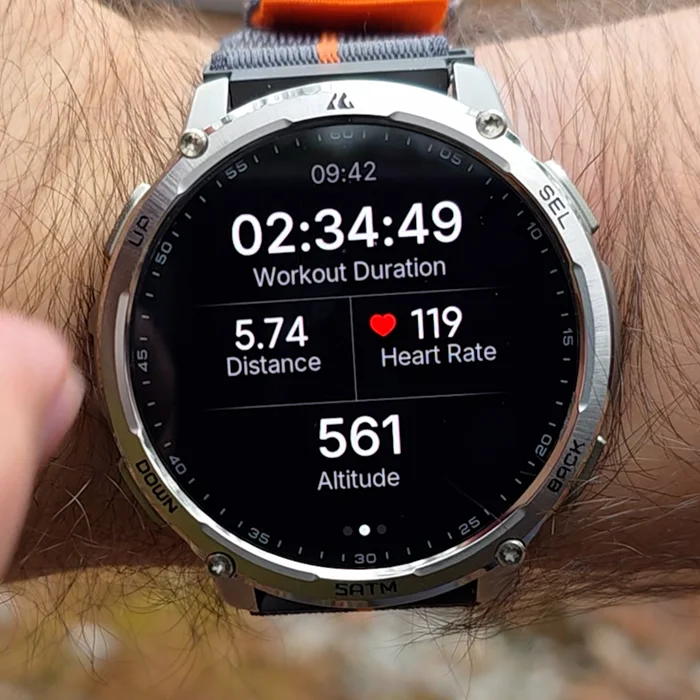
One issue I ran into with workout tracking has to do with which metrics are actually recorded during certain activities. When using the hiking workout mode, the watch only records heart rate and calories. That immediately stood out to me, because for most people, hiking is exactly where steps, distance, and elevation matter the most.
By comparison, workout modes like outdoor walking and mountaineering do record steps and distance along with calories. After noticing this, I followed up with KOSPET directly. They confirmed this behavior is intentional, and part of how the current software structure is designed. KOSPET has said they shared my feedback with their technical team and are working on improvements, but as the software stands today, it is something you should know before getting into it.
Hiking mode records less
- Heart rate and calories only
- No steps, distance, or elevation
- The one place those metrics matter most
Mountaineering / Walking full tracking
- Records steps, distance, and calories
- Rolls up into your daily summary
- The reliable workaround for a hike
Some workouts do not count toward your daily steps
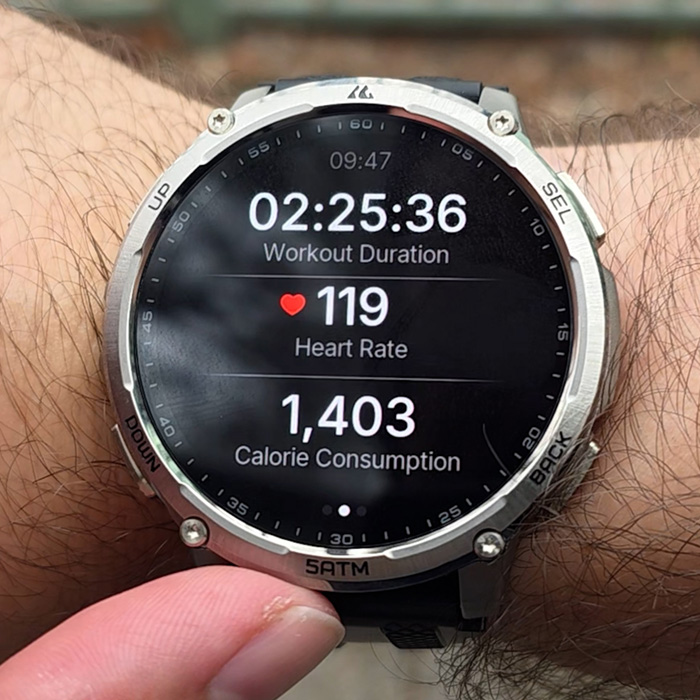
There is one more software behavior I want to call out, because this one feels more serious than just which metrics show up during a workout. After completing certain workouts, the steps recorded during that session are not added to the overall daily step count. That means your daily step total, your weekly averages, and your monthly trends can all be artificially low, even though you were clearly active.
I brought this up to KOSPET, and they confirmed that only specific workout modes currently sync steps, distance, and calories back into the daily activity summary. Those modes are:
- Outdoor running
- Outdoor walking
- Track run
- Mountaineering
- Treadmill
- Indoor walking
- Indoor running
If you use any workout mode outside of this list, the activity still records but the steps do not fully roll up into your daily totals. Honestly, that feels like a really strange software decision. It does not just affect one day's screen: it throws off your long-term averages, trends, and any data you are using to track consistency over time. This is another piece of feedback KOSPET took to hopefully implement in the future.
Practical fix: pick a mode from the list above even if it is not a 100% match to what you are doing. Start Mountaineering or Outdoor Walking for a hike so the steps actually reach your daily total.
Great hardware held back by software
So here is my honest takeaway. From a hardware perspective, KOSPET absolutely nailed this. The build quality, the flashlight, the display, the durability, and especially the battery life: this watch feels ready for real-world abuse right out of the box.
Where the Tank T4C stumbles is on the software side. A lot of the biggest frustrations I ran into are not hardware limitations, they are design and software choices. And that is actually an important distinction, because software is something that can improve over time through updates. As the watch stands today, you just need to understand those tradeoffs and choose your workout modes carefully. If KOSPET tightens up the software experience, the hardware foundation here is already solid.
Frequently Asked Questions
What is the difference between the Tank T4C and the regular T4?
The main difference, as explained to me by KOSPET, is the addition of the built-in flashlight. To keep it more affordable, they removed some advanced sports features like the professional diving mode and certain workout modes such as stair climbing and track running that were on the original T4. The things they removed seem mostly software-related, not hardware, which is a curious choice.
Does the KOSPET Tank T4C support GPS tracking?
Yes, the Tank T4C includes built-in GPS with multi-satellite support, allowing it to record outdoor activities without needing your phone. GPS performance is solid for general tracking, though battery usage will increase during longer GPS-enabled workouts.
Can you reply to messages or calls on the KOSPET Tank T4C?
The Tank T4C supports Bluetooth calling and message notifications when paired with your phone. Android users can send quick replies, while iOS users are limited to viewing notifications only.
Is the KOSPET Tank T4C compatible with iPhone and Android?
Yes. The watch pairs with both iOS and Android devices using the ApexMove companion app. All health, workout, and activity data sync through the app, where it can be reviewed and managed.
Can the software on the KOSPET Tank T4C improve over time?
Yes. Most of the limitations discussed in this review are software-related rather than hardware constraints. Software updates could improve workout tracking behavior and data synchronization in the future, making the watch more capable over time.